April 19 ~ Today in Music History

today

OCMS 1836 ~ Augustus D. Julliard, American music patron; responsible for founding The Julliard School of Music
More information about Julliard

. 1892 ~ Germaine Tailleferre, French composer

. 1905 ~ Tommy Benford, Drummer with Jelly Roll Morton’s Red Hot Peppers


. 1920 ~ Frank Fontaine, Comedian, actor, singer

. 1924 ~ A new show joined the airwaves. The Chicago Barn Dance aired on WLS radio in the Windy City. Later, the famous program would be renamed The National Barn Dance. This program was the first country music jamboree on radio. (The Grand Ole Opry on WSM Radio in Nashville, TN began in 1925.) National Barn Dance continued for many years on the radio station that was owned by retailer, Sears Roebuck & Co. WLS, in fact, stood for ‘World’s Largest Store’. Though the Barn Dance gave way to rock music and now, talk radio, The Grand Ole Opry continues each weekend in Nashville.

. 1927 ~ Don Barbour, Singer with the group, The Four Freshmen

. 1928 ~ Alexis Korner, Musician: guitar, singer

. 1935 ~ Dudley Moore, English pianist and actor

. 1942 ~ Alan Price, Musician: keyboards, singer: groups: Alan Price Combo, The Animals. Some favorites were House of the Rising Sun, We Gotta Get Out of This Place

. 1942 ~ Larry (Hilario) Ramos, Jr., Musician, guitar, singer with the group: The Association

. 1943 ~ Eve Graham, Singer with The New Seekers

. 1943 ~ Czeslaw Bartkowski, jazz musician, drums

. 1945 ~ The musical Carousel, based on Molnar’s Liliom, opened at the Majestic Theatre in New York City. John Raitt and Jan Clayton starred in the show which ran for 890 performances. Music was by the team of Richard Rodgers and Oscar Hammerstein.

. 1947 ~ Murray Perahia, American pianist and conductor

. 1947 ~ Mark Volman, Saxophonist, singer

. 1959 ~ Singer Harry Belafonte appeared in the first of two benefit concerts for charity at Carnegie Hall in New York City.

. 1967 ~ Nancy Sinatra and her dad, Frank, received a gold record award for their collaboration on the hit single, Something Stupid.

. 2000 ~ Richard L. Campbell, a classical music announcer on WCPE-FM died during his on-the-air shift, apparently of a massive heart attack. He was 67. On the air, Campbell catered to his audience by using his warm baritone voice to soothing effect. Before coming to WCPE about 10 years ago, he was a computer programmer and helped design the station’s traffic system.

March 11 ~ Today in Music History

today

. 1851 ~ The first performance of Giuseppe Verdi’s opera “Rigoletto” was given in Venice.

Rigoletto lacks melody.  This opera has hardly any chance of being kept in the repertoire.” ~ Gazette Musicale de Paris, reviewing Rigoletto shortly after its premiere.

. 1876 ~ Carl Ruggles, American composer

. 1897 ~ Henry Dixon Cowell, American composer
More information about Cowell

. 1903 ~ Lawrence Welk, American accordionist and conductor of “champagne” music
More information about Welk

. 1914 ~ William Lloyd Webber, English composer

. 1919 ~ Mercer Ellington, Trumpeter, bandleader, songwriter, only son of Duke Ellington. He led the Duke’s band after he died.

. 1921 ~ Astor Piazzola, Argentine tango composer, bandoneon player and arranger

. 1942 ~ Vaughn Monroe and his orchestra recorded the classic, Sleepy Lagoon. It was the last song Monroe would record for Bluebird Records. Vaughn sang on the track while Ray Conniff played trombone. Both later moved to different record companies. Monroe went with RCA and Conniff to Columbia. The big- voiced baritone of Monroe was regularly heard on radio and he was featured in several movies in the 1950s. He died in May, 1973. Racing With the Moon and Ghost Riders in the Sky were two of his greatest contributions to popular music.

. 1950 ~ Bobby McFerrin, Singer, pianist, jazz musician, songwriter, improvisational solo, McFerrin can sing all vocal parts and imitate instruments.

. 1968 ~ Otis Redding posthumously received a gold record for the single, (Sittin’ on) The Dock of the Bay. Redding was killed in a plane crash in Lake Monona in Madison, WI on December 10, 1967. The song was recorded just three days before his untimely death. He recorded 11 charted hit songs between 1965 and 1969. Otis Redding was inducted into the Rock and Roll Hall of Fame in 1989.

. 1985 ~ DJs around the U.S. began questioning listeners to see which ones could name the 46 pop music stars who appeared on the hit, We Are the World. The song, airing first on this day as a single, contains a “Who’s Who” of contemporary pop music.

. 2000 ~ Roy Henderson, a baritone famed for his performances of Frederick Delius’ works and a teacher of Kathleen Ferrier, died. He was 100.

. 2003 ~ Sidney Lippman, a songwriter who helped compose hits for Nat King Cole and other artists, died. He was 89. Lippman, who studied musical composition at the Juilliard School in New York, wrote or co-wrote several well-known songs, including Too Young, a song Cole took to the top of the charts in 1951. That hit, co-written by longtime collaborator Sylvia Dee, came two years after he teamed up with Buddy Kaye and Fred Wise on ‘A’ You’re Adorable (The Alphabet Song), a No. 1 hit performed by Perry Como and the Fontane Sisters.

. 2015 ~ Jimmy Greenspoon died.  He was an American keyboard player and composer, best known as a member of the band, Three Dog Night.
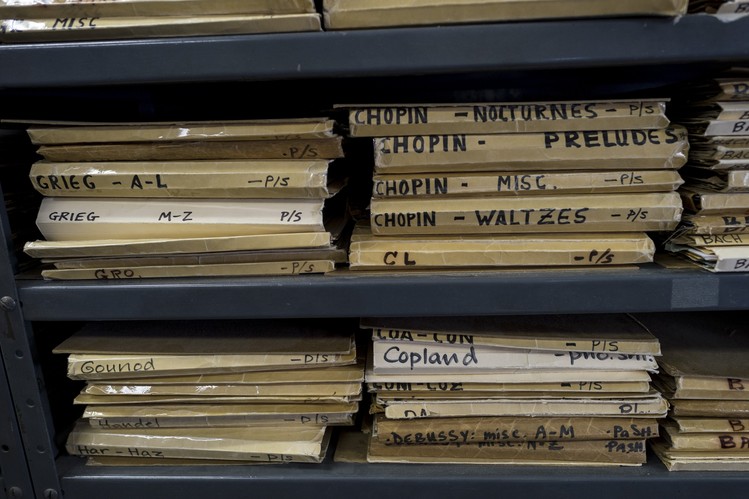
NYC’s Last Classical Sheet Music Store to Close

music-store

The store, on West 54th Street between Broadway and Eighth Avenue, opened in 1937 and provided the city’s musicians scores from the standard— Bach, Beethoven —to the arcane. Ms. Rogers bought it in 1978.

Frank Music is the last store in the city dedicated to selling classical sheet music, Ms. Rogers said, although other places such as the Juilliard School’s bookstore at Lincoln Center have it on their shelves.

Frank Music’s stock, which Ms. Rogers counts as hundreds of thousands of scores, was purchased by an anonymous donor as a gift for the Colburn School, a music conservatory in Los Angeles.

The school and Ms. Rogers declined to comment on financial details.

Colburn School’s president and chief executive, Sel Kardan, called Frank Music’s scores “an invaluable resource for our students and faculty for years to come.”

To the 63-year-old Ms. Rogers, nothing is more important than the arts.

“The idea that classical music is irrelevant is ridiculous,” she said, bemoaning the comparative salaries of tubists and stockbrokers. “People should be paid in terms of what they contribute to people’s well being.”

The store’s celebrity clients over the years have included pianists Emanuel Ax and Jeremy Denk, violinist Pamela Frank and cellist David Finckel.

One of Ms. Rogers’s favorite memories is a telephone call from the violinist Itzhak Perlman, asking for Kreisler scores.

The composer Bruce Adolphe, who is resident lecturer at the Chamber Music Society of Lincoln Center, described the store as a musical meeting ground.

“Frank’s Music was not just a store but a crucible,” he said, “a nexus where musicians from Suzuki beginners and their parents, to Joshua Bell, or the Brentano’s Mark Steinberg, would meet by chance.”

Read the entire article at NYC’s Last Classical Sheet Music Store to Close – WSJ.

February 22 ~ Today in Music History

today


. 1817 ~ Niels Wilhelm Gade, Danish composer

. 1834 ~ Albert Heinrich Zabel, harpist and composer

mu. 1857 ~ Robert Baden-Powell, founder of the Boy Scouts

. 1923 ~ Frederick A. Julliard set up a million-dollar fund to establish a music school. Today, Juilliard is one of the world’s leading music and dance schools.

. 1927 ~ David Ahlstrom, American composer

. 1931 ~ Maurice Chevalier recorded Walkin’ My Baby Back Home for Victor Records in New York City. The same tune was recorded 21 years later by Nat ‘King’ Cole and Johnny Ray. It became a major hit for both artists.

. 1945 ~ Oliver (Swofford), Singer

. 1956 ~ Elvis Presley entered the music charts for the first time. Heartbreak Hotel  began its climb to the number one spot on the pop listing, reaching the top on April 11, 1956. It stayed at the top for eight weeks.

. 1958 ~ Roy Hamilton’s record, Don’t Let Go, became #13 in its first week on the record charts. The song was the first stereo record to make the pop music charts. 1958 was the year for several stereo recordings, including Hang Up My Rock and Roll Shoes by Chuck Willis, Yakety Yak by the Coasters, Born Too Late by The Poni-Tails,It’s All in the Game by Tommy Edwards and What Am I Living For by Chuck Willis.

. 1965 ~ Filming began for The Beatles’ second movie, “HELP!”, in the Bahamas.

. 1976 ~ Florence Ballard passed away.  She was an American vocalist, one of the founding members of the popular Motown vocal group the Supremes. Ballard sang on sixteen top forty singles with the group, including ten number-one hits.

. 2001 ~ Ray Hendricks, a singer of the Big Band era who performed with Benny Goodman and Betty Grable, died at the age of 88. His career took him to Hollywood and across the country with stars including Goodman, Grable, Hoagy Carmichael, Ben Bernie, Ray Noble and Sid Lippman. His earliest performances were on Spokane radio station KFPY. He soon set out for California with Bob Crosby, brother of Bing Crosby. After serving as a flying instructor in the Air Force during World War II, he returned to Spokane and formed his own orchestra. He continued playing local venues for several decades, but said he regretted not pushing his career after the war.

. 2001 ~ Herbert Kupferberg, a music critic and a senior editor of Parade magazine, died at the age of 83. For more than 20 years, Kupferberg was an editor and critic for The New York Herald Tribune. After it folded in 1966, he joined Parade. He also wrote reviews for The Atlantic Monthly, and The National Observer. Kupferberg, born in New York in 1918, published several books including Amadeus: A Mozart Mosaic and Those Fabulous Philadelphians: The Life and Times of a Great Orchestra, a history of the Philadelphia Orchestra.

January 29 ~ Today in Music History

today

. 1715 ~ Georg Christoph Wagenseil, Austrian composer

. 1782 ~ Daniel François Esprit Auber, French composer, primarily of comic operas

. 1784 ~ Ferdinand Ries, German composer. Ries was a friend, pupil and secretary of Ludwig van Beethoven.

. 1862 ~ Frederick (Fritz) Theodor Albert Delius, British composer Read quotes by and about Delius
More information about Delius

. 1876 ~ Havergal Brian, British classical composer

. 1889 ~ Huddie Ledbetter, Blues singer

. 1924 ~ Luigi Nono, Italian composer

. 1937 ~ Tommy Dorsey and his orchestra waxed the famous Song of India on Victor Records.

. 1942 ~ Claudine Longet, Singer, formerly married to Andy Williams

. 1947 ~ David Byron, Singer

. 1949 ~ Tommy Ramone (Erdelyi), Drummer with The Ramones

. 1953 ~ Teresa Teng, Chinese singer

. 1954 ~ Oprah Winfrey, Entertainer, Emmy Award-winning talk show host

. 1962 ~ Fritz Kreisler died.  He was an Austrian-born violinist and composer

. 1966 ~ “Sweet Charity”, with Gwen Verdon, opened at the Palace Theatre in New York City. The musical, by Neil Simon, was an adaptation of the Federico Fellini film, “Notti di Cabiria”. The play ran for 608 performances. In

. 1969, Hollywood produced a big-budget version of the Broadway musical starring Shirley MacLaine.

. 1973 ~ Johnny Rivers received a gold record for the hit single, Rockin’ Pneumonia and the Boogie Woogie Flu. As is tradition, Rivers removed the fragile gold disk from the wooden frame and, as he was putting it on his stereo, had a ferocious sneezing fit and never did find out how his song sounded in solid gold.

. 1977 ~ From the One-Hit Wonder File, this note: Rose Royce earned the #1 spot on the music charts with Car Wash, from the movie of the same name. The song stayed at the peak of the pop charts for one week, then faded away.

. 1981 ~ Cozy (William Randolph) Cole passed away

. 2001 ~ Suzanne Bloch, a concert chamber musician and teacher at the Juilliard School, died at her home. She was 94. Bloch played and taught ancient instruments, in particular the lute, a guitar- like instrument common in 18th-century Europe. Mostly self-taught, she also played the recorder and the virginal, a tiny relative of the harpsichord. Beginning in the late 1930s, she performed frequently in concert, often dressed in Renaissance costume. She taught classes at Juilliard from 1942 to 1985. After marrying Paul Smith, a mathematician who became chairman of Columbia University’s mathematics department, Bloch played chamber music with well-known scientists, including Albert Einstein. Born in Geneva, Bloch moved to New York with her family in 1916, when her musician father, Ernest Bloch, began teaching and conducting in the United States. Bloch promoted her father’s music throughout her life, collecting clippings, writing program notes and founding the Ernest Bloch Society in 1967.

Van Cliburn, American classical pianist, dies

cdcovers/tchaikovsky/concerto no 1 van cliburn.jpg

cdcovers/tchaikovsky/concerto no 1 van cliburn.jpg (Photo credit: exquisitur)

Van Cliburn was just a pianist much the way Neil Armstrong was merely an astronaut. Simply put, the tall Texan’s musical talent and successes were out of this world.

Cliburn, who died Wednesday February 27, 2013 at age 78 at his Fort Worth home due to complications from bone cancer, was 23 when he strode into Moscow for the inaugural International Tchaikovsky Competition, created to showcase Soviet cultural superiority.

Playing with unerring precision and sublime emotion, he took the top prize and was given a ticker-tape parade in Manhattan, the first and last time a pianist won such an honor.

“Imagine galvanizing the attention of the entire world in the pre-Internet, pre-global TV year of 1958,” says Howard Reich, who got to know the Texas-based pianist while researching his 1993 biography, Van Cliburn. “As a Texan, he was so emblematic of the United States. But the Russians fell in love with his romanticism.”

In many ways, however, that seminal performance both made his name and sealed his fate.

The pieces that won him the competition — Tchaikovsky’s Piano Concerto No. 1 and Rachmaninoff’s Piano Concerto No. 3 — sold countless records (his Tchaikovsky No. 1 was the first classical record to sell more than a million copies) and became required concert staples.

“Playing on that treadmill for the next 20 years led him to burn out, and by 1978 he looked terrible and bowed out of public life,” says Reich. “He was a gentle soul, and that harsh public spotlight had a negative effect on him.”

It would be nine years before Cliburn performed again, at the White House for Ronald Reagan and Soviet premier Mikhail Gorbachev. Although he made occasional appearances in the following decades, he spent most of his time overseeing his foundation and a quadrennial competition that bears his name.

“I can’t think of anyone who has done more to help promote the instrument and young performers than Van,” says Cliburn’s friend Yoheved Kaplinsky, chairman of the piano department at New York’s Juilliard School of Music, which Cliburn attended. “He was an icon in Fort Worth, and a person of great humility.”

Born Harvey Lavan Cliburn Jr. in Shreveport, La., Cliburn started piano lessons at age 3 and immediately showed prowess under the watchful eye of his mother, who had trained on the instrument under a teacher who had studied with Franz Liszt.

After moving to Texas, Cliburn played with Houston’s symphony at age 12, and at 17 entered Juilliard. At 20, he performed with the New York Philharmonic at Carnegie Hall, setting the stage for his triumphant coup in Russia.

No one can imagine a ticker-tape parade for a pianist in this era, but in Cliburn’s heyday he was as much an inevitable cultural icon as he was a reluctant political figure. In the late ’50s, the Cold War was raging, the Beatles were still practicing and classical music still held sway.

But what truly made Cliburn unique was the humble ease with which he went about seducing the alleged enemy.

“Van marched in full of the musical values of the Old World, full of tremendous sincerity and with a remarkable ability to connect with audiences,” says Kaplinsky. “He may have transcended the boundaries of the art world and breached into the political world, but foremost Van was a consummate artist.”

That artistry is on display in various YouTube clips of Cliburn reprising his competition-winning form in Moscow in 1962. The pianist’s eyes are often closed as massive hands fly across the length of the keyboard. Utterly lost in the music, Cliburn seems almost oblivious to his audience.

“He had more of everything,” says Reich. “More height, more smiles, more sweep on the piano.”

In his later years, Cliburn collected the usual array of awards accorded cultural heroes. A Kennedy Center Honors tribute in 2001, a Presidential Medal of Freedom in 2003, and in 2004 Russia’s equivalent, the Russian Order of Friendship. In 2004, there was a predictable Grammy Lifetime Achievement Award, and in 1994 a less-expected guest appearance as himself in the TV cartoon Iron Man.

On the personal front, Cliburn was a devout Baptist but also quietly gay; in the late ’90s, his longtime partner, Thomas Zaremba, unsuccessfully sued the pianist over compensation claims.

Ultimately, Cliburn will be remembered not just as a performer of startling skill, but also as a global cultural sensation in the age of shortwave radio.

“He did something that no one could have ever imagined back then,” says Reich. “He was ubiquitous.”

Adapted from USA Today