• 1723 ~ Carl Friedrich Abel, German composer of the Classical era. He was a renowned player of the viola da gamba, and composed important music for that instrument.
• 1821 ~ Giovanni Bottesini, Italian Romantic composer, conductor, and a double bass virtuoso
• 1853 ~ Maria Teresa Carreno, Venezuelan pianist, singer, composer, and conductor.
1858 ~ Giacomo Puccini, Italian opera composer
More information about Puccini
1883 ~ Edgard Varèse, French-born American avant-garde composer
More information about Varèse
• 1874 ~ Franz Schmidt, Austrian composer, cellist and pianist.
• 1885 ~ (Joseph) Deems Taylor, American opera composer and writer, music critic for New York World from 1921 until 1925, New York American from 1931 to 1932, intermission commentator for Sunday radio broadcasts of NY Philharmonic (1936 to 1943), president of ASCAP, married to poet and playwright Mary Kennedy
• 1901 ~ André Kostelanetz, Russian-born American conductor and arranger of Broadway show tunes
• 1941 ~ Jimmy Lunceford and his orchestra recorded Blues in the Night on Decca. The song became one of Lunceford’s biggest hits. Between 1934 and 1946 Jimmy Lunceford had more hits (22) than any other black jazz band (except Duke Ellington and Cab Calloway).
• 1944 ~ Barry Jenkins, Drummer with Nashville Teens and also the Animals
• 1946 ~ Rick Nielsen, Guitarist, singer with Cheap Trick
• 1958 ~ The Chipmunks were at the #1 position on the music charts on this day in 1958 as Alvin, Simon, and Theodore sang with David Seville. The Chipmunk Song, the novelty tune that topped the charts for a month, is still a Christmas favorite today…
Christmas, Christmas time is near
Time for toys and time for cheer
We’ve been good, but we can’t last
Hurry Christmas, hurry fast
Want a plane that loops the loop
Me, I want a hula hoop
We can hardly stand the wait
Please Christmas, don’t be late.
• 1972 ~ Folk singer Joni Mitchell received a gold record for the album, For the Roses. The album included the song, You Turn Me on, I’m a Radio.
• 1981 ~ London was the scene of a rock ’n’ roll auction where buyers paid $2,000 for a letter of introduction from Buddy Holly to Decca Records. Cynthia and John Lennon’s marriage certificate was worth $850 and an autographed program from the world premiere of the Beatles film Help! brought $2,100.
• 1984 ~ CBS Records announced plans for the release of Mick Jagger’s first solo album, set for February,
• 1985 ~ The Rolling Stones went solo after a 20-year career with the self- proclaimed “greatest rock ’n’ roll band in the world.” The album: She’s the Boss.
• 2002 ~ Joe Strummer (John Mellors), who brought punk attitude and politics to one of the most significant bands in rock ‘n’ roll history, the Clash, died of a heart attack at his home in Somerset, England. He was 50. Strummer, a singer, guitarist, songwriter, activist and actor, had been touring with his band the Mescaleros since the release of their second album “Global a- Go-Go” in July 2001; the latest leg of the tour ended in November in Liverpool. The Clash, which formed in 1976, released its first album in ’77 and broke up for good in 1986, will be inducted into the Rock and Roll Hall of Fame in March. The original lineup of Strummer, Mick Jones, Terry Chimes and Paul Simonon was expected to re-form for the induction ceremony and play the band’s first single, “White Riot,” at the ceremony. Although it was written as an advertising tagline, the Clash successfully lived up to its slogan as “the only band that matters.” The son of a diplomat, Strummer was born John Graham Mellor on Aug. 21, 1952, in Ankara, Turkey. He attended boarding schools in London, and as a teenager grew infatuated with reggae, R&B and rock ‘n’ roll. He formed a pub band, the 101ers, in 1974, which he gave up to form the Clash with Jones, Chimes and Keith Levene. The band was playing standard rock ‘n’ roll prior to Strummer’s arrival. He added reggae to the mix and upped the ante in politics and intensity. He took a Jones tune, for example, that was a complaint about a girlfriend and turned it into one of the band’s early anthems, “I’m So Bored With the U.S.A.” “Within the Clash, Joe was the political engine of the band,” British troubadour Billy Bragg said. “Without Joe there’s no political Clash, and without the Clash the whole political edge of punk would have been severely dulled.” Jones and Strummer penned all of the tunes on their debut and often worked as a team, though later albums would have songs attributed solely to Strummer and, for their final two efforts, have all songs attributed to the band.
Back on the subway to the Lincoln Center for the Big Apple Circus. We’d seen them a couple times here but Michael had never seen them. On the grounds of the Lincoln Center, everything is under the tents where here, much is outside.
We found that Michael had bought tickets in the VIP Seating & Lounge. This included:
The best seats in the tent! First row, center ringside
Private Concierge
Complimentary Circus Meal – includes hot dog, soda and choice of popcorn or cotton candy
Cheese, vegetable and fruit crudite
Juice, water, wine, and beer
Dessert
Souvenir Book (We didn’t get this!)
Private restrooms (They called this the Golden Restroom)
Coat rack
Photo opps as you try on our circus costumes and hats
Close-up magician who did card tricks with us
THE GRAND TOUR is a circus extravaganza set in the 1920s and featuring acts from the four corners of the globe. Ships, trains, automobiles, and airplanes will serve as the backdrop for breathtaking acts of wonder, accompanied by the seven-piece Big Apple Circus Band playing live at each of more than 100 performances. Acts will include clowns, jugglers, acrobats, and aerialists, from Africa, Asia, Australia, Europe, and North and South America, as well as domestic and rescue animals, all creating performances that will leave audiences smiling and cheering. The show runs 1 hour and 50 minutes including a 20-minute intermission.
I was glad to see the ringmaster, John Kennedy Kane, was back. The last time we went here at home, there had been a female ringmaster.
There were so many neat acts and we were right there, front and center, to see them. Some of the acts seemed like they would land in our laps.
This is one of the clown acts:
A sample of some of the other acts. I loved the Wheel of Wonder, about 1:20:
And, a short TV interview:
This video is so cool – “Our performers give a bird’s eye view of what it’s like to perform under the Big Top! Get your tickets today and see the joy and wonder of this season’s show for yourself!”
WINDJAMMERS
Circus marches are called “screamers” because they are traditionally so high, loud & fast!! Circus Band members are often called “windjammers” because they jam so much wind into their instruments in the process of playing these screamers. Playing the circus requires incredible endurance & skills on your instrument. The windjammers play almost none stop and much of the music is really difficult!
The greatest circus bands were about 100 years ago in the heyday of the circus. At that time the big top band could be 25 or so, plus there were often sideshow musicians as well. Cowboy bands, women’s bands and bands of Blacks were often part of the sideshows.
Contemporary circuses are much smaller all the way around, and some don’t use live musicians at all, just “canned” music (recordings). Others carry 3 musicians, a drummer, a trumpet player and a keyboard (synthesizer) player. A few, like the Big Apple Circus, still have bands. The Big Apple Circus has 8 musicians on its band stand: a conductor/trumpet, a person who plays alto sax and clarinet, one who plays tenor sax and flute, a violin, a trombone, a bass player, a keyboard player and a drummer.
In the “old days,” being a circus musician was one of the most strenuous jobs a musician could have. In the days before musicians’ unions, the windjammer would be expected to play for the circus parade, play a pre-show free concert for the townspeople, ballyhoo around the grounds before the big top show, play the show itself (nonstop for two or three hours!), play post show concerts on the grounds or play sideshows. Then after everyone left, they helped take down the tents or do other chores around the grounds. It was a busy day and the pay was not very good, but it was an exciting life with lots of great music, and many musicians loved it!
THE MUSIC
Entry of the Gladiators (Thunder and Blazes) was written in 1897 by, the Czechoslovakian composer, Julius Fucik (1872-1916). This march is a classic circus march & one that just about everyone will think, “Ah, circus!” when they hear it. Thunder and Blazes (as it is most frequently called) and Fucik’s Florentiner March are probably his most well known marches.
Most circus marches follow the standard American military march form, but often abbreviated (no repeats in the second half):
Introduction (a bit longer than military marches)
First strain (repeated)
Second strain (repeated)
Trio (more mellow and the key changes)
Breakup strain (often called the dogfight in military marches)
Last strain
In a circus march, the last strain is often the same as the trio, but louder, and often the trio, breakup strain and last strain are not repeated like they are in a military march (in military marches, the trio and breakup strain are often reversed & the way they repeat may vary).
The music sets the scene for the performer’s act. Different music is needed for different kinds of acts: the bareback riders galloping around the hippodrome need a lively tune, the trapeze artists want something more peaceful, and of course the clowns need music that sounds humorous (like trombone smears!).
In the early days of the circus, the band masters would take some of the European classical music and arrange it for the circus band. “The most obvious example would be the beautiful, flowing waltz music that is essential to the trapeze artists (‘flyers’ and ‘catchers’). The bandmaster and musicians must be precise in coordinating the music and the timing of the artists, requiring rehearsal with the artists and the musicians. Similarly, it may be interesting to note that the bareback riders perform in a smaller ring because of the gait of the horses. The centrifugal effect requires a ring of a certain diameter for timing. Thus, the conductor must follow the gait of the horses, whereas the aerialists depend on the tempo of the music for timing their act.”
Modern circuses also play a lot of popular tunes, jazz and other songs that people will recognize. You will likely hear fewer of the standard circus marches at a circus today.
The drummer has a particularly challenging and important role in the circus music. He/she must “play the tricks.” Usually the drummer is situated so that he can see the ring because it is his job to accent and intensify what is happening in the ring. This was true 100 years ago, and it is true today. If the act is getting tense, the drummer will get intense. If someone slides down a rope or vaults off the trampoline, there will be a cymbal crash or drum hit when the performer reaches the floor. Sometimes the cues come from the conductor or from the ring master, but sometimes it is the drummer who is really in charge!
Circus bands occasionally play a John Philip Sousa composition during the traditional Center Ring Concert, but his melodic marches are not the right structure for most circus acts.
Sousa’s Stars and Stripes Forever is never part of the regular program. It is reserved for emergency use – sometimes called the “Disaster March”. If a major problems happens — an animal gets loose, a high wind threatens the tent, or a fire breaks out — the band plays the march as warning signal to every worker on the circus lot that something is wrong.
For lesser problems, the 12th Street Rag was played to alert the clowns to come out and divert attention during the more common mishaps.
Edward F. Shevlin describes what goes on in the cirus band as follows:
“Our music is usually by Karl King, Alexander, Fred Jewell, C. E. Duble and other old time circus bandmasters and musicians. Much of the music by these circus musician-composers is amenable to quick cut-offs and tempo changes as necessary to fit particular acts. Hence, Windjammers usually play two musicians to a stand so that when the conductor cuts to a new piece and tempo, one musician can quickly move the music to expose the next piece while the other continues without skipping a beat! We might quickly go from a march to a Samba or rhumba or galop; or from a waltz to an up-tempo march or galop for the “come down” when the aerialists quickly descend into the net or slide down a rope at the conclusion of their act . . .followed by that ubiquitous B-flat chord! The old circus bands would play anything from Ragtime to a Polonaise or a tone poem!”
*Information from an email from Edward F. Shevlin, a Windjammer who happened upon this page! Many thanks, Mr. Shevlin!
THE BANDWAGON
When the circus came to town, there was always a circus parade — the parade served to get the wagons filled with people, equipment, baggage, tents and animals to the location of the circus, but it also provided some free advertisement. The wagons were very elaborate & were intended to get people interested in the circus so they would come and see the acts. The band road on top of a bandwagon and inside the band wagon was luggage, tents and other necessities.
Hey, have you ever heard the term, “jump on the bandwagon”? Here’s the story. In 1848, when Zachary Taylor won the Whig party nomination for president, Dan Rice, a famous clown whose attire inspired the image of Uncle Sam, invited Mr. Taylor to ride on the bandwagon that Dan Rice had. When the bandwagon arrived at the center of town, Dan Rice stopped his parade and made a very emotional speech supporting Zachary Taylor’s candidacy. Someone noted that Dan Rice was on Mr. Taylor’s bandwagon and the term stuck, so that to jump on the bandwagon means to get involved with whatever the issue is. “He jumped on the ecology bandwagon.” “She is definitely on the civil rights bandwagon.”
Below you will find some links to pictures of bandwagons.
The Columbia Bandwagon– purchased by James Bailey for the Barnum & Bailey Circus — and see this wagon hitched to FORTY horses!!! The picture including the wagon & the band is at the bottom of the page.
Most people pronounce this instrument “cal eye’ o pee”. Circus people pronounce it “cal’ ee ope” (last syllable like “rope”). What is a calliope?? It is a huge instrument made of whistles with a steam engine that blows steam through the whistles when you press the key. Most calliopes are played with a keyboard like a piano keyboard & each key controls one whistle. It is LOUD!!!! Some can be heard up to 3 – 5 miles! Don’t stand too close to one!
The calliope traditionally brought up the rear in a circus parade.
Most performing entities have some superstitions. One of the superstition in circus bands is that you can not play Franz von Suppe’sLight Cavalry March. Quoting from Mr. Beal’s book:
“To play it on the circus lot means disaster and sudden death.”You may not believe this but most circus folks do, at least those who know the facts. Played once in Oklahoma, a train wreck followed and sixteen were killed. Played again, this time while [Merle] Evans was on tour with Miller Bros. 101 Ranch Wild West, a blowdown followed and 38 fatalities resulted. [A blow down is a wind that destroys all or part of the tents.]
“And the last time Merle played it a cornet player died immediately after the performance. That was enough for Evans. He collected the parts, tied them up in a neat bundle, and dropped them over the nearest bridge…
“From that day to this the music of Suppe’s Light Cavalry march is taboo. Even its presence in the music trunk would be considered a serious menace to the life and safety of the circus musicians.”
A second superstition about the music played, is that the only time you can play Home Sweet Home is during the very last performance of the season, the very last song. Otherwise it could mean the immediate closing of the show.
Information from:
Beal, George Brinton. Through the Back Door of the Circus with George Brinton Beal. Springfield, Massachusetts: McLoughlin Bros., Inc., 1938. p. 1-20.
Some important Windjammers and composers of circus music
Karl King — Karl King was the band master for the Barnum and Bailey Circus. He was one of the first composers to write for student bands. Learn about his music and his life.
The Great Circus Parade — here is a section of the Circus World Museum website dedicated to the circus parade that they put on every summer. (WMS students: The video we watched in Circus 2 was of this parade). http://www.circusparade.com/cwm.htm
Sounds of the Circus — This is the site of the South Shore Circus Concert Band which is ” one of the few bands in the country dedicated to preserving authentic music from the golden age of the American Circus.” The site includes pictures, CDs to purchase and a few RealAudio files for circus music. http://world.std.com/~tsh/circus.html
Definitions & ExplanationsScreamers – Circus marches are called screamers because they are so loud, fast & often very high!
Windjammers – Circus musicians are often called windjammers because they jam so much wind into their instruments in the process of playing these screamers.
Ballyhooing – The dictionary defines the verb “ballyhoo” as a vigorous attempt to win customers. When not playing, the musicians went around the grounds & the town shouting about the circus & trying to get people to come see it. Ex: “Come to the circus tonight! See flying trapeze artists and the ….”
Hippodrome – The hippodrome is the track around the inside of the ring where the horses were run.
Trombone Smears – Smear refers both to a trombone technique and to a type of music. The technique (officially called a glissando) where the trombonist pulls the slide in or out without tonguing and you get a smearing sound as the notes move up or down, rather than a distinct set of individual notes. Smear also refers a type of music that includes and features these smear techniques. These pieces are often used as clown music. Henry Fillmore wrote many trombone smears and they had an African-American minstrel sound to them.
• 1898 ~ Irene (Marie) Dunne, Actress in Show Boat, Anna and the King of Siam, Alternate Delegate to the United Nations, Kennedy Center Honors Lifetime Achievement Award in 1985.
• 1909 ~ Vagn Holmboe, Danish composer and music critic
• 1920 ~ An English-born comedian named Leslie Downes became an American citizen. He had lived in the United States since 1908 and became one of the nation’s true ambassadors for show business and charity. We say, “Thanks for the memories,” to Bob Hope.
• 1928 ~ For the first time, a living actress in the United States had a theatre named after her. The Ethel Barrymore Theatre opened in New York City.
• 1932 ~ Al Jolson recorded April Showers on Brunswick Records.
• 1938 ~ John Harbison, American composer and conductor
• 1944 ~ Bobby Colomby, Drummer, singer with Blood, Sweat & Tears
• 1948 ~ Little Stevie Wright, Singer with The Easybeats
• 1949 ~ Harry Belafonte had his second session with Capitol Records. Included in the session were Whispering and Farewell to Arms. With eight tunes then recorded and little enthusiasm from record buyers, Capitol decided to part company with Belafonte by not renewing the singer’s contract. He went to RCA Victor in April, 1952.
• 1952 ~ Jimmy Boyd reached the #1 spot on the record charts with the Christmas song of the year, I Saw Mommy Kissing Santa Claus.
• 1957 ~ Billy (Steven) Bragg, Songwriter, guitarist, singer
• 1966 ~ Chris Robinson, Singer with The Black Crowes
• 1972 ~ Jack Albertson and Sam Levine starred as two retired vaudevillians in Neil Simon’s classic comedy, The Sunshine Boys, which opened at the Broadhurst Theatre in NYC. The play had a run of 538 performances. The movie version later became a box office smash, as well.
• 1973 ~ Singer Bobby Darin passed away following open-heart surgery at the age of 37. He left a legacy of memories in rock ’n’ roll and pop tunes, as well as on television and in movies (even an Oscar nomination for his role in Captain Newman, M.D.). The story of Darin being groomed to replace Frank Sinatra at Capitol Records is absolutely true. Unfortunately, Capitol didn’t think the grooming was going so well, and withheld many of Darin’s songs for many years; releasing them in a compilation CD in 1995. Good stuff to listen to: Splish Splash, Queen of the Hop, Dream Lover, Mack the Knife, Beyond the Sea, If I Werea Carpenter, etc. At the end, Darin, who had recorded for Atco, Capitol and Atlantic Records had just begun recording for Motown.
• 1980 ~ Shirley Temple Black became a grandmother. Her oldest daughter gave birth to a baby girl.
• 2000 ~ Roebuck “Pops” Staples, patriarch of the Staple Singers whose lyrics on “Respect Yourself” and other hits delivered a civil rights message with a danceable soul beat, passed away. “They took this really positive message music and made it contemporary and popular by putting it with electric guitars and inserting a groove,” said Sherman Wilmott, who is helping create a museum in Memphis, Tennessee, honoring the musical stars at Stax Records, the Staple Singers’ principal label. Born in Winona, Mississippi, Staples learned to sing acappella and developed his Delta blues electric guitar style. Starting out as a gospel group in 1948, the Staple Singers with son Pervis and daughters Mavis and Cleotha as singers reached an even wider audience with 1970s soul hits such as Respect Yourself,I’ll Take You There and If You’re Ready (Come Go With Me). Before achieving stardom, Staples resisted taking his family on tour and held jobs in Chicago’s stockyards andsteel mills. Staples came to believe he could contribute in song to the battle for blacks’ civil rights being waged by the Rev. Martin Luther King and others, Wilmott said. “He sang and played guitar. He was extremely well- spoken and calm and intelligent,” he said. Another daughter, Yvonne, told the Tribune: “When Dr. King started preaching, Pops said ‘I think we can sing it.’ That’s what he felt,” she said. “He believed that the world could be made a better place for all of us.” At age 80, Staples won a Grammy Award as a solo artist in 1994 for his album “Father Father.” He also received a National Heritage Fellowship Award at the White House from first lady Hillary Rodham Clinton. The group entered the Rock and Roll Hall of Fame last year. In a 1998 interview with the Tribune, Staples said his musical education began early. “We’d come home and didn’t have anything to do after we eat but go to bed. So we’d go out in the yard and sing.”
• 2000 ~ Rob Buck, lead guitarist for the rock band 10,000 Maniacs, died of liver failure at the age of 42, three weeks after he collapsed at his home in western New York.
2004 ~ Blues singer-guitarist Son Seals, one of the most distinctive voices to emerge in the genre during the 1970s, died at the age of 62.
More information about Son Seals
2004 ~ Italian soprano Renata Tebaldi, one of the great post-World War II opera divas who Arturo Toscanini said had the “voice of an angel,” died at the age of 82.
More information about Renata Tebaldi
• 1888 ~ Fritz Reiner, Hungarian-born American conductor who was the musical director of the Pittsburgh Symphony, New York Metropolitan Opera and Chicago Symphony. He died in 1963
• 1952 ~ Jeff Davis, Bass with Amazing Rhythm Aces
• 1952 ~ Janie Fricke, Singer, Country Music Association Female Vocalist of the Year in 1982 and 1983
• 1957 ~ Meredith Willson’sThe Music Man opened at the Majestic Theatre in New York City. The Broadway show starred Robert Preston and had a run of 1,375 shows. It also had 76 trombones and 101 cornets in the band…
• 1960 ~ Neil Sedaka’sCalendar Girl was released on RCA Victor Records. The song became Sedaka’s fourth record to make the charts. Other hits from the guy who made money off of a love song for Carole King (Oh, Carol) include The Diary, Stairway to Heaven, Bad Girl, Next Door to an Angel, Happy Birthday Sweet Sixteen, Laughter in the Rain and Breaking Up is Hard to Do.
• 1960 ~ Frank Sinatra recorded his first session with his very own record company. Frank did Ring-A-Ding-Ding and Let’s Fall in Love for Reprise Records.
• 2000 ~ Milt Hinton, a jazz bassist and photographer called “The Judge” by the jazz greats he worked with and photographed during a 70-year career, died at the age of 90. During his career, Hinton performed with almost every luminary of jazz and popular music, from Louis Armstrong, Cab Calloway, Dizzy Gillespie and John Coltrane to Bing Crosby, Frank Sinatra, Barbra Streisand and Paul McCartney. Hinton also documented his world with a camera, compiling close to 60,000 negatives depicting hundreds of jazz artists and popular musicians on the road, in the studio, backstage and at parties.
• 2001 ~ Bill Bissell, a former University of Washington marching band director who helped create “The Wave”, died in his sleep. He was 70. Bissell directed the Huskies’ band with flair, innovation and humor from 1970 until he retired in 1994. He and former Washington yell leader Robb Weller introduced “The Wave,” in which fans stand with arms raised and cheer section by section, to college football 20 years ago. Bissell directed halftime shows at 14 bowl games, including six Rose Bowls and an Orange Bowl, and was awarded a Citation of Excellence from the National Band Association in 1981.
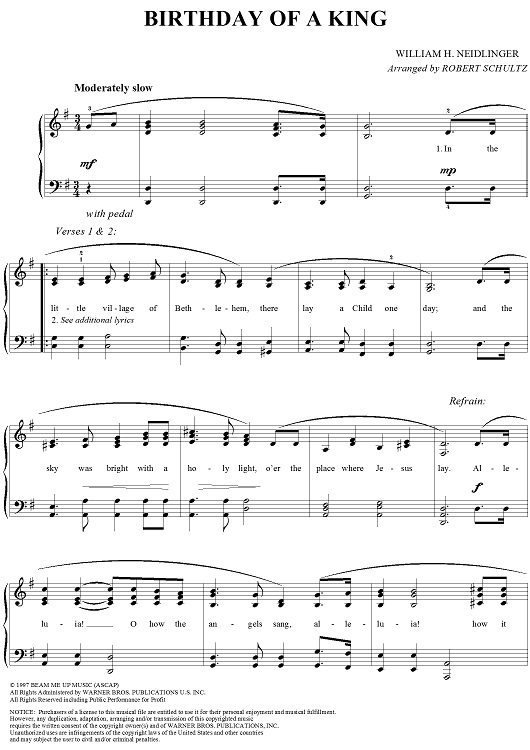
Words and music by William Harold Neidlinger (1863-1924), circa 1890. Neidlinger was a composer, conductor, organist at St. Michael’s Church, New York City, and voice teacher, but his main interest was working with retarded children, and he founded a school for this purpose in East Orange, N.J. Originally published in 1912 in Neidlinger’s native Brooklyn, the song has been popular ever since, particularly as a baritone solo, since it shows off the voice quite well and is not difficult to sing.
1. In the little village of Bethlehem,
There lay a Child one day;
And the sky was bright with a holy light
Over the place where Jesus lay.
Refrain Alleluia! O how the angels sang. Alleluia! How it rang! And the sky was bright with a holy light ‘Twas the birthday of a King.
2. ‘Twas a humble birthplace,
But O how much God gave to us that day,
From the manger bed what a path has led,
What a perfect, holy way. Refrain
Beautiful song of God’s love for His creation.
Done beautifully by The Brooklyn Tabernacle Choir.
• 1926 ~ Benny Goodman played a clarinet solo. This was not unusual for Benny except that it was his first time playing solo within a group recording session. Goodman was featured with Ben Pollack and His Californians on He’s the Last Word.
• 1936 ~ Tommy Steele (Hicks), Singer, actor
• 1937 ~ Art Neville, Keyboards, percussion, singer with The Neville Brothers
• 1943 ~ Dave Dee (Harmon), Tambourine, singer, record promoter
• 1955 ~ Carl Perkins wrote Blue Suede Shoes. Less than 48 hours later, he recorded it at the Sun Studios in Memphis. The tune became one of the first records to be popular simultaneously on rock, country and rhythm & blues charts.
• 1958 ~ Mike Mills, Bass with R.E.M
• 1961 ~ Sarah Dallin, Singer with Bananarama
• 1969 ~ Tiny Tim (Herbert Buchingham Khaury) married Miss Vickie (Victoria Budinger) on The Tonight Show starring Johnny Carson. This is the Tiny Tim of the falsetto version of Tiptoe Through the Tulips fame. The NBC-TV program earned the second-highest, all-time audience rating; second only to Neil Armstrong’s walking on the the moon. Mr. Tiny Tim and Miss Vickie had a daughter, Tulip. Then in 1977 they stopped tiptoeing together.
• 1969 ~ Chicago Transit Authority became a gold record for the group of the same name (they later changed their name to Chicago). When the album was released by Columbia Records, it marked the first time an artist’s debut LP was a double record.
• 1970 ~ The Beach Boys played to royalty at Royal Albert Hall in London. Princess Margaret was in attendance and shook the royal jewelry to such classics as Good Vibrations, I Get Around and Help Me, Rhonda.
• 1977 ~ Elvis Costello, making a rare TV appearance, agreed to perform on NBC’s Saturday Night Live.
• 2004 ~ Johnnie Carl, Crystal Cathedral Orchestra conductor, took his life. Mr. Carl has been in the employment of the Crystal Cathedral for nearly 30 years and was internationally renowned as a conductor and as a composer and arranger of over 3,500 musical pieces. He was 57 years old.
1803 ~ Louis-Hector Berlioz, French composer, conductor, music critic and major force in the development of musical form during the Romantic Era
More information about Berlioz
• 1931 ~ Rita Moreno (Rosita Alverio), Dancer, Academy and Emmy Award-winning actress
• 1934 ~ Curtis Williams, Singer with The Penguins
• 1935 ~ Tom Brumley, Steel guitar with Buck Owens and the Buckaroos, Stone Canyon Band
• 1939 ~ Marlene Dietrich recorded Falling In Love Again on the Decca label.
• 1940 ~ David Gates, Guitarist, keyboard, singer with Bread
• 1944 ~ Brenda Lee (Tarpley), American singer of popular music
• 1944 ~ “The Chesterfield Supper Club” debuted on NBC radio. Perry Como, JoStafford and many other stars of the day shared the spotlight on the 15-minute show that aired five nights a week. The show was sponsored by Chesterfield cigarettes.
• 1952 ~ An audience of 70,000 people watched from 31 theatres as Richard Tucker starred in Carmen. The event was the first pay-TV production of an opera. Ticket prices ranged from $1.20 to $7.20.
• 1982 ~ Toni Basil reached the #1 one position on the pop music charts for the first time, with her single, Mickey.
• 2000 ~ Ruth Martin, a writer whose translations of both popular and obscure operas were widely used in American opera houses, died at the age of 86. Martin collaborated with her husband Thomas Martin in translating the librettos of some of the world’s most famous operas, including Mozart’sDon Giovanni and The Marriage of Figaro, as well as Puccini’sBoheme, and Bizet’sCarmen. Martin and her husband also translated some of the rarest operas, such as Offenbach’sGrand Duchess of Gerolstein, and Dvorák’sRusalka. The Martins’ translations were marked by their clarity and singability, and despite the increasing use of closed-captioning systems in major opera houses, their translations are still used widely. Martin contributed articles on opera for Opera News, Aria, and Theater Arts. She also served on the boards of the New York Federation of Music Clubs, the Liederkranz Foundation and the National Opera Foundation.
• 2001 ~ Erik Johns, who wrote the libretto for Aaron Copland’s only full-length opera, The Tender Land, died in a fire at his home in Fishkill, N.Y. He was 74. Born Horace Eugene Johnston in Los Angeles, Johns began his career in music as a dancer. He met Copland when he was 19 at a New Year’s Eve party in New York. In 1952 the two began collaborating on an opera based on Let Us Now PraiseFamous Men, a book by writer James Agee and photographer Walker Evans that describes the lives of several Southern sharecropper families during the Depression. Copland composed the music and Johns wrote the libretto, or the words. The work was originally commissioned as a television opera by NBC but was subsequently rejected by the network. The New York City Opera performed it at its premiere at City Center in April 1954 in a short two-act version. The two later added a third act.
• 2001 ~ Jose Fajardo, a Cuban flutist who was one of the most influential bandleaders in Latin music, died an aneurysm. He was 82. The Cuban native had emigrated from Cuba in 1961, when he refused a request from the Cuban government to continue a musical tour to other communist countries. During his lengthy career, Fajardo recorded more than 40 albums and performed around the world. He was credited with expanding the audience for charanga, a Cuban musical style that backs a singer with flute, violins, piano, bass and percussion. Fajardo started his first group, Fajardo y sus Estrellas, in the 1940s. He later led three bands by the same name. After moving to the United States, he founded bands in New York and Miami and began performing in new style called pachanga, featuring a slightly more assertive rhythm. Fajardo was featured on “Cuban Masters: Los Originales,” an album of performances by leading Cuban musicians that was released November 2001.
• 2002 ~ Kay Rose, the first woman to win an Academy Award for sound editing, died. She was 80. Rose won the statuette for her work on the 1984 film The River. A native of New York, Rose was recognized in March with a career achievement award from the Cinema Audio Society. The Motion Picture Sound Editors gave her a similar lifetime achievement award in 1993. In October 2002, directors George Lucas and Steven Spielberg endowed the Kay Rose Chair in the Art of Sound and Dialogue Editing at the University of Southern California’s School of Cinema-Television. The chair is the first of its kind in the country. After studying film at Hunter College, she became a civilian film apprentice for the Army Signal Corps during World War II. There, she helped create such training films as How to Erect a Double Apron Barbed Wire Fence and the John Huston documentary Report from the Aleutians. She moved to Hollywood in 1944 and found a job as an assistant to an editor at Universal studios. In 1951, she married film editor Sherman Rose. Together, they produced the 1954 sci-fi cult classic, Target Earth. They later divorced. During her five-decade career, Rose received sound editing credits on such films as The Rose,Ordinary People,On Golden Pond,The Milagro Beanfield War,The Prince of Tides,For the Boys and Speed.
• 1910 ~ Tenor Enrico Caruso and conductor Arturo Toscanini were featured at the Metropolitan Opera House in New York City for the world premiere of Puccini’sThe Girl of the Golden West.
• 1913 ~ Morton Gould, American Pulitzer Prize-winning composer, conductor and pianist
• 1924 ~ Ken Albers, Bass singer with The Four Freshmen
• 1927 ~ For the first time, famed radio announcer George Hay introduced the WSM Barn Dance as the Grand Ole Opry. The show’s title may have changed but it remained the home of country music.
• 1930 ~ Duke Ellington and his orchestra recorded the haunting Mood Indigo on Victor Records. It became one of the Duke’s most famous standards.
• 1943 ~ Chad Stuart, Guitarist, lyricist, singer with the duo – Chad & Jeremy
• 1946 ~ Christopher ‘Ace’ Kefford, Bass with The Move
• 1947 ~ Walter ‘Clyde’ Orange, Drummer, singer with The Commodores
• 1948 ~ Jessica Cleaves, Singer with Friends of Distinction
• 1949 ~ Frank Beard, Drummer with ZZ Top
• 1949 ~ Fats Domino recorded his first sides for Imperial Records. The legend from New Orleans recorded The Fat Man, one of the earliest rock and roll records. The title also turned into Domino’s nickname and stayed with him through his years of success.
• 1951 ~ John (Raul) Rodriguez, Singer
• 1953 ~ Harry Belafonte debuted on Broadway in Almanac at the Imperial Theatre. Critics hailed Belafonte’s performance as “electrifyingly sincere.” Also starring in the show: Hermione Gingold, Billy DeWolfe, Polly Bergen and Orson Bean.
• 1966 ~ The Beach Boys made a one-week stop at the top of the Billboard Hot 100 asGood Vibrations made it to #1. It was the third #1 hit the group scored. The others were I Get Around and Help Me, Rhonda.
• 1967 ~ Otis Redding and four members of the Bar-Kays (Otis’ backup group) were killed in the crash of a private plane near Madison, Wisconsin. Redding was 26 years old. His signature song, (Sittin’ On) The Dock of the Bay was recorded three days before his death. It was #1 for four weeks beginning February 10, 1968. Redding was inducted into the Rock and Roll Hall of Fame in 1989. The Bar-Kays biggest hit was in July, 1967: Soul Finger. James Alexander, bass player for the group, was not on the plane. Ben Cauley, trumpet player, survived the crash. The group played for a time with various new members.
• 1987 ~ Jascha Heifetz passed away
Read quotes by and about Heifetz
More information about Heifetz
• 1926 ~ Benny Goodman’s first recording session was this day. He played clarinet with the Ben Pollack Orchestra on a tune titled Downtown Shuffle on Victor Records. Goodman, incidentally, was all of 17 years old.
• 1938 ~ Tatiana Troyanos, American mezzo-soprano
• 1938 ~ David Houston, Grammy Award,winning singer, actor
• 1944 ~ Neil Innes, Keyboard, singer, songwriter with The Bonzo Dog Doo-Dah Band
• 1950 ~ Joan Armatrading, British rock singer and songwriter
• 1953 ~ Frank Sinatra recorded Young At Heart. The song was turned down by Nat‘King’ Cole and other artists, believe it or not. It became a top hit in the U.S. in March of 1954.
• 1954 ~ Jack Hues, Singer with Wang Chung
• 1956 ~ Sylvia (Sylvia Allen), Singer
• 1956 ~ The Million Dollar Session was held at Sun Records in Memphis, TN. ElvisPresley, Johnny Cash, Carl Perkins and Jerry Lee Lewis gathered for an impromptu jam session. Six songs by the artists were recorded at this session. None of the songs was released for nearly three decades.
• 1957 ~ Donny Osmond, Singer with the Osmond Brothers, TV host of Donny and Marie, actor
• 1973 ~ Keith Moon, Rod Stewart and Roger Daltrey opened the rock opera Tommy in London. The show featuring Tommy, Pinball Wizard and other tunes, was so hot that tickets sold for $50 and up.
• 1984 ~ The Jackson’s Victory Tour came to a close at Dodger Stadium in Los Angeles after 55 performances in 19 cities. The production was reported to be the world’s greatest rock extravaganza and one of the most problematic. The Jackson brothers received about $50 million during the five-month tour of the U.S., with some 2.5 million fans in attendance.
• 2000 ~ Marina Koshetz, who followed her famous Russian diva mother Nina to the opera and concert stage and into the movies, died at the age of 88.
• 2004 ~ Country and Western singer Jerry Scoggins, whose baritone rendition of the theme song of “The Beverly Hillbillies” became one of television’s favorite tunes, died at age 93.
• 1842 ~ The Philharmonic Society of New York, the first permanent orchestra in the U.S., held its first concert. Despite uncomfortable seating, the event was a huge success. They performed works of Beethoven.
1863 ~ Pietro Mascagni, Italian composer and conductor
More information about Mascagni
• 1887 ~ Ernst Toch, Austrian-born American composer
• 1911 ~ Louis Prima, Trumpeter, bandleader with Louis Prima and His New Orleans Gang, Gleeby Rhythm Orchestra; songwriter, singer, married to Keely Smith
• 1931 ~ Bobby Osborne, Musician, mandolin, singer with the duo – Osborne Brothers
• 1942 ~ Harry Chapin, American folk-rock singer and songwriter, Recipient of Special Congressional Gold Medal, Worldwide Humanitarian for the Hungry, Needy and Homeless
• 1948 ~ NBC presented Horace Heidt’s Youth Opportunity Program for the first time. The talent show earned Dick Contino, an accordionist, the $5,000 prize as the program’s first national winner.
• 1949 ~ Tom Waits, Singer, songwriter, playwright, married to Kathleen Brennan
• 1954 ~ Mike Nolan, Singer with Bucks Fizz
• 1957 ~ Pat Boone was at the top of the pop charts for the first of six weeks withApril Love. His other number one hits included Ain’t That a Shame, I Almost Lost My Mind, Don’t Forbid Me and Love Letters in the Sand.
• 1984 ~ Michael Jackson was in Chicago to testify that the song, The Girl is Mine, was exclusively his and he didn’t swipe the song, Please Love Me Now. It was a copyright infringement case worth five million dollars. He won.


 1858 ~ Giacomo Puccini, Italian opera composer


 Hanukkah
  MaryO'Studio