• 1826 ~ Walter Cecil Macfarren, English pianist and composer, born in London
• 1850 ~ Wagner’s opera, Lohengrin, was performed for the first time.
• 1894 ~ Karl Böhm, Austrian conductor
• 1913 ~ Richard Tucker, American tenor
More information about Tucker
• 1924 ~ Dinah Washington, American rhythm-and-blues singer. She popularized many, many great songs, including What a Diff’rence a Day Makes, Unforgettable, and several hits with Brook Benton.
• 1925 ~ Billy (William Wayne) Grammer, Singer
• 1925 ~ Donald O’Connor, American dancer, singer and actor.
• 1931 ~ You Rascal You was recorded by Henry Allen, with the Luis Russell Band, for the Victor label.
• 1939 ~ Clem Cattini, Drummer with Tornados
• 1948 ~ Daniel Seraphine, Drummer with Chicago
• 1951 ~ Wayne Osmond, Singer with The Osmond Brothers
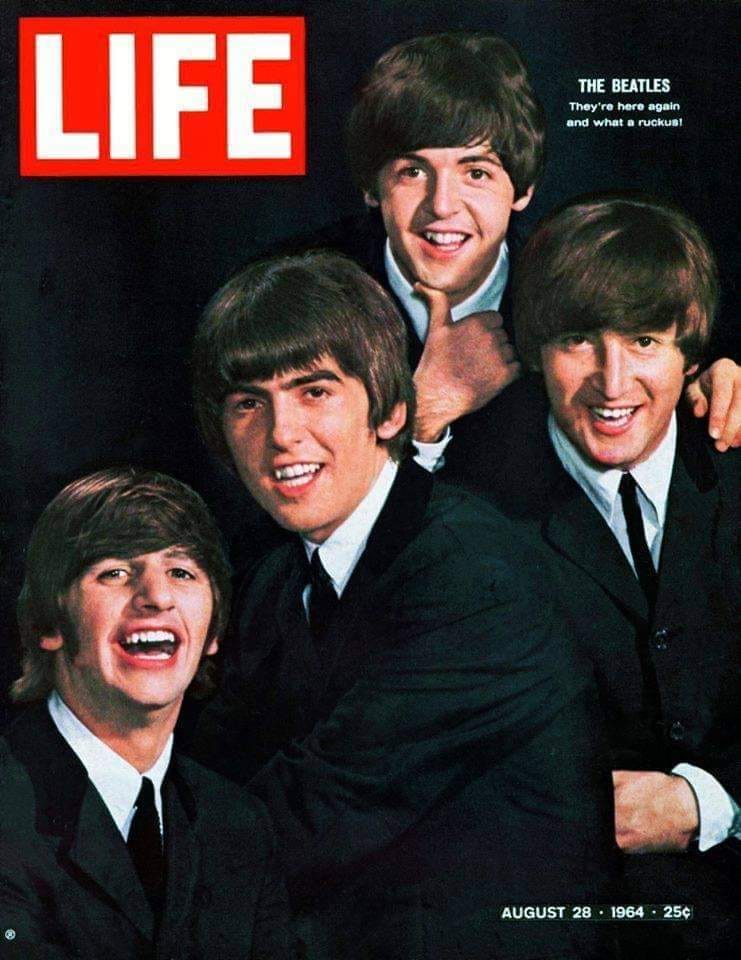
• 1964 ~ The Beatles appeared on the cover of LIFE magazine, only 6 months after they were first on the Ed Sullivan Show.
• 1984 ~ The Jacksons’ Victory Tour broke the record for concert ticket sales. The group surpassed the 1.1 million mark in only two months.
• 2002 ~ Kay Gardner, whose last musical work with the Bangor Symphony Orchestra memorialized the Sept. 11 terrorist attacks, died of a heart attack. She was in her early 60s.
On hearing of her death, symphony officials scheduled Gardner’s work, “Lament for Thousand,” for the orchestra’s season-opening concert Oct. 13 at the Maine Center for the Arts in Orono.
Gardner was a pianist, flutist and conductor who performed in 46 states and several countries.
More than 20 years ago, she sued the Bangor Symphony, unsuccessfully, for sex discrimination after she had applied for a conducting position and learned that orchestra members had been asked how they felt about working with a female conductor.
In 2000, she was the guest conductor for a 40-member orchestra of women from the Bangor Symphony, playing a repertoire written by women.
Gardner studied music at the University of Michigan and at the State University of New York at Stony Brook. In 1972, she helped found a feminist and openly lesbian women’s band, Lavender Jane.
• 1879 ~ New York’s Madison Square Garden displayed a real floating ship in a gigantic water tank as Gilbert and Sullivan’s operetta, H.M.S. Pinafore, was performed.
• 1902 ~ Stefan Wolpe, German-born American composer
• 1913 ~ Bob Crosby, Bandleader with The Bob Cats, brother of Bing Crosby
• 1918 ~ Leonard Bernstein, American conductor, composer and pianist
Read quotes by and about Bernstein
Links to more information about Bernstein Grammy winner
• 1939 ~ Dorothy embarked on a journey down the yellow brick road with a lion, a tin man and a scarecrow in the classic film “The Wizard of Oz.”
• 1941 ~ Skinnay Ennis and his orchestra recorded the tune Don’t Let Julia Fool Ya.
• 1942 ~ Walter Williams, Singer with The O’Jays
• 1955 ~ Elvis Costello (Declan McManus), Musician, songwriter
• 1961 ~ Billy Ray Cyrus, Singer
• 1964 ~ The Beatles received a gold record for their hit single A Hard Day’s Night. It was the third gold record for the Fab Four. They would collect 18 more through 1970.
• 1971 ~ Ted Lewis passed away. He was an American entertainer, bandleader, singer, and musician.
• 1982 ~ The group, Fleetwood Mac, received a gold record for the album Mirage.
• 2001 ~ Aaliyah died at the age of 22. She was a R&B singer and budding actress who made her film debut in “Romeo Must Die” and was killed in a plane crash in the Bahamas.
• 2001 ~ Jazz musician John Nelson, the father of pop star Prince, died at the age of 85. Nelson was the model for a character in the 1984 Prince movie “Purple Rain.” He also co-wrote songs on several of his son’s hit albums.
In the 1950s, Nelson was a pianist in the jazz group Prince Rogers Trio featuring singer Mattie Shaw. Shaw and Nelson married, and they named their son Prince Roger Nelson.
Nelson left the household when Prince was about 10 and his sister Tyka was 8. The father and son reconciled after Prince began his climb to fame.
Nelson co-wrote Computer Blue on the Purple Rain album, The Ladder on Around the World in a Day; Christopher Tracy’s Parade and Under the Cherry Moon on Parade and Scandalous on the Batman soundtrack.
• 2008 ~ Josef Tal, Israel composer (Israeli art music), died at the age of 97
• 1854 ~ Moritz Moszkowski, Polish-born German pianist and composer More information about Moszkowski
• 1900 ~ Ernst Krenek, Austrian-born American composer, conductor and pianist
• 1905 ~ Constant Lambert, British composer, conductor and writer
• 1912 ~ Gene (Eugene Curran) Kelly, Dancer, actor: Singin’ in the Rain, An American in Paris, Anchors Aweigh, The Three Musketeers, Marjorie Morningstar, Inherit the Wind, North and South Book I; director: Singin’ in the Rain, Hello, Dolly!, A Guide for the Married Man, The Cheyenne Social Club
• 1917 ~ Tex (Sol) Williams, American country-western singer
• 1923 ~ Billy Jones and Ernie Hare, The Happiness Boys, were heard on radio for the first time. The two were billed as radio’s first comedians and were also credited with creating and performing the first singing commercial.
• 1936 ~ Rudy Lewis, Singer with Drifters
• 1942 ~ Patricia McBride, Ballerina: New York City Ballet. For many years she was Mikhail Baryshnikov’s only partner
• 1943 ~ LIFE magazine spotlighted a dance craze that was sweeping the U.S.A., the Lindy Hop
• 1947 ~ Keith Moon, Singer, drummer with The Who
• 1947 ~ Margaret Truman, daughter of U.S. President Harry S Truman, presented her first public concert. Margaret sang before 15,000 people at the Hollywood Bowl. The concert did not get great reviews. In fact, the critics didn’t like Margaret’s singing at all. And Margaret’s dad didn’t like the critics, and said so, from the White House.
• 1949 ~ Rick Springfield, Singer
• 1951 ~ Mark Hudson, Singer with The Hudson Brothers
• 1966 ~ The U.S. premiere of the motion picture Help!, starring The Beatles, was held for thousands of moviegoers wanting to see the group’s first, color, motion picture. Their first film, A Hard Day’s Night, had been produced in black and white.
• 1990 ~ David Rose passed away
• 2001 ~ Kathleen Freeman, a veteran character actress whose face if not her name was known to audiences from television sitcoms, the film classic “Singin’ in the Rain” and Broadway’s “The Full Monty,” died of lung cancer at the age of 82. Freeman gave her final performance in “The Full Monty”. She played a sassy piano player in the hit musical and earned a Tony nomination in May 2001.
Big, brash and funny were Freeman’s trademarks in playing recalcitrant maids, demented nuns, mouthy housekeepers, battle-ax mothers, irate landladies and nosy neighbors.
Starting in the Golden Age of television, Freeman appeared in such shows as “Topper,” “The Donna Reed Show,” “The Beverly Hillbillies,” “The Dick Van Dyke Show,” “Hogan’s Heroes,” “The Lucy Show,” “The Golden Girls,” “Murphy Brown” and “Married … With Children.”
“This will sound very corny and I’m sorry,” Freeman said last year in an Associated Press interview, “but I have always had the sense I was put here to do this: I am somebody who is around to help the world laugh. I have always had that sense. Corny but absolutely true.”
In “Singin’ in the Rain,” considered by many to be the best movie musical ever made, she played Jean Hagen’s frustrated voice teacher. Among Freeman’s other films were the sci-fi thriller “The Fly,” “The Rounders” with Henry Fonda, “Far Country” with Jimmy Stewart, and “North to Alaska” starring John Wayne. More recently she appeared in “Dragnet,” “Gremlins II,” “Nutty Professor II: The Klumps” and both “Blues Brothers” comedies.
Freeman was born in Chicago and was propelled into show business at age 2. Her parents had a vaudeville act, Dixon and Freeman, in which their daughter did a little dance.
Freeman attended the University of California at Los Angeles, where she majored in music and was going to be a classical pianist. Then, she said, “A terrible thing happened. I got in a play and got a laugh. I just said a line and, `boom.”‘
Freeman then worked in many small theater groups, including the Circle Players, acting for such eminent directors – and actors – as Charles Laughton, Charlie Chaplin and Robert Morley.
At the same time, the early 1950s, the television explosion took over Los Angeles. From her first regular sitcom role, as the maid in “Topper,” Freeman went on to do just about every sitcom of the last 50 years.
For all her voluminous credits, Freeman’s stage credits were mostly on the road – touring as Miss Hannigan in “Annie” for 18 months, then in “Deathtrap” and later with Lauren Bacall in “Woman of the Year.”
Her only other Broadway appearance was for five months in the 1978 production of “13 Rue de l’Amore” starring Louis Jordan.
• 2001 ~ Frank Emilio Flynn, a blind pianist and Latin jazz pioneer who performed with many great American jazz artists, died at the age of 80.
Flynn lost his sight at age 13 but continued to study and perform classical works, transcribed into Braille, with the Symphonic Orchestra of Havana.
Flynn’s great passion was jazz, and in the 1950s he developed his own jazz-influenced ballad style, known in Cuba as “feeling.”
Performing with the Quinteto Cubana de Musica Moderno, or Cuban Quintet of Modern Music, he developed into one of the most important Cuban jazz musicians of his era.
• 1881 ~ Georges Enesco, Rumanian composer, violinist and conductor
• 1918 ~ Sgt. Irving Berlin’s musical about army life in World War I opened at the Century Theatre in New York City. Yip Yip Yaphank included songs, such as Mandy and Oh, How I Hate to Get Up in the Morning.
• 1939 ~ Ginger (Peter) Baker, Trumpeter, drummer with Cream
• 1939 ~ The Dick Jurgens Orchestra recorded Day Dreams Come True at Night on Okeh Records. Eddy Howard was the vocalist on the piece. It became Jurgens’ theme song.
• 1940 ~ Johnny Nash, American pop-reggae singer, songwriter and guitarist
• 1943 ~ Billy J. Kramer (William Ashton), Singer with The Dakotas
• 1945 ~ Ian Gillan, Singer with Deep Purple
• 1947 ~ Gerard Schwarz, American trumpeter and conductor
• 1951 ~ John Deacon, Bass with Queen, score of Flash Gordon
• 1964 ~ The Beatles began their first North American concert tour. They would visit 26 cities.
• 1972 ~ NBC-TV presented The Midnight Special for the first time. John Denver was the host for the first show. Wolfman Jack was the show’s announcer. The Midnight Special proved to be a ratings success.
• 1991 ~ Richard Maltby passed away. He was an American musician, conductor, arranger and bandleader.
• 2001 ~ Singer Betty Everett, whose recording of The Shoop Shoop Song (It’s In His Kiss) made Billboard’s Top 10 in 1964, died Sunday. She was 61.
Everett is remembered primarily for one huge hit song in the 1960s, but she also recorded many other songs and was recognized as one of the top soul singers of her time.
Starting at age 9, Everett played the piano and sang in church. She continued to sing in gospel choirs before moving to Chicago in 1957, where she recorded a string of hits on local record labels such as C.J. Cobra and OneDerful that included I’ll Be There and I’ve Got a Claim On You.
Everett signed a contract in the early 1960s with VeeJay, a record label that was then issuing recordings by The Beatles.
Everett recorded The Shoop Shoop Song in the spring of 1964, and it soared to Billboard’s Top 10.
The song was later recorded by Cher in the soundtrack for the 1990 movie Mermaids and more recently by Vonda Shepard of the Fox television show Ally McBeal.
• 2017 ~ Bea Wain, American singer and radio host (Deep Purple, Heart and Soul), died at the age of 100
• 1750 ~ Antonio Salieri, Italian composer and conductor
More information about Salieri
• 1873 ~ Leo Slezak, Austrian tenor
• 1907 ~ Howard Swanson, American composer
• 1916 ~ Moura Lympany, Saltash England, pianist
• 1937 ~ The first FM radio construction permit was issued. It went to W1X0J (later to become WGTR) in Boston, MA. The station went on the air two years later.
• 1939 ~ Johnny Preston, Singer
• 1944 ~ Carl Wayne, Singer with The Move
• 1949 ~ Ralph Flanagan and his orchestra recorded their first tune on wax, You’re Breaking My Heart.
• 1950 ~ Dennis Elliott, Drummer with Foreigner
• 1957 ~ Ron Strykert, Guitarist with Men at Work
• 1958 ~ Perez Prado, the ‘Mambo King’, received one of the first gold records awarded by the Record Industry Association of America (RIAA). The single, Patricia, was certified as having sold over one million copies.
• 1973 ~ Jazz drummer Gene Krupa played for the final time with members of the original Benny Goodman Quartet. Krupa, a jazz and big band legend, died on October 6, 1973.
• 1981 ~ Robert Russell Bennett passed away
• 1981 ~ Rex Harrison brought the award-winning My Fair Lady back to Broadway as he recreated the role of Henry Higgins. The play had originally opened in 1956.
• 2001 ~ Jack Elliott, a composer and conductor who worked on numerous hit television shows and movies, died of a brain tumor. He was 74.
Elliott came to Los Angeles in the early 1960s to work as a musical arranger on Judy Garland’s television show.
He gained a reputation as one of the top composers and arrangers in Hollywood. If a television show was popular in the 1970s, it most likely had the music of Elliott and his frequent collaborator Allyn Ferguson. They worked on such shows as: “Police Story,” “Barney Miller,” “Starsky and Hutch,” “Charlie’s Angels” and “The Love Boat.”
He also worked in films and teamed with director Carl Reiner on several projects, including: “The Comic,” “The Jerk” and “Oh God.”
Elliott served as music director for the 1984 Summer Olympics in Los Angeles, writing the music for the opening and closing ceremonies as well as conducting the orchestra.
• 2003 ~ Tony Jackson, bass player for The Searchers, a Liverpool band best known for the 1964 song “Needles and Pins,” died at the age of 63.
Jackson sang and played bass for The Searchers, a Liverpool band that briefly rivaled The Beatles for popularity in the early 1960s. “Needles and Pins” made the top 20 in the United States after it was released in 1964.
Jackson was lead singer on the band’s first two British hits, “Sweets for My Sweet” and “Sugar and Spice,” but played bass only on the enduring “Needles and Pins” and “Don’t Throw Your Love Away.”
Feeling sidelined, Jackson quit the group in 1964. His follow-up band, Tony Jackson and the Vibrations, failed to score a hit and he drifted out of the music business.
• 2004 ~ Elmer Bernstein, American movie music composer (The Magnificent Seven, To Kill A Mockingbird, The Age Of innocence, Thoroughly Modern Mille), died at the age of 82
• 1795 ~ Heinrich Marschner, German opera composer
• 1863 ~ Gabriel Pierné, French composer, conductor and organist
• 1929 ~ Bill Evans, American jazz pianist and composer
• 1932 ~ Eydie Gorme (Edith Gormezano), Grammy Award-winning singer, married since 1957 to Steve Lawrence.
• 1938 ~ Robert Johnson passed away
• 1939 ~ The famous vaudeville house, Hippodrome, in New York City, was used for the last time. There were several places called the Hippodrome around the country. They weren’t, generally, theatres, nor true nightclubs. Hippodromes were designed for the wide variety of vaudeville acts available at the time … dancing, music, comedy and skits.
• 1940 ~ Marching Along Together, by Frankie Masters and his orchestra, was recorded for Okeh Records.
• 1942 ~ Barbara George, Singer
• 1945 ~ Suzanne Farrell (Ficker), Ballerina
• 1953 ~ James ‘J.T.’ Taylor, Singer with Kool and The Gang
• 1958 ~ Madonna (Madonna Louise Veronica Ciccone), Singer
• 1962 ~ Brian Epstein, manager of The Beatles, handed drummer Pete Best his walking papers. Best had been with the group for 2-1/2 years. Ringo Starr (Richard Starkey) was picked to take his place. One month later, the group recorded, Love Me Do.
• 1977 ~ Elvis Presley was rushed from Graceland to Baptist Memorial Hospital in Memphis, Tennessee. Doctors’ efforts to revive him were fruitless and he was pronounced dead (coronary arrhythmia) at 3:30 p.m. He was 42 years old.
• 1984 ~ Prince was pictured on the cover of Rolling Stone magazine. He was shown with his left armpit exposed.
• 1984 ~ Though it didn’t make the pop music charts, a new single by Elvis Presley was released by RCA Victor Records. The song was originally recorded in 1956 at the Tupelo (MS) Fairgrounds. It was called, Baby, Let’s Play House.
• 2000 ~ Sally Amato, who founded the Amato Opera Theater with her husband, Anthony Amato, in 1948, died at the age of 82.
Amato, who performed under her maiden name, Serafina Bellantone, was born in Little Italy in 1917. As a child she appeared in vaudeville skits in local movie theaters.
She met her husband when they were both appearing in an operetta at New Jersey’s Paper Mill Playhouse, and they founded the Amato Opera Theater to provide young singers with a chance to perform.
• 2000 ~ Alan Caddy, English musician (The Tornados) died
• 2007 ~ Max Roach, American percussionist, drummer, and composer died
• 2018 ~ Aretha Franklin passed away at the age of 76. Franklin won 18 Grammy Awards and is one of the best-selling musical artists of all time, having sold over 75 million records worldwide. Franklin received numerous honors throughout her career including a 1987 induction into the Rock and Roll Hall of Fame, in which she became the first female performer to be inducted. She was inducted to the UK Music Hall of Fame in 2005. In August 2012, Franklin was inducted into the GMA Gospel Music Hall of Fame. Franklin is listed in at least two all-time lists on Rolling Stone magazine, including the 100 Greatest Artists of All Time, and the 100 Greatest Singers of All Time.
1778 ~ Augustus Toplady, English hymn-writer who wrote Rock of Ages, died.
• 1868 ~ Leone Sinigaglia, Italian composer
• 1888 ~ An audio recording of English composer Arthur Sullivan’s “The Lost Chord”, one of the first recordings of music ever made, is played during a press conference introducing Thomas Edison’s phonograph in London, England.
• 1926 ~ Buddy (Armando) Greco, Singer and pianist
• 1937 ~ Brian Fennelly, American composer, pianist and conductor
• 1940 ~ Dash Crofts, Drums, mandolin and keyboard with Champs; singer is a duo with Seals and Crofts
• 1941 ~ David Crosby (Van Cortland), American rock singer, guitarist and songwriter. Performed with The Byrds as well as Crosby, Stills, Nash and Young
• 1941 ~ Connie Smith (Meadows), Singer
• 1946 ~ Larry Graham, Bassist and singer with Sly and the Family Stone as well as Graham Central Station
• 1971 ~ Elton John put the finishing touches to his Madman Across the Water LP at Trident Studios, London. Since the album’s release on Feb 2, 1972, it has sold over two million copies in the U.S. alone.
• 1981 ~ The BBC recording of the Royal Wedding of Prince Charles and Lady Diana reached number one on the album charts in Britain.
• 1985 ~ Michael Jackson took control of the Beatles’ publishing rights. It was during their collaboration on 1983’s “Say Say Say” that former Beatle Paul McCartney is said to have advised King of Pop Michael Jackson to invest some of his enormous wealth in music publishing. It was sound financial advice that McCartney may have come to regret giving on August 14, 1985, when Michael Jackson purchased the publishing rights to the vast majority of the Beatles’ catalog for $47 million, outbidding McCartney himself.
• 2000 ~ Leonard Kwan, a master of slack key guitar whose composition Opihi Moemoe is considered a classic of the genre, died at the age of 69. Kwan began recording in 1957 and most recently recorded two albums for George Winston’s Dancing Cat Records. The second was released in September.
Kwan also was the first slack key guitarist to publicly share his instrument tunings in an instruction book.
Hawaiian slack key, or ki ho`alu, is a unique musical style dating to the 1830s, when Spanish and Mexican cowboys arrived in the islands. Some of the guitar strings are slacked from the standard tuning and songs are played in a finger-picking style, with the thumb playing bass. In 1960, he recorded, Slack Key, the world’s first all-instrumental slack key album.
• 2001 ~ Nicholas Orloff, a dancer and ballet teacher, died at the age of 86.
Orloff was known for his performance of the Drummer, a character he originated in David Lichine’s 1940 “Graduation Ball.”
He was a popular teacher with the Ballet Theater and other schools. He continued to teach in Manhattan schools even after suffering from a stroke three years ago.
Orloff appeared in the 1950 French film “Dream Ballerina” and on Broadway in the musical “Pipe Dream.”
He also was the ballet master of the Denver Civic Ballet in the mid- 1970s.
Born in Moscow, Orloff trained in Paris. He performed with the Ballet Russe de Monte Carlo, the Original Ballet Russe, Ballet Theater, as the American Ballet Theater was known, and the Grand Ballet du Marquis de Ceuvas.
• 2001 ~ Daniel Adrian Carlin, an Emmy-winning music editor who worked with soundtrack composers Lalo Schifrin and Ennio Morricone, died of complications from lung cancer and pulmonary fibrosis. He was 73.
Carlin edited the music for “Scorpio,” “The Outlaw Josey Wales,” “Ghost,” “Gorillas in the Mist,” “Dead Poets Society” and “Cliffhanger.” He won a music-editing Emmy in 1987 for his work on the miniseries “Unnatural Causes.”
He was founder in 1972 of La Da Music. Now known as Segue Music, it is considered the leading film and television editing company.
• 1961 ~ Roy Hay, Musician, guitar with Culture Club
• 1966 ~ The last tour for The Beatles began at the International Amphitheater in Chicago, and John Lennon apologized for boasting that the Beatles were more popular than Jesus Christ. London’s Catholic Herald said Lennon’s comment was “arrogant … but probably true.”
• 1967 ~ Fleetwood Mac made their stage debut at the National Blues and Jazz Festival in Great Britain.
• 1992 ~ John Cage, American composer (Imaginary Landscape No 1/O’O), died of a stroke at the age of 79
• 1865 ~ Alexander Konstantinovich Glazunov, Russian symphonic composer, conductor and educator. He wrote eight completed symphonies and two piano concertos. One of his last works (1934) was a concerto for saxophone.
• 1893 ~ Douglas Stuart Moore, American composer and educator
• 1895 ~ The first Promenade concert under conductor Henry Wood took place at Queen’s Hall in London. He remained in sole charge of the “Proms”, the annual British classical music festival, until 1940.
• 1928 ~ Jimmy Dean (Seth Ward), Grammy Award-winning singer, TV host of The Jimmy Dean Show, sausage mogul
• 1928 ~ Eddie Fisher, Singer, TV host of Coke Time with Eddie Fisher, father of Carrie Fisher and Tricia Leigh Fisher
• 1940 ~ Bobby Hatfield, Singer with The Righteous Brothers
• 1943 ~ Veronica ‘Ronnie’ Spector (Bennett), Singer with The Ronettes
• 1947 ~ Ian Anderson, Musician: flute, singer with Jethro Tull
• 1954 ~ Eliot Fisk, American guitarist
• 1954 ~ Elvis Presley made one of his first professional appearances, at Overton Park, in his hometown of Memphis, TN. He used the occasion to debut his new record, That’s All Right (Mama), and was a big crowd pleaser.
• 1961 ~ Jon Farriss, Musician, drums, singer with INXS
• 1967 ~ Lorraine Pearson, Singer with Five Star
• 1968 ~ Michael Bivins, Singer with New Edition, Bell Biv DeVoe
• 1985 ~ Madonna’s album Like a Virgin became the first solo album by a female artist to be certified for sales of five million copies.
• 1987 ~ A Chorus Line celebrated its 5,000th performance. It was estimated that 25 million theatregoers had seen the musical since it opened in 1975. An estimated 16.7 million people had seen the show on Broadway, with another 8.3 million taking in the touring production. A Chorus Line became the longest-running show on The Great White Way on September 29, 1983 and ended its Broadway run in 1990.
• 2003 ~ Gregory Hines, Tony Award winner tap-dancing actor who started on Broadway and in movies including “White Nights” and “Running Scared,” died at the age of 57. The dancer, among the best in his generation, won a 1993 Tony for the musical “Jelly’s Last Jam.”
Hines became internationally known as part of a jazz tap due with his brother, Maurice, and the two danced together in the musical revue “Eubie!” in 1978. The brothers later performed together in Broadway’s “Sophisticated Ladies” and on film in 1984’s “The Cotton Club.”
In “The Cotton Club,” Hines also had a lead acting role, which led to more work in film. He starred with Mikhail Baryshnikov in 1985’s “White Nights” and with Billy Crystal in 1986’s “Running Scared,” and he appeared with Whitney Houston and Angela Bassett in 1995’s “Waiting to Exhale,” among other movies.
On television, he had his own sitcom in 1997 called “The Gregory Hines Show,” as well as a recurring role on “Will and Grace.” March 2003, he appeared in the spring television series “Lost at Home.”
• 2013 ~ Eydie Gorme, American singer, died at the age of 84