• 1709 ~ Franz Xaver Richter, Austro-Moravian singer, violinist, composer, conductor and music theoretician
• 1879 ~ Gilbert and Sullivan’s operetta, H.M.S. Pinafore, opened. Arthur Sullivan conducted the orchestra while William Gilbert played the role of a sailor in the chorus and in the Queen’s Nay-vee.
• 1912 ~ Terence Beckles, pianist/teacher
• 1913 ~ Mary Martin, American singer and actress, primarily for the musical theater, Tony and Emmy Award-winning actress, mother of actor Larry Hagman
• 1924 ~ Lady Be Good opened in New York City. George Gershwin wrote the music while Fred and Adele Astaire were well-received by the show’s audience for their dancing talents.
• 1936 ~ Lou Rawls (Louis Allen), American Grammy Award-winning singer of popular music, TV regular on Dean Martin Presents
• 1938 ~ Sandy Nelson, Drummer
• 1939 ~ Diane Lennon, Singer with The Lennon Sisters on Lawrence Welk Show, Jimmy Durante Presents the Lennon Sisters
• 1940 ~ Glenn Miller got a call from ASCAP (American Society of Composers and Publishers). He was informed that he couldn’t use his Moonlight Serenade as his band’s theme song. He had to use Slumber Song instead because of an ASCAP ban.
• 1945 ~ Bette Midler, American Grammy Award-winning pop-rock singer and actress
• 1945 ~ Burl Ives made his concert debut. He appeared at New York’s Town Hall. We lovingly listen every year for the voice of this old-time radio personality as the narrator and banjo-pickin’ snowman in TV’s Rudolph the Red-Nosed Reindeer.
• 1946 ~ Gilbert (Raymond) O’Sullivan, Singer
• 1950 ~ John Wesley Ryles, Singer
• 1950 ~ Ernest John Moeran passed away
• 1968 ~ Promises, Promises opened on Broadway. The play ran for 1,281 performances, earning $35,000 in profits each week of 1969. Dionne Warwick had a hit version of the title song.
• 1986 ~ Horace Heidt, orchestra leader (Swift Show Wagon), died at the age of 85
• 1989 ~ Alvin Ailey, US choreographer (Blues Suite, Revelations), died at the age of 58
• 1997 ~ Stéphane Grappelli, French jazz violinist who founded the Quintette du Hot Club de France, died at the age of 89
• 2012 ~ Galina Vishnevskaya, Russian soprano opera singer, died at the age of 85
. 1632 ~ Jean-Baptiste Lully, Italian-born French composer More information about Lully
. 1829 ~ Anton Rubinstein, Russian composer and pianist. He founded the Saint Petersburg Conservatory. More information about Rubinstein
. 1895 ~ Joseé Iturbi, Musician, pianist, conductor of the Rochester Philharmonic Orchestra
. 1915 ~ Dick Vance, Trumpeter
. 1929 ~ Berry Gordy, Jr., Founder of Motown Records
. 1934 ~ Ethel Ennis, Singer with Benny Goodman Orchestra
. 1939 ~ Gary Troxel, Singer with The Fleetwoods
. 1940 ~ Bruce Channel, Singer
. 1943 ~ Randy (Randall Stuart) Newman, American pop-rock songwriter, singer and pianist More information about Newman Grammy winner
. 1945 ~ R.B. Greaves, Singer
. 1948 ~ Beeb Birtles, Guitarist with The Little River Band
. 1949 ~ Alexander Godunov, Ballet dancer, actor
. 1949 ~ Paul Shaffer, Bandleader on Late Show with David Letterman, comedian
. 1956 ~ Holding the #1 spot on the music charts: Guy Mitchell singing Singing the Blues. The song remained at the top of the Hit Parade for 10 weeks. Here’s a bit of trivia: Ray Conniff whistled the intro to Singing the Blues.
. 1966 ~ The New Vaudeville Band received a gold record for Winchester Cathedral this day.
. 1974 ~ John Lennon appeared in concert for the last time, at NYC’s Madison Square Garden. Lennon joined Elton John to sing Whatever Gets You Through the Night as well as I Saw Her Standing There.
. 1471 ~ Guillaume Du Fay, French composer, died. Considered the leading composer of the early Renaissance.
. 1750 ~ Anton Thadaus Johann Nepomuk Stamitz, composer
. 1804 ~ Sir Julius Benedict, Musician, composer
. 1813 ~ Michele Puccini, Composer
. 1867 ~ Charles (Charles-Louis-Eugèn) Koechlin, French composer. He studied under Massenet and Fauré at the Paris Conservatoire. He excelled in colorful and inventive orchestration in his symphonies, symphonic poems, choral-orchestral works (including seven based on Kipling’s Jungle Book), film music, and works inspired by Hollywood, such as the Seven Stars Symphony. He also wrote prolifically for a wide range of vocal and chamber combinations. His writings included studies of recent French music and treatises on music theory.
. 1898 ~ Nelly Steuer-Wagenaar, Dutch pianist
. 1900 ~ Leon Barzin, Belgian conductor (NY City Ballet 1948-58)
. 1904 ~ Sir Julius Benedict, German-born English conductor and composer
. 1912 ~ David Merrick (Margulois), Broadway producer of Gypsy, Hello, Dolly!,Beckett, Oliver, Fanny, Stop the World: I Want to Get Off, 42nd Street
. 1935 ~ Al Jackson, Jr., Dummer with Booker T. and the M.G.’s; Roy Milton Band
. 1935 ~ Eeny Meeny Miney Mo was recorded by Ginger Rogers and Johnny Mercer. The tune was recorded at Decca Records in Los Angeles.
. 1942 ~ Jimi (James Marshall) Hendrix, American rock guitarist, singer and songwriter
. 1944 ~ Dozy (Trevor Davies), Bass with Dave Dee, Dozy, Beaky, Mick and Tich
. 1944 ~ Eddie Rabbitt, Songwriter, Kentucky Rain for Elvis Presley; singer, his 17 albums garnered 26 #1 country hits and 8 pop hits
. 1953 ~ Boris Grebenshikov, Russian rock musician
. 1959 ~ Charlie Burchill, Guitarist with Simple Minds
. 1967 ~ The Association, a California group, earned a gold record for the hit Never My Love, on Warner Bros. Records. The group also earned worldwide fame for other hits including Windy, Cherish and Along Comes Mary.
. 1979 ~ Hilary Hahn, American violinist
. 1982 ~ The #1 song in the U.S. was former Commodore Lionel Richie’s Truly. The love song stayed at the top of the charts for two weeks. The song was his first solo hit and followed Endless Love, a duet with Diana Ross in 1981.
. 2000 ~ Walter Bailes, a member of the popular 1940s-era Grand Ole Opry duo The Bailes Brothers, died at the age of 80. Walter Bailes, a West Virginia native, and his brother Johnny were the classic Bailes Brothers duo. Brothers Kyle and Homer also performed with the group over the years in varying combinations. Walter wrote much of the group’s material, including popular songs like Dust on the Bible and I Want to be Loved. During their run on the Grand Ole Opry from 1944 to 46, they were among the show’s most popular acts. Kitty Wells, Flatt & Scruggs, and The Everly Brothers all recorded songs written by Walter Bailes. The Bailes Brothers left the Opry in 1946 and moved to Shreveport, La., where they helped launch the Louisiana Hayride radio show. They continued to occasionally perform throughout the 1950s.
. 1585 ~ Thomas Tallis, English composer, died at the age of 80
. 1666 ~ Giuseppe Guarneri, Italian violin maker
. 1876 ~ Manuel de Falla, Spanish composer and conductor
More information about de Falla
. 1889 ~ The first ‘Nickel-in-the-Slot’ (jukebox) was placed in service in the Palais Royal Saloon in San Francisco, California. Juke, at the time, was a slang word for a disorderly house, or house of ill repute. The unit, developed by Louis T. Glass, contained an Edison tinfoil phonograph with four listening tubes. There was a coin slot for each tube. 5 cents bought a few minutes of music. The contraption took in $1,000 in six months!
. 1903 ~ Enrico Caruso, famed Italian tenor, made his debut in the United States at the Metropolitan Opera House in New York City. He sang in the role of the Duke in Rigoletto.
. 1920 ~ Herman Nieland, Dutch organist/pianist/composer
. 1924 ~ Vincent Lopez and some 40 jazz musicians presented a concert of upbeat music at the Metropolitan Opera House in NYC.
. 1928 ~ Jerry Bock, American songwriter for the musical theater
. 1933 ~ Krzysztof Penderecki, Polish composer and conductor
More information about Penderecki
. 1935 ~ Ethel Leginska became the first woman to write an opera and conduct it. Her original work, titled Gale, opened at the Chicago City Opera Company.
. 1938 ~ Bob Hope and Shirley Ross recorded a song for the film, The Big Broadcast of 1938. Thanks for the Memory became Decca record number 2219. It also became Hope’s theme song.
. 1955 ~ Ludovico Einaudi, Italian composer and pianist
. 1974 ~ Billy Swan reached the #1 spot on the singles charts for the first and only time. I Can Help was the most popular song in the U.S. for two weeks.
. 1710 ~ Wilhelm Friedemann Bach, composer, son of J.S. Bach
. 1880 ~ Lillian Russell made her vaudeville debut, in New York City.
. 1899 ~ Hoagy (Hoagland Howard) Carmichael, American jazz pianist and songwriter, singer, bandleader, attorney
. 1909 ~ Helen Hayes appeared for the first time on the New York stage. She was a member of the cast of In Old Dutch, which opened at the Herald Square Theatre.
. 1913 ~ Lord Benjamin Britten, British composer Read quotes by and about Britten More information about Britten Grammy winner
. 1925 ~ Gunther Schuller, American composer, conductor, French-horn player and educator
. 1938 ~ Bunny Berigan and his orchestra recorded Jelly Roll Blues on Victor Records. The tune became a standard for the band.
. 1943 ~ Floyd Sneed, Drummer with Three Dog Night
. 1946 ~ Aston Barrett, Musician with ‘Family Man’, bass with Bob Marley & The Wailers
. 1949 ~ Steve ‘Miami’ Van Zandt, Singer, songwriter, guitar
. 1950 ~ Tina (Martina) Weymouth, Bass with Talking Heads
. 1953 ~ Craig Hundley, Pianist with the Craig Hundley Trio
. 1955 ~ RCA paid the unheard of sum of $25,000 to Sam Phillips of Memphis, TN for the rights to the music of a truck driver from Tupelo, Mississippi: Elvis Presley. Thanks to negotiations with Elvis’ manager, Colonel Tom Parker, RCA tossed in a $5,000 bonus as well, for a pink Cadillac for Elvis’ mother.
. 1957 ~ The Miles Davis Quintet debuted with a jazz concert at Carnegie Hall in New York.
. 1965 ~ The production of Man of LaMancha, including the classic The Impossible Dream, opened in New York City for the first of 2,328 performances.
. 1975 ~ Dr. Zhivago appeared on TV for the first time. The production, including Somewhere My Love, had earned $93 million from theater tickets over ten years. NBC paid $4 million for the broadcast rights.
. 1977 ~ Tony Orlando returned to the concert stage after a self-imposed, three-month retirement following the suicide death of his good friend, Freddie Prinze. Orlando appeared in concert in San Carlos, California.
. 2001 ~ Norman Granz, the impresario who helped make jazz more accessible to the public while making the music business fairer to black performers, died in Geneva, Switzerland, of complications from cancer. He was 83. Granz owned four labels – Clef, Norgran, Verve and Pablo – and at one time or another recorded most of the major names in jazz, including Louis Armstrong, Count Basie, Duke Ellington, Ella Fitzgerald, Dizzy Gillespie, Billie Holiday, Charlie Parker and Oscar Peterson. Many historians credit him with bringing top jazz performers in integrated bands into venues across the country through a series called Jazz at the Philharmonic. Granz’s efforts also helped end a system in which white performers generally earned far more than blacks. He insisted on equality in pay, dining and accommodations for his musicians. In 1947, he told Down Beat magazine that he lost $100,000, then a sizable sum, by turning down bookings in segregated concert halls.
• 1724 ~ First Performance of J. S. Bach’s Sacred Cantata No. 26 Ach wie flüchtig, ach wie nichtig performed on the 24th Sunday following Trinity. A portion of Bach’s second annual Sacred Cantata cycle in Leipzig, 1724-25.
• 1736 ~ J. S. Bach named court composer by Poland’s King Agustus III.
• 1826 ~ Composer Felix Mendelssohn and his sister Fanny performed his overture to “A Midsummer Night’s Dream” for the first time.
• 1828 ~ Death of Austrian composer Franz Schubert in Vienna, at the age of 31 from typhus. He is buried near Beethoven.
• 1859 ~ Mikhail Ippolitov-Ivanov, Russian composer and conductor
More information about Ippolitov-Ivanov
• 1874 ~ Birth of composer Karl Adrian Wohlfahrt.
• 1875 ~ First Performance of Tchaikovsky‘s Third Symphony, in Moscow.
• 1888 ~ Piano Debut in Boston of composer Edward MacDowell with the Kneisel Quartet.
• 1905 ~ Tommy Dorsey, American trombonist and bandleader
• 1923 ~ First Performances of Béla Bartók‘sFive Dances and Zoltán Kodály‘sPsalums Hungaricus in Budapest, marking the 50th anniversary of the union of cities Buda and Pest.
• 1936 ~ Birth of classical music commentator (Detroit Symphony broadcasts) Dick Cavett, in Kearney, Nebraska. ABC-TV talk show host (Dick Cavett Show).
• 1936 ~ First concert recorded on magnetic tape with the London Philharmonic orchestra conducted by Sir Thomas Beecham at BASF’s own concert hall in Ludwigshaven, Germany.
• 1937 ~ Ray Collins, Songwriter
• 1938 ~ Hank Medress, Singer with The Tokens, record producer
• 1943 ~ Fred Lipsius, Piano, sax with Blood Sweat & Tears
• 1943 ~ Stan Kenton and his orchestra recorded Artistry in Rhythm, the song that later become the Kenton theme. It was Capitol record number 159. The other side of the disk was titled, Eager Beaver.
• 1944 ~ Agnes Baltsa, Greek mezzo-soprano
• 1954 ~ Sammy Davis, Jr. was involved in a serious auto accident in San Bernardino, CA. Three days later, Davis lost the sight in his left eye. He later referred to the accident as the turning point of his career.
• 1957 ~ American conductor Leonard Bernstein named Music Director of the New York Philharmonic. First American-born and educated conductor named to head an important American Orchestra.
• 1961 ~ A year after Chubby Checker reached the #1 spot with The Twist, the singer appeared on The Ed Sullivan Show to sing the song again. The Twist became the first record to reach #1 a second time around, on January 13, 1962.
• 1962 ~ For the first time, a jazz concert was presented at the White House. Jazz had previously been served as background music only.
• 2000 ~ First Performance of Philip Glass‘ Double Concerto for Timpani and Orchestra, by the American Composers Orchestra. Lincoln Center in New York.
• 2017 ~ Della Reese [Delloreese Patricia Early], American singer and actress (Della Reese Show, Royal Family), died at the age of 86
• 2017 ~ Mel Tillis [Lonnie Melvin Tillis], American country singer (Who’s Julie, M-M-Mel), died of respiratory failure at the age of 85
• 1569 ~ Paul Sartorius, German organist and composer
• 1615 ~ Guillaume Dumanoir, II, French violinist and composer who composed dance music enjoyed by Louis XIV
• 1667 ~ Nathaniel Schnittelbach, composer, died at the age of 34
• 1715 ~ Girolamo Abos, composer of Italian opera and church music.
• 1720 ~ Carlo Antonio Campioni, Italian composer.
• 1757 ~ Daniel Read, American composer of the First New England School, and one of the primary figures in early American classical music.
• 1775 ~ Karl Marian Paradeiser, German composer, died at the age of 28.
• 1780 ~ Robert Archibald Smith, English composer.
• 1829 ~ Anton G Rubinstein, Russian pianist/conductor/composer
• 1840 ~ Frederick Scotson Clark, composer.
• 1848 ~ Frédéric Chopin played his final piano concert at a Polish benefit ball at Guildhall in London.
• 1850 ~ Giuseppe Verdi‘s opera Stifellio was first performed at the Teatro Grande in Trieste despite difficulties with the censors which resulted in cuts and changes.
• 1852 ~ Minnie Hauk, American soprano
• 1854 ~ First Performance of Anton Rubinstein‘s Ocean Symphony in Leipzig.
• 1860 ~ Edmund Scheucker, Viennese harpist.
• 1861 ~ Vaclav Suk, Czech-born Russian composer and violinist.
• 1861 ~ First Performance of Johannes Brahms‘ Piano Quintet No. 1 in g, Op. 25, at a rehearsal in Hamburg, with pianist Clara Schumann.
• 1862 ~ The work noted above received its official premiere with members of the Hellmesberger Quartet; Brahms at the piano, in Vienna.
• 1870 ~ Alfred Hill, Australian composer
• 1873 ~ David Karl Björling, Swedish tenor
• 1873 ~ W.C. Handy, American blues composer and bandleader
More information about Handy
• 1889 ~ George S. (Simon) Kaufman, Playwright: The Cocoanuts, A Night at the Opera, with Moss Hart, The Man Who Came to Dinner, You Can’t Take It with You
• 1893 ~ George Alexander Osborne, Irish pianist and composer (La Pluie de perles), died of natural causes at the age of 87
• 1894 ~ Debut of opera star Enrico Caruso in Mario Morelli’s L’Amico Francesco at Naples Teatro Nuovo.
• 1895 ~ Paul Hindemith, German-born American composer and conductor
Read quotes by and about Hindemith
More information about Hindemith
• 1896 ~ Lawrence Mervil Tibbett, American baritone
• 1905 ~ Eddie (Albert) Condon, Guitarist, bandleader, promoter of Dixieland Jazz
• 1908 ~ Conductor Arturo Toscanini made his debut in the United States this day. He appeared at the Metropolitan Opera House in New York, conducting Aida.
• 1931 ~ Bob Gibson, Singer, songwriter, leader of folk music movement in late ’50s, duo of Gibson and (Bob) Camp
• 1932 ~ The Palace in New York City closed its doors. It was the most famous vaudeville theater in America. Later, it became a movie house with live performances preceding the flicks; most notably: the team of Dean Martin and Jerry Lewis in their heyday.
• 1935 ~ The Rodgers and Hart musical, Jumbo, opened in New York City for a run of 233 performances.
• 1937 ~ Bob Crosby and his orchestra recorded South Rampart Street Parade on Decca Records.
• 1945 ~ Martine Van Hammel, Ballet, American Ballet Theatre
• 1955 ~ ‘Tennessee’ Ernie Ford drove to the top spot on the record charts on this day. Sixteen Tons, where he owed his “soul to the company store…”, became the fastest-selling record in history, jumping to #1 in just 3 weeks. The tune, on Capitol Records, stayed at #1 for eight weeks.
• 1964 ~ Albert Hay Malotte, composer, died at the age of 69
• 1964 ~ Diana Krall, Canadian Jazz pianist and singer
• 1970 ~ Anne Murray received a gold record for Snowbird. She was the first Canadian recording artist to receive a gold record.
• 2000 ~ Russ Conway, a British pianist known as the “Prince Charming of Pop” who sold
More than 30 million records in the 1950s and ’60s, died at age 75. He had 17 consecutive hits in the late 1950s and early 1960s, and won a silver disc when his record Roulette topped 250,000 sales – a total rapidly equaled by three other hits, Sidesaddle, China Tea and Snow Coach. Conway’s formal piano education consisted of one lesson at age 4. He left school at 14 and got work in a lawyer’s office. But he was sent to juvenile detention for three years for taking money he found in a package. In a detention center, he found a piano to play. While doing a stint as a pianist in a club, he was discovered by choreographer Irving Davies. He went on to provide piano accompaniment to a string of singers. Soon he was composing the songs that made him famous and won him the nicknames “Prince Charming of Pop” and the “Sheik of the Keyboard.”
• 2001 ~ Blue guitarist and singer Isaac Scott, a major figure in the city’s music scene for more than a quarter century, died of complications from diabetes. He was 56. A stream of musicians paid their respects to Scott, said his ex-wife, Eloise DePoe. He was found in his apartment Nov. 4 and never regained consciousness. Scott recorded several albums, including “The Isaac Scott Band,” “Big Time Blues Man” and “High Class Woman.” He also appeared on the compilation albums “Live at the San Francisco Jazz Festival” and “Live at the Roadhouse.” Primarily a “cover artist,” Scott did not write his own songs, which hindered national recognition. But he received several local honors, including the Washington Blues Society’s Hall of Fame (1991) and lifetime-achievement (2000) awards. He also performed at last year’s opening of the Experience Music Project. Scott taught himself piano and guitar, and started out playing gospel music, once touring the West Coast with the Five Blind Boys of Mississippi. In 1974, he turned his attention to blues, with a sound flavored by his love of Seattle-born guitar legend Jimi Hendrix. Like Albert Collins, an early influence, Scott played electric guitar with his thumb instead of a pick, which contributed to his distinctive sound. He also was known for his stamina, often playing two- and three-hour sets.
• 2001 ~ Tommy Flanagan, a jazz pianist who worked with such artists as Ella Fitzgerald, died of an arterial aneurysm. He was 71. Flanagan, part of his own classic jazz trio, accompanied Fitzgerald for 20 years, also acting as her musical director. He also worked for Tony Bennett. He became a celebrated figure in jazz with such trio albums as “Jazz Poet” (1989) and “Let’s” (1993). Flanagan’s trio included bassists George Mraz and Peter Washington, and drummers Kenny Washington, Lewis Nash and Albert Heath. Flanagan won the distinguished Danish Jazzpar Prize in 1993. Born in Detroit, Flanagan was the youngest of six children. He recorded “Sunset and the Mockingbird: The Birthday Concert,” live at the Vanguard in 1998. He was to appear at Iridium this holiday season.
.1817 ~ Louis Lefébure-Wély, French organist and composer
.1854 ~ George Whitefield Chadwick, American composer and conductor
.1868 ~ Gioachino (Antonio) Rossini, Italian composer (Barber of Seville, William Tell), died at the age of 76. “Delight must be the basis and aim of this art,” Rossini wrote. “Simple melody – clear rhythm!” Rossini’s contribution to the development of opera was immense.
.1921 ~ Loonas Kokkonen, Finnish composer
.1943 ~ Leonard Bernstein replaced an indisposed Bruno Walter as conductor of the New York Philharmonic Orchestra. Thus began a legendary career and worldwide appreciation for Bernstein’s many compositions with the orchestra.
.1951 ~ Nicolai Karlovich Medtner died. He was a Russian composer and pianist.
.1965 ~ Julie Harris starred in “Skyscraper”, which opened on Broadway in New York City. The musical ran for seven months.
.1968 ~ This was a good day for The Beatles. Their movie, “Yellow Submarine”, premiered in the U.S. and the single, Hey Jude, topped the pop music charts (it was in its 7th of 9 weeks at #1).
.1975 ~ Whoa Whoa Whoa, Feeeelings. One of the great lounge-lizard songs of all time, Feelings by Morris Albert, went gold.
.1988 ~ Antal Dorati, Hungarian-American conductor (Dresden Opera 1928-29), died at the age of 82
.1999 ~ Donald Mills passed away. He had been one of the Mills Brothers.
.2000 ~ Cecil Blackwood, a gospel singer who was a member of the Blackwood Brothers and crooned with Elvis Presley, of cancer at the age of 66. The Blackwood Brothers, who have won nine Grammys and 20 Dove awards, were a favorite of Elvis Presley, who briefly sang with Cecil Blackwood in a group named the Songfellows. The Blackwood Brothers were formed in 1934, the same year Blackwood was born in Ackerman, Miss. He became the group’s baritone in 1954. The Blackwood Brothers have recorded 300 albums, backed country stars Porter Wagoner and Barbara Mandrell, and are members of the Southern Gospel Music Hall of Fame.
.2000 ~ Jimmy Payne Sr., a tap dancer whose rhythm and technique, as well as a mastery of precise steps, attracted Bob Fosse, June Allyson, Gregory Hines, Lena Horne and others to his Chicago studio, died Nov. 13 at the age of 95. The son of a Cuban mother and Barbadian father, Payne grew up in the Panama Canal Zone before moving to New York in 1917. After traveling from New York to Chicago in 1947, Payne helped introduce African and Afro-Cuban rhythms to the dance scene. He taught in a number of Chicago dance studios from the 1950s into the 1970s. He continued to teach some of the city’s top dancers until his regimen was slowed by a number of strokes in his early 90s.
.2000 ~ New York entertainment lawyer and tax expert Joseph Taubman, who wrote how-to books for people working in the business side of show business, died at the age of 81. Taubman’s clients included Lionel Richie, Pete Seeger, Joan Baez and Arlo Guthrie. He also served as counsel to the National Film Board of Canada. Taubman wrote “Financing a Theatrical Production,” and his treatises on various aspects of the entertainment business published in the 1970s remain in print.
.2000 ~ The site, thebeatles.com, went live and is the band’s only official presence on the Internet among a flood of unofficial fan sites.
.2002 ~ Mieke van Hoek, a dance choreographer and teacher, died. She was 56. The Dutch-born van Hoek taught modern-dance choreography and dance improvisation at the Rotterdamse Dansacademie. After emigrating to the United States in 1977, van Hoek worked as a teaching assistant at the American Dance Festival in Durham, N.C., and studied at the Laban/Bartenieff Institute in New York. She founded a center for meditation, healing and the arts in Canones in 2000.
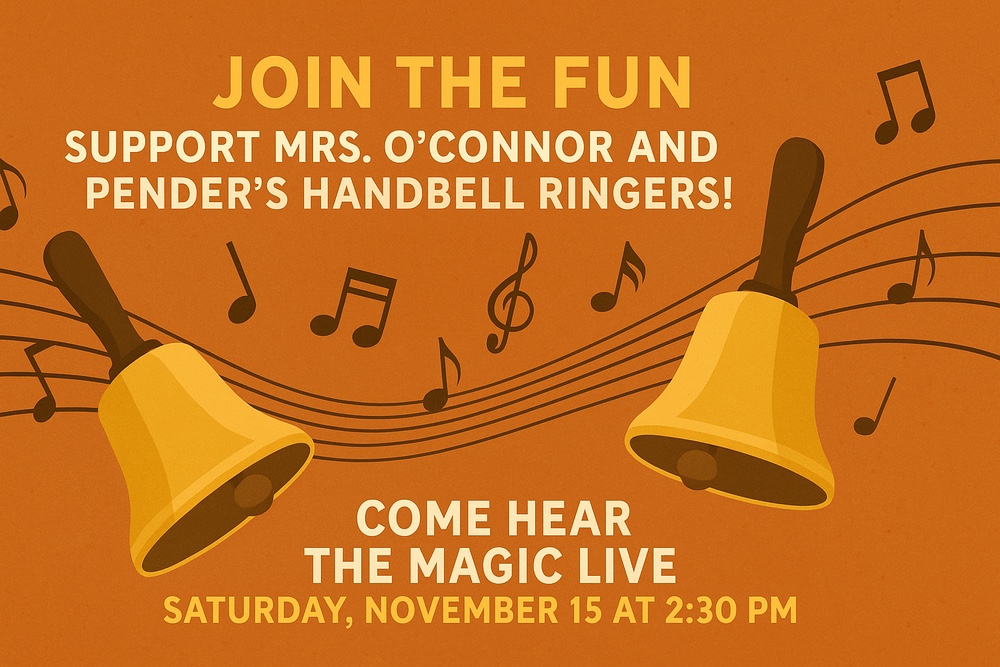
On November 14–15, Pender’s Carillon and Joy Ringers, directed by Brian Stevenson, will attend a local Handbell Festival alongside ten other handbell choirs for an unforgettable weekend of music.
🎵 Mrs. O’Connor will be performing in the final concert, and you’re invited to come hear the magic live at the free final concert on Saturday, November 15 at 2:30 PM!
✨ This festival, led by renowned composer and conductor Jason Krug, will fill the room with incredible energy and sound — imagine dozens of ringers creating beautiful harmonies together!
Bring your family and friends for an afternoon of breathtaking music, joyful community, and plenty of smiles. Let’s fill the audience with O’Connor Studio families and cheer on these amazing musicians! 💛
It’s going to be a spectacular experience you won’t want to miss!
. 1483 ~ Martin Luther, German religious reformer, composer of hymns and flutist
.1668 ~ François Couperin, French composer and organist
Read more about Couperin
.1888 ~ Fritz Kreisler, a 13-year-old violinist from Vienna, made his American debut in New York City.
.1900 ~ “Floradora” opened in New York City this day. The play was received by cheering audiences.
.1928 ~ Ennio Morricone, Italian composer/musician
.1939 ~ Muggsy Spanier and his band recorded Dipper Mouth Blues on Bluebird Records.
.1944 ~ Tim Rice, British author and librettist
Read more about Rice
.1956 ~ Billie Holiday returned to the New York City stage at Carnegie Hall after a three-year absence. The concert was called a high point in jazz history.
.1969 ~ “Can you tell me how to get … how to get to Sesame Street?” The classic, “Sesame Street” debuted on 170 Public Broadcasting stations and 20 commercial outlets. Created by the Children’s Television Workshop, the show starred endearing characters including Gordon, Susan, Bob, Bert, Ernie, the Cookie Monster, Oscar the Grouch and, of course, Big Bird!
.1986 ~ “Bruce Springsteen & The E Street Band Live/1975-85”, the long-anticipated album by ‘The Boss’, hit record stores this day. Fans made the LP a one~day sellout, buying over a million copies and generating more first-day dollars than any record in 30 years. It’s a five-disc, 40-song set.
.1993 ~ “Joseph and the Amazing Technicolor Dreamcoat” opened at Minskoff Theater in New York for 223 performances
.1994 ~ Carmen McRae passed away
.2014 ~ “Uptown Funk” single released by Bruno Mars (Billboard Song of the Year 2015, Grammy Record Of The Year, Grammy Song of the Year 2016)
.2015 ~ Allen Toussaint passed away. He was a New Orleans-based pianist, songwriter and Rock and Roll Hall of Famer.
.2015 ~ Robert Lawson Craft died. He was an American orchestral conductor, scholar and writer. Mr. Craft spent nearly a quarter-century as Stravinsky’s amanuensis, rehearsal conductor, musical adviser, globe-trotting traveling companion and surrogate son. After Stravinsky’s death in 1971, at 88, he was a writer, lecturer, conductor, public intellectual and keeper of the Stravinskian flame.


 Grammy winner


 MaryO'Studio