May 16 in Music History

today

• 1813 ~ Stephen Heller, Hungarian pianist, teacher and composer whose career spanned the period from Schumann to Bizet, and was an influence for later Romantic composers.

• 1892 ~ Richard Tauber (Ernst Seiffert), Austrian-born British tenor. He sang a wide range of music and was as equally at home in opera, notably Mozart, as in Austrian operetta.

• 1913 ~ Woody (Woodrow Charles) Herman, American jazz clarinetist, bandleader and composer

• 1922 ~ Eddie Bert, Jazz musician, trombone

• 1929 ~ The first Academy Awards were presented on this night, hosted by Douglas Fairbanks and William C. de Mille. This first awards ceremony of the Academy of Motion Picture Arts and Sciences was held at the Hollywood Roosevelt Hotel in Los Angeles. It attracted an audience of 200 people.

• 1929 ~ Paul Whiteman and his orchestra backed Bing Crosby for the tune, Sposin’, which ‘Der Bingle’ recorded for Columbia Records. Betty Carter (Lillie Mae Jones) (1930) Jazz singer: toured with Lionel Hampton & Miles Davis

• 1946 ~ The Irving Berlin musical, Annie Get Your Gun, at New York’s Imperial Theatre. Once of the most successful shows presented on a Broadway stage, the show ran for 1,147 performances.

• 1947 ~ Barbara Lee, Singer with The Chiffons

• 1947 ~ Darrel Sweet, Drummer, singer

• 1953 ~ Bill Haley and His Comets made it to the Billboard music charts for the first time with Crazy Man Crazy. The tune went to number six and became the first rock ’n’ roll record to make the pop music chart.

• 1965 ~ The Roar of the Greasepaint, The Smell of the Crowd, a Broadway musical starring Anthony Newley, made its premiere at the Shubert Theatre in New York City. Cyril Ritchard appeared in the production which entertained audiences for 231 performances.

• 1966 ~ Janet Jackson, Singer

• 1990 ~ Jim Henson, the famous creator who of the Muppets, a cast of puppets including Kermit the Frog, Big Bird, Elmo, Ernie and Bert, died at the age of 54.

• 1990 ~ The entertainer who could do it all, Sammy Davis, Jr., died this day, in Beverly Hills, California, USA. From vaudeville at age three (with his father and uncle) to the star of Broadway’s “Mr. Wonderful”, from Las Vegas nightclubs to hit records, the actor, singer, dancer, impersonator, and musician performed his way into the hearts of young and old everywhere. The world mourned the passing of Sammy Davis, Jr. at age 64 of throat cancer.

• 1993 ~ Marv Johnson passed away.  He was an American R&B and soul singer.

• 1995 ~ Lola Flores, fiery Spanish dancer and singer, died. She made many films but was best known for her flamenco movements and passionate songs.

May 14 in Music History

today

• 1885 ~ Otto Klemperer, German conductor, In his early career he championed modern works.

• 1916 ~ Skip (Lloyd) Martin, Bandleader, composer, arranger

• 1917 ~ Norman Luboff, Choral leader, The Norman Luboff Choir

• 1925 ~ Patrice Munsel, Soprano, Metropolitan Opera diva at age 17; actress in The Great Waltz, Melba; radio performer: The Great Sopranos – Voices of Firestone Classic Performances; radio host: The Patrice Munsel Show

• 1925 ~ Al Porcino, Jazz musician, trumpet

• 1936 ~ Bobby Darin (Cassotto), Grammy Award-winning singer, inducted into Rock and Roll Hall of Fame in 1990

• 1937 ~ Duke Ellington and his band recorded the classic, Caravan, for Brunswick Records.

• 1943 ~ Jack Bruce, Musician: bass with the group Cream

• 1943 ~ Derek Leckenby, Guitarist with Herman’s Hermits

• 1944 ~ Troy Shondell, Singer

• 1945 ~ Gene Cornish, Guitarist with The Young Rascals

• 1952 ~ David Byrne, American rock composer, singer, American rock composer, performance artist and movie director

• 1957 ~ The musical, New Girl in Town, opened at the 46th Street Theatre in New York City. Thelma Ritter and Gwen Verdon starred in the Broadway adaptation of Eugene O’Neill’s Anna Christie. New Girl in Town had a run of 431 performances.

1959 ~ “President Dwight D. Eisenhower broke ground for Lincoln Center at the site of Avery Fisher Hall, then named Philharmonic Hall. Musicians representing the Lincoln Center constituents participated: Leonard Bernstein led the New York Philharmonic and the Juilliard Chorus (Frederick Prausnitz, director), and Leonard Warren and Risë Stevens (Juilliard Graduate School ’36, voice), both of The Metropolitan Opera, performed excerpts from I Pagliacci and Carmen.” ~Jeni Dahmus, archivist at The Juilliard School

• 1971 ~ The Honey Cone received a gold record for the single, Want Ads. The female soul trio was formed in Los Angeles in 1969 and scored two million-sellers, Want Ads and Stick Up. The trio had a total of four songs on the charts that were moderate hits. Only Want Ads, however, made it to the number one position.

• 1971 ~ Danny Wood, Singer with New Kids on the Block

• 1998 ~ Frank Sinatra, one of the world’s greatest popular singers, died.

• 2001 ~ Loften Mitchell, a Tony Award-nominated playwright and early leader of the black theater movement, died at the age of 82. Mitchell was nominated for a Tony Award in 1976 for his book for the musical “Bubbling Brown Sugar,” a performance of black music and dance. He also wrote “A Land Beyond the River,” “Star of the Morning,” and the books “Voices of the Black Theater” and “Black Drama.” For many years he taught at the State University of New York at Binghamton, and he was the recipient of a Guggenheim Fellowship and a grant from the Rockefeller Foundation.

• 2003 ~ Otto Edelmann, whose dark bass-baritone propelled him to some of the world’s most renowned opera stages over a career spanning more than four decades, died. He was 86. Edelmann was often associated with masterful performances as Ochs in “Der Rosenkavalier,” and Hans Sachs in “Die Meistersinger von Nuernberg.” With his powerful voice, Edelmann was a favorite choice for Wagnerian roles. Edelmann trained at the Vienna Music Academy, now the Vienna University for Music and Performing Arts, under coaches including Gunnar Graarud. After a 1937 debut as Figaro in Gera, Germany, he sang in Nuremberg until 1940, when he was drafted into Hitler’s army. Captured by the Soviets, he spent several years as a prisoner of war. Edelmann’s postwar debut at the Vienna State Opera, as the hermit in “Der Freischuetz” in 1947, was the first of a 36-year engagement in the Austrian capital that included 430 performances in 36 different roles. He also was a regular for decades at the Salzburg Festival and other annual music events across Europe. Edelmann later turned increasingly to teaching, and in 1982 was appointed singing professor at the Vienna Music Academy.

•  B.B. King, “the King of the Blues,” whose stinging guitar solos and husky, full-throated vocals made him an international music icon and the most commercially successful performer in blues history, died at the age of 89.

May 13 in Music History

today

OCMS 1842 ~ Sir Arthur Seymour Sullivan, British composer, best known for his comic operettas
Read quotes by and about Sullivan
More information about Sullivan

• 1868 ~ Composer Gioacchino Rossini died. He was was very superstitious. He particularly feared Friday the thirteenth. And here’s an incredible fact: he died on Friday the thirteenth, 1868!

• 1911 ~ Maxine Sullivan (Marietta Williams), Singer

• 1912 ~ Gil Evans, Canadian jazz pianist, composer, arranger and bandleader

• 1914 ~ Johnny ‘Johnnie’ Wright, Country singer: duo: Johnnie and Jack, married to singer Kitty Wells since 1937

• 1938 ~ Louis Armstrong and his orchestra recorded the New Orleans jazz standard, When the Saints Go Marching In, on Decca Records.

• 1941 ~ Ritchie Valens (Richard Steven Valenzuela), Singer
More about Valens

• 1943 ~ Mary Wells, Singer

• 1946 ~ Danny Klein, Musician, bass with The J. Geils Band

• 1950 ~ Stevie Wonder, American rock singer, songwriter and instrumentalist.   A child prodigy who developed into one of the most creative musical figures of the late 20th century. Wonder who has been blind from shortly after birth, signed with Motown’s Tamla label at the age of eleven and continues to perform and record for Motown to this day. Wonder has scored over 40 other US & UK Top 40 singles.
More information about Wonder

• 1954 – The Pajama Game made its debut on Broadway in New York City at the St. James Theatre. Harold Prince produced The Pajama Game, his first Broadway endeavor. The show ran for 1,063 performances. John Raitt and Janis Paige starred in the leading roles. Carol Haney came to national fame for her rendition of the song, Steam Heat. The movie version also starred Raitt — along with Doris Day.

• 1971 ~ Aretha Franklin, the ‘Queen of Soul’, received a gold record for her version of Bridge over Troubled Water, originally a Paul Simon and Art Garfunkel tune.

• 1984 ~ The Fantasticks, playing at the Sullivan Theatre in Greenwich Village in New York City, became the longest-running musical in theatre history with performance number 10,000 on this night. The Fantasticks opened on May 3, 1960.

May 11 in Music History

today

• 1885 ~ Joseph “King” Oliver, American jazz cornetist and bandleader

• 1888 ~ Irving Berlin, Russian-born American songwriter and lyricist
More information about Berlin
Grammy winner

• 1894 ~ Martha Graham, Modern dancer: Denishawn dance school and performing troupe, Graham company, established school of modern dance at Bennington College; choreographer

• 1895 ~ William Grant Still, American composer
More information about Still

• 1927 ~ The Academy of Motion Picture Arts and Sciences was founded; although the first Oscars were not presented for several years after its founding.

• 1931 ~ Dick Garcia, Guitarist

• 1941 ~ Eric Burdon, Singer with The Animals

• 1943 ~ Les (John) Chadwick, Bass with Gerry & The Pacemakers

• 1965 ~ Liza Minnelli opened in Flora the Red Menace. The musical ran for only 87 performances at the Alvin Theatre.

• 1970 ~ The Chairmen of the Board received a gold record for the hit, Give Me Just a Little More Time. The Detroit group recorded three other songs in 1970, with moderate success.

• 1979 ~ Lester Flatt passed away.  He was a bluegrass guitarist and mandolinist, best known for his collaboration with banjo picker Earl Scruggs in the The Foggy Mountain Boys.

• 2000 ~ Zydeco trumpeter Warren Ceasar, who recorded three solo albums and performed with the legendary Clifton Chenier, died of a brain aneurysm. He was 48. Ceasar, who was born and raised in Basile, was the nephew of the late internationally known fiddler, Canray Fontenot. In addition to his role as frontman for Warren Ceasar and the Zydeco Snap Band, Ceasar also played with Clifton Chenier, who is known as “The Grandfather of Zydeco.” Ceasar also performed with soul greats Isaac Hayes and Al Green.

May 6 in Music History

today

•  1833 ~ Johannes Brahms, German composer
More information about Brahms

• 1840 ~ Piotr Ilyich Tchaikovsky, Russian composer
Listen to Tchaikovsky’s music
Read about Tchaikovsky
Read quotes by and about Tchaikovsky
More information about Tchaikovsky

• 1919 ~ Eva (Evita) Peron, Argentina’s spiritual leader and wife of Argentina’s President, Juan Peron; actress on stage, film and radio; subject of the Broadway musical and film Evita

• 1927 ~ Elisabeth Söderström, Swedish soprano

• 1931 ~ Teresa Brewer (Breuer), Singer

• 1941 ~ Glenn Miller and his Orchestra recorded one of the great American music standards, Chattanooga Choo Choo
More information about Chattanooga Choo Choo

• 1942 ~ Felix Weingartner, Austrian conductor and composer, died; best known for his interpretations of Wagner and Beethoven.

• 1958 ~ Pianist Van Cliburn signed an artist’s contract with RCA Victor Records.

• 1966 ~ The Mamas & The Papas made the climb to the top of the Billboard pop music chart with Monday, Monday.

• 1995 ~ Ray McKinley passed away.  He was an American jazz drummer, singer, and bandleader.

• 2002 ~ Buster Brown, a tap star and choreographer who danced on stage, in films and on television, died. He was 88. Brown was one of the last surviving members of the Copasetics, a legendary group of veteran dancers who performed together. Known for his quick rhythms and charm, Brown was a mentor and teacher for a younger generation of dancers. Brown, who was born James Brown in Baltimore, began his dancing career with a trio called the Three Aces and Speed Kings. He eventually began a solo career, appearing in the Hollywood musical “Something to Shout About” in 1943. Brown toured with the bands of Count Basie, Dizzy Gillespie and Duke Ellington, and was a featured dancer in Ellington’s concerts in the 1960s. He danced in the films “The Cotton Club” and “Tap” and on two public television specials. He also performed with the original casts of the Broadway musicals “Bubbling Brown Sugar” and “Black and Blue.” Brown toured South America with the Cab Calloway Orchestra and was commissioned by the State Department to perform in several African counties. He also taught master classes throughout Europe. Beginning in 1997, Brown was master of ceremonies at a weekly Sunday tap jam at the Manhattan club Swing 46, where young and old dancers stopped by to perform. He recently received an honorary doctorate from Oklahoma City University.

May 2 in Music History

today

• 1660 ~ Alessandro Scarlatti, Italian composer
More information about Alessandro Scarlatti

• 1895 ~ Lorenz Hart, American lyricist and librettist
More information about Hart

• 1901 ~ Bing Crosby, American actor and singer of popular music

• 1924 ~ Theodore Bikel, Entertainer, singer, actor

• 1938 ~ Ella Fitzgerald recorded one of her biggest hits, A-Tisket, A-Tasket, with Chick Webb’s band. Following Webb’s death, Fitzgerald took over the band for some three years.

• 1939 ~ “Peter and the Wolf” first heard in Moscow.

• 1946 ~ Leslie Gore, Singer

• 1960 ~ Harry Belafonte presented his second Carnegie Hall concert in New York City.

• 1965 ~ Ed Sullivan had said he would not have this British rock group on his CBS- TV Sunday night show again. This night, however, Ed softened up — and allowed Mick Jagger and the Rolling Stones to make a second appearance on The Ed Sullivan Show.

• 1985 ~ Larry Clinton passed away.  He was a trumpeter who became a prominent American bandleader and arranger.

• 2001 ~ Robert McKinley “Uncle Bob” Douglas, a renowned mountain fiddler who debuted at the Grand Ole Opry at age 100 last year, died of pneumonia. He was 101. He was scheduled to receive the state’s highest arts award, the Governor’s Folklife Heritage Award, on May 15 at Nashville’s Ryman Auditorium. Douglas, a retired steamfitter who never pursued a lucrative commercial career, won the Smithsonian Institution’s national fiddling contest in 1975 and performed at the 1982 World’s Fair in Knoxville.

• 2003 ~ George Wyle, 87, who wrote the theme song to “Gilligan’s Island,” the Christmas classic “The Most Wonderful Time of the Year” and more than 400 other songs, died. “The Ballad of Gilligan’s Island,” which he wrote with the show’s creator and producer, Sherwood Schwartz, became one of the most popular television theme songs. The show debuted on CBS in 1964 and ran until 1967, and its reruns have remained popular. The New York native moved to Los Angeles in 1946 to write and conduct music for “The Alan Young Radio Show.” He went on to work as choral director for television shows including “The Dinah Shore Show,” “The Jerry Lewis Show” and “The Andy Williams Show.” He also handled music for specials by magician David Copperfield and Carol Channing and for the People’s Choice Awards presentations.

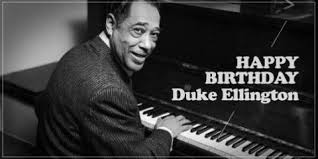
Duke Ellington’s Birthday

ellington-bd
Duke Ellington (1899 to 1974) was a composer, bandleader, and pianist. He was born Edward Kennedy Ellington in Washington, D.C.

From an early age, the handsome, sharply dressed teenager (that’s where he got the nickname, Duke) was headed for success. At first it was art. He won a poster-design contest and an art scholarship, left school and started a sign-painting business. But it was his natural piano-playing ability that attracted the young women, so Duke Ellington headed in that direction. He developed his keyboard skills by listening to local black ragtime pianists; he composed his first piece, Soda Fountain Rag, around 1915. A successful professional musician by the early 1920s, he left Washington in the spring of 1923 for New York, which was his home base for the rest of his life. Between December 1927 and 1931 his orchestra held forth at Harlem’s Cotton Club, where regular radio broadcasts, together with an active recording schedule, helped him establish a nationwide reputation. Take the “A” Train was his “signature song”.

In such compositions as Black and Tan Fantasy (1927), Mood Indigo (1930),Solitude (1934), and Echoes of Harlem (1935), Ellington emerged as a distinctive composer for his ensemble, employing the rhythms, harmonies, and tone colors of jazz to create pieces that vividly captured aspects of the African-American experience. At the same time, he sought to broaden jazz’s expressive range and formal boundaries in such extended works asReminiscing in Tempo (1935), Black, Brown, and Beige (1943), and Harlem(1951).

An essential feature of Ellington’s composing method was to write with specific instrumentalists in mind, often drawing them into the creative process by building entire pieces out of their musical ideas.

He wrote scores for big band pieces, film scores, operas, ballets, Broadway shows, gospel music, musicals, films, television, and ballet and in the 1960s produced a series of sacred concerts combining his orchestra, choirs, vocalists, and dancers. He would work with each section of his orchestra as an entity unto its own and then bring them together to create the unique sounds such as, Mood Indigo. Over 1,000 musical pieces are credited to the great Duke Ellington. James Lincoln Collier studied the Duke and his Orchestra, comparing Duke Ellington to a “master chef who plans the menus, trains the assistants, supervises them, tastes everything, adjusts the spices … and in the end we credit him with the result.”

Ellington was successful, as few others have been, in reconciling the practical function of a popular entertainer with the artistic aspirations of a serious composer. His rich legacy consists of hundreds of recordings, his many pieces that have entered the standard repertory, and his musical materials now preserved in the Duke Ellington Collection at the Smithsonian Institution. There is a statue of Duke Ellington in New York.

 Ellington’s birthday

 anniversary of Ellington’s death

Ellington’s works were played in an Grammy Winning performance, Forty-Second Annual Awards

Read quotes by and about Ellington

 News Item about Ellington

April 29 in Music History

today


OCMS 1879 ~ Sir Thomas Beecham, English conductor. Founded the Royal Philharmonic Orchestra in 1947 and did much to promote the works of Delius, Sibelius and Richard Strauss.
Read quotes by and about Beecham

. 1895 ~ Sir Malcolm Sargent, English conductor, born. He was in charge of the Liverpool Philharmonic Orchestra from 1942 until 1948 and of the BBC Symphony Orchestra from 1950 until 1957.

OCMS 1899 ~ Duke Ellington, American jazz pianist, bandleader and composer
Read quotes by and about Ellington
More information about Ellington
Grammy winner

. 1913 ~ Donald Mills, Singer with The Mills Brothers.

. 1925 ~ Danny Davis (George Nowland), Grammy Award-winning bandleader with Danny Davis and the Nashville Brass. Best Country Instrumental Performance in 1969, Country Music Awards Instrumental Group of the Year 1969 to 1974

. 1927 ~ Carl Gardner, Singer with The Coasters

. 1931 ~ (Anthony James) Lonnie Donegan, Folk singer, musician: guitar, banjo

. 1933 ~ Rod McKuen, Singer, poet-song writer

. 1936 ~ Zubin Mehta, Indian conductor, Los Angeles Philharmonic Orchestra, and violinist

. 1936 ~ April Stevens (Carol Lo Tempio), Singer

. 1943 ~ Duane Allen, Singer with the Oak Ridge Boys

. 1947 ~ Tommy James (Jackson), Singer with Tommy James and The Shondells

. 1949 ~ Francis Rossi, Musician, guitar and singer with Status Quo

. 1968 ~ Hair made its way from Greenwich Village to Broadway. The show certainly opened eyes. It was the first time that actors appeared nude in a Broadway musical. Hair ran for 1,844 shows on and off Broadway. It was even more successful in its London run later. Big songs from the show: Hair (The Cowsills) and Aquarius/Let the Sunshine In (The 5th Dimension).

. 1969 ~ Sir Duke, Duke Ellington, celebrated his 70th birthday. He was honored with the presentation of the Medal of Freedom, the U.S. government’s highest civilian honor.

. 2001 ~ Opera diva Rita Nellie Hunter, a powerful soprano celebrated for her fine Wagnerian performances, died at the age of 67. Hunter, originally from Wallasey, England, was best remembered as the quintessential Brunnhilde of Wagner’s “Ring” cycle, which she performed in London, New York, Germany and Sydney. Hunter’s agile voice led her through performances of Verdi’s “Aida,” and “Macbeth,” Puccini’s “Turandot” and Strauss’ challenging “Elektra.” Despite her remarkable voice, Hunter did not reach international stardom. Her physical size, at a time when the opera was seeking slimmer performers, and the fact that she sang roles primarily in English, kept her from achieving global fame. Hunter married tenor John Darnley Thomas in 1960, and after his death in 1994, took over management of his Singing Academy in Sydney.

April 22 in Music History

today

. 1858 ~ Dame Ethel Smyth, British composer

. 1912 ~ Kathleen Ferrier, British contralto singer, born. Best known for her emotional performances of Gustav Mahler’s “Das Lied von der Erde” (“Song of the Earth”).

OCMS 1916 ~ Yehudi Menuhin, American violinist
Read quotes by and about Menuhin
More information about Menuhin

. 1921 ~ Candido (Camero), Musician: bongos, congas, tres, bass: over 100 recording credits with famous jazz, Latin and R&B artists

. 1922 ~ Charles Mingus, American jazz double-bass player, pianist, composer and bandleader

. 1936 ~ Glen Campbell, Grammy Award-winning singer

. 1940 ~ The first all-Chinese commercial radio program was broadcast over KSAN radio in San Francisco, CA. Later, KSAN would become a pioneer in playing ‘underground rock’ music.

. 1943 ~ Mel Carter, Singer

. 1950 ~ Peter Frampton, Singer, guitarist

. 1956 ~ Elvis Presley made his Las Vegas debut on this night at the Frontier Hotel. With Heartbreak Hotel at the top of the pop charts, one can imagine the excitement generated by the new ‘King of rock and roll’. Even with a number one hit, Elvis was not yet well-received by the middle-aged audience. Management of the Frontier was so unimpressed, they gave Elvis his walking papers after one week of a two-week engagement.

. 2001 ~ Jazz pianist-composer Isaac Cole, brother of the late singer Nat King Cole who worked on his niece Natalie’s multiple Grammy-winning 1991 album, died of cancer. He was 73. Ike Cole said he may have benefited from being compared with his more famous brother, who died in 1965 of lung cancer at 45, but that he disliked being accused of “trying to live off the name.” Ike Cole said he decided against changing his name because, shortly before dying, Nat asked him not to. He and brother Freddy toured in 1990 with a show saluting their famous brother. Ike Cole had played a bass drum in an Army band but in 1957, he formed the Ike Cole Trio in Chicago, where he was born, and went on the road. Winning major TV exposure, he soon was booked steadily for Las Vegas shows. His trio also regularly toured Japan, Australia and Europe as well as the United States. Though he often sang a medley of his older brother’s hits, Ike primarily was a jazzman. He played keyboard when Natalie Cole recorded her late father’s songs for a 1991 album that won three Grammys.

April 21 in Music History

today

. 1880 ~ Estelle Liebling, American soprano

. 1899 ~ Randall Thompson, American composer

. 1920 ~ Bruno Maderna, Italian-born German conductor and composer

. 1924 ~ Don Cornell (Louis Varlaro), Singer

. 1924 ~ Clara Ward, Gospel singer, Clara Ward Gospel Troupe

. 1931 ~ Carl Belew, Country singer

. 1947 ~ Iggy Pop (James Newell Osterburg), Singer, songwriter, with the Psychedelic Stooges

. 1963 ~ The Beatles and The Rolling Stones met for the first time together, at the Crawdaddy Club in Richmond, England. The Stones opened show.

. 1977 ~ Annie opened on Broadway at the Alvin Theatre. Andrea McArdle was a shining star in the title role. Annie continued on the Great White Way until January 2, 1983.

. 2016 ~ Prince Rogers Nelson died.  He was known by the mononym Prince, was an American singer, songwriter, multi-instrumentalist, record producer, and actor. Prince was renowned as an innovator, and was widely known for his eclectic work, flamboyant stage presence, and wide vocal range.