March 20 ~ This Day in Music History

. 1812 ~ Jan Ladislav Dussek died.  He was a Czech composer and pianist.

. 1828 ~ Henrik Ibsen, Norwegian playwright. He wrote Peer Gynt, which Grieg later set to music.

. 1890 ~ Lauritz Melchior, Danish-born American tenor
More information about Melchior

. 1890 ~ Beniamino Gigli, Italian operatic tenor, born; with a repertory of over 60 roles, he retired in 1955 after over 40 years singing.

. 1907 ~ Ozzie Nelson, Bandleader, actor in The Adventures of Ozzie and Harriet. He was married to actress, Harriet Nelson and they were the parents of David and Ricky Nelson.

. 1915 ~ Sviatoslav Richter, Russian pianist
More information about Richter

. 1917 ~ Dame Vera Lynn, English singer and sweetheart of British forces during World War Two

. 1920 ~ Marian McPartland, British jazz pianist
More information about McPartland

. 1936 ~ Benny Goodman and his orchestra recorded Christopher Columbus on Victor Records in Chicago, IL.

. 1948 ~ Eugene Ormandy and the Philadelphia Symphony Orchestra were featured in the first televised symphonic concert. CBS-TV, with help from its then Philadelphia television station, WCAU-TV 10, carried the program from the Philadelphia Academy of Music, the home of the world- famous orchestra. The concert was televised live, at 5 p.m.

Ninety minutes later, NBC-TV carried TV’s second symphonic concert. This one was from Carnegie Hall in New York City. Arturo Toscanini and the NBC Symphony Orchestra was featured in a presentation of Wagner compositions.

. 1969 ~ Beatle John Lennon married Yoko Ono at the Rock of Gibraltar on this day. Lennon called the location, “quiet, friendly and British.” He was the second Beatle to marry in eight days. Paul McCartney and Linda Eastman were wed a week earlier.

March 17 ~ This Day in Music History

Happy Saint Patrick’s Day


. 1884 ~ Joseph Bonnet, French organist and composer.  He founded the organ department at the Eastman School of Music during his time in the U.S.

. 1901 ~ Alfred Newman, Conductor
More information about Newman

. 1917 ~ Nat “King” Cole, American jazz singer and pianist
More information about Cole

. 1930 ~ Paul Horn, American jazz flutist, saxophonist, clarinetist and composer
More information about Horn

. 1938 ~ Rudolf Nureyev, Dancer
More information about Nureyev

. 1944 ~ John Lill CBE, English classical pianist

. 1944 ~ John Sebastian, American pop-rock singer songwriter and guitarist, His group, The Lovin’ Spoonful performed Do You Believe In Magic, Summer In The CityDaydream, You Didn’t Have to be So Nice, Nashville Cats His solos include Darling Be Home Soon and Welcome Back

Happy Pi Day!

pi-day

Pi Symphony: The Ruse Performance Movement I.

Pi Symphony orchestral performance in Ruse, Bulgaria, Nov. 19th, 2010

The melodies and rhythms are based on the numbers of π (3.14159…etc), which describes the ratio of a circle’s circumference to its diameter.

To read more about how this came to be written, see http://www.pisymphony.com/gpage.html


There is also another work based on π called What pi sounds like

Today is pi day, and to celebrate, we bring you a musical representation of π, to 31 decimal places, at 157 beats per minute (which, incidentally, is 314 divided by two).

For more information about this work, please see A musical interpretation of pi


Finally, 18 Wheels on a Big Rig, includes a  verse in which they divide the wheels by π.

Enjoy your Pi Day! pi-day-pie

March 10 ~ This Day in Music History

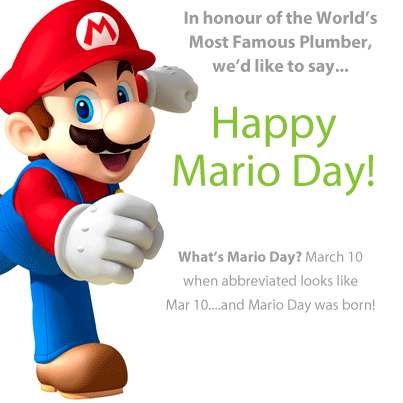
mario-day

National Mario Day is observed each year on March 10th and honors Mario from the popular Nintendo game.
It is celebrated on March 10th because of the way the date appears, when abbreviated (Mar.10),  it looks just like the name Mario.

. 1832 ~ Muzio Clementi died.  He was an Italian-born English composer, pianist, pedagogue, conductor, music publisher, editor, and piano manufacturer.  He is also the subject of this month’s Piano Explorer, which is enjoyed by my students.

. 1844 ~ Pablo de Sarasate, Spanish violinist

. 1879 ~ Ignaz Moscheles died.  He was a Bohemian composer and piano virtuoso

. 1892 ~ Arthur Honegger, French composer
Read quotes by and about Honegger
More information about Honegger

1903 ~ “Bix” Beiderbecke, American jazz cornetist
More information about Beiderbecke

. 1935 ~ Nelson Eddy recorded Ah! Sweet Mystery of Life for Victor Records. The song came from the film, “Naughty Marietta”. Later, Eddy recorded the classic tune with Jeanette MacDonald.

. 1937 ~ An audience of 21,000 jitterbuggers jammed the Paramount Theatre in New York City to see a young clarinetist whom they would crown, ‘King of Swing’ on this night. The popular musician was Benny Goodman.

. 1940 ~ W2XBS-TV in New York City originated the first televised opera as members of the Metropolitan Opera Company presented scenes from “I Pagliacci”.

. 1956 ~ Julie Andrews was 23 years old this night when she made her TV debut. She appeared with Bing Crosby and Nancy Olson in the musical adaptation of Maxwell Anderson’s play, “High Tor”.

. 2003 ~ Lionel Dakers, who directed the Royal School of Church Music for 16 years, died at age 79. Dakers was a stickler for high musical standards and opposed some of the modernizing trends in English church music. Dakers was organist at Ripon Cathedral from 1954 to 1957, then moved to Exeter Cathedral before his appointment as director of the Royal School of Church Music in 1972. In 1976, he was appointed a director of Hymns Ancient & Modern, publisher of some of the most widely used Anglican hymnals.

. 2016 ~ Keith Emerson died.  He was an English keyboardist and composer.

Piano Maestro – New Easter Song

pm-easter


There’s an “egg-citing” new song release in Piano Maestro so students can play more Easter themed songs!

“This Is Amazing Grace” by Phil Wickham has just been added! It can be found in the Holiday (Easter) category in the Library in three different versions – easy, melody line and a nice 2 hand version!

Enjoy!

If This Had Been a Leap Year

Leap-Year-2016

. 1792 ~ Gioachino Rossini, Italian composer
Read quotes by and about Rossini
More information about Rossini

. 1898 ~ Wladimir Rudolfovich Vogel, Russian-born Swiss composer

. 1904 ~ Jimmy Dorsey, American clarinetist, bandleader and saxophonist

. 1916 ~ Dinah (Frances Rose) Shore, Emmy Award-winning singer and entertainer

. 1932 ~ Bing Crosby and the Mills Brothers teamed up to record Shine for Brunswick Records.

. 1936 ~ Fanny Brice brought her little girl character “Baby Snooks” to radio on “The Ziegfeld Follies of the Air” on CBS Radio. Miss Brice presented the character and later sang My Man on the program. She was 44 at the time, and was known as America’s “Funny Girl” long before Barbra Streisand brought her even greater fame and notoriety nearly 30 years later.

. 1964 ~ The United States was in the grip of Beatlemania! I Want to Hold Your Hand, by the lads from Liverpool, was in its 5th week at #1 on the pop charts. It stayed there until March 21, when it was replaced by She Loves You, which was replaced byCan’t Buy Me Love, which was finally replaced by Hello Dolly, by Louis Armstrong, on May 9, 1964. 14 straight weeks of #1 music by The Beatles!

Musical Quotes – from Presidents

presidents-day

“The future of our nation depends on providing our children with a complete education that includes music.”

– Gerald Ford

“The future belongs to young people with an education and the imagination to create.”

Barack Obama

“The Arts and Sciences, essential to the prosperity of the State and to the ornament of human life, have a primary claim to the encouragement of every lover of his country and mankind.”

George Washington

“I must study politics and war, that my sons may study mathematics and philosophy…in order to give their children the right to study painting, poetry, music and architecture.”

John Q. Adams

“Aeschylus and Plato are remembered today long after the triumphs of Imperial Athens are gone. Dante outlived the ambitions of thirteenth century Florence. Goethe stands serenely above the politics of Germany, and I am certain that after the dust of centuries has passed over cities, we too will be remembered not for victories or defeats in battle or in politics, but for our contribution to the human spirit.”

John F. Kennedy

“Music education opens doors that help children pass from school into the world around them – a world of work, culture, intellectual activity, and human involvement. The future of our nation depends on providing our children with a complete education that includes music.”

– Gerald Ford

“Music is about communication, creativity, and cooperation, and by studying music in schools, students have the opportunity to build on these skills, enrich their lives, and experience the world from a new perspective.”

– Bill Clinton

“Education is not the means of showing people how to get what they want. Education is an exercise by means of which enough men, it is hoped, will learn to want what is worth having.”

Ronald Reagan

Music “brings us together, helping us reflect upon who we are, where we have come from, and what lies ahead.” The Arts and Music transcend “languages, cultures, and borders.” … “exchange ideas and styles and share in the artistic vibrancy born from diverse experiences and traditions.

– President Obama in a 2010 message to the World Choir Games in Shaoxing, China

Millions of Americans earn a living in the arts and humanities, and the non-profit and for-profit arts industries are important parts of both our cultural heritage and our economy…. We must recognize the contributions of the arts and humanities not only by supporting the artists of today, but also by giving opportunities to the creative thinkers of tomorrow. Educators across our country are opening young -minds, fostering innovation, and developing imaginations through arts education.

– White House Proclamation, National Arts and Humanities Month 2014

“In a lot of the poorest countries we’re trying to help, the level of violence is a continuous undercurrent…There’s an enormous amount of evidence that giving people an opportunity for creative expression improves their ability to learn in school and increases their ability and desire to navigate life in a positive rather than a negative way.” Music “taught me discipline and teamwork on the one hand and the importance of creativity.”

The THEA Foundation in Arkansas has proved the merits of including art instruction in the schools.

Clinton said:

“Every place they’ve done this program, you see a reduction in the dropout rate and an increase in the academic performance of the young people. Having strong arts instruction supports learning in a very substantial way.”

-Bill Clinton in an interview with Patrick Cole at the 2011 Clinton Global Initiative

Adapted from http://www.nafme.org/the-most-musical-united-states-presidents/

Musical U.S. Presidents

presidents-day


Presidents’ Day (celebrated on the third Monday in February), was originally established in 1885 in recognition of George Washington. The holiday became popularly known as Presidents’ Day after it was moved as part of the 1971 Uniform Monday Holiday Act, an attempt to create more three-day weekends for the nation’s workers. Presidents’ Day is now popularly viewed as a day to celebrate all U.S. presidents past and present.

Wondering how many U.S. Presidents played musical instruments?

Thomas Jefferson (1743 – 1826) Third president of the United States, drafted the Declaration of Independence, and played the violin and cello.

John Quincy Adams (1767 – 1848) The sixth president of the United States formulated the Monroe Doctrine, and played the flute.

John Tyler (1790-1862) The tenth president of the United States was the first Vice President to become President by the death of his predecessor.  He played the violin.

Abraham Lincoln (1809-1865) The sixteenth president of the United States issued the Emancipation Proclamation and played the violin.

Ulysses S. Grant (1822- 1884) The eighteenth president of the United States certainly scrapes the bottom of the list. He was tone deaf and famously commented, “I only know two tunes. One of them is Yankee Doodle and the other isn’t.”

Chester Alan Arthur (1829 – 1886) Became the 21st president of the United States following the assassination of President James A. Garfield. He played the banjo.

Franklin Roosevelt (1882-1945) The 32nd President of the United States and the fifth cousin to President Theodore Roosevelt, played the piano and sang soprano in his school choir.

Woodrow Wilson (1856 – 1924) The 28th president of the United States and creator of the League of Nations, played the violin and sang tenor in his college glee club.

Warren Harding (1865-1923) The 29th president of the United States organized the Citizen’s Cornet Band, available for both Republican and Democratic rallies. He once remarked that, “I played every instrument but the slide trombone and the E-flat cornet.”

Calvin Coolidge (1872-1933) The 30th president of the United States was determined to preserve old moral and economic precepts amid American prosperity. He played the harmonica.

Harry Truman (1884 – 1972) The 33rd president of the United States who served during the conclusion of World War II, played the piano.

Richard Nixon (1913 – 1994) The 37th president of the United States, who ended American fighting in Vietnam and later resigned from office in the aftermath of the Watergate Scandal, was a classically-trained pianist and also played the accordion. He composed and played this piece, set to concerto form with “15 Democratic violinists.”  Nixon takes a dig at Harry Truman just before playing.:

Ronald Reagan (1911-2004) The 40th president of the United States implemented the Reagan Revolution, which aimed to reinvigorate the American people and reduce their reliance upon Government. He played the harmonica.

Bill Clinton (born 1946) The 42nd president of the United States and the first Democratic president since Franklin D. Roosevelt to win a second term, plays the saxophone.

Barack Obama (born 1961) The 44th president of the United States and first African American president has broken into song on several recent occasions. President Obama sang Amazing Grace at the funeral for South Carolina State Senator Clementa Pinckney:

February 20 ~ This Day in Music History

presidents-day


. 1803 ~ Friedrich Theodor Fröhlich, Swiss Composer

. 1937 ~ Nancy Wilson, American jazz singer

. 1941 ~ Buffy (Beverly) Sainte-Marie, Singer, songwriter, married to Jack Nitzsche

. 1940 ~ Christoph Eschenbach, German pianist and conductor

. 1940 ~ Larry Clinton and his orchestra recorded Limehouse Blues on Victor Records.

. 1946 ~ Sandy Duncan, Dancer, actress

. 1946 ~ J. (Jerome) Geils, Guitarist with The J. Geils Band

. 1950 ~ Walter Becker, Bass, guitarist with Steely Dan

. 1951 ~ Randy California (Wolfe), Singer, guitarist with Spirit

. 1963 ~ Ian Brown, Singer with Stone Roses

. 1974 ~ After a decade of marriage, Cher filed for separation from husband Sonny Bono. Not long afterwards, she filed for divorce and the accompanying alimony. This time she sang, I Got You Babe, for real … before becoming a successful solo singer and movie actress in films such as “Moonstruck” (Best Actress Oscar in 1987).

. 1975 ~ Brian (Thomas) Littrell, Singer with Backstreet Boys

. 1982 ~ Singer Pat Benatar married musician-producer Neil Geraldo in Hawaii.