Diwali is the Hindu festival of lights celebrated every year in autumn in the northern hemisphere (spring in southern hemisphere). One of the most popular festivals of Hinduism, it spiritually signifies the victory of light over darkness, good over evil, knowledge over ignorance, and hope over despair.
As per India’s official holiday calendar, Diwali in 2017 will be on October 19, coinciding with the 15th day of Kartik, the holiest month in the Hindu lunar calendar.
• 1938 ~ The Bob Crosby Orchestra recorded I’m Free for Decca. Billy Butterfield was featured on trumpet. A few years later, the song would be retitled, What’s New.
• 1939 ~ Benita Valiente, American soprano
• 1944 ~ Peter Tosh (Winston McIntosh), Singer, baritone and musician. He uses homemade instruments and performed reggae with Bob Marley
• 1944 ~ An actor who would become legend in scores of tough guy roles made his stage debut in New York. Marlon Brando appeared in the Broadway hit, “I Remember Mama”.
• 1945 ~ Jeannie C. Riley (Stephenson), Grammy Award-winning singer
• 1953 ~ Julius LaRosa, popular singer of the time, was unceremoniously fired on the air by Arthur Godfrey. “Julie lacks humility,” Godfrey told the stunned audience, while putting his arm around LaRosa. He said, “So, Julie, to teach you a lesson, you’re fired!”
• 1956 ~ Nino DeFranco, Singer with The DeFranco Family
• 1957 ~ Karl Wallinger, Musician, keyboards, guitarist with World Party
• 1959 ~ Twelve-year-old Patty Duke made her first Broadway appearance, in “The Miracle Worker”. The play would last for 700 performances and become a classic motion picture, launching Patty to fame and fortune.
Today, since it’s a “teaching day”, I’m thankful for my piano studio, my students, and my piano 🙂
When I was growing up, my dad was a minister, meaning we lived in whatever parsonage the church chose to let us live in. The one we had in Pawcatuck, CT had an upright piano that someone had put out in the sunroom. Not the best place for a piano, but I digress.
Since we had the piano already, someone – probably my mom – decided that I would take lessons. We had the organist from the Baptist church just across the river in Westerly, RI
Apparently, Clara Pashley was fondly remembered at the church (now Central Baptist Church) since she was mentioned in an article from 2010.
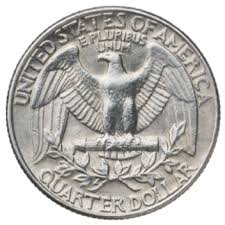
Miss Pashley walked to our house each week and taught me (and my mom who was always listening in) piano for the grand sum of 25 cents.
I started with Ada Richter’s classic Teaching Little Fingers to Play, which has now been morphed into the John Thompson library.
From there, it was the Michael Aaron series, and some sheet music.
There was no music store in our town, so I have no idea where any of this music came from – but I still have it all.
My parents did very well for their quarter a week investment, especially since my mom paid good attention and was able to beef up lessons she’d had as a child. Later on, she played well enough that she was church organist for a local Roman Catholic Church.
But I digress…
In those days, kids couldn’t do a whole lot of activities, so in 6th grade, I decided I wanted to be a Girl Scout. Bye, bye Clara.
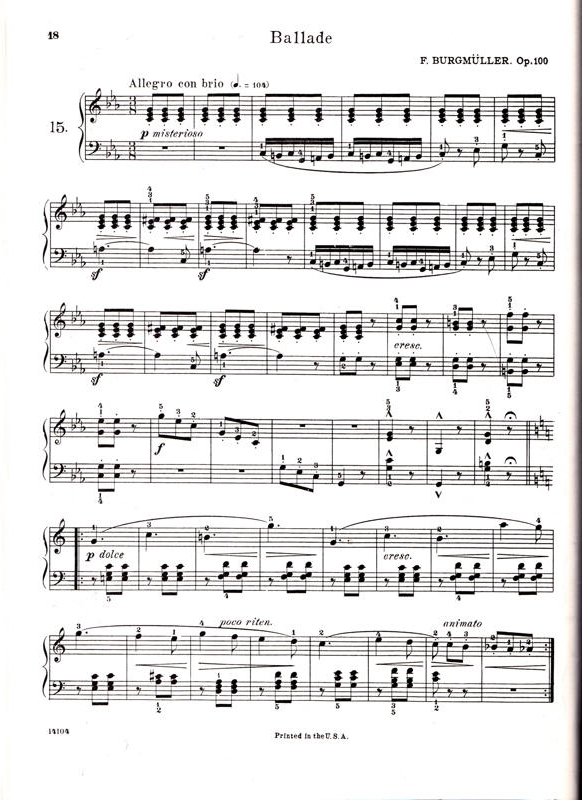
Girl Scouts didn’t last long but I did play piano in a talent show. I remember, I carefully cut Burgmüller’s Ballade out of my Michael Aaron book and made a nice construction paper cover. (I still have this, too)
I doubt that I played this well but here’s what it was supposed to sound like:
A few years intervened and we moved to Springfield, MA. The parsonage piano there was in terrible shape and in the dark, never-used basement. But I decided to make it mine and cleared up the area around it and started “practicing”.
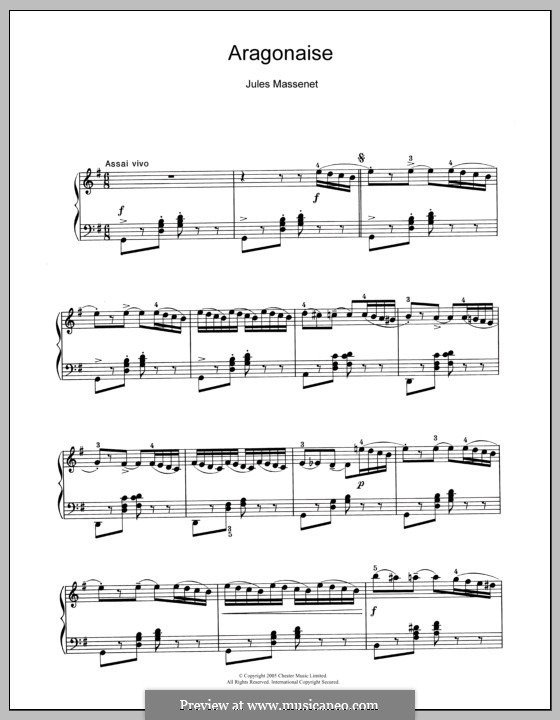
My Junior or Senior year of High School I decided I wanted to major in music in college. I decided to learn, on my own, a piano arrangement of Aragonnaise by Jules Massenet. I have no idea why or where that sheet music came from but I started working furiously on this piece.
Hopefully, at some point, it should have sounded like this:
I started pedaling (no pun intended!) my music to the Universities of Connecticut and Massachusetts and ended up at UMass Amherst since we were state residents.
Early morning gym classes (usually swimming), then wet hair traipsing across campus to music theory in winter 5 days a week. AARRGGH!
But I stuck it out.
My wonderful piano teacher, Howard Lebow, was killed in a car accident my sophomore year and I was devastated. There will be more about him in a post on January 26, 2018 here on https://oconnormusicstudio.com
I took yet another break from piano lessons – but I kept playing.
After DH graduated, we moved to Milwaukee, WI for his graduate school. Besides working 2 jobs, I found time to commandeer the practice rooms at the University of Wisconsin. I also found a teacher at the Schaum School of Music. She was amazed that I had no piano at home to practice on.
When we later moved to Alexandria, VA my DH gave me a choice of new car or piano. So, I found a used piano. The owner had acquired it in a divorce and wanted it gone. Yesterday. She even paid to move it out of her apartment.
The new-to-me piano took up half our living room. When my parents came to visit, their feet were under my piano as they slept on cots.
I found yet another new piano teacher and she is still my best friend to this day.
That piano moved to several locations before I bought a brand new Yamaha grand piano. The movers accidentally brought in the wrong one and I made them return it. The people who lived in an apartment were probably unhappy when they had to return my piano and take their own new baby grand back.
I started teaching as a traveling piano teacher in Silver Spring, Maryland. I continued that in Wilmington, DE.
When we got to Fairfax, VA I decided no more traveling. Students would come to me. And so they have since 1973.
What is supposed to be our living room is filled with music books, electric keyboards, the grand piano, 2 organs, 2 violins, 2 clarinets, a hand-made (by me!) dulcimer and other musical “stuff”.
Piano playing has gotten me through the worst times of my life. Teaching has been a lifeline for me, as well.
I am so thankful for the students who have stayed with me over the years.
• 1935 ~ Victor record #25236 was recorded by Tommy Dorsey and orchestra. It would become one of the most familiar big band themes of all time, I’m Getting Sentimental Over You.
• 1943 ~ Russ Giguere, Guitarist, singer with The Association
• 1947 ~ Laura Nyro, Singer
• 1952 ~ Keith Knudsen, Drummer singer with The Doobie Brothers
• 1979 ~ Following extensive renovation to return Radio City Music Hall to the look and feel of its 1931 art deco glory, the venerable New York City theatre reopened. “Snow White and the Seven Dwarfs” was the first live presentation.
• 1983 ~ Kenny Rogers and Dolly Parton received a gold record to add to their collections for their smash, Islands in the Stream.
• 1938 ~ This was a big day in Tinseltown. NBC moved to the corner of Sunset and Vine, the ‘Crossroads of the World’. The new Hollywood Radio City drew thousands of visitors ready to fill studio-audience seats for popular radio programs.
• 1940 ~ James Seals, Singer, guitar, saxophone, fiddle with Seals and Crofts
• 1940 ~ One year before recording that memorable song, Fry Me Cookie, with a Can of Lard, Will Bradley’s orchestra recorded Five O’Clock Whistle, also on Columbia Records.
• 1941 ~ Alan Howard, Bass with Brian Poole & The Tremeloes
• 1942 ~ Gary Puckett, Singer with The Union Gap
• 1945 ~ Actress Ava Gardner made news. She married bandleader Artie Shaw.
• 1946 ~ Jim Tucker, Guitarist with The Turtles until 1965
• 1949 ~ Bill Hudson, Comedian, singer with The Hudson Brothers, was married to actress Goldie Hawn
• 1953 ~ The first concert of contemporary Canadian music presented in the U.S. was performed by conductor Leopold Stokowski at Carnegie Hall in New York City.
• 1955 ~ Jose Ferrer and Claire Bloom starred on NBC’s Producer’s Showcase. They performed in “Cyrano De Bergerac”. Ferrer also won an Oscar for his performance in the film version.
• 1958 ~ Alan Jackson, Singer
• 1962 ~ Though the ‘Fab Four’ would appear on both radio and television, on what they would call ‘Auntie Beeb’ (the BBC), The Beatles made their first appearance this day on Great Britain’s Grenada TV Network.
• 1967 ~ A controversial rock musical “Hair”, opened on this day at the Anspacher Theatre in New York City. It ran for 1,742 performances and then became a movie.
• 1983 ~ Actor Anthony Quinn lit up the Great White Way in the revival of the 1968 musical, “Zorba”, that reunited Quinn with Lila Kedrova, who played Madame Hortense. They both had appeared in the film portrayal, “Zorba the Greek”, which won Quinn a nomination for Best Actor, and an Oscar for Kedrova as Best Supporting Actress. This was one of the few films that came before the Broadway show, rather than the reverse.
• 2003 ~ Bernard Schwartz, who produced “Coal Miner’s Daughter,” the Academy Award-nominated biopic of country singer Loretta Lynn, died of complications following a stroke. He was 85. Schwartz was a one-time Broadway child actor who got into television and film production in the 1950s, working on the popular paranormal suspense show “Alcoa Presents: One Step Beyond” and the hit science fiction film “Journey to the Center of the Earth.” Schwartz’ best known and most lauded production was “Coal Miner’s Daughter,” the 1980 film inspired by Lynn’s song of the same name. Sissy Spacek won an Oscar for her portrayal of Lynn and the film won the Golden Globe award for best musical or comedy. It also was nominated for an Oscar for best picture. In 1985, Schwartz featured Patsy Cline’s life in “Sweet Dreams,” which was named for one of her songs and starred Jessica Lange as the music legend killed in a plane crash. He also produced country singer Amy Grant’s 1986 TV special “Headin’ Home for the Holidays” and worked with Priscilla Presley on the 1988 miniseries “Elvis and Me.” Another of his best-known productions was 1983’s “Psycho II,” the darkly humorous but far bloodier sequel to Hitchcock’s 1960 thriller about troubled motel operator Norman Bates. Other feature films included “The Wackiest Ship in the Army,” “Global Affair,” which starred Bob Hope, and “Rage,” which starred Glenn Ford. Schwartz also produced “That Man Bolt” and “Bucktown,” both vehicles for former football star Fred Williamson, and the thriller “Roadgames” starring Stacey Keach and Jamie Lee Curtis.
1855 ~ William Barclay Squire, British musicologist
• 1893 ~ On this day a song called “Goodmorning to All” was copyrighted by two teachers who wrote it for their kindergarten pupils. The title was later changed to “Happy Birthday to You”. The copyright was claimed illegal in September, 2015.
• 1941 ~ Fry Me Cookie, with a Can of Lard was recorded by the Will Bradley Orchestra on Columbia. Ray McKinley was featured.
• 1942 ~ Dave Lovelady, Drummer with The Fourmost
• 1943 ~ C.F. (Fred) Turner, Musician with Bachman~Turner Overdrive
• 1947 ~ Bob Weir (Hall), American rock guitarist and singer with The Grateful Dead
• 1953 ~ Tony Carey, Keyboards with Rainbow
• 1959 ~ Gary Kemp, Guitarist with Spandau Ballet, brother of musician Martin Kemp
• 1969 ~ Wendy Wilson, Singer with Wilson Phillips, daughter of Beach Boys singer, Brian Wilson
• 1972 ~ John C. Fogerty and Creedence Clearwater Revival called it a career … and the group disbanded. Fogerty continued in a solo career with big hits including, Centerfield and The Old Man Down the Road.
• 1976 ~ Memphis, TN disc jockey Rick Dees and his ‘Cast of Idiots’ made it all the way to number one on the Billboard Hot 100 with the immortal Disco Duck (Part 1). Dees is still around, but not as a recording artist. He’s a DJ in Los Angeles and is hosting several varieties of the Weekly Top 40 show, syndicated around the world.
• 1983 ~ George Liberace passed away. He was an American musician and television performer. Born in Menasha, Wisconsin, he was the elder brother and business partner of famed U.S. pianist Liberace.
• 1990 ~ Art Blakey passed away. He was an American jazz drummer and bandleader.
• 2000 ~ David Golub, American pianist and chamber music conductor, passed away at the age of 50. Born in Chicago, Golub grew up in Dallas, where he began learning the piano. In 1969 he moved to New York and spent his student years honing his technique at New York’s Juilliard School of Music. He also began conducting during summer breaks at Vermont’s Marlboro festival. In 1979, he accompanied violinist Isaac Stern on a tour of China. A film about the tour, “From Mao to Mozart,” won the 1980 Academy Award for Best Documentary. As a performer, Golub was perhaps best known for his work with violinist MarkKaplan and cellist Colin Carr in the trio they formed in 1982. In the late 1990s, Golub began cultivating his interest in opera. Under his leadership, the Padua Chamber Orchestra recorded some of Haydn’s least-known work for opera. An acclaimed chamber ensemble performer – most notably with the Golub-Kaplan-Carr Trio – Golub led the Padua Chamber Orchestra during the 1994-95 season and took it on tour in the United States in 1999. He is survived by his wife, Maria Majno.
• 2001 ~ Oscar-winning composer and lyricist Jay Livingston, whose collaboration with Ray Evans led to such hits as Silver Bells, Que Sera, Sera and Mona Lisa, died of pneumonia. He was 86. Livingston’s songwriting partnership with Evans spanned 64 years. Often called the last of the great songwriters, Livingston and Evans had seven Academy Award nominations and won three – in 1948 for Buttons and Bows in the film The Paleface, in 1950 for Mona Lisa in Captain Carey, USA, and in 1956 for Que Sera, Sera in The Man Who Knew Too Much. They wrote the television theme songs for Bonanza and Mr. Ed, and were honored by the American Society of Composers, Authors and Publishers for the most performed music for film and TV for 1996. Livingston was born on March 28, 1915, in the Pittsburgh suburb of McDonald. He met Evans in 1937 at the University of Pennsylvania, where they were both students. The team’s final project was the recording, Michael Feinstein Sings the Livingston and Evans Song Book, due for 2002 release.
• 1906 ~ American premièr of Puccini’s opera, “Madama Butterfly”, Washington, D.C.
• 1913 ~ David Carroll, Conductor, arranger, record producer for The Diamonds and The Platters
• 1925 ~ Mickey (McHouston) Baker, Guitarist, singer in the duo, Mickey and Sylvia
• 1925 ~ Grand Ole Opry started on radio in Nashville, Tennessee (where it still originates). It was first heard on network radio in 1939. The show finally made it to TV on this day in 1955.
• 1926 ~ Karl Richter, German organist and conductor
• 1931 ~ The production of “Cat and the Fiddle” opened in New York. It played for 395 performances.
• 1932 ~ The first city-owned opera house, the War Memorial Opera House of San Francisco, opened this day. “Tosca” was the first opera presented.
• 1937 ~ Barry McGuire, Singer, songwriter with The New Christy Minstrels
• 1942 ~ Don Stevenson, Drummer, singer with Moby Grape
• 1946 ~ Richard Carpenter, Composer, singer, Grammy Award-winning group, the Carpenters
• 1948 ~ Chris De Burgh (Davidson), Singer, songwriter
• 1951 ~ I Love Lucy debuted on CBS-TV. For the next 20 years, Lucille Ball would be a TV regular. She did take 1956 off. Why? No, having little Ricky had nothing to do with it. She starred in “Damn Yankees” on Broadway that year.
• 1953 ~ Tito (Toriano) Jackson, Singer with The Jackson Five, brother of Michael, Janet, Jermaine, LaToya
• 1953 ~ “Teahouse of the August Moon” opened on Broadway to begin a long and successful run of 1,027 performances.
• 1964 ~ An American treasure passed away. Cole Porter, renowned lyricist and composer, died at age 73. I’ve Got You Under My Skin and hundreds of other classics crossed all musical style and format boundaries throughout his long and rich career. More information about Porter
• 2001 ~ Etta James, the prolific jazz vocalist whose soulful, blues-influenced recordings over more than a half century won her acclaim and two Grammy nominations, died of complications from a bout with cancer. She was 72. Jones’ style was described as a cross between Billie Holiday, her idol, and Dinah Washington. She died the same day her last recording, Etta Jones SingsLady Day, hit music stores. Born in Aiken, S.C., Jones was a teenager when she was discovered while competing in a contest at the famed Apollo Theater in Harlem. Jones collaborated with such greats as Oliver Nelson, Earl “Fatha” Hines, Kenny Burrell and Cedar Walton, both in concert and on recordings. She recorded prolifically for RCA, Prestige, Muse and more recently Highnote Records. Jones earned a gold record for her 1960 recording Don’t Go to Strangers, and received a Grammy nomination in 1981 for Save Your Love For Me. She got a second Grammy nomination in 1999 for a collection of songs: My Buddy – Etta Jones Sings the Songs of Buddy Johnson. Jones was the recipient of many awards, including the prestigious Eubie Blake Jazz Award and the Lifetime Achievement Award from the International Women in Jazz Foundation.
• 1930 ~ I Got Rhythm, by George Gershwin, sung by Ethel Merman, was a show-stopper in the production of “Girl Crazy” on Broadway. It was Merman’s debut on the Great White Way as she captivated audiences and launched her stellar career. “Girl Crazy” went on for 272 performances.
• 1931 ~ Rafael Puyana, Colombian harpsichordist
• 1938 ~ Melba Montgomery, Singer
• 1938 ~ One of the great songs of the big band era was recorded by Bob Crosby (Bing’s brother) and The Bob Cats. Big Noise from Winnetka on Decca Records featured Bob Haggart and Ray Bauduc. Haggart whistled and played bass, while Bauduc played the skins.
• 1939 ~ Broadcast Music, Inc. (BMI) was organized on this day to compete with ASCAP (American Society of Composers and Publishers). The two music licensing organizations’ goal is to ensure that composers, artists and publishers are properly paid for the use of their works.
• 1940 ~ Cliff Richard (Harry Webb), Singer
• 1946 ~ Justin Hayward, Guitarist, singer with The Moody Blues
• 1961 ~ The Broadway production “How to Succeed in Business without Really Trying” opened.
• 1971 ~ It was John and Yoko Day on The Dick Cavett Show on ABC. The couple promoted Lennon’s new LP (Imagine) and film (Imagine) and Yoko’s book, two films and a fine arts show.
• 1996 ~ Eighteen years after its creation, The Rolling Stones’ Rock & Roll Circus was finally released. The 1968 event put together by The Stones comprised two concerts on a circus stage and included performances by The Who, Taj Mahal, Marianne Faithfull and Jethro Tull. John Lennon and Yoko Ono performed as part of a supergroup called The Dirty Mac, along with Eric Clapton, Mitch Mitchell and Keith Richards. It was originally planned to be aired on BBC TV.
• 2001 ~ Willam Farr Christensen, a Utah dancer who started on the vaudeville stage and went on to become one of the most important figures in American ballet, died at the age of 99. Founder of the San Francisco Ballet and Utah’s Ballet West, Christensen was the first person in the United States to choreograph full-length versions of several ballet classics, including “The Nutcracker”, “Coppelia” and “Swan Lake”. With his brothers Lew and Harold, he toured the famous Orpheum vaudeville circuit in the 1920s, performing a ballet act at a time when few Americans were familiar with the art. By 1934, Christensen had quit the circuit to found the first ballet company in Portland, Ore., then left three years later to join the San Francisco Opera Ballet as a principal soloist. Within a year he was named ballet master of the company. In 1941 he founded the San Francisco Ballet, the first major ballet company in the West. Christensen choreographed the country’s first full-length production of “The Nutcracker” in 1944, and today it is a Christmas tradition for nearly every ballet company in the nation.
• 1902 ~ The Gibson Mandolin guitar company was formed. Gibson’s first electric guitar the ES-150 was produced in 1936, and in 1946 Gibson introduced the P-90 single coil pickup, which was eventually used on the first Les Paul model made in 1952.
• 1906 ~ Paul Creston, American composer and organist
• 1908 ~ Johnny Green, Songwriter of Coquette, Body and Soul, I’m Yours, (You Came Along From) Out of Nowhere, I Cover the Waterfront, Easy Come, Easy Go; won five Oscars for work on MGM films: “Easter Parade”, “West Side Story”, “Oliver”, “An American in Paris”, “Bye Bye Birdie”, “High Society”, “Raintree County”, “The Great Caruso”, “Summer Stock” and “Brigadoon”
• 1928 ~ You’re the Cream in My Coffee … comes from “Hold Everything”, which opened on Broadway this day and ran for 413 performances.
• 1937 ~ The Mutual Broadcasting System debuted Thirty Minutes in Hollywood. 48 sponsors shared the cost of the program that aired in 72 cities nationwide. It was the first Mutual co-op radio show. George Jessel and Norma Talmadge starred. Music was provided by the Tommy Tucker Orchestra.
• 1940 ~ Moonlight and Roses, by Lanny Ross, was recorded on the Victor label.
• 1942 ~ The anniversary of the first production of Verdi’s opera Aida by an all African-American cast
• 1946 ~ Ben Vereen, American dancer and singer of popular music, Tony Award-winning actor, TV host of You Write the Songs
• 1953 ~ Midge (James) Ure, Singer, songwriter
• 1955 ~ David Lee Roth, Singer with Van Halen
• 1958 ~ Tanya Tucker, Singer
• 1961 ~ Martin Kemp, Bass with Spandau Ballet, brother of musician Gary Kemp
• 1970 ~ Neil Diamond reached the #1 spot on the pop music charts for the first time with Cracklin’ Rosie. In 1972, Diamond would reach a similar pinnacle with Song Sung Blue.
• 1979 ~ Not just Rumours, but fact, that Fleetwood Mac got a star on the Hollywood Walk of Fame.
• 2001 ~ Patricia Anne McKinnon, whose singing career began on Canadian television’s “Singalong Jubilee”, died of lymphatic cancer. She was 53. McKinnon was born in Shilo, Manitoba. Beginning her singing career at the age of 13, McKinnon sang for the Halifax-produced “Singalong Jubilee,” a show on the Canadian Broadcasting Corporation. She also starred in television programs, including “Juliette,” “Show of the Week,” and “A Go Go ’66.” For more than 28 years McKinnon fought Hodgkins disease, which put her career on hold at times.
• 2003 ~ Eugene Istomin, one of the first great classical pianists born in America, died after battling liver cancer. He was 77. At 17, Istomin won both the prestigious Leventritt and Philadelphia Youth Orchestra awards. In 1943, he made sensational debuts in the same week with the Philadelphia Orchestra under Eugene Ormandy and the New York Philharmonic under Artur Rodzinski, playing Johannes Brahms’Second Piano Concerto. At 25, he began a long association with cellist Pablo Casals. A year and a half after Casals’ death in 1973, Istomin married his widow, Marta, now president of the Manhattan School of Music. In a career that carried him throughout the world, Istomin gave more than 4,000 concerts with leading conductors – including Bruno Walter, Fritz Reiner, George Szell, Leopold Stokowski and Leonard Bernstein.
The day signifies Christopher Columbus’ arrival to America on October 12, 1492
1813 ~ Giuseppe Verdi, Italian composer
Read quotes by and about Verdi
More information about Verdi
1835 ~ Camille Saint-Saëns, French composer, organist and conductor Saint-Saëns’ Carnival of the Animals is featured in Disney’s Fantasia and Fantasia 2000.
Read quotes by and about Saint-Saëns
More information about Saint-Saëns
• 1931 ~ Russ Columbo’s Prisoner of Love was recorded on Victor Records.
1940 ~ John Lennon, British rock singer, songwriter and guitarist
More information about Lennon
• 1935 ~ Cavalcade of America was first broadcast on radio this very day. The CBS show featured some of Hollywood and Broadway’s most famous stars in leading roles in the half-hour radio dramas. Thomas Chalmers narrated the stories about obscure incidents and people in American history. The orchestra (yes, radio shows had live orchestras back then) was led by Donald Voorhees. The show aired from 1935 to 1953, changing from CBS to NBC in 1939; with one sponsor for its entire duration. The DuPont Company introduced its slogan on Cavalcade of America …”Better things for better living through chemistry…”
• 1947 ~ “High Button Shoes”, opened on Broadway in New York City with an entertainer named Phil Silvers in the lead. The popular show ran for 727 performances.
• 1948 ~ Jackson Browne, Songwriter, singer
• 1967 ~ “And now…heeeeeeeeerrrree’s the Doctor!” Coming out of the NBC Tonight Show Orchestra to become musical director of The Tonight Show Starring Johnny Carson, Doc Severinsen replaced Skitch Henderson on this night. Doc became famous for an eccentric wardrobe, quick wit, great trumpet solos and fabulous charts. Tommy Newsome became Doc’s backup arranger for many of the tunes the band played. Later, Doc and the band would move to solo albums, group CDs and incredibly successful concert tours. Doc went on to play with various symphony orchestras and even became the owner of a custom trumpet company in the San Francisco Bay Area.
• 1973 ~ Priscilla Presley, was divorced from Elvis in Santa Monica, CA. Ms. Presley got $1.5 million in cash, $4,200 per month in alimony, half interest in a $750,000 home plus about 5% interest in two of Elvis’ publishing companies.
• 1973 ~ Paul Simon got a gold record this day for his hit, Loves Me like a Rock.
• 1975 ~ John Lennon turned 35. To celebrate, Yoko Ono Ono presented John with a newborn son, Sean Ono Lennon.
• 1976 ~ Ludwig van Beethoven’s “Symphony number 5 in c minor” landed for a twenty-two-week stop in the first spot on the Top 5. Beethoven is dead and this isn’t a ghost story. It’s simply a case of Beethoven being updated with a disco-rock beat and a catchy new title: A Fifth of Beethoven.
• 1985 ~ A 2½ acre garden memorial was dedicated to John Lennon by his widow,Yoko Ono, this day. The memorial in New York City’s Central Park is named Strawberry Fields.
• 2001 ~ Herbert Ross died at the age of 76. He was a director and choreographer whose credits include the hit movies “The Goodbye Girl,” “The Sunshine Boys” and “The Turning Point.”
• 2003 ~ Don Lanphere, a saxophone player who came on strong at the dawn of bebop, nearly succumbed to drugs and drinking, then recovered to become the city’s jazz “grandpop,” died of hepatitis C. He was 75. As lead tenor in the Seattle Repertory Jazz Orchestra and in smaller groups, Lanphere’s versatility and virtuosity ranged from blazing riffs on the tenor to a solo jazz rendition of the Lord’s Prayer on the soprano sax. Many who were born long after Lanphere’s boyhood gigs with such legends as Charlie Parker, Fats Navarro and Max Roach hailed him as a jazz patriarch or, as his Web site proclaimed, “Seattle jazz grandpop.” Born in the apple country of central Washington about 95 miles east of Seattle, Lanphere played as a teenager with touring bands in Seattle, then studied music briefly at Northwestern University in Evanston, Ill. By the time he got to New York, captivated by the post-World War II bebop revolution, he was hooked on heroin. By his early 20s he had recorded with Navarro and Roach and played gigs with Parker, Woody Herman and top big bands, including one led by Artie Shaw. He could write a chart, the chord arrangement on which jazz improvisation is based, from the sound of water dripping in a tub. Battling alcohol and narcotics addictions that resulted in at least one arrest, he was back at his father’s store in Wenatchee – “from the Big Apple to the little apple,” he once said – by 1960. Only after he and his wife Midge became born-again Christians in 1969 did he dust off his horn. In an interview in 1998, he said that without the conversion, “I would be dead by now.”
• 1898 ~ Alfred Wallenstein, American cellist and conductor
• 1911 ~ Jo (Jonathan) Jones, Drummer, piano, reeds, trumpet. The first to minimize use of base drum, keeping time on top cymbal. He played with Count Basie, Benny Goodman sextet.
• 1942 ~ TIME magazine described Command Performance, which debuted this day, as “…the best wartime program in radio.” The show was originally produced by the U.S. War Department in cooperation with Armed Forces Radio Services specifically for those in the military overseas. It continued until 1949 and was reprised for more than three decades in syndication. Command Performance was hosted by Bob Hope,Bing Crosby, Don Wilson and Harry Von Zell and featured just about every major Hollywood and Broadway star.
• 1945 ~ Kevin Godley, Drummer, singer with 10cc
• 1949 ~ David Hope, Bass with Kansas
• 1950 ~ The Frank Sinatra Show debuted. It was the crooner’s first plunge into TV, the beginning of a $250,000 per year, five-year contract. Ben Blue, The Blue Family, the Whippoorwills and Axel Stordahl’s orchestra were regulars on the show.
• 1951 ~ John Cougar Mellencamp, Singer
• 1953 ~ Tico Torres, Drummer with Bon Jovi
• 1955 ~ Yo-Yo Ma, Chinese-born American cello virtuoso
• 1969 ~ Put on your headband, love beads, surfer’s cross and give the peace sign. It was on this day that The Youngbloods hit, Get Together, passed the million-selling mark to achieve gold record status.
• 1982 ~ “Cats”, another musical hit by Andrew Lloyd Webber, began a long Broadway run. It’s most memorable for its song, Memories. Cats ended on September 10, 2000.
• 1995 ~ Alanis Morissette went to No.1 on the US album chart with her third album Jagged Little Pill. The record produced six successful singles, including ‘You Oughta Know’, ‘Ironic’, ‘You Learn’, ‘Hand in My Pocket’, and ‘Head over Feet’ and went on to become the biggest selling album ever by a female artist with sales over 30m. Do you have a favorite track from the album?
• 2000 ~ Dennis Sandole, a jazz guitarist and mentor to John Coltrane, died at 87. Beginning in the early 1940s, Sandole played with some of the major swing-era bands of the time, including those led by Charlie Barnet, Boyd Raeburn, Tommy Dorsey and Ray McKinley. He also recorded film soundtracks and played at recording sessions for Frank Sinatra and Billie Holiday. Sandole was mentor to jazz giantJohn Coltrane from 1946 to the early 1950s, teaching him music theory and exposing him to music from other cultures. He recorded some of his own music, including “Modern Music From Philadelphia” in 1956. In 1999 Cadence Jazz released “The Dennis Sandole Project,” which contained parts of a jazz ballet/opera he wrote in the 1960s and 70s called “Evenin’ Is Cryin'”. Sandole published a book, “Guitar Lore,” in 1981.
• 2003 ~ Arthur Berger, a composer, critic and teacher who was an influential analyst of contemporary music, died of heart failure. He was 91. In 1943, Berger began a decade as a music critic for the New York Herald Tribune. Later, he was one of the founders of the periodical Perspectives of New Music. In 1953, he published the first book-length study of composer Aaron Copland. Berger’s “Ideas of Order” premiered with the New York Philharmonic in 1952. His primary interest as a composer, however, was in chamber music and in music for the piano. His neoclassicalQuartet for Winds is probably his most performed work. Igor Stravinsky admired Berger’s music, and Copland wrote of its distinction, craftsmanship, individuality and idiosyncrasy. Over his career, Berger taught at Mills College in California, Brandeis University and the New England Conservatory of Music. Berger celebrated his 90th birthday last year by publishing a collection of essays, “Reflections of an American Composer.”
• 2003 ~ William Bennett, whose Manhattan music studio gave hope to those with aspirations of escaping the corporate world to become rock stars, Oct. 7 from injuries he received in a car accident. He was 49. Bennett bought Off Wall Street Jam in 1997. The TriBeCa studio became a place where he mentored other musicians and helped to arrange music engagements at city clubs. Bennett grew up on the Upper East Side in a show business family. He majored in music in college and played guitar in bands like the Immortal Primitives, which had opened for the Ramones. But he eventually wound up working at a photography agency and did not play guitar for years. A friend advised him to purchase the studio, which grew to more than 400 dues-paying members.
• 2003 ~ John Pagaard “Johnnie” Jessen, a former vaudeville saxophone player and University of Washington instructor who inspired pop musician Kenny G, died at the age of 94. At Jessen’s retirement from the university in 1989, Kenny Gorelick, who shortened his name to Kenny G for performing and recording, said 12 years of working with Jessen were crucial to his success. “I made a breakthrough after I started studying with Johnnie,” he said. “One morning I woke up and I could play twice as fast. He had this great tone on flute, and got me to the point where I was doubling on clarinet and flute.” The son of Danish immigrants, Jessen was playing the violin at parties by age 9 and soon afterward formed his first band, the Rinky Dinks. He went on to play on cruise ships crisscrossing the Pacific Ocean in the 1920s and on the RKO vaudeville circuit behind stars such as Betty Grable, Judy Garland and Sammy Davis, Jr. in the 1930s.





 1898 ~ Shin’ichi Suzuki, Japanese educator and violin teacher
 Grammy winner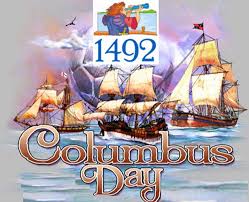
 MaryO'Studio