. 1771 ~ A review of a concert in Venice given today by 15 year old Mozart read: “He worked out (a fugue theme) for more than an hour with such science, dexterity, harmony and proper attention to rhythm that even the greatest connoisseurs were astounded.”
. 1851 ~ (Paul-Marie-Theodore) Vincent d’Indy, French composer and conductor
More information about d’Indy
. 1868 ~ Patty Smith Hill, songwriter, with Mildred Hill, composers of Happy Birthday To You. It’s first title was Good Morning to All
. 1892 ~ Ferde Grofe, Composer
More information about Grofe
. 1914 ~ Snooky Lanson (Roy Landman), Singer, vocalist on Your Hit Parade on radio and TV
. 1920 ~ Richard Hayman, Musician, house conductor for Mercury Records, harmonica player
. 1921 ~ Harold Nicholas, American dancer known as one of the world’s greatest dancers (Nicholas Brothers)
Children: don’t try this at home – never, ever dance on a piano!
. 1927 ~ Mstislav Rostropovich, Soviet cellist and conductor
More information about Rostropovich
. 1931 ~ Burt Collins, Jazz musician, trumpet, flugel horn, played with Jess Roden Band, Lalo Schifrin, T. Rex
. 1945 ~ Ella Fitzgerald and the Delta Rhythm Boys recorded the classic, It’s Only a Paper Moon for Decca Records.
. 1947 ~ Tom Sullivan, Singer, composer
. 1950 ~ Tony Banks, Keyboards with Genesis
. 1950 ~ Jazz pianist Erroll Garner became one of the first jazz instrumentalists to give a solo concert. He played the Music Hall in Cleveland, OH. In 1954, Garner would gain international applause for writing and recording a standard that has been presented many times since: Misty. Johnny Mathis and Sarah Vaughan are but two of many recording artists to offer vocal renditions of this renowned Garner composition. Play Misty for me.
. 1951 ~ Frank Sinatra recorded I’m a Fool to Want You for Columbia.
. 1952 ~ “Singin’ in the Rain”, a musical comedy directed by Gene Kelly and Stanley Donen, starring Gene Kelly and Debbie Reynolds, premiered at Radio City Music Hall in New York City
. 1958 ~ CBS Laboratories announced a new stereophonic record that was playable on ordinary LP phonographs, meaning, monaural. In stereo, on the proper equipment, a new rich and fuller sound was heard. It eventually became a standard for record and equipment buyers.
. 1959 ~ Andrew Farriss, Keyboards with INXS
. 1967 ~ Pop hit Happy Together by The Turtles became the No. 1 song in America.
. 1970 ~ Mariah Carey. Grammy Award-winning singer. She has sold more than 120 million albums and singles since her debut in 1990, only artist with a #1 single in every year of the 1990s. She has spent more weeks at #1 than any other artist
. 1971 ~ Janis Joplin started her second (and final) week at the top of the pop music charts with the hit, Me and Bobby McGee, written by Kris Kristofferson.
. 1975 ~ Sir Arthur Bliss, English composer and Master of the Queen’s Music, died. Master of the Queen’s Music (or Master of the King’s Music) is a post in the Royal Household of the Sovereign of the United Kingdom. The holder of the post originally served the monarch of England.
The post is roughly comparable to that of Poet Laureate. It is given to people eminent in the field of classical music; they have almost always been composers (George Frederick Anderson was one exception; he was a violinist who is not known to have ever composed any music). Duties are not clearly stated, though it is generally expected the holder of the post will write music to commemorate important royal events, such as coronations, birthdays, anniversaries, marriages and deaths, and to accompany other ceremonial occasions. The individual may also act as the Sovereign’s adviser in musical matters.
. 2015 ~ Tomas Tranströmer, winner of the 2013 Nobel Prize for Literature, died at the age of 83.
His poems, translated into 60 languages, have been set to music by some of Sweden’s foremost composers.
A passionate pianist, Tomas Tranströmer had to relearn how to play after a stroke in 1990 left him paralyzed down his right side. He said that playing the piano every day was the key to saving his life.
. 2017 ~ Arthur Blythe, American jazz saxophonist, died at the age of 76
. 1784 ~ Mozart‘s Piano Concerto No. 15 in B flat, K. 450 in B flat, K. 450 was first performed. Mozart was the soloist.
It is a concertante work for piano, or pianoforte, and orchestra. Mozart composed the concerto for performance at a series of concerts at the Vienna venues of the Trattnerhof and the Burgtheater. In a letter to his father, Mozart compared this concerto with the 16th concerto in D:
“I consider them both to be concertos which make one sweat, but the B flat one beats the one in D for difficulty.” Indeed, many pianists consider this to be the most difficult of all of Mozart’s piano concertos. The concerto is primarily difficult from its many quick scale patterns which must be played perfectly and also from its many fast chord patterns moving up and down.
Beginning with this concerto, Mozart began to use the term “grand” to describe his concerti such as K.450 which feature a prominent and required wind section for the ensemble. The work is orchestrated for solo piano, flute, two oboes, two bassoons, two horns, and strings.
The concerto is in three movements: 1. Allegro 2. Andante in E-flat major 3. Allegro
. 1808 ~ María Felicità Malibran, Spanish contralto
. 1895 ~ Arthur Murray, dancer
. 1900 ~ June (Algeria Junius) Clark, Musician, trumpeter
. 1916 ~ Enrique Granados, Spanish composer, died in the English Channel. Best known for his piano suite “Goyescas” after paintings by Goya.
. 1920 ~ Gene Nelson (Eugene Leander Berg), Actor, dancer in Lullaby of Broadway, Oklahoma, Tea for Two, The West Point Story
. 1922 ~ Dave Appell, Arranger for big bands: Benny Carter, Earl ‘Fatha’ Hines; TV music director, record producer, singer, songwriter, musician with Dave Appell and the Applejacks
. 1928 ~ Byron Janis (Yanks), American pianist, NBC Symphony Orchestra; well-known piano performance on Hugo Winterhalter’s Rhapsody in Blue recording, composed by George Gershwin.
. 1935 ~ After a year as a local show from New York City, “Major Bowes’ Original Amateur Hour” was heard on the entire NBC radio network. The show stayed on the air for 17 years. Later, Ted Mack took over for Bowes and made the move from radio to television.
. 1937 ~ Benjamin Luxon, British baritone
. 1941 ~ Glenn Miller began work on his first motion picture for 20th Century Fox. The film was Sun Valley Serenade.
. 1958 ~ Elvis Presley reported to local draft board 86 in Memphis, TN. He became US 53310761. Oddly, since Elvis was now ‘government property’ serving his time in the Army, Uncle Sam stood to lose an estimated $500,000 in lost taxes each year that Private Presley was in the Army.
. 1980 ~ Capitol Records released some rare Beatles tracks. Included in the album were stereo versions of Penny Lane and She Loves You, sung by the group in German, under the title, Sie Liebt Dich. Also included was a German version of I Want to Hold Your Hand or, in the Teutonic tongue, Komm Gib Mir Deine Hand.
. 2000 ~ French Quarter pianist and chanteuse Lily Simha Hood, whose fans included Tennessee Williams, died of kidney failure. She was cagey about revealing her age, and her husband asked that the secret remain with her death. Her musical career began on a whim. After dinner one night in 1976, the Hoods and a friend stopped at Lafitte’s Blacksmith Shop, a Bourbon Street bar across from their house. Mrs. Hood played a few tunes on the piano for her friend and was hired on the spot, even though she wasn’t looking for a job. Soon, “Miss Lily” had a crowd of regulars including Tennessee Williams, who would bring in a songbook for her to sing from. Mrs. Hood never formally studied the piano and never learned to read music. She was self-taught and learned by listening. She performed at Lafitte’s for 16 years, but health problems ended her career about 1993.
. 1809 ~ Johann Georg Albrechtsberger passed away. He was was an Austrian musician.
. 1824 ~ “I am convinced that the soul and spirit of Mozart have passed into the body of young Liszt” ~ Review of a concert given on this day by Franz List in Paris.
. 1875 ~ Maurice Ravel, French composer
More information on Ravel
. 1907 ~ Victor Alphonse Duvernoy, French piano virtuoso, composer and professor of piano at the Conservatoire de Paris, died at the age of 64
. 1917 ~ In the United States, RCA released the first jazz record ever: The Dixie Jazz Band One Step by Nick LaRocca’s Original Dixieland Jazz Band.
. 1917 ~ Robert Erickson, American composer
. 1939 ~ Guy Lombardo and his Royal Canadians recorded one of the most popular songs of the century. The standard, “Auld Lang Syne”, was recorded for Decca Records.
. 1955 ~ “Peter Pan”, with Mary Martin as Peter and Cyril Richard as Captain Hook, was presented as a television special for the first time.
. 1969 ~ The Apollo astronauts began this day of their space voyage by singing Happy Birthday.
. 1985 ~ The song We Are the World, from the album of the same name, was played on the radio for the first time. Forty-five of pop music’s top stars gathered together to combine their talents to record the music of Lionel Richie and Michael Jackson. Richie and Jackson sang, too, while Quincy Jones did the producing of the USA for Africa record. The proceeds of the multimillion-selling recording went to aid African famine victims. The project, coordinated by Ken Kragen, was deemed a huge success.
. 2001 ~ Frankie Carle, a big-band leader best known for Sunrise Serenade, at the age of 97. Carle, who died in Mesa, Ariz., reached the high point of his popularity during World War II, when he was the focus of a bidding war among bands. His repertory was wide, ranging from classics like a revival of Stephen Foster’sSwanee River, to a World War II release that anticipated the Allied victory called I’m Going to See My Baby. Although Carle’s music did not rank high on record industry charts after the 1940s, he still toured and played concerts into the 1980s, some 70 years after he began his musical career.
. 2003 ~ A four-day walkout by 325 Broadway musical orchestra members over the issue of the size of the orchestras required for Broadway shows, forcing nearly every Broadway musical to cancel performances. The Musicians claim they want to replace live music with a virtual orchestra, a couple of synthesizers and computer-generated sound.
. 2015 ~ Steve Zegree died. He was a legendary jazz educator and former Western Michigan University Gold Company director.
. 1766 ~ Samuel Wesley, English organist and composer in the late Georgian period. Wesley was a contemporary of Mozart (1756–1791) and was called by some “the English Mozart.”
. 1771 ~ Johann Baptist Cramer, English musician of German origin. He was the son of Wilhelm Cramer, a famous London violinist and musical conductor, one of a numerous family who were identified with the progress of music during the 18th and 19th centuries.
. 1832 ~ Frederic Chopin’s first Paris concert. The musicologist Arthur Hedley has observed that “As a pianist Chopin was unique in acquiring a reputation of the highest order on the basis of a minimum of public appearances—few more than thirty in the course of his lifetime.”
. 1842 ~ Arrigo Boito, Italian composer, librettist and poet
. 1858 ~ Arnold Dolmetsch, British music antiquarian and musician
. 1932 ~ Michel Legrand, Academy Award-Winning composer for Best Original Score: Yentl in 1983, Brian’s Song, Ice Station Zebra
. 1934 ~ Renata Scotto, Italian soprano. She made her operatic debut at age 18 and is best known for performances as Violetta in La Traviata, Cio-Cio- San in Madama Butterfly, Mimi (and the occasional Musetta) in La Bohème, Lucia in Lucia di Lammermoor, Lady Macbeth in Macbeth and Francesca in Francesca da Rimini. She is also an opera director.
. 1940 ~ Frances Langford recorded one of the classic songs of all time — and one that would become a Walt Disney trademark. When You Wish Upon a Star was recorded on Decca Records during a session in Los Angeles. Many artists have recorded the song, including pop diva Linda Ronstadt (with the Nelson Riddle Orchestra in the early 1980s). One can hear the song not only on record, but as the theme in the opening credits of any Disney movie, video and TV program and those “I’m going to Disneyland/World!” commercials, too.
. 1942 ~ Paul Jones, Harmonica, singer with Manfred Mann
. 1943 ~ Stephen Douglas Burton, American composer and teacher
. 1947 ~ Lonnie Turner, Bass, singer with The Steve Miller Band
. 1964 ~ The musical, “What Makes Sammy Run”, opened in New York at the 54th Street Theatre. Making his Broadway debut in the show was Steve Lawrence. The production ran for 540 performances.
. 1985 ~ Yul Brynner reprised his role in “The King and I” setting a box office record for weekly receipts. The show took in $520,920.
. 1990 ~ Johnnie Ray died. He was an American singer, songwriter, and pianist.
. 1991 ~ Webb Pierce passed away. He was one of the most popular American honky tonk, rockabilly vocalists, guitarists of the 1950s
. 1994 ~ Donald Phillips, pianist/composer, died at the age of 80
. 1834 ~ Albert Heinrich Zabel, harpist and composer
. 1857 ~ Robert Baden-Powell, founder of the Boy Scouts
. 1923 ~ Frederick A. Julliard set up a million-dollar fund to establish a music school. Today, Juilliard is one of the world’s leading music and dance schools.
. 1927 ~ David Ahlstrom, American composer
. 1931 ~ Maurice Chevalier recorded Walkin’ My Baby Back Home for Victor Records in New York City. The same tune was recorded 21 years later by Nat ‘King’ Cole and Johnny Ray. It became a major hit for both artists.
. 1945 ~ Oliver (Swofford), Singer
. 1956 ~ Elvis Presley entered the music charts for the first time. Heartbreak Hotel began its climb to the number one spot on the pop listing, reaching the top on April 11, 1956. It stayed at the top for eight weeks.
. 1958 ~ Roy Hamilton’s record, Don’t Let Go, became #13 in its first week on the record charts. The song was the first stereo record to make the pop music charts. 1958 was the year for several stereo recordings, including Hang Up My Rock and Roll Shoes by Chuck Willis, Yakety Yak by the Coasters, Born Too Late by The Poni-Tails, It’s All in the Game by Tommy Edwards and What Am I Living For by Chuck Willis.
. 1965 ~ Filming began for The Beatles’ second movie, “HELP!”, in the Bahamas.
. 1976 ~ Florence Ballard passed away. She was an American vocalist, one of the founding members of the popular Motown vocal group the Supremes. Ballard sang on sixteen top forty singles with the group, including ten number-one hits.
. 1985 ~ Efrem A Zimbalist, Russian/US composer/violinist, died at the age of 95
. 1989 ~Tina Turner won a Grammy for Best Female Rock Vocalist at age 49 on this date. She originally had recorded with her husband Ike Turner, however, she had left Ike in 1976. From that time until 1981 she had remained behind the scenes. After 1981, she became one of the oldest female artists in history to stage such a strong comeback, and she changed her tune to Rock and Roll. Her first solo album Private Dancer had sold five million copies. She was introduced in the Rock and Roll Hall of Fame in 1991.
. 2001 ~ Ray Hendricks, a singer of the Big Band era who performed with Benny Goodman and Betty Grable, died at the age of 88. His career took him to Hollywood and across the country with stars including Goodman, Grable, Hoagy Carmichael, Ben Bernie, Ray Noble and Sid Lippman. His earliest performances were on Spokane radio station KFPY. He soon set out for California with Bob Crosby, brother of Bing Crosby. After serving as a flying instructor in the Air Force during World War II, he returned to Spokane and formed his own orchestra. He continued playing local venues for several decades but said he regretted not pushing his career after the war.
. 1736 ~ Johann Georg Albrechtsberger, Austrian musician
. 1809 ~ (Jacob Ludwig) Felix Bartholdy Mendelssohn, German composer
More information about Mendelssohn
. 1900 ~ Mabel Mercer, British-born American cabaret singer
. 1904 ~ Luigi Dallapiccola, Italian composer
More information about Dallapiccola
. 1911 ~ Jehan Alain, French organist and composer
. 1928 ~ Frankie Vaughn (Abelson), Singer
. 1929 ~ Russell Arms, Singer
. 1940 ~ Angelo D’Aleo, Singer with Dion and The Belmonts
. 1941 ~ Jimmy Dorsey and his orchestra recorded the classic, Amapola, on Decca Records. Helen O’Connell and Bob Eberly joined in a vocal duet on this very famous and popular song of the Big Band era.
. 1943 ~ Eric Haydock, Bass with The Hollies
. 1943 ~ Dennis Edwards, singer with the Temptations since 1968. He sang on a string of the group’s hits including “I Can’t Get Next to You,” “Ball of Confusion” and “Papa Was a Rollin’ Stone” in an initial tenure that stretched to 1977.
. 1947 ~ Melanie (Safka), Singer
. 1947 ~ Dave Davies, Singer, guitarist with The Kinks
. 1950 ~ Ed, Gene, Joe and Vic, The Ames Brothers, reached the #1 spot on the pop music charts for the first time, as Rag Mop became the most favorite song in the U.S. The brothers enjoyed many successes with their recording efforts.
.
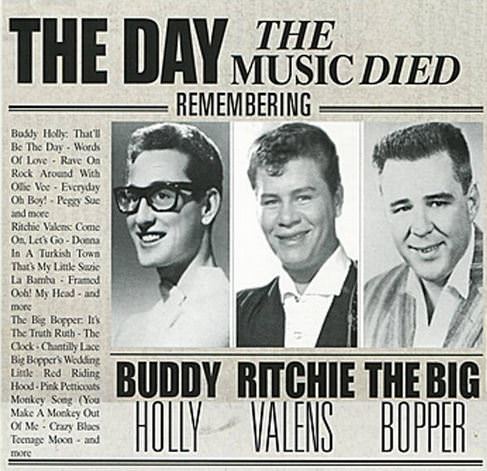
1959 ~ 22-year-old Buddy Holly, 28-year-old J.P. Richardson (The Big Bopper) and 17-year-old Ritchie Valens died in an airplane crash near Mason City, Iowa. February 3rd has been remembered as ‘The Day the Music Died’ since Don McLean made the line popular in his 1972 hit, “American Pie”. Buddy Holly, born Charles Hardin Holly in Lubbock, Texas, recorded That’ll Be the Day, Peggy Sue, Oh, Boy, Maybe Baby, and others, including It Doesn’tMatter Anymore (recorded just before his death, a smash in the U.K., non-top-10 in the U.S.). Buddy was inducted into the Rock and Roll Hall of Fame in 1986. A convincing portrait of the singer was portrayed by Gary Busey in The Buddy Holly Story, a made for TV movie. J.P. (Jiles Perry) Richardson was from Sabine Pass, TX. He held the record for longest, continuous broadcasting as a DJ at KTRM Radio in Beaumont, TX in 1956. He was on the air for 122 hours and eight minutes. In addition to his smash hit, Chantilly Lace, Richardson also penned Running Bear (a hit for Johnny Preston) plus White Lightning (a hit for country star, George Jones). Richard Valenzuela lived in Pacoima, CA (near LA) and had a role in the 1959 film, Go Johnny Go. Ritchie Valens’ two big hits were Donna and La Bamba … the last, the title of a 1987 film depiction of his life. La Bamba also represented the first fusion of Latin music and American rock. Of the three young stars who died in that plane crash, the loss of Buddy Holly reverberated the loudest over the years. But, fans of 1950s rock ‘n’ roll will agree, all three have been sorely missed.
. 1959 ~ Lol (Laurence) Tolhurst, Drummer, keyboard with The Cure
. 1964 ~ The British group, The Beatles, received its first gold record award for the single, I Want To Hold Your Hand. The group also won a gold LP award for “Meet The Beatles”. The album had been released in the United States only 14 days earlier.
. 1971 ~ Lynn Anderson received a gold record for the single, Rose Garden. The Grand Forks, ND country singer was raised in Sacramento, CA. In addition to being a singer, she was an accomplished equestrian and California Horse Show Queen in 1966.
. 1974 ~ “Pajama Game” closed at Lunt Fontanne Theater NYC after 65 performances
. 1979 ~ “YMCA“ by Village People peaked at #2 on the pop singles chart. It was fun to dance to!
. 2002 ~ Remo Palmier, a self-trained guitarist who was a fixture in the New York jazz scene in the 1940s, died at the age of 78, and had been suffering from leukemia and lymphoma, his wife said. Over the course of his career, Palmier played with jazz legends Charlie Parker, Billie Holiday and Dizzy Gillespie, among others. Born Remo Palmieri in the Bronx, Palmier achieved his greatest fame performing with broadcaster Arthur Godfrey on CBS, and taught Godfrey how to play the ukulele. After Godfrey retired, Palmier released his own albums, “Windflower and “Remo Palmier”.
. 1912 ~ Erich Leinsdorf, Austrian-born American conductor
. 1937 ~ Glen Gray and his Casa Loma Orchestra recorded A Study in Brown, on Decca Records.
. 1941 ~ John Steel, Singer, drummer with The Animals
. 1944 ~ Florence LaRue (Gordon), Singer with The Fifth Dimension
. 1962 ~ Clint Black, Singer, actor
. 2002 ~ Blues and jazz pianist Abie “Boogaloo” Ames died at the age of 83. Ames was born on Big Egypt Plantation in Cruger, Miss., on May 23, 1918. He began playing piano at the age of 5 and his style earned him the nickname “Boogaloo” in the 1940’s. Ames moved to Detroit as a teenager and started a band, touring Europe with Louis Armstrong in 1936. Ames worked at Motown Studio and befriended other great musicians like Nat King Cole and Erroll Garner. In 1980, Ames moved to Greenville, where he became a regular performer at local clubs and festivals. Cassandra Wilson’s forthcoming Blue Note CD tentatively titled “Belly of the Sun” is set to include Darkness in the Delta, a song written by Ames for the CD. Ames was named the 2001 winner of the Artist’s Achievement Award of the Governor’s Awards for Excellence in the Arts in the state of Mississippi. With his protege and 1990s musical partner Eden Brent, Ames performed at the Kennedy Center for Performing Arts in Washington, D.C., in 2000. Ames’ last public performance was in October 2001 at the E.E. Bass Cultural Center in Greenville with another former student, Mulgrew Miller.
. 2002 ~ David Stetler, a big band swing drummer who played with Benny Goodman and Spike Jones, died of pneumonia. He was 79. A Seattle native, Stetler was discovered in high school by Lunceford. With a style close to that of Gene Krupa and Jo Jones, Stetler toured the country in the 1940s but returned to Seattle after his first son was born. He backed up national acts in local performances, including many during the world’s fair in 1962.
. 2003 ~ Charlie Biddle, a leader of Montreal’s jazz scene in the 1950s and ’60s who played bass with Thelonious Monk and Charlie Parker, died after a battle with cancer. He was 76. Biddle was a native of Philadelphia who moved to Canada in 1948. Over the next five decades, the World War II veteran and former car salesman became synonymous with jazz in Montreal. Biddle opened his own club, Uncle Charlie’s Jazz Joint, in suburban Ste- Therese in 1958. He later performed in such legendary Montreal nightspots as The Black Bottom and the Penthouse, where he worked with the likes of Oscar Peterson, Art Tatum, Charlie Parker and Lionel Hampton. When there were no jobs in Montreal, Biddle played smaller Quebec cities with a group called Three Jacks and a Jill. Until recently, Biddle played four nights a week at Biddle’s Jazz and Ribs, a Montreal landmark for nearly 25 years. Coincidentally, the club closed Tuesday for planned renovations, which included erecting a wall of fame to honor Biddle and others who have played at the club. In 1979, he organized the three-day festival that some say paved the way for the renowned Montreal International Jazz Festival. News Item about Charlie Biddle
. 2003 ~ Jerome Hines, a bass vocalist who performed regularly at the Metropolitan Opera during a career that spanned more than six decades, died. He was 81. Hines spent 41 years performing at the Met, more than any other principal singer in its history. He was known for his timbral richness, as well as the research he conducted into the historical and psychological background of the roles he portrayed. During his career at the Met, he portrayed 45 characters in 39 works, including title roles in Mussorgsky’s “Boris Godunov” and Mozart’s “Don Giovanni,” and Colline in Puccini’s “La Boheme.” He gave a total of 868 performances at the Met, retiring in 1987. He went on to perform with regional opera companies and at benefits. Hines, who became a born-again Christian in the 1950s, composed his own opera, “I Am the Way,” about the life of Jesus. He sang the title role at the Met in 1968 and 93 times around the world.
. 2003 ~ Saxophonist Cornelius Bumpus, a former member of the Doobie Brothers who had performed with Steely Dan since 1993, died en route to a series of performances in California. He was 58. Bumpus began his career at age 10, playing alto saxophone in the school band in Santa Cruz, Calif. In 1966, he spent six months performing with Bobby Freeman, and joined Moby Grape in 1977, writing one tune for the “Live Grape” album. Bumpus also recorded two solo albums and toured with his own band. Since performing with The Doobie Brothers in the early 1980s, Bumpus played with a number of bands, most recently with Steely Dan, which won the “Album of the Year” Grammy for its 2000 “Two Against Nature” release. His relations with his former Doobies bandmates turned contentious in the late 1990s, when they sued him and several other musicians over their use of the Doobies name. A federal judge in 1999 ruled against Bumpus and the other musicians, ordering them not to use the name.
Statistically, people who’ve ‘liked’ Mozart on Facebook have a higher IQ. It got us thinking… what would Mozart ‘like’ on Facebook? And what would his profile look like?! On the tenth anniversary of the social network’s launch, we’ve imagined what the composer might have posted online throughout his life.
. 1885 ~ Jerome Kern, American songwriter and composer of musical comedies He was known as the father of the American musical, composing Show Boat, Ol’ Man River, Smoke Gets in Your Eyes, Lovely to Look At, The Way You Look Tonight and The Last Time I Saw Paris
. 1895 ~ Harry Ruby (Rubinstein), Musician and composer
. 1901 ~ Giuseppe Verdi, Italian composer, died at the age of 77. He was an Italian operatic composer, the leading figure of Italian music in the nineteenth century and made important contributions to the development of opera.
. 1905 ~ John Schaum, Pianist, composer and music educator. Schaum began his career as a piano teacher in the late 1920s. In 1933 he founded the Schaum Piano School in Milwaukee. About the same time he began to compose piano music for teaching purposes. He also founded the first company to produce award stickers specifically for music students. Always on the lookout for better materials for his students, Schaum eventually decided to create his own books, beginning in 1941 with Piano Fun for Boys and Girls, which he later revised as the first in a series of nine piano method books that became the Schaum Piano Course, completed in 1945. These books are still widely used today.
. 1918 ~ Skitch Henderson, Conductor of the Tulsa Symphony Orchestra, bandleader, musical director of NBC-TV’s The Tonight Show with Steve Allen and Johnny Carson
. 1948 ~ Mikhail Baryshnikov, Bolshoi ballet dancer, defected to the U.S.
. 1961 ~ Leontyne Price made her debut at the Metropolitan Opera House in New York City. She sang in the role of Leonora in “Il Trovatore”. Price was only the seventh black singer to make a debut at the Met. Marian Anderson was the first (1955).
. 1968 ~ The Bee Gees played their first American concert, as a group. They earned $50,000 to entertain at the Anaheim Convention Center in California. This is identical to what The Beatles were paid to perform at the Hollywood Bowl a few years earlier.
. 1968 ~ Otis Redding’s (Sittin’ On) The Dock of the Bay was released on this day, seven weeks after the singer’s death. It became #1 on March 16, 1968 and remained at the top spot for a month. Redding began his recording career in 1960 with Johnny Jenkins and The Pinetoppers (on Confederate Records). He sang a duet with Carla Thomas and had 11 chart hits. Redding of Dawson, GA was killed in a plane crash at Lake Monona near Madison, WI. Four members of the Bar-Kays were also killed in the crash. The Dock of the Bay, his only number one song, was recorded just three days before his death.
. 1973 ~ John Lennon wrote and recorded “Instant Karma” in a single day
. 1973 ~ Mr and Mrs O got married 🙂 Read more here.
. 1982 ~ “Joseph & the Amazing Dreamcoat” opened at the Royale NYC for 747 performances
. 1984 ~ Michael Jackson’s hair caught on fire during the filming of a Pepsi commercial in Los Angeles. Pyrotechnics did not operate on cue, injuring the singer. Jackson was hospitalized for a few days and fans from around the world sent messages of concern.
. 2000 ~ Friedrich Gulda, Austrian pianist died at the age of 69.
. 2014 ~ Pete Seeger, American folk singer and activist, helped create the modern American folk music movement, died at 94
Wolfgang Amadeus Theophilus Mozart lived between 1756 and 1791. He is considered to be a classical composer. Mozart, born in Salzburg, Austria, began composing before most children go to kindergarten. By the time he was six he had played the piano and violin in public.
A Wunderkind, a prodigy of the first rank before the age of five, Mozart astounded the musical world with compositions of unsurpassed brilliance. His father Leopold had recognized his talent at the age of three and immediately set out to teach him to play the harpsichord, violin, and organ. Mozart and his sister made their debut in Munich when he was just six and traveled about Europe together, performing at courts and before royalty, always with success. While still a little child Mozart was inventing symphonies, sonatas, and his first opera. Legends abound about how Mozart could hear an entire work in his head and write everything down without making even one change.
As a child performer he was often treated as a freak. People would cover his hands as he played the piano, make him compose tunes on the spot and perform all sorts of other musical tricks.
In 1787 Mozart became court composer to Joseph II. He played for royalty, received commissions from aristocrats and in his short lifetime composed nearly a thousand masterpieces, including symphonies, operas, serenades, sonatas, concertos, masses, vocal works, and church works.
Mozart was a prolific composer writing masterpieces using every form of music, including his operas “The Marriage of Figaro” (based on a play by Pierre Beaumarchais), “Don Giovanni”, “Cosi fan tutte” and “The Magic Flute”. His mastery of instrumental and vocal forms, from symphony to concerto and opera, was unrivalled in his own time and perhaps in any other.
Composing the Requiem Mass commissioned for Count Walsegg, he felt he was writing his own requiem and he died before it was finished.
Wolfgang Amadeus Mozart, composer, died in Vienna Austria at the age of 35, penniless, on December 5th, 1791, of malignant typhus. Mozart, the precocious child prodigy, composed several pieces that are deemed central to the classical era. Though he ranked as one of the greatest musical genius, he did not live a life of affluence as none of his compositions earned him a decent commission but the world is forever enriched by such works as Eine Kleine Nachtmusik, the Symphonies No. 38 through 41 and the Coronation Mass.
Lorin Maazel performed at the 1939 New York World’s Fair when he was only 9. He conducted two major symphonies before he was 13 and went on to a successful career as an adult conductor.
MacDowell
Edward MacDowell lived from 1860 until 1908. He was an American pianist and composer and was one of the first American composers to achieve any degree of international fame. He studied in Paris, eventually at the Conservatoire, before moving to study the piano with Carl Heymann at the Hoch Conservatory in Frankfurt, where he had composition lessons with Joachim Raff. There was encouragement from Liszt and further years spent in Europe until his return to the United States in 1888. There he succeeded in establishing himself as a teacher, pianist and composer, with appointment as the first Professor of Music at Columbia,a position he held until 1904. His last years were clouded by mental illness.
Piano music by MacDowell is effective if not innovative. It includes two piano concertos, four sonatas, the Tragica, Eroica, Norse and Keltic, studies and a quantity of genre pieces.
Machaut
Guillaume de Machaut was born sometime around 1300 in Rheims(?), France and died: April 13, 1377. Rheims, France He was a French poet and musician as well as a composer of monophonic and polyphonic music. He is also known as the leading representative of the Ars nova tradition.
Machaut lived his life in the higher ranks of service, first as secretary to John of Luxembourg, King of Bohemia, and then as a canon (a church official) at the Cathedral of Rheims. Like many in the fourteenth century, Machaut’s life and works reflect an equal measure of the sacred and secular. Most of his works were either secular (such as his many chansons) or a mix of sacred and ceremonial (including many of his motets and his hocket David, which was probably written for the coronation service of King Charles V in 1364). At the same time, he wrote what is probably the first full setting of the Mass Ordinary by a single composer (the Messe de Nostre Dame). He was a man of the cloth, having taken minor orders at an early age. Yet toward the end of his life he maintained a romantic/literary affair with a young woman named Perrone.
Much of Machaut’s polyphonic music reflects the interest that composers had in building complex structures based on the repetition and manipulation of borrowed melodies (a technique called isorhythm). In some of his works, these techniques are applied to all the voices. The harmonies found in Machaut’s pieces are built around the fifth and the octave, the primary consonances of the period. His secular music carries on the musical and textual traditions of the troubadours and trouv?res. Most are written in the fixed forms such as the virelei, rondeau and ballade.
Marchaut’s works include: Sacred/ceremonial music, including Messe de Nostre Dame, 23 motets, hocket “David” Secular music, including 42 ballades, 22 rondeaux, 33 virelais, 19 lais, 1 complainte, 1 chanson royale
Mahler
Gustav Mahler lived from 1860 until 1911. Like so many other musicians, Mahler started early, learning the piano at six and giving his first recital at the age of ten.
In 1909, he became conductor of the New York Philharmonic Orchestra and the Vienna Court Opera. Mahler, a Bohemian composer, used huge orchestras, the largest for his “Symphony for a Thousand”. He also completed nine symphonies and several song-cycles notably “Das Lied von der Erde.” Mahler’s music was used in the 1971 movie, Death in Venice.
Mancini
Henry Mancini (Enrico Nicola Mancini) lived from 1924 until 1994. He was an Academy Award-winning composer of movies such as Moon River in 1961, Days of Wine and Roses in 1962, Breakfast at Tiffany’s score in 1961, Victor/Victoria score in 1982. He also composed themes for The Pink Panther, Mr. Lucky, Peter Gunn, Charade, NBC Mystery Movie, NBC Nightly News, Love Theme from Romeo & Juliet and received 20 Grammy Awards.
Marriner
Sir Neville Marriner, born in 1924, is a British violinist and conductor. He was born in Lincoln, Lincolnshire, EC England, UK and he studied at the Royal College of Music and the Paris Conservatory. He first played violin with the London Philharmonia and the London Symphony Orchestra, then turned to conducting. He has held posts with the Los Angeles Chamber Orchestra from 1968 until 1977, the Minnesota Orchestra from 1979 until 1986, and the Stuttgart Radio Symphony Orchestra 1984 until 1989. Since 1956 he has been founder-director of the Academy of St Martin-in-the-Fields chamber ensemble. He was knighted in 1985.
Marsalis
The Marsalis clan of New Orleans is a large one. Ellis, the head of the family, plays piano, Jason plays drums. Wynton plays trumpet and Branford plays saxophone. Together and individually, this family has done quite a lot to inspire young musicians.
Massanet
Jules Emile Frederick Massenet lived from 1842 until 1912. He was a composer who was born in Montaud, France. He studied at the Paris Conservatoire, where he was professor from 1878 until 1896. He made his name with the comic opera Don Caesar de Bazan. Other operas followed, including Manon (1884), considered by many to be his masterpiece, Le Cid (1885), and Werther (1892). Among his other works are oratorios, orchestral suites, music for piano, and songs.
McCartney
Sir (James) Paul McCartney was born in 1942. He is a musician, songwriter, and composer who was born in Liverpool, Merseyside, NW England, UK. He was the Beatles’ bass guitarist, vocalist, and member of the Lennon-McCartney songwriting team, he made his debut as a soloist with the album McCartney (1970), heralding the break-up of the group. In 1971 he formed the band Wings (disbanded in 1981) with his wife Linda (1942–98). “Mull of Kintyre’ (1977) became the biggest-selling UK single (2.5 million). In 1979 he was declared the most successful composer of all time: by 1978 he had written or co-written 43 songs that sold over a million copies each.
His Liverpool Oratorio (written in association with Carl Davis) was performed by the Royal Liverpool Philharmonic Orchestra at Liverpool Cathedral in 1991, and he has since continued to develop his interests as a classical composer, notably in Standing Stone (1997). He collaborated with Harrison and Starr in the retrospective Beatles’ anthology in 1995.
He wrote the books All You Need Is Love (1968) and Paul McCartney In His Own Words (1976), and wrote, produced, and composed the music for a successful animated film, Rupert and the Frog Song in 1984.
He won a Grammy Award in 1990 and was inducted into the Rock and Roll Hall of Fame on March 15, 1999. He was knighted in 1997.
McPartland
Marian Turner McPartland was born in Windsor, England in 1920. She is a versatile pianist and jazz musician. She moved to America in 1945 and led a trio from 1951 and founded Halcyon Records. In 1973 she began an adjunct career as the host of jazz radio programs and National Public Radio show – Marian McPartand?s Piano Jazz.
Melba
Nellie Melba, whose birth name was Helen Porter Mitchell, was an Australian singer born in Melbourne, Australia in 1861. She was taught to sing by mother, educated at Presbyterian Ladies’ College, married 1881 and decided to sing professionally. She visited London and Paris in 1886 and debuted in Brussels as Gilda in Verdi’s “Rigoletto” in 1887.
First diva of the century as Nellie Melba (from her home town), she demanded a pound more than Caruso at his peak for her three-octave voice. Upset that Escoffier named a dessert Peach Melba without paying royalties, she patented her name in the US. For WWI fundraising concerts she was made a Dame Commander of the Order for the British Empire in 1918. Her career took her to London’s Covent Garden and New York’s Metropolitan opera houses. She gave her name to Melba Toast, Peach Melba and Melba Sauce. Melba died 1931 from and infection following an unsuccessful face lift.
Melchoir
Lauritz Lebrecht Hommel Melchior was a tenor who born in Copenhagen, Denmark in 1890. He died in 1973. Beginning as a baritone in 1913, he went on to become arguably the foremost Wagnerian tenor of the century. He sang in Bayreuth from 1924 until 1931 and regularly at the Metropolitan Opera from 1926 until 1950). In the late 1940s and early 1950s he appeared in several Hollywood movies.
Melchior was sometimes called ‘The Heroic Tenor’ or ‘The Premier Heldentenor of the 20th Century’.
Mendelssohn
Felix Bartholdy Mendelssohn lived between 1809 and 1847. He is considered to be a romantic composer and pianist best known for his symphonies and concert overtures. Mendelssohn played the piano in public by the age of nine, so he was often compared to Mozart.
He composed works for solo instruments and orchestra, and German songs. Some of his better known works are the “Wedding March”, “Elijah” and “Fingal’s Cave”. Felix Mendelssohn, along with Hector Berlioz was one of the first conductors of a large orchestra.
Mendelssohn harmonized the works of other composers, including Johann Cruger.
Menotti
Menotti’s “Amahl and the Night Visitors” was the first opera ever written for television and is the most frequently performed opera in the United States. He won a Pulitzer prize for his opera, The Consul, in 1950.
Menuhin
Yehudi Menuhin made his violin debut as a child prodigy by appearing with the San Francisco Orchestra at the age of 7 in 1923. He was wearing short pants, which were then fashionable for boys his age. He later became a music statesman by promoting music as a univeral peacemaker and as a means to realize greater global understanding. He was born in New York City in 1916 but became a British citizen in 1985.
Messiaen
Olivier (Eugène Prosper Charles) Messiaen lived from 1908 until 1992. He was a composer and organist, born in Avignon, France. He studied at the Paris Conservatoire, where his teachers included Paul Dukas.
His 20/21 earned him a Grammy
Meyerbeer
Giacomo Meyerbeer lived from 1791 until 1864. He was a German Grand opera composer. His most famous works are “Les Huguenots” and “L’Africaine”. His Hellish Waltz from Robert du Diable, transcribed by Liszt probably caused more public commotion than any other piano piece in history.
Midori
Midori (Mi Dori Goto) is a Japanese violin virtuoso who began lessons at age four.
Milhaud
arius Milhaud, 1892 to 1974, was born in the southern French city of Aix-en-Provence. Darius Milhaud was trained at the Paris Conservatoire, originally as a violinist, before turning to composition. He enjoyed a close association with the diplomat-poet Paul Claudel, whom he accompanied to Brazil as secretary, after Claudel’s appointment as Minister at the French delegation in Rio de Janeiro. On his return to Paris in 1918, after two years abroad, Milhaud was for a time in the circle of Jean Cocteau and a member of the diverse group of French composers known as Les Six. Extremely prolific as a composer in many genres, Milhaud spent the years of the 1939 war in the United States, where he taught, combining this position with a similar post at the Paris Conservatoire after 1947.
Two works in particular have proved attractive additions to repertoire. The first, Saudades do Brasil, a suite for piano, is based on music heard in Brazil during the composer’s stay there between 1916 and 1918. Scaramouche, arranged for two pianos from incidental music for Moli?re’s Le M?decin Volant, is a lively jeu d’esprit, in the spirit of the commedia dell’arte character of the title.
Darius Milhaud wrote a considerable amount of music for the theatre, operas, ballets and incidental music, as well as film and radio scores. Collaboration with Claudel brought the opera Christophe Colombe and a number of compositions of incidental music for plays ranging from those of Shakespeare to the work of contemporaries such as Brecht, Supervielle, Giraudoux and Anouilh. With Cocteau he wrote the ballets Le Boeuf sur le Toit (The Ox on the Roof) and the jazz La Cr?ation du Monde, for the Ballets n?gres. These represent only a small fraction of his dramatic work.
Milhaud was equally prolific as a composer of orchestral music of all kinds, including twelve symphonies and a variety of concertos, some of which reflect the influence of his native Provence.
Milhaud contributed widely also to the repertoire of French song both in choral settings and in songs for solo voice and piano, with texts chosen from a great variety of sources from Rabindranath Tagore and Andre Gide to the words of Pope John XXIII, the last in a choral symphony Pacem in terris.
In addition to eighteen string quartets and useful additions to duo sonata repertoire, not least for viola, an instrument used for the Quatre Visages of 1943, representations in music of four different kinds of girls, Milhaud provided for wind quintet the charming suite La cheminée du roi René and the attractive Pastorale of 1935 for oboe, clarinet and bassoon. He shows here, as elsewhere, a characteristically French adroitness in writing for woodwind instruments.
Miller
(Alton) Glenn Miller, lived from 1904 until 1944 and was born in Clarinda, Iowa. He was a trombonist who he attended the University of Colorado before joining Ben Pollack’s orchestra in Chicago in 1924. He moved to New York in 1928, where he free-lanced for the next nine years as a studio musician and worked as a sideman with a succession of bandleaders, including Red Nichols, the Dorsey Brothers, and Ray Noble. After his first band failed in 1937, he put together a second orchestra in 1938. For the next four years, with hits such as “Moonlight Serenade” and “In the Mood,” it was the most successful dance band of the period. In 1942, he joined the U.S. Air Force, for which he organized the Glenn Miller Army Air Force Band to entertain the troops. While stationed in Europe, he died on a flight from England to France in a plane that disappeared over the English Channel.
Minelli
Liza May Minnelli was born in 1946 in Los Angeles, California. She is a singer, dancer, stage and screen actress. Her parents are actress Judy Garland and director Vincente Minnelli and her half-sister is singer-actress Lorna Luft.
Minnelli was less than 3 years old when she made her screen debut in In the Good Old Summertime (1949), which co-starred her mother. She became the youngest-ever actress to win a Tony Award, for Flora, the Red Menace (1965), at age nineteen. She is the only singer in history to sell out Carnegie Hall for three weeks straight.
Monteverdi
Claudio Monteverdi lived from 1567 until 1643 and was considered to be a baroque composer. He was the first great composer of opera.
Monteverdi introduced the orchestral prelude, enlarged the orchestra, and improved its role by recognizing instrumental differences. His first opera “Orfeo” was performed in 1607.
Moog
Robert Moog was born in 1934. He invented the first music synthesizer in 1964.
Morley
Morton
Jelly Roll Morton, born Ferdinand Joseph La Menthe in 1885, was one of the most influential composers of the jazz era, bridging an important gap between ragtime, blues, and jazz. In a sense, he was the first great jazz composer.
His career began in New Orleans, where he began to experiment with a unique blend of blues, ragtime, Creole, and Spanish music in bordellows as a piano player. Along with being a musician, he also worked as a gambler, pool shark, vaudeville comedian, and was known for his flamboyant personality and diamond front tooth.
Morton became successful when he started making what would be some of the first jazz recordings in 1923 with “the New Orleans Rhythm Kings”. Whether he played on the West Coast, New Orleans, or in Chicago, his recordings were always very popular. He joined the group “the Red Hot Peppers” in 1924 and made several classic albums with the Victor label.
Nothing but success came to him until 1930, when “Hot Jazz” began to die out, and big bands began to take over. Morton died in 1941, claiming that a voodoo spell was the cause of his demise.
Moscheles
Ignaz Moscheles was a Bohemian composer and piano virtuoso.
Mouret
Jean Joseph Mouret’s Rondeau was the theme for many years of TV’s Masterpiece Theater Mouret wrote his music in Paris in the early 1700’s
Mozart
Wolfgang Amadeus Theophilus Mozart lived between 1756 and 1791. He is considered to be a classical composer. Mozart, born in Salzburg, Austria, began composing before most children go to kindergarten. By the time he was six he had played the piano and violin in public.
A Wunderkind, a prodigy of the first rank before the age of five, Mozart astounded the musical world with compositions of unsurpassed brilliance. His father Leopold had recognized his talent at the age of three and immediately set out to teach him to play the harpsichord, violin, and organ. Mozart and his sister made their debut in Munich when he was just six and traveled about Europe together, performing at courts and before royalty, always with success. While still a little child Mozart was inventing symphonies, sonatas, and his first opera. Legends abound about how Mozart could hear an entire work in his head and write everything down without making even one change.
As a child performer he was often treated as a freak. People would cover his hands as he played the piano, make him compose tunes on the spot and perform all sorts of other musical tricks.
In 1787 Mozart became court composer to Joseph II. He played for royalty, received commissions from aristocrats and in his short lifetime composed nearly a thousand masterpieces, including symphonies, operas, serenades, sonatas, concertos, masses, vocal works, and church works.
Mozart was a prolific composer writing masterpieces using every form of music, including his operas “The Marriage of Figaro” (based on a play by Pierre Beaumarchais), “Don Giovanni”, “Cosi fan tutte” and “The Magic Flute”. His mastery of instrumental and vocal forms, from symphony to concerto and opera, was unrivalled in his own time and perhaps in any other.
Composing the Requiem Mass commissioned for Count Walsegg, he felt he was writing his own requiem and he died before it was finished.
Wolfgang Amadeus Mozart, composer, died in Vienna Austria at the age of 35, penniless, on December 5th, 1791, of malignant typhus. Mozart, the precocious child prodigy, composed several pieces that are deemed central to the classical era. Though he ranked as one of the greatest musical genius, he did not live a life of affluence as none of his compositions earned him a decent commission but the world is forever enriched by such works as Eine Kleine Nachtmusik, the Symphonies No. 38 through 41 and the Coronation Mass. In the year 2000, there have been some new discoveries about Mozart’s death.
Munch
Charles Munch was a French composer who lived from 1891 until 1968. He was born in Strasbourg, France. After a long career as a violinist, he made his conducting debut in Paris in 1932 and three years later organized his own orchestra there. He became conductor of the Boston Symphony in 1949 and stayed until 1962. In the latter year he organized the Orchestre de Paris; he died on tour with that group in Virginia. Munch was known for allowing his players room to express themselves, producing warm and musical performances.
Mussorgsky
Modest Petrovich Mussorgsky lived from 1839 until 1881. This Russian composer, born in Karevo, Russia, was educated for the army, but resigned his commission in 1858 and began the serious study of music under Balakirev.
He is most known for his dramatic opera Boris Godunov, first performed in St Petersburg in 1874. In this opera, he emphasized that speech is made more poignant by the accompanying music.
His piano suite Pictures from an Exhibition (1874) has also kept a firm place in the concert repertoire. Other operas and large-scale works remained uncompleted as the composer sank into the chronic alcoholism which hastened his early death. His friend Rimsky-Korsakov undertook the task of musical executor, arranged or completed many of his unfinished works, and rearranged some of the finished ones.
Mussorgsky’s Night on Bald Mountain was featured in the Walt Disney movie Fantasia.
Mutter
Anne-Sophie Mutter’s remarkable career began at the age of 13 when she appeared as soloist with Herbert von Karajan and the Berlin Philharmonic at the 1977 Salzburg Whitsun Festival. Since then she has been in demand as both a soloist and chamber music partner in major music centers throughout Europe, the Americas and Asia.
Her long list of honors for recordings includes the Grand Prix du Disque, the Grammy Award in the United States, and Holland’s Edison Award. Her most recent releases have been “The Berlin Recital” with pianist Lambert Orkis and live recordings of Brahms’ Violin Concerto and Schumann’s “Fantasy” with the New York Philharmonic and Kurt Masur. Her recording of Penderecki’s Violin Concerto No. 2 with the London Symphony Orchestra conducted by the composer (coupled with Bartok’s Violin Sonata No. 2) was released in early 1998. All of Beethoven’s sonatas will be recorded live during her worldwide tour and released by the autumn of 1998.
An ardent champion of contemporary music, Miss Mutter has given premiere performances of several works written especially for her by composers such as Witold Lutoslawski, Norbert Moret, Krzysztof Penderecki, Wolfgang Rihm and Sebastian Currier. Over the next few years she will participate in premiere performances of works by contemporary composers whom she especially admires.
In 1987 Miss Mutter established the Rudolf Eberle Endowment which supports talented young string musicians throughout Europe. This endowment was recently incorporated into the Munich-based Anne-Sophie Mutter Foundation and Friends Circle which share the same objective.
Miss Mutter has a strong commitment to social and health problems of our time. She supports work in these fields through regular benefit concerts. The proceeds from one of her three Beethoven evenings in Munich will go to the Christiane-Herzog-Stiftung for sufferers of cystic fibrosis. In the same year she will perform a benefit concert for the German Red Cross with the proceeds going to an orphanage in Romania. In Philadelphia a concert for Temple University’s Esther Boyer College of Music will take place.
She is a holder of the Order of Merit of the Federal Republic of Germany.







 MaryO'Studio