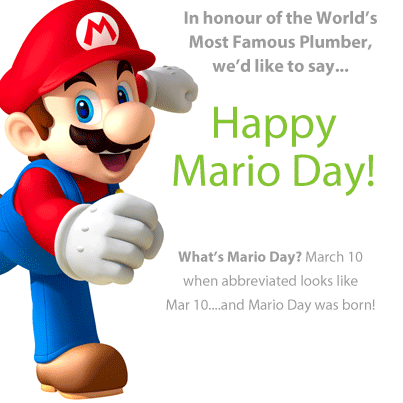
National Mario Day is observed each year on March 10th and honors Mario from the popular Nintendo game.
It is celebrated on March 10th because of the way the date appears, when abbreviated (Mar.10), it looks just like the name Mario.
. 1832 ~ Muzio Clementi died. He was an Italian-born English composer, pianist, pedagogue, conductor, music publisher, editor, and piano manufacturer. He is also the subject of this month’s Piano Explorer, which is enjoyed by my students.
. 1844 ~ Pablo de Sarasate, Spanish violinist
. 1879 ~ Ignaz Moscheles died. He was a Bohemian composer and piano virtuoso
. 1892 ~ Arthur Honegger, French composer
Read quotes by and about Honegger
More information about Honegger
1903 ~ “Bix” Beiderbecke, American jazz cornetist
More information about Beiderbecke
. 1910 ~ Carl Heinrich Carsten Reinecke, composer, died at the age of 85
. 1935 ~ Nelson Eddy recorded Ah! Sweet Mystery of Life for Victor Records. The song came from the film, “Naughty Marietta”. Later, Eddy recorded the classic tune with Jeanette MacDonald.
. 1937 ~ An audience of 21,000 jitterbuggers jammed the Paramount Theatre in New York City to see a young clarinetist whom they would crown, ‘King of Swing’ on this night. The popular musician was Benny Goodman.
. 1940 ~ W2XBS-TV in New York City originated the first televised opera as members of the Metropolitan Opera Company presented scenes from “I Pagliacci”.
. 1956 ~ Julie Andrews was 23 years old this night when she made her TV debut. She appeared with Bing Crosby and Nancy Olson in the musical adaptation of Maxwell Anderson’s play, “High Tor”.
. 1977 ~ E Power Biggs, English organist/composer (CBS), died at the age of 70
. 2003 ~ Lionel Dakers, who directed the Royal School of Church Music for 16 years, died at age 79. Dakers was a stickler for high musical standards and opposed some of the modernizing trends in English church music. Dakers was organist at Ripon Cathedral from 1954 to 1957, then moved to Exeter Cathedral before his appointment as director of the Royal School of Church Music in 1972. In 1976, he was appointed a director of Hymns Ancient & Modern, publisher of some of the most widely used Anglican hymnals.
. 2016 ~ Keith Emerson died. He was an English keyboardist and composer with English rock musician Emerson, Lake & Palmer.
. 2017 ~(Joan) Joni Sledge, vocalist (Sister Sledge “We are Family”), died at the age of 60
. 1887 ~ Heitor Villa-Lobos, Brazilian composer and collector of Brazilian folk songs
More information about Villa-Lobos
. 1917 ~ The first jazz recording for Victor Records was released. The Original Dixieland ‘Jass’ Band performed on the tune The Dixie Jass Band One Step. The word ‘Jass’ was later changed to ‘Jazz‘.
. 1928 ~ Lou Levy, Pianist with Supersax; recorded with Sinatra, Peggy Lee, Nancy Wilson and Anita O’Day
. 1931 ~ Barry Tuckwell, Austrian French-horn player
. 1931 ~ Without a Song was recorded by Lawrence Tibbett for Victor Records. This wonderful melody came from the film, “The Southerner” and has been a hit for many, including Willie Nelson, Frank Sinatra and Tony Bennett.
. 1947 ~ Eddie Hodges, Singer, actor
. 1948 ~ Eddy Grant, Singer, songwriter
. 1950 ~ Eugene Fodor, Violinist, made solo debut at age 10 with the Denver Symphony, won first national competition at age 12, won first prize in International Paganini Competition, won highest prize in International Tchaikovsky Competition
More information about Fodor
. 1958 ~ Andy (Andrew Roy) Gibb, Singer with the Bee Gees, host of TV’s Solid Gold
. 1960 ~ Elvis Presley returned to civilian life after a two-year hitch in the U.S. Army. Not since General Douglas MacArthur returned from battle has a soldier received such publicity. Elvis said he probably would not be growing his famous and long sideburns back, though he did relent in later years.
. 1963 ~ Patsy Cline, Cowboy (Lloyd) Copas and Hankshaw Hawkins were killed in a plane crash at Camden, TN, near Nashville. The famous country music stars were returning from a benefit performance. Cline, the ‘Queen of Country Music’ was elected to the Country Music Hall of Fame in 1973. Jessica Lange played Patsy in the 1985 biographical film, Sweet Dreams, named after one of Cline’s hugely popular songs. Willie Nelson wrote her biggest hit, Crazy, which become a number one country hit and a top 10 pop song in November, 1961.
. 1969 ~ The rock magazine, Creem, was published for the first time this day.
. 1973 ~ Roberta Flack, riding at #1 on the pop music charts with, Killing Me Softly with His Song, could hardly wait to rip into the fancy frame containing her brand new gold record. She flew to the stereo machine and set the needle down on the shiny surface, only to hear Come Softly to Me. She was so impressed by this unexpected turn of the table that she wound up humming the old Fleetwoods song for three days.
. 2016 ~ Nikolaus Harnoncourt, Austrian conductor, particularly known for his historically informed performances of music from the Classical era and earlier, died at the age of 86
. 1766 ~ Samuel Wesley, English organist and composer in the late Georgian period. Wesley was a contemporary of Mozart (1756–1791) and was called by some “the English Mozart.”
. 1771 ~ Johann Baptist Cramer, English musician of German origin. He was the son of Wilhelm Cramer, a famous London violinist and musical conductor, one of a numerous family who were identified with the progress of music during the 18th and 19th centuries.
. 1832 ~ Frederic Chopin’s first Paris concert. The musicologist Arthur Hedley has observed that “As a pianist Chopin was unique in acquiring a reputation of the highest order on the basis of a minimum of public appearances—few more than thirty in the course of his lifetime.”
. 1842 ~ Arrigo Boito, Italian composer, librettist and poet
. 1858 ~ Arnold Dolmetsch, British music antiquarian and musician
. 1932 ~ Michel Legrand, Academy Award-Winning composer for Best Original Score: Yentl in 1983, Brian’s Song, Ice Station Zebra
. 1934 ~ Renata Scotto, Italian soprano. She made her operatic debut at age 18 and is best known for performances as Violetta in La Traviata, Cio-Cio- San in Madama Butterfly, Mimi (and the occasional Musetta) in La Bohème, Lucia in Lucia di Lammermoor, Lady Macbeth in Macbeth and Francesca in Francesca da Rimini. She is also an opera director.
. 1940 ~ Frances Langford recorded one of the classic songs of all time — and one that would become a Walt Disney trademark. When You Wish Upon a Star was recorded on Decca Records during a session in Los Angeles. Many artists have recorded the song, including pop diva Linda Ronstadt (with the Nelson Riddle Orchestra in the early 1980s). One can hear the song not only on record, but as the theme in the opening credits of any Disney movie, video and TV program and those “I’m going to Disneyland/World!” commercials, too.
. 1942 ~ Paul Jones, Harmonica, singer with Manfred Mann
. 1943 ~ Stephen Douglas Burton, American composer and teacher
. 1947 ~ Lonnie Turner, Bass, singer with The Steve Miller Band
. 1964 ~ The musical, “What Makes Sammy Run”, opened in New York at the 54th Street Theatre. Making his Broadway debut in the show was Steve Lawrence. The production ran for 540 performances.
. 1985 ~ Yul Brynner reprised his role in “The King and I” setting a box office record for weekly receipts. The show took in $520,920.
. 1990 ~ Johnnie Ray died. He was an American singer, songwriter, and pianist.
. 1991 ~ Webb Pierce passed away. He was one of the most popular American honky tonk, rockabilly vocalists, guitarists of the 1950s
. 1994 ~ Donald Phillips, pianist/composer, died at the age of 80
. 1653 ~ Arcangelo Corelli, Italian violinist and composer
More information on Corelli
. 1902 ~ Marian Anderson, American contralto
Read quotes by and about Anderson
More information on Anderson
. 1904 ~ Puccini’s opera, Madama Butterfly was first performed at La Scala, the world’s most famous opera house in Milan, Italy.
. 1909 ~ Marjorie Lawrence, Opera soprano: “One of the truest Wagnerian interpreters of our time, unchallenged for the stirring magnificence of her Brunnhilde and the tender simplicity of her Sieglinde, or the stately loveliness of her Elsa and the compelling malevolence of her Ortrud.”
. 1923 ~ Buddy (Boniface) DeFranco, Clarinetist, bandleader. He won all modern jazz music polls in the early 1950s
. 1946 ~ Dodie Stevens (Geraldine Ann Pasquale), Singer
. 1954 ~ Doris Day’s single, Secret Love, became the #1 tune in the U.S. The song, from the motion picture, “Calamity Jane”, stayed at the top of the music charts for three weeks.
. 1962 ~ The Beach Boys started making waves with their first Southern California hit, Surfin’. Their new musical style swept the U.S. like a tidal wave when they hit nationally with Surfin’ Safari in August of this same year.
. 1962 ~ Gene Chandler hit #1 with Duke of Earl on this day. The song stayed at the top for three weeks. It hit #1 on the rhythm & blues charts, as well. Duke of Earl was Chandler’s biggest hit out of a half-dozen he recorded. His only other million-seller came with Groovy Situation in 1970. Curtis Mayfield wrote several hits for Chandler, including Just Be True, What Now and Nothing Can Stop Me. Chandler’s real name is Eugene Dixon. He owned his own record label, Mr. Chand, from 1969 to 1973, though Groovy Situation was recorded in 1970 for Mercury.
. 1966 ~ Staff Sgt. Barry Sadler received a gold record from RCA Victor, for both the album and the single of The Ballad of the Green Berets. Sadler, who recorded one other single (“The “A” Team”) for the label, had served in Vietnam until injuring a leg in a Viet Cong booby trap.
. 1972 ~ Billie Joe Armstrong, Grammy Award-winning singer (1994), guitarist and songwriter with Green Day
. 1998 ~ Bob Merrill passed away. Merrill was an American songwriter, theatrical composer, lyricist, and screenwriter.
. 2010 ~ Kathryn Grayson [Zelma Hedrick], American vocalist and actress (Anchors Aweigh, Kiss Me Kate), died of natural causes at the age of 88
. 2017 ~ Alan Aldridge, British artist, graphic designer and illustrator whose artwork was used in record covers for The Beatles and The Who, died at the age of 73
Presidents’ Day (celebrated on the third Monday in February), was originally established in 1885 in recognition of George Washington. The holiday became popularly known as Presidents’ Day after it was moved as part of the 1971 Uniform Monday Holiday Act, an attempt to create more three-day weekends for the nation’s workers. Presidents’ Day is now popularly viewed as a day to celebrate all U.S. presidents past and present.
Wondering how many U.S. Presidents played musical instruments?
Thomas Jefferson (1743 – 1826) Third president of the United States, drafted the Declaration of Independence, and played the violin and cello.
John Quincy Adams (1767 – 1848) The sixth president of the United States formulated the Monroe Doctrine, and played the flute.
John Tyler (1790-1862) The tenth president of the United States was the first Vice President to become President by the death of his predecessor. He played the violin.
Abraham Lincoln (1809-1865) The sixteenth president of the United States issued the Emancipation Proclamation and played the violin.
Ulysses S. Grant (1822- 1884) The eighteenth president of the United States certainly scrapes the bottom of the list. He was tone deaf and famously commented, “I only know two tunes. One of them is Yankee Doodle and the other isn’t.”
Chester Alan Arthur (1829 – 1886) Became the 21st president of the United States following the assassination of President James A. Garfield. He played the banjo.
Franklin Roosevelt (1882-1945) The 32nd President of the United States and the fifth cousin to President Theodore Roosevelt, played the piano and sang soprano in his school choir.
Woodrow Wilson (1856 – 1924) The 28th president of the United States and creator of the League of Nations, played the violin and sang tenor in his college glee club.
Warren Harding (1865-1923) The 29th president of the United States organized the Citizen’s Cornet Band, available for both Republican and Democratic rallies. He once remarked that, “I played every instrument but the slide trombone and the E-flat cornet.”
Calvin Coolidge (1872-1933) The 30th president of the United States was determined to preserve old moral and economic precepts amid American prosperity. He played the harmonica.
Harry Truman (1884 – 1972) The 33rd president of the United States who served during the conclusion of World War II, played the piano.
Richard Nixon (1913 – 1994) The 37th president of the United States, who ended American fighting in Vietnam and later resigned from office in the aftermath of the Watergate Scandal, was a classically-trained pianist and also played the accordion. He composed and played this piece, set to concerto form with “15 Democratic violinists.” Nixon takes a dig at Harry Truman just before playing.:
Ronald Reagan (1911-2004) The 40th president of the United States implemented the Reagan Revolution, which aimed to reinvigorate the American people and reduce their reliance upon Government. He played the harmonica.
Bill Clinton (born 1946) The 42nd president of the United States and the first Democratic president since Franklin D. Roosevelt to win a second term, plays the saxophone.
Barack Obama (born 1961) The 44th president of the United States and first African American president has broken into song on several recent occasions. President Obama sang Amazing Grace at the funeral for South Carolina State Senator Clementa Pinckney:
. 1709 ~ Charles Avison, English composer during the Baroque and Classical periods. He was a church organist at St John The Baptist Church in Newcastle and at St. Nicholas’s Church.
. 1878 ~ Selim Palmgren, Finnish composer, pianist, and conductor
. 1866 ~ David Mannes, American violinist and conductor; founder of the Mannes College of music
. 1896 ~ Alexander Brailowsky, Pianist
. 1901 ~ Wayne King, ‘The Waltz King’, saxophonist and bandleader
. 1907 ~ Alec Wilder, American composer, arranger and songwriter
. 1910 ~ Albert Heinrich Zabel died. He was a German composer and virtuoso harpist.
. 1915 ~ Emil Waldteufel, [Charles Levy], French composer (Estudiantina), died
. 1916 ~ Bill Doggett, Musician
. 1918 ~ Patti Andrews (Patricia Marie Andrews), Lead singer with The Andrews Sisters
. 1935 ~ Sonny (Salvatore) Bono, Singer in the group Sonny and Cher. He later became mayor of Palm Springs, CA and a US Congressman
. 1938 ~ John Corigliano, American composer
More information about Corigliano
. 1939 ~ Herbie & Harold Kalin, Singers, The Kalin Twins
. 1942 ~ Shep Fields and his orchestra recorded Jersey Bounce on Bluebird Records.
. 1956 ~ James Ingram, Singer
. 1963 ~ The Beatles moved to the top of the British rock charts with Please, Please Me exactly one month after the record was released. It was the start of the Beatles domination of the British music charts, as well as the beginning of the British Invasion in America and elsewhere around the world.
. 1968 ~ Elvis Presley received a gold record for his sacred album of hymns, How< Great Thou Art. Despite his popularity in the pop music world, Elvis won only 3 Grammy Awards — one for this album, the Lifetime Achievement Award in 1970; then for He Touched Me in 1972. He did, however, receive over a dozen Grammy nominations.
. 1972 ~ Led Zeppelin made their Australian live debut when they kicked off a six-date tour at the Subiaco Oval, Perth. Police battled with over 500 fans who rammed locked gates trying to get into the concert. Over 4,000 fans stood outside the venue without tickets and local residents jammed police phone lines to complain about the noise.
. 2015 ~ Leslie Gore died. She was an American singer. At the age of 16, in 1963, she recorded the pop hit “It’s My Party”, and followed it up with other hits including “Judy’s Turn to Cry” and “You Don’t Own Me”.
. 1714 ~ Gottfried August Homilius, German composer, cantor and organist
. 1789 ~ Armand-Louis Couperin, French composer, organist, and harpsichordist died at the age of 63
. 1875 ~ Fritz Kreisler, Austrian-born American violinist and virtuoso/composer Some of his best-known works are Caprice Viennois, Tambourin Chinois, Liebesfreud and La Gitana
. 1901 ~ Jascha Heifetz, Russian-born American violinist
Read quotes by and about Heifetz
More information about Heifetz
. 1911 ~ Jussi Björling, Swedish tenor
. 1912 ~ Burton Lane (Levy), Composer of How Are Things in Glocca Morra, That Old Devil Moon, Look to the Rainbow, How About You, I Hear Music, Come Back to Me, On a Clear Day You Can See Forever, How Could You Believe Me?; His Broadway musicals were Finian’s Rainbow (collaboration with Yip Harburg), On a Clear Day You Can See Forever (collaboration with Alan Jay Lerner). He contributed songs to over 30 films: Babes on Broadway, Royal Wedding, Ship Ahoy, St. Louis Blues and credited with discovering Judy Garland
. 1927 ~ Stan Getz (Stanley Gayetzby), American jazz tenor saxophonist
. 1937 ~ Tom Smothers, Entertainer, The Smothers Brothers Comedy Hour, The Smothers Brothers Show, The Steve Allen Show, Dick’s Brother
. 1937 ~ Guy Lombardo and his orchestra recorded one of Guy’s most famous tunes. Boo Hoo was waxed on Victor Records and became one of the group’s all-time great hits.
. 1940 ~ Alan Caddy, Guitarist with The Tornados
. 1941 ~ Serge Alexandrovich Tcherepnin, composer
. 1942 ~ Graham Nash, Singer with Crosby, Stills, Nash and Young
. 1947 ~ Peter Lucia, Drummer with Tommy James and The Shondells
. 1949 ~ Ross Valory, Bass with Journey
. 1959 ~ The Coasters tune, Charlie Brown, was released. The tune went to #2 and stayed there for three weeks, but didn’t make it to the top spot of the charts. A catchy song (“Fee fee fi fi fo fo fum. I smell smoke in the auditorium…”), it was on the charts for a total of 12 weeks. The song at number one, preventing Charlie Brown from reaching the top, was Venus, by Frankie Avalon.
. 1996 ~ Gene Kelly, American actor and dancer (Singin’ in the Rain), died at the age of 83
. 2001 ~ French pianist Nicole Henriot, who entered the Paris Conservatory at age 7 and went on to perform around the globe with conductor Charles Munch, died at the age of 75. Emerging on the world music scene after World War II, Henriot built her reputation on interpretations of works from Liszt to Prokofiev, and especially French composers such as Ravel, Fauré and Milhaud. She was most famous for her performances with Munch, music director of the Boston Symphony from 1949 to 1962. Munch, who died in 1968, was the uncle of Henriot’s husband. Born in 1925, Henriot won the Paris Conservatory’s first prize at age 13. During the war, Henriot gave aid to her brother, a member of the French Resistance. When Gestapo agents searched her home in 1944, she managed to destroy her brother’s secret documents but was badly beaten. After the war, Henriot became the first French pianist to appear in Britain and began an international tour that took her from Scandinavia to Egypt. She made her American debut in 1948 as a soloist with the New York Philharmonic under Munch’s direction. When Munch formed the Orchestra of Paris in 1967, Henriot was one of the fledgling orchestra’s first soloists. In the 1970s and 1980s, Henriot devoted herself to teaching, and worked at the Conservatory of Liege, Belgium, and at the Walloon Conservatory of Brussels.
. 2001 ~ Victor Norman, who founded the Eastern Connecticut Symphony Orchestra and conducted the group for three decades, died at the age of 95. Colleagues said Norman was a visionary who needed to be as skilled in politics as he was in music to keep the symphony together. “He had this idea that a symphony orchestra could be created around here, when really it had been tried several times before, never with any kind of significant success,” said Charles Frink, a New London composer who studied with Norman. Norman founded the New London Civic Orchestra in 1946. It merged with the Willimantic Orchestra in 1952 to become the Eastern Connecticut Symphony Orchestra. He stepped down from the podium in 1980. In his retirement, Norman composed music. Two of his orchestral pieces were performed by the New Britain Symphony Orchestra and the Westminster Community Orchestra in Princeton, N.J. His memoirs, “Victor Norman: A Life in Music, a Lifetime of Learning,” were published in 1999.
. 2015 ~ French piano virtuoso Aldo Ciccolini died at age 89. Born on August 15, 1925, into a musical family in Naples, Aldo Ciccolini was a child prodigy, beginning composition classes in the city’s conservatory at age nine.
. 1962 ~ Fritz Kreisler died. He was an Austrian-born violinist and composer
. 1966 ~ “Sweet Charity”, with Gwen Verdon, opened at the Palace Theatre in New York City. The musical, by Neil Simon, was an adaptation of the Federico Fellini film, “Notti di Cabiria”. The play ran for 608 performances. In 1969, Hollywood produced a big-budget version of the Broadway musical starring Shirley MacLaine.
. 1973 ~ Johnny Rivers received a gold record for the hit single, Rockin’ Pneumonia and the Boogie Woogie Flu. As is tradition, Rivers removed the fragile gold disk from the wooden frame and, as he was putting it on his stereo, had a ferocious sneezing fit and never did find out how his song sounded in solid gold.
. 1977 ~ From the One-Hit Wonder File, this note: Rose Royce earned the #1 spot on the music charts with Car Wash, from the movie of the same name. The song stayed at the peak of the pop charts for one week, then faded away.
. 1981 ~ Cozy (William Randolph) Cole passed away
. 1996 ~ The 6,138th performance of “Cats” was held in London, surpassing the record of Broadway’s longest-running musical, “A Chorus Line”
. 2001 ~ Suzanne Bloch, a concert chamber musician and teacher at the Juilliard School, died at her home. She was 94. Bloch played and taught ancient instruments, in particular the lute, a guitar-like instrument common in 18th-century Europe. Mostly self-taught, she also played the recorder and the virginal, a tiny relative of the harpsichord. Beginning in the late 1930s, she performed frequently in concert, often dressed in Renaissance costume. She taught classes at Juilliard from 1942 to 1985. After marrying Paul Smith, a mathematician who became chairman of Columbia University’s mathematics department, Bloch played chamber music with well-known scientists, including Albert Einstein. Born in Geneva, Bloch moved to New York with her family in 1916, when her musician father, Ernest Bloch, began teaching and conducting in the United States. Bloch promoted her father’s music throughout her life, collecting clippings, writing program notes and founding the Ernest Bloch Society in 1967.
. 2015 ~ Rod McKuen, American singer-songwriter (Jean) and poet, died at the age of 81
. 2019 ~ James Ingram, American R&B singer-songwriter and musician (Just Once), died at the age of 66
. 1795 ~ Johann Christoph Friedrich Bach, harpsichordist and composer, the fifth son of Johann Sebastian Bach, died at the age of 62
. 1905 ~ Maria von Trapp, singer
. 1908 ~ Stéphane Grappelli, French jazz violinist
. 1913 ~ Jimmy Van Heusen (Edward Chester Babcock), American songwriter and Academy Award-winning composer. He wrote Swinging on a Star in 1944, All the Way in 1957, High Hopes in 1959 and Call Me Irresponsible in 1963. He also wrote the music to over 75 songs for Frank Sinatra with lyricists Johnny Burke and Sammy Cahn … My Kind of Town and Second Time Around
. 1928 ~ Eartha Kitt, American singer of popular music. See January 17 for Ms. Kitt’s real birthday.
. 1934 ~ Huey “Piano” Smith, American rhythm and blues pianist (Rockin’ Pneumonia & Boogie Woogie Flu, Having a Good Time), born in New Orleans, Louisiana
. 1934 ~ The Apollo Theatre opened in New York City as a ‘Negro vaudeville theatre’. It became the showplace for many of the great black entertainers, singers, groups and instrumentalists in the country.
. 1945 ~ Jacqueline DuPré, British cellist
. 1956 ~ Buddy Holly had his first of three 1956 recording sessions for Decca Records and producer, Owen Bradley, in Nashville. Nothing much came out of those sessions. He formed the group, The Three Tunes (changed later to The Crickets), and went on to find fame and fortune when he hooked up with producer Norman Petty in New Mexico. Holly died in a plane crash near Mason City, IA, February 3, 1959 (“the day the music died”). He was 22. Holly was inducted into the Rock and Roll Hall of Fame in 1986.
. 1979 ~ The Gizmo guitar synthesizer was first demonstrated.
. 1988 ~ “Phantom of the Opera” opened at Majestic Theater in New York City for 4,000+ performances
. 1992 ~ Jose Ferrer, Puerto Rican actor, theater, and film director, died.
. 1995 ~ Geoffrey Penwill Parsons, piano accompanist, died at the age of 65
. 1998 ~ Shinichi Suzuki, Japanese music teacher (Suzuki Method), died at the age of 99
. 2003 ~ John Browning, American pianist (Leventritt Award-1956), died at the age of 69
. 2019 ~ Michel Legrand, French composer, film arranger and jazz musician (Summer of ’42, Windmills of Your Mind), died at the age of 86
. 1889 ~ Huddie “Leadbelly” Ledbetter, American blues guitarist, folk singer and songwriter
. 1891 ~ Mischa Elman, violinist
1894 ~ Walter Hamor Piston, American composer
More information about Piston
. 1899 ~ Alexander Tcherepnin, Composer
. 1922 ~ Ray Anthony (Antonini), Bandleader
. 1926 ~ David Tudor, American pianist and composer of experimental music
. 1935 ~ Buddy Blake (Buddy Cunningham), Recording artist: recorded for Sun Records as B.B. Cunningham and Buddy Blake; record executive: Cover Record Co., Sam Phillips’ Holiday Inn label
. 1941 ~ Ron Townson, Singer with The 5th Dimension
. 1942 ~ Harry Babbitt sang as Kay Kyser and his orchestra recorded, Who Wouldn’tLove You, on Columbia Records. The record went on to be a big hit for Kyser.
. 1947 ~ George Grantham, Drummer with Poco
. 1958 ~ The rock ‘n’ roll classic, Get a Job, by The Silhouettes, was released.
. 1958 ~ Elvis Presley got a little U.S. mail this day with greetings from Uncle Sam. The draft board in Memphis, TN ordered the King to report for duty; but allowed a 60-day deferment for him to finish the film, “King Creole”.
. 1964, The Beatles, a British rock group, released its first LP album, “Meet The Beatles“, in the US record stores. The album turned out to be a super hit and reached #1 position on music charts by early February.
. 1965 ~ John Michael Montgomery, Country singer
. 1965 ~ Alan Freed, the ‘Father of Rock ‘n’ Roll’, died in Palm Springs, CA. Freed was one of the first radio disc jockeys to program black music, or race music, as it was termed, for white audiences. In the 1950s, Freed, at WJW Radio in Cleveland, coined the phrase, “rock ‘n’ roll,” before moving to WABC in New York. He was fired by WABC for allegedly accepting payola (being paid to play records by certain artists and record companies). The 1959-1960 congressional investigation into payola made Freed the scapegoat for what was a widespread practice. Freed, not so incidentally, died nearly penniless after the scandal was exposed.
. 2002 ~ Actress, writer and musician Carrie Hamilton, daughter of actress Carol Burnett, died of cancer. She was 38. Hamilton, whose father was the late producer Joe Hamilton, appeared in the television series “Fame” and had guest roles on other shows, including “Murder She Wrote,” “Beverly Hills 90210” and “thirtysomething.” She also starred in television movies. She and her mother collaborated on a stage version of Burnett’s best-selling memoir “One More Time.” The resulting play, “Hollywood Arms,” will have its world premiere in Chicago in April, said Burnett’s publicist, Deborah Kelman. Hamilton spoke publicly in the ’80s about her struggles with addiction and her decision to go drug-free. She starred as Maureen in the first national touring version of the musical “Rent” and wrote and directed short films through the profit-sharing production company Namethkuf. She won “The Women in Film Award” at the 2001 Latino Film Festival for her short film “Lunchtime Thomas.”
. 2002 ~ John Jackson, who went from gravedigger to one of the pre-eminent blues musicians in the country, died from kidney failure. He was 77. During his long career, Jackson played for presidents and in 68 countries. Jackson earned a living as a cook, a butler, a chauffeur and a gravedigger before his music career took off. He was playing guitar for some friends at a gas station in Fairfax in 1964 when Charles L. Perdue, who teaches folklore at the University of Virginia, pulled in to get some gas. He listened as Jackson taught a song to a mailman he knew. He and Jackson became friends, and Perdue eventually helped launch Jackson’s career by introducing him to people in the music business. The seventh son of 14 children, Jackson had just three months’ education at the first-grade level. But he earned the admiration of fans from all walks of life around the world. B.B. King, Eric Clapton, Bob Dylan, Bonnie Raitt and Pete Seeger are among the performers he has played with and befriended. Among his numerous awards is the National Endowment for the Arts’ Heritage Fellowship Award, which he received in 1986.