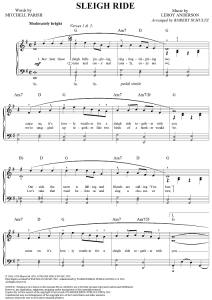
I’ve always liked Leroy Anderson’s Sleigh Ride as a secular Christmas song 🙂 It’s not technically a Christmas song since the words never mention Christmas but it’s often played now so it seems like a way to ease into the season.
Anderson had the original idea for the piece during a heat wave in July 1946; he finished the work in February 1948. Lyrics, about a person who would like to ride in a sleigh on a winter’s day with another person, were written by Mitchell Parish in 1950.
The orchestral version was first recorded in 1949 by Arthur Fiedler and The Boston Pops Orchestra. The song was a hit record and has become the equivalent of a signature song for the orchestra.
A new last year, fun arrangement has been made for piano duet. I have copies here for loan and it’s available on amazon (of course! What isn’t?)
• 1709 ~ Franz Xaver Richter, Austro-Moravian singer, violinist, composer, conductor and music theoretician
• 1879 ~ Gilbert and Sullivan’s operetta, H.M.S. Pinafore, opened. Arthur Sullivan conducted the orchestra while William Gilbert played the role of a sailor in the chorus and in the Queen’s Nay-vee.
• 1913 ~ Mary Martin, American singer and actress, primarily for the musical theater, Tony and Emmy Award-winning actress, mother of actor Larry Hagman
More about Mary Martin
• 1924 ~ Lady Be Good opened in New York City. George Gershwin wrote the music while Fred and Adele Astaire were well-received by the show’s audience for their dancing talents.
• 1936 ~ Lou Rawls (Louis Allen), American Grammy Award-winning singer of popular music, TV regular on Dean Martin Presents
• 1938 ~ Sandy Nelson, Drummer
• 1939 ~ Diane Lennon, Singer with The Lennon Sisters on Lawrence Welk Show,Jimmy Durante Presents the Lennon Sisters
• 1940 ~ Glenn Miller got a call from ASCAP (American Society of Composers and Publishers). He was informed that he couldn’t use his Moonlight Serenade as his band’s theme song. He had to use Slumber Song instead because of an ASCAP ban.
• 1945 ~ Bette Midler, American Grammy Award-winning pop-rock singer and actress
• 1945 ~ Burl Ives made his concert debut. He appeared at New York’s Town Hall. We lovingly listen every year for the voice of this old-time radio personality as the narrator and banjo-pickin’ snowman in TV’s Rudolph the Red-Nosed Reindeer.
• 1968 ~ Promises, Promises opened on Broadway. The play ran for 1,281 performances, earning $35,000 in profits each week of 1969. Dionne Warwick had a hit version of the title song.
. 1954 ~ George McArdle, Bass guitarist with Little River Band
. 1954 ~ June Pointer, Singer with The Pointer Sisters
. 1955 ~ Billy Idol (Broad), Guitarist, singer, songwriter
. 1957 ~ John Aston, Guitarist with these groups: Photons, Psychedelic Furs
. 1957 ~ Richard Barbieri, Drummer with Japan, composer
. 1968 ~ Diana Ross and The Supremes hit the #1 spot on the music charts with Love Child. The somewhat controversial tune (for the times) stayed at the top for two weeks.
. 1971 ~ ABC-TV presented Brian’s Song as the ABC Movie of the Week. The touching story was about Chicago Bears running back Brian Piccolo and his friendship with Gayle Sayers, who watched Brian die a tragic death. The theme song, Brian’s Song, was performed by Michel Legrand.
. 1974 ~ The Eagles hit, Best of My Love, was released. It would take until March 1, 1975 for it to reach the #1 spot on the top 40 charts.
. 1970 ~ Des’ree, Singer
. 1996 ~ Tiny Tim died performing Tiptoe Through the Tulips to an audience at a benefit in Minneapolis, Minnesota. He cut the song short, commenting to his wife, Miss Sue, that he felt ill. As he was making his way with Sue to her table, amidst the applause of his loyal fans, he collapsed, was taken to a Minneapolis hospital and died without regaining consciousness.
1797 ~ Gaetano Donizetti, Italian composer
More information about Donizetti
. 1825 ~ Rossini’s Barber of Seville was presented in New York City. It was the first Italian opera to be presented in the United States.
. 1877 ~ Thomas Alva Edison demonstrated a hand-cranked sound recording phonograph machine that was capable of recording human voice and other sounds.
. 1895 ~ Busby Berkeley (William Berkeley Enos), Director of Forty Second Street, Gold Diggers of 1935, Footlight Parade, Hollywood Hotel, Stage Struck, GoldDiggers in Paris, Babes in Arms, Strike Up the Band, Girl Crazy, Take Me Outto the Ball Game, Babes on Broadway, For Me and My Gal
. 1932 ~ John Gary (Strader), Singer, songwriter, diver, inventor. He holds two patents on underwater propulsion devices – diving buddy and aqua-peller
. 1932 ~ The Gay Divorcee opened in New York City. The Cole Porter musical featured the classic, Night and Day.
. 1933 ~ John Mayall, Songwriter, bandleader
. 1938 ~ Tommy Dorsey and his orchestra recorded Hawaiian War Chant for Victor Records.
. 1939 ~ Meco (Monardo), Musician, music producer
. 1940 ~ Chuck Mangione, American jazz musician (flugelhorn) and Grammy Award-winning composer
. 1941 ~ Denny Doherty, Singer with Mamas and Papas, TV host
. 1944 ~ Felix Cavaliere, Singer with The (Young) Rascals
. 1947 ~ Louis Armstrong and his sextet lit up Carnegie Hall in New York City with a night of jazz and more.
. 1948 ~ The first opera to be televised was broadcast from the Metropolitan Opera House in New York City. Othello, by Verdi, was presented over WJZ-TV.
. 1950 ~ I Fly Anything, starring singer Dick Haymes in the role of cargo pilot Dockery Crane, premiered on ABC Radio. The show only lasted one season and Haymes went back to singing.
. 1951 ~ Barry Goudreau, Guitarist with Orion the Hunter; Boston
. 1968 – Jonathan Rashleigh Knight, Singer, dancer with New Kids on the Block
. 1975 ~ Silver Convention had the #1 pop tune this day, called Fly, Robin, Fly.
. 1986 ~ The blockbuster five-record set, Bruce Springsteen & The E Street Band Live/1975-85, debuted at #1 on the album charts this day. No five-record set had made the top 25 until then. No five-record set had ever gone platinum until then. The price tag? $25.
. 2001 ~ George Harrison, the “quiet Beatle” who added both rock ‘n’ roll flash and a touch of the mystic to the band’s timeless magic, died. He was 58. Harrison died at 1:30 p.m. at a friend’s Los Angeles home following a battle with cancer, longtime friend Gavin De Becker told The Associated Press late Thursday. Harrison’s wife, Olivia Harrison, and son, Dhani, 24, were with him. “He left this world as he lived in it, conscious of God, fearless of death, and at peace, surrounded by family and friends,” the Harrison family said in a statement. “He often said, ‘Everything else can wait but the search for God cannot wait, and love one another.”‘ With the death of Harrison, the band’s lead guitarist, there remain two surviving Beatles, Paul McCartney and Ringo Starr. John Lennon was shot to death by a deranged fan in 1980. “I am devastated and very, very sad,” McCartney told reporters outside his London home Friday. “He was a lovely guy and a very brave man and had a wonderful sense of humor. He is really just my baby brother.” In a statement, Starr said: “George was a best friend of mine. I loved him very much and I will miss him greatly. Both (wife) Barbara and I send our love and light to Olivia and Dhani. We will miss George for his sense of love, his sense of music and his sense of laughter.”
1632 ~ Jean-Baptiste Lully, Italian-born French composer
More information about Lully
1829 ~ Anton Rubinstein, Russian composer and pianist. He founded the Saint Petersburg Conservatory.
More information about Rubinstein
. 1895 ~ Joseé Iturbi, Musician, pianist, conductor of the Rochester Philharmonic Orchestra
. 1915 ~ Dick Vance, Trumpeter
. 1929 ~ Berry Gordy, Jr., Founder of Motown Records
. 1934 ~ Ethel Ennis, Singer with Benny Goodman Orchestra
. 1939 ~ Gary Troxel, Singer with The Fleetwoods
. 1940 ~ Bruce Channel, Singer
1943 ~ Randy (Randall Stuart) Newman, American pop-rock songwriter, singer and pianist
More information about Newman Grammy winner
. 1945 ~ R.B. Greaves, Singer
. 1948 ~ Beeb Birtles, Guitarist with The Little River Band
. 1949 ~ Alexander Godunov, Ballet dancer, actor
. 1949 ~ Paul Shaffer, Band leader on Late Show with David Letterman, comedian
. 1956 ~ Holding the #1 spot on the music charts: Guy Mitchell singing Singing theBlues. The song remained at the top of the Hit Parade for 10 weeks. Here’s a bit of trivia:Ray Conniff whistled the intro to Singing the Blues.
. 1966 ~ The New Vaudeville Band received a gold record for Winchester Cathedral this day.
. 1974 ~ John Lennon appeared in concert for the last time, at NYC’s Madison Square Garden. Lennon joined Elton John to sing Whatever Gets You Through the Night as well as I Saw Her Standing There.
. 1867 ~ Charles (Louis Eug’ne) Koechlin, French composer. He studied under Massenet and Fauré at the Paris Conservatoire. He excelled in colourful and inventive orchestration in his symphonies, symphonic poems, choral- orchestral works (including seven based on Kipling’s Jungle Book), film music, and works inspired by Hollywood, such as the Seven Stars Symphony. He also wrote prolifically for a wide range of vocal and chamber combinations. His writings included studies of recent French music and treatises on music theory.
. 1900 ~ Leon Barzin, Belgian conductor (NY City Ballet 1948-58)
. 1904 ~ Sir Julius Benedict, German-born English conductor and composer
. 1912 ~ David Merrick (Margulois), Broadway producer of Gypsy, Hello, Dolly!,Beckett, Oliver, Fanny, Stop the World: I Want to Get Off, 42nd Street
. 1944 ~ Dozy (Trevor Davies), Bass with Dave Dee, Dozy, Beaky, Mick and Tich
. 1944 ~ Eddie Rabbitt, Songwriter, Kentucky Rain for Elvis Presley; singer, his 17 albums garnered 26 #1 country hits and 8 pop hits
. 1953 ~ Boris Grebenshikov, Russian rock musician
. 1959 ~ Charlie Burchill, Guitarist with Simple Minds
. 1967 ~ The Association, a California group, earned a gold record for the hit Never My Love, on Warner Bros. Records. The group also earned worldwide fame for other hits including Windy, Cherish and Along Comes Mary.
. 1982 ~ The #1 song in the U.S. was former Commodore Lionel Richie’sTruly. The love song stayed at the top of the charts for two weeks. The song was his first solo hit and followed Endless Love, a duet with Diana Ross in 1981.
. 2000 ~ Walter Bailes, a member of the popular 1940s-era Grand Ole Opry duo The Bailes Brothers, died at the age of 80. Walter Bailes, a West Virginia native, and his brother Johnny were the classic Bailes Brothers duo. Brothers Kyle and Homer also performed with the group over the years in varying combinations. Walter wrote much of the group’s material, including popular songs like Dust on the Bible and I Want to be Loved. During their run on the Grand Ole Opry from 1944 to 46, they were among the show’s most popular acts. Kitty Wells, Flatt & Scruggs, and The Everly Brothers all recorded songs written by Walter Bailes. The Bailes Brothers left the Opry in 1946 and moved to Shreveport, La., where they helped launch the Louisiana Hayride radio show. They continued to occasionally perform throughout the 1950s.
. 1980 ~ “Wings Over America” premiered in New York City. The movie is about the first American tour of Paul McCartney and Wings.
. 2001 ~ Paul Hume, a music critic who once drew the ire of President Harry Truman after he panned his daughter’s recital, died of pneumonia at his home in Baltimore. Hume was 85. Hume worked for The Washington Post and built a reputation as one of the most learned critics in the nation. Classical music legends Vladimir Horowitz, Eugene Ormandy and Leonard Bernstein all held Hume in high esteem. Hume will always be remembered for his review of a recital by Truman’s daughter, Margaret, in 1950, in which he criticized her singing as flat. After reading the review, Truman wrote an angry, threatening letter to Hume. Truman’s remarks got him in hot water with the public, which felt he shouldn’t take time to joust with critics as the nation fought the Korean War. A Chicago native, Hume taught music history at Georgetown University from 1950 to 1977 and was a visiting professor at Yale University from 1975 to 1983. He wrote several books, including a study of Catholic church music and a biography of Giuseppe Verdi.
. 2003 ~ Meyer Kupferman, a prolific composer whose work ranged from contemporary classical music to opera, ballet and jazz, died. He was 77. Kupferman, a virtuoso clarinetist, taught composition and music theory at Sarah Lawrence College, where he was a staff member from 1951 to 1993. During his tenure there, he also served as chair of the music department and conducted the orchestra, chorus and chamber improvisation ensemble. In 1948 Kupferman wrote both his first piano concerto and opera. In all, he produced seven operas, 12 symphonies, nine ballets, seven string quartets, 10 concertos and hundreds of chamber works. His compositions have been performed and recorded worldwide. Kupferman also was commissioned by the Hudson Valley Philharmonic to write ‘FDR’ for the centennial of Franklin Roosevelt’s birth. The manuscript of the piece is now held by the Roosevelt Library. William Anderson, a family friend and a guitarist who performed Kupferman’s music, told the New York Times that Kupferman died of heart failure.
“The New-England Boy’s Song about Thanksgiving Day”, also known as “Over the River and Through the Wood”, is a Thanksgiving poem by Lydia Maria Child originally published in Flowers for Children, Volume 2.
Although many people sing “to grandmother’s house we go,” the original edition shows that the author’s words were “to grandfather’s house.”
This poem celebrates the author’s childhood memories of visiting her Grandfather’s House.
Over the river, and through the wood,
To grandfather’s house we go;
The horse knows the way,
To carry the sleigh,
Through the white and drifted snow.
Over the river, and through the wood,
To grandfather’s house away!
We would not stop
For doll or top,
For ‘t is Thanksgiving day.
Over the river, and through the wood,
Oh, how the wind does blow!
It stings the toes,
And bites the nose,
As over the ground we go.
Over the river, and through the wood,
With a clear blue winter sky,
The dogs do bark,
And children hark,
As we go jingling by.
Over the river, and through the wood,
To have a first-rate play—
Hear the bells ring
Ting a ling ding,
Hurra for Thanksgiving day!
Over the river, and through the wood—
No matter for winds that blow;
Or if we get
The sleigh upset,
Into a bank of snow.
Over the river, and through the wood,
To see little John and Ann;
We will kiss them all,
And play snow-ball,
And stay as long as we can.
Over the river, and through the wood,
Trot fast, my dapple grey!
Spring over the ground,
Like a hunting hound,
For ‘t is Thanksgiving day!
Over the river, and through the wood,
And straight through the barn-yard gate;
We seem to go
Extremely slow,
It is so hard to wait.
Over the river, and through the wood,
Old Jowler hears our bells;
He shakes his pow,
With a loud bow wow,
And thus the news he tells.
Over the river, and through the wood—
When grandmother sees us come,
She will say, Oh dear,
The children are here,
Bring a pie for every one.
Over the river, and through the wood—
Now grandmother’s cap I spy!
Hurra for the fun!
Is the pudding done?
Hurra for the pumpkin pie!
I think this poem by Aileen Fisher says it best… ~ All In A Word ~
T
turkey, talk, and tangy weather. H
for harvest stored away,
home, and hearth, and holiday. A
for autumn’s frosty art,
and abundance in the heart. N
for neighbors, and November,
nice things, new things to remember. K
for kitchen, kettles’ croon,
kith and kin expected soon. S
for sizzles, sights, and sounds,
and something special that abounds.
That spells THANKS — for joy in living and a jolly good Thanksgiving.
1896 ~ Virgil Thomson, American composer, conductor and music critic Read quotes by and about Thomson
More information about Thomson
. 1924 ~ Paul Desmond, American jazz also saxophonist and composer
. 1925 ~ Derroll Adams, Country singer, played with Jack Elliott
. 1931 ~ Nat Adderley, Musician, cornet, mellophone, French horn, trumpet, brother of Cannonball Adderley
. 1941 ~ Percy Sledge, Singer
. 1949 ~ Rudolph, the Red-Nosed Reindeer, by Johnnie Marks, appeared on the music charts and became THE musical hit of the Christmas season. Although GeneAutry’s rendition is the most popular, 80 different versions of the song have been recorded, with nearly 20,000,000 copies sold.
. 1955 ~ Following a summer at the top of the American pop charts, Rock Around the Clock by Bill Haleyand His Comets became the #1 song in Great Britain.


 1797 ~ Gaetano Donizetti, Italian composer
 Grammy winner


