• 1844 ~ Richard D’Oyly Carte, British impresario; producer of Gilbert and Sullivan operettas. He also founded the Savoy Theater in London.
• 1912 ~ Virgil Fox, Organ virtuoso: credited for bringing the organ “to the forefront among classical concert instruments”
• 1919 ~ Betty Comden, Composer
• 1919 ~ Pete Seeger, American folk singer, banjo player, guitarist and songwriter
• 1924 ~ Joe Ames, Singer with The Ames Brothers
• 1926 ~ Jimmy Cleveland, Composer, musician, trombone
• 1928 ~ Dave Dudley (Pedruska), Country singer
• 1933 ~ James Brown, American rhythm-and-blues singer songwriter, dancer and instrumentalist, The Godfather of Soul, Rock and Roll Hall of Fame in 1986
• 1937 ~ Frankie Valli (Francis Castellucio), Falsetto singer with The Four Seasons
• 1939 ~ Beer Barrel Polka, one of the standards of American music, was recorded by The Andrews Sisters for Decca Records. Patti, Maxine and LaVerne turned this song into a giant hit.
• 1951 ~ In Britain, the King and Queen inaugurated the Festival of Britain on London’s South Bank and also opened the Festival Hall.
• 1956 ~ Most Happy Fella, a musical by Frank Loesser, opened at the Imperial Theatre in New York City. The show, an adaptation of They Knew What They Wanted by Sidney Howard, ran for 676 performances on Broadway.
• 1960 ~ The play, The Fantasticks, opened at the Sullivan Playhouse in New York City. It would later become the longest-running off-Broadway play.
• 1971 ~ NPR, National Public Radio, the U.S. national, non-commercial radio network, was born.
• 1997 ~ Narciso Yepes, famous Spanish classical guitarist, died.
• 2001 ~ Legendary jazz drummer Billy Higgins died at the age of 64. Higgins was one of the most recorded figures in the history of jazz, performing with John Coltrane, Dexter Gordon, Herbie Hancock, Milt Jackson, Charles Lloyd, Pat Metheny, Lee Morgan, Art Pepper and Joshua Redman, among others. He played with pianist Cedar Walton and was involved with the first edition of bassist Charlie Haden’s innovative Quartet West. Higgins came to prominence in the 1950s with saxophonist Ornette Coleman’s free jazz group, which included Haden and trumpeter Don Cherry. Higgins’ drumming laid the foundation for the group’s free jazz flights of fancy. That group sparked a decade of innovation in jazz that was carried on by the Coleman Quartet, Coltrane, George Russell, Charles Mingus and Albert Ayler, among others. Higgins’ ability to adapt his sense of swing to any genre made him one of the most in-demand drummers of the past four decades. Higgins helped found World Stage, a storefront performance space and teaching venue in Los Angeles’ Leimert Park. He was also on the jazz faculty at the University of California, Los Angeles. Higgins was awarded a National Endowment for the Arts Jazz Master’s Fellowship in 1997.
• 2002 ~ Yevgeny Svetlanov, a renowned Russian pianist, composer and former chief conductor of the Bolshoi Theater, died. He was 73. He was born in Moscow in 1928. He graduated from the Gnesinykh Musical- Pedagogical Institute and from the Moscow Conservatory. For several years he was conductor and chief conductor of the Bolshoi Theatre. From 1965 on he was artistic director and chief conductor of the State Symphonic Orchestra of USSR. He composed several symphonies, symphonic poems, chamber music works, and vocal-instrumental works. Svetlanov was the chief conductor of the Bolshoi Theater from 1963 to 1965, when he was named artistic director and chief conductor of the Soviet State Symphony. He was named a People’s Artist of the Soviet Union in 1968 and was awarded the Lenin prize in 1972 and the Order of Lenin 1978. He was given the Soviet State prize for creative achievement in 1983. Svetlanov was born in the Soviet Union in 1928. In 1951, he graduated from the Gnesin Institute of Music. Svetlanov graduated from the Moscow Conservatory in 1955 as a pianist, composer and conductor.
. 1759 ~ George Frideric Handel, organist, violinist and composer, died. Among his best known oratorios are “Saul,” “Israel in Egypt” and the “Messiah”.
. 1900 ~ Salvatore Baccaloni, Opera singer
. 1922 ~ Soprano Jeanette Vreeland sang the first radio concert from an airplane as she flew over New York City.
. 1922 ~ Ali Akbar Khan, Indian composer and maestro sarod player
. 1933 ~ Morton Subotnick, American composer of experimental music
. 1935 ~ Loretta Lynn, American country-music singer, songwriter and guitarist, first woman to earn the CMA’s Entertainer of the Year award; named ACM Artist of the Decade in 1979
. 1941 ~ Hildegarde recorded the standard Darling Je Vous Aime Beaucoup on Decca Records. Hildegarde was the elegant singer with the long white gloves who was accompanied by the Harry Sosnik Orchestra. It took another 14 years, but Nat ‘King’ Cole turned the song into an even bigger hit, landing at number 7 on the pop music charts.
. 1951 ~ Julian Lloyd Webber, British cellist
. 1958 ~ Pianist Van Cliburn was presented on national TV for the first time on NBC’s The Tonight Show with Jack Paar.
. 1958 ~ Laurie London reached the top spot on the music charts with He’s Got theWhole World in His Hands, knocking Perry Como’sCatch a Falling Star down a peg or two.
. 1960 ~ The musical Bye Bye Birdie opened at the Martin Beck Theatre in New York City. Chita Rivera and Dick Van Dyke starred in the Broadway show which ran for 607 performances.
. 1967 ~ Herman’s Hermits, featuring lead singer Peter Noone, went gold with the single, There’s a Kind of Hush. It was a two-sided hit, with the flip-side, NoMilk Today, also receiving considerable play. Hush, however, was a top five song, while the ‘B’ side just made it into the top 40 at number 35.
. 1995 ~ Burl Ives, Oscar-winning actor and singer whose gentle voice helped popularize American folk music, died. He played powerful dramatic roles in movies including “The Big Country,” for which he won an Academy Award for best supporting actor, and “Cat on a Hot Tin Roof.”
I’ve been thinking a bit about shoes lately, specifically organ shoes. Many people probably don’t know that organists usually use special shoes to help them play the pedals on an organ. When I was learning a new piece, I would play barefoot to help feel where my feet should go but when playing in church I always had my Organmaster shoes on.
Organmaster Shoes began in 1976 when an organist, Carol Carlson, struggled to find shoes that would work for organ.
Organmaster Shoes began in 1976 when an organist, Carol Carlson, struggled to find shoes that would work for organ pedaling. She knew that many organists, like herself, were playing in bare feet or slippers. Normal dress shoes did not allow the organist to FEELwhat note the foot was touching and were too slippery on the pedals. After years of searching, she finally decided to design the perfect organ shoes and sell them herself!
Her shoes for Toe-Heel Pedal Technique have a FULL HEEL providing solid contact with the pedals and 1 ¼ inches high to avoid injuring a leg muscle.
The shoes are very secure on the foot while playing the pedals. The women’s shoe has an elasticized strap with a buckle and the men’s shoe is a lace-up dress oxford.
However, it is the SUEDE LEATHER SOLES on the bottom of the shoes which make her shoes so special and which her customers rely on to tell what note the foot is touching. The shoes slide over the pedals, but don’t slip off because the suede provides just the right amount of grip allowing the organist to FEEL his or her way across the pedal board. The shoes also play silently on the pedals.
The shoes were an immediate hit producing an overwhelming response by organists. Very soon the shoes were being shipped all over the world. Many organ teachers tell us they require their students to wear our shoes as well.
Organ legend Virgil Fox took organ shoes to the extreme when he studded the heels with diamonds so that they would sparkle as he was playing Bach’s Gigue Fugue, or as he said “…when I dance the gigue.”
Anyway, shortly after Thanksgiving 2010 our church organist, Bob Chiralo AKA “Mr. Bob” to the kids, learned that he had cancer. During his surgery and treatment, his organ shoes sat neatly behind the organ and I would see them every week at choir rehearsal and Sunday services.
His shoes being there always gave me the hope that he might be back to use them soon.
Tuesday, April 12, 2011, Bob lost his battle with cancer and at choir rehearsal I noticed that his shoes were gone, too. That struck me as so final.
Bob won’t be back with us but I’m sure he’s putting those shoes to good use playing in heaven.
Thanks for all those years of service you provided to our church!
Robert Philip Chiralo died on April 12, 2011 of brain cancer. His wife was at his side, as was Father Alexander Drummond, who administered the Sacraments of the Church and a dear family friend, Jeanne Dalaba.
Bob was born on May 8, 1949 in Reading, Pennsylvania. He was an honor student throughout his school years there and began studying piano at age 8. At age 16, he was certified by the Lutheran Church to serve as an Organist/Choir Director. He continued his organ studies through his undergraduate years and was a lifetime member of the American Guild of Organists, serving in various capacities in that organization. In his deep devotion as a church musician he continuously served at various churches in Pennsylvania, California and most recently as organist at Pender UMC in Fairfax, Virginia.
He was an active Republican grassroots pro-life volunteer, member of the Fairfax County Republican Committee and spent several years as a tour guide at Manassas Battlefield Park. He was a student of world history, particularly military history.
Bob Chiralo had over thirty-five years of technical, management, and business development experience in intelligence and defense with the Federal Government. This began with his early work at the Aerospace Corporation, continued through his employment at Logicon Geodynamics and Logicon Ultrasystems (both now part of TASC, Inc.), and led to his current position at SRI International. Bob established a professional reputation as a pioneer in the area of Measurement and Signature Intelligence, especially in applying the science of sensors to the growing field of overhead sensing systems support for our national security and intelligence communities. This included extensive involvement in the evaluation of new remote sensing and hyperspectral detection technologies and culminating in his role in helping establish the Spectral Information Technology Applications Center (SITAC) to better formalize the evaluation of various new methods in these arenas. Bob’s expertise also led to one of the more interesting assignments of his professional career, his service as a technical advisor on imagery processing in connection with the House of Representatives 1978 investigation of the assassination of President John F. Kennedy.
Bob joined the Washington Office of SRI in 1998 as Intelligence Community Program Development Manager; his responsibilities included support of the company’s business development efforts and Intelligence Community Program Development, including project and program management spanning nearly the entire spectrum of the intelligence and national security communities. He was also quite active professionally. He was a founding member of the Measurement and Signature Intelligence Association, and an officer and past Chairman of the organization, and played a key role in its 2008 reorganization as the Advanced Technical Intelligence Association (ATIA). He was also an active member of the Institute for Electrical and Electronic Engineers (IEEE), the American Society of Photogrammetry and Remote Sensing (ASPRS), the North American Remote Sensing Industries Association (NARSIA) and the National Military Intelligence Association (NMIA). He held a B.A. in Physics from Wittenberg University (1971) and an MS in Electrical Engineering from the University of Pennsylvania (1973) in addition to other ongoing professional studies connected to his work.
He is survived by his wife of 30 years, Monica Dolle Chiralo of Centreville, VA; daughter and son-in-law Monette and Michael Johnstone with grandchildren Melissa Mae and Maxfield Alexander Johnstone of Seattle, WA; parents Anthony Philip and Mary Jane Chiralo of Reading, PA; and brother Joel Anthony Chiralo of Carney, MD.
The Funeral Mass will be held at Saint Andrew the Apostle Catholic Church in Clifton, VA on Monday morning, April 18 at 11:30 with burial following in the Garden of the Blessed Mother at Fairfax Memorial Park. A celebration of his life and music ministry will follow at Pender United Methodist Church in Fairfax. In lieu of flowers, it was his desire that donations be made toThe Jeanne Bussard Center, 555 South Market St., Frederick, MD 21701. This is a facility which serves mentally and physically handicapped adults. It was dear to his heart.
~~
Addendum:
1) Monica says:
“Bob is, indeed, using them (his shoes) – because he is wearing them, with his black cassock, a rosary in his hands and a Phillies’ hat on his head. Sure hope St. Peter isn’t a Yankees fan!”
2) This interview Virgil Fox shows his shoes even better in the first few minutes.
11200137D HOUSE JOINT RESOLUTION NO. 5031Offered April 25, 2011
Celebrating the life of Robert Philip Chiralo.
———-Patron– Hugo———-Unanimous consent to introduce———-WHEREAS, Robert Philip Chiralo of Centreville, a highly respected professional who played a pioneering role in the development of measurement and signature intelligence, died on April 12, 2011; and
WHEREAS, a native of Pennsylvania, Robert “Bob” Chiralo received a bachelor’s degree from Wittenberg University and a master’s degree from the University of Pennsylvania; and
WHEREAS, Bob Chiralo enjoyed a successful career that spanned more than three decades and involved technical, management, and business development work in intelligence and defense with the federal government; and
WHEREAS, Bob Chiralo began his distinguished career at the Aerospace Corporation before moving to Logicon Geodynamics and Logicon Ultrasystems (both now part of TASC, Inc.); in 1998 he joined the Washington Office of SRI International; and
WHEREAS, a brilliant innovator, Bob Chiralo recognized the role that the science of sensors could play in the growing field of overhead sensing systems support for the national security and intelligence communities; and
WHEREAS, Bob Chiralo became actively involved in the evaluation of new remote sensing and hyperspectral detection technologies, eventually helping to establish the Spectral Information Technology Applications Center; and
WHEREAS, highly regarded for his technical expertise, Bob Chiralo proudly served his country in a variety of ways, including working as a technical advisor on imagery processing during the investigation of the assassination of President John F. Kennedy; and
WHEREAS, Bob Chiralo made numerous contributions to his profession through his affiliation with different organizations; he was a founding member of the Measurement and Signature Intelligence Association and played a key role in its 2008 reorganization as the Advanced Technical Intelligence Association; and
WHEREAS, Bob Chiralo was also an active member of the Institute for Electrical and Electronics Engineers, the American Society of Photogrammetry and Remote Sensing, the North American Remote Sensing Industries Association, and the National Military Intelligence Association; and
WHEREAS, Bob Chiralo was a gifted musician who learned to play the organ as a young boy; at the age of 16, he received certification from the Lutheran church as an organist/choir director and continued his organ studies as an undergraduate; and
WHEREAS, a lifetime member of the American Guild of Organists, Bob Chiralo took great pride in serving as a church musician, most recently at Pender United Methodist Church in Fairfax; and
WHEREAS, an active member of the community, Bob Chiralo was a stalwart member of the Fairfax County Republican Committee and spent several years as a tour guide at Manassas National Battlefield Park; and
WHEREAS, a devoted family man, Bob Chiralo will be greatly missed by his wife of 30 years, Monica; daughter, Monette and her family, including two grandchildren; parents, Anthony Philip and Mary Jane; and numerous other family members, friends, and admirers; now, therefore, be it
RESOLVED by the House of Delegates, the Senate concurring, That the General Assembly hereby note with great sadness the loss of a pioneering leader in the intelligence community and respected community supporter, Robert Philip Chiralo; and, be it
RESOLVED FURTHER, That the Clerk of the House of Delegates prepare a copy of this resolution for presentation to the family of Robert Philip Chiralo as an expression of the General Assembly’s respect for his memory.
. 1732 ~ Franz Joseph Haydn, Austrian composer
Listen to Haydn’s music
More information about Haydn
. 1872 ~ Sergei Pavlovich Diaghilev. He was a Russian art critic, patron, ballet impresario and founder of the Ballets Russes.
. 1901 ~ John Stainer died. He was an English composer and organist whose music, though not generally much performed today, was very popular during his lifetime.
. 1935 ~ Herb Alpert, American trumpeter, bandleader (Tijuana Brass), composer, record company executive: the “A” of A&M Records
. 1937 ~ Phil Harris recorded one of his best-known songs in Los Angeles, CA. That’s What I Like About the South was recorded on a 78 RPM disk. Harris would move to TV stardom and continue as a popular vocalist during the 1950s with such hit songs as The Thing.
. 1943 ~ The show, Away We Go, was renamed. The show opened at the St. James Theatre in New York City and, thanks to the talents of stars like Alfred Drake, Joan Roberts and Howard DeSilva, it became an instant hit. The show ran for 2,248 performances, until 1948. The musical, which has grossed millions of dollars on stage and as a blockbuster movie was initially produced for the sum of $75,000. It is still legendary among musical productions – especially after it was retitled Oklahoma!
. 1944 ~ Rod Allen (Rodney Bainbridge), Bass, singer with The Fortunes
. 1944 ~ Mick Ralphs, Guitarist
. 1945 ~ Al Nichol, Guitarist, keyboards with The Turtles
. 1953 ~ Sean Hopper, Keyboards with Clover and Huey Lewis and The News
. 1959 ~ Angus Young, Guitarist with AC/DC
. 1967 ~ Jimi Hendrix burned his guitar for the first time in a public performance at Finsbury Park in London.
. 1985 ~ Tootsie’s Orchid Lounge, long a favorite of country music stars, closed its doors in Nashville, TN.
. 1788 ~ Charles Wesley, writer of over 5,500 hymns and, with his brother John, the founder of Methodism, died.
. 1871 ~ The Royal Albert Hall in London opened
. 1878 ~ Albert Von Tilzer, Composer. He was the composer of “Take Me out to the Ball Game” among other old favorites.
More information about Von Tilzer
. 1879 ~ “Eugene Onegin”, best-known opera by Russian composer Tchaikovsky, was first performed at the Maliy Theatre in Moscow
. 1902 ~ Sir William Walton, British composer
More information about Walton
. 1906 ~ E. Power Biggs, English Organist
. 1918 ~ Pearl Mae Bailey, American jazz singer, lead in black cast of Hello Dolly
. 1936 ~ Richard Rodney Bennett, British composer
. 1947 ~ Bobby Kimball (Toteaux), Singer with Toto
. 1949 ~ Michael Brecker, Jazz musician, reeds with The Brecker Brothers
. 1951 ~ The King and I, the wonderful Rodgers and Hammerstein musical based on Margaret Langdon’s novel, Anna and the King of Siam, opened this night in 1951 on Broadway. The King and I starred Yul Brynner in the role of the King of Siam. The king who, along with his subjects, valued tradition above all else. From this day forward, the role of the King of Siam belonged to Yul Brynner and no other. Brynner appeared in this part in more than 4,000 performances on both stage and screen (the Broadway show was adapted for Hollywood in 1956). Anna, the English governess hired to teach the King’s dozens of children, was portrayed by Gertrude Lawrence. Ms. Lawrence and Mr. Brynner acted, danced and sang their way into our hearts with such memorable tunes as Getting to Know You, Shall We Dance, Hello, Young Lovers, I Whistle a HappyTune, We Kiss in a Shadow, I Have Dreamed, Something Wonderful, A Puzzlement and March of the Siamese Children. The King and I ran for a total of 1,246 outstanding performances at New York’s St. James Theatre.
. 1952 ~ Roy Henderson’s last singing performance was on this date in the role of Christus in Bach’s “St. Matthew Passion” at Southwark Cathedral, the Anglican cathedral on the south bank of the Thames in London.
. 1973 ~ Hommy, the Puerto Rican version of the rock opera Tommy, opened in New York City. The production was staged at Carnegie Hall.
. 1973 ~ After recording On the Cover of ‘Rolling Stone’, Dr. Hook finally got a group shot on the cover of Jann Wenner’s popular rock magazine. Inside, a Rolling Stone writer confirmed that members of the group (Dr. Hook and the Medicine Show) bought five copies of the magazine for their moms – just like in the song’s lyrics!
. 1980 ~ Annunzio Paolo Mantovani, Anglo-Italian conductor and arranger, died. Created the “Mantovani sound” that made him a highly successful recording artist and concert attraction.
. 1982 ~ Carl Orff, German composer of “Carmina Burana,” died.
. 1999 ~ Legendary U.S. jazz and blues singer Joe Williams died aged 80.
. 2001 ~ John Lewis, a pianist who masterminded one of the most famous ensembles in jazz, the Modern Jazz Quartet, died at the age of 80. The M.J.Q., as the quartet was known, remained mostly unchanged from the mid-1950’s to the 90’s. It began recording in 1952 with Lewis, vibraphonist Milt Jackson, bassist Percy Heath and drummer Kenny Clarke. When Clarke moved to Paris in 1955, Connie Kay replaced him and the quartet continued until Kay’s death in 1994. Lewis contributed the bulk of the group’s compositions and arrangements, including Django and Two Degrees East, Three Degrees West, and he insisted members wear tuxedos to dignify jazz as an art. He was born in LaGrange, Ill., in 1920, and grew up in Albuquerque, N.M. His entree to the jazz world came during World War II, when he met Kenny Clarke, an established drummer in the nascent bebop movement. At Clarke’s urging, Lewis moved to New York after his discharge and eventually replaced Thelonious Monk as Dizzy Gillespie’s pianist. He also performed or recorded with Charlie Parker, Lester Young and Ella Fitzgerald. In 1952 he formed the M.J.Q. with Clarke, Jackson and Heath. The quartet was a steady seller of records and concert tickets well into the 1970’s. Lewis also taught music at Harvard and the City College of New York, and in the late 1950’s helped found the Lenox School of Jazz in Massachusetts.
. 1905 ~ Nadia Boulanger made her public concert debut at the piano.
. 1924 ~ Christa Ludwig, German mezzo-soprano
. 1935 ~ Theresa Berganza, Spanish mezzo-soprano
. 1937 ~ David Del Tredici, American composer
. 1942 ~ Fats Waller recorded The Jitterbug Waltz in New York for Bluebird Records. The Jitterbug Waltz was inspired by some piano exercises that Waller’s son Maurice had been practicing on the piano.
. 1955 ~ The Ballad of Davy Crockett, by Bill Hayes, reached the number one spot on the pop music charts and stayed for five weeks beginning this day. The smash hit song sold more than 7,000,000 records on more than 20 different labels. Everyone seemed to be singing the song that saluted the frontier hero who was “Born on a mountain top in Tennessee…” Coonskin caps were seen everywhere as the Crockett craze spread like a frontier fire.
. 1963 ~ Peter, Paul and Mary released the single, Puff The Magic Dragon.
. 1971 ~ Simon & Garfunkel’s Bridge Over Troubled Water LP and single won six Grammys including Record, Song and Album of the Year. Aretha Franklin won the Best Female R&B Performance Grammy for Don’t Play That Song. B.B. King won the Best Male R&B Vocal Performance Grammy for The Thrill Is Gone.
. 1985 ~ A Chorus Line played performance number 4,000 this night at New York’s famed Shubert Theatre. The show originally opened in July, 1975, and became the longest-running show to light up the Great White Way in September, 1983.
. 1999 ~ Honoring a roster of music artists that range from The Beatles to the Backstreet Boys, the Recording Industry Association of America presented the first Diamond Awards, given in recognition of albums and singles that have sold a million copies or more.
. 1999 ~ Clarence “Gatemouth” Brown and the late Roosevelt Sykes were inducted into the Blues Foundation Hall of Fame.
. 1681 ~ Georg Philipp Telemann, German composer. One of the leading composers of the German Baroque, Georg Philipp Telemann was immensely prolific and highly influential. He wrote an opera at age 12, produced it at school, and sang the lead. His mother put all his instruments away and forbade further music. However, he continued to study and write in secret. He led a remarkably busy life in Hamburg, teaching, composing two cantatas for each Sunday, leading a collegium, and writing immense amounts of additional music. For two centuries musical scholars tended to look down on him by comparison with Bach, but from the midpoint of the twentieth century his reputation soared as musicologists began cataloging his immense output, uncovering masterpiece after masterpiece.
More information about Telemann
. 1727 ~ Johann Gottlieb Goldberg, German virtuoso harpsichordist, organist, and composer of the late Baroque and early Classical period
. 1804 ~ Johann Strauss, Sr., Austrian composer; “The Father of the Waltz”
Read quotes by and about Strauss
More information about Strauss
. 1864 ~ (John Luther) Casey Jones, railroad engineer, subject of The Ballad of Casey Jones, killed in train crash Apr 30, 1900
. 1879 ~ Albert Einstein, Mathematician and enthusiastic amateur violinist
Read quotes by and about Einstein
. 1885 ~ “The Mikado,’ the comic operetta by Gilbert and Sullivan, premiered at the Savoy Theater, London.
. 1912 ~ Les Brown, Bandleader, Les Brown and His Band of Renown
. 1922 ~ Les Baxter, Bandleader
. 1931 ~ Phil Phillips (Baptiste), Singer
. 1933 ~ Quincy Delight Jones, Jr., American jazz composer, trumpeter, band leader and pianist. He composed film scores, TV show themes; record producer; arranger; 25 Grammys, Grammy’s Trustees Award in 1989, Grammy’s Legends Award in 1990; Musical Director for Mercury Records, then VP; established Qwest Records
. 1934 ~ Shirley Scott, Swinging, blues-oriented organist, recorded mostly with former husband Stanley Turrentine
. 1941 ~ Years before Desi Arnaz would make the song Babalu popular on the I Love Lucy TV show, Xavier Cugat and his orchestra recorded it with Miguelito Valdes doing the vocal. The song was on Columbia Records, as was the Arnaz version years later.
. 1945 ~ Walter Parazaider, Reeds with Chicago
. 1955 ~ Boon Gould, Guitarist with Level 42
. 1958 ~ The Recording Industry Association of America (RIAA) certified the first gold record. It was Perry Como’sCatch A Falling Star on RCA Victor Records. The tune became the first to win million-seller certification, though other songs dating as far back as the 1920s may have sold a million records or more. Due to lack of a certification organization like the RIAA, they weren’t awarded the golden platter. The next three gold records that were certified after Perry Como’s million seller were the 45 rpm recordings of He’s Got the Whole World in His Hands by Laurie London, Patricia, an instrumental by the ‘Mambo King’, Perez Prado and Hard Headed Woman by Elvis Presley. The first gold-album certification went to the soundtrack of the motion picture, Oklahoma!, featuring GordonMacRae. Is there really a gold record inside the wooden frame presented to winners? Those who know say, “No.” Its a gold-leaf veneer of maybe 18 kt. gold and/or it is a record painted gold. Yes, the song earning the award is supposed to be the one making up the gold record, but this is not always the case, according to several artists who have tried to play theirs.
. 1959 ~ Elvis Presley made the album charts, but no one would have known by the title of the disk. For LP Fans Only was the first LP ever issued without the artist’s name to be found anywhere on the cover — front or back.
. 1976 ~ Busby Berkeley, U.S. director and choreographer, died. He was best known for his lavish mass choreography in the films “42nd Street,” “Gold Diggers of 1933” and “Roman Scandals.”
. 1985 ~ Bill Cosby captured four People’s Choice Awards for The Cosby Show. The awards were earned from results of a nationwide Gallup Poll. BarbaraMandrell stunned the audience by announcing that she was pregnant while accepting her second award on the show. Bob Hope won the award as All-Time Entertainer beating Clint Eastwood and Frank Sinatra for the honor.
. 2016 ~ Sir Peter Maxwell Davies died. He was an English composer and conductor.
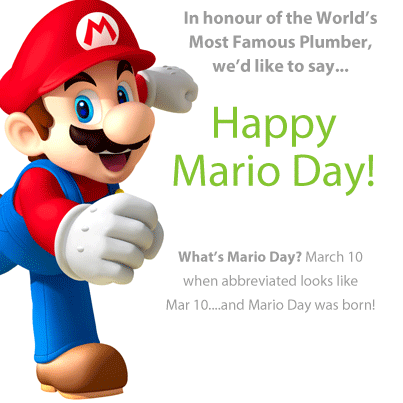
National Mario Day is observed each year on March 10th and honors Mario from the popular Nintendo game.
It is celebrated on March 10th because of the way the date appears, when abbreviated (Mar.10), it looks just like the name Mario.
. 1832 ~ Muzio Clementi died. He was an Italian-born English composer, pianist, pedagogue, conductor, music publisher, editor, and piano manufacturer.
. 1844 ~ Pablo de Sarasate, Spanish violinist
. 1879 ~ Ignaz Moscheles died. He was a Bohemian composer and piano virtuoso
. 1892 ~ Arthur Honegger, French composer
Read quotes by and about Honegger
More information about Honegger
1903 ~ “Bix” Beiderbecke, American jazz cornetist
More information about Beiderbecke
. 1935 ~ Nelson Eddy recorded Ah! Sweet Mystery of Life for Victor Records. The song came from the film, “Naughty Marietta”. Later, Eddy recorded the classic tune with Jeanette MacDonald.
. 1937 ~ An audience of 21,000 jitterbuggers jammed the Paramount Theatre in New York City to see a young clarinetist whom they would crown, ‘King of Swing’ on this night. The popular musician was Benny Goodman.
. 1940 ~ W2XBS-TV in New York City originated the first televised opera as members of the Metropolitan Opera Company presented scenes from “I Pagliacci”.
. 1956 ~ Julie Andrews was 23 years old this night when she made her TV debut. She appeared with Bing Crosby and Nancy Olson in the musical adaptation of Maxwell Anderson’s play, “High Tor”.
. 2003 ~ Lionel Dakers, who directed the Royal School of Church Music for 16 years, died at age 79. Dakers was a stickler for high musical standards and opposed some of the modernizing trends in English church music. Dakers was organist at Ripon Cathedral from 1954 to 1957, then moved to Exeter Cathedral before his appointment as director of the Royal School of Church Music in 1972. In 1976, he was appointed a director of Hymns Ancient & Modern, publisher of some of the most widely used Anglican hymnals.
. 2016 ~ Keith Emerson died. He was an English keyboardist and composer.
. 1727 ~ Armand-Louis Couperin, French composer, organist, and harpsichordist of the late Baroque and early Classical periods.
. 1890 ~ Dame Myra Hess, British pianist
. 1929 ~ Tommy Newsom, Musician: tenor sax, arranger, composer, back-up conductor for NBC’s Tonight Show Band
. 1943 ~ George Harrison, British rock singer, guitarist and songwriter and former member of The Beatles group
. 1952 ~ The complete choreographic score of Cole Porter’s “Kiss Me Kate” became the first musical choreography score given a copyright. The work was the effort of Hanya Holm.
. 1953 ~ The musical, “Wonderful Town”, opened at the Winter Garden Theatre in New York City. The show was based on the book, “My Sister Eileen”, and the ran for 559 performances.
. 1957 ~ Buddy Holly and The Crickets traveled to Clovis, NM, to record That’ll Be the Day (one of the classics of rock ‘n’ roll) and I’m Looking for Someone to Love. Both songs were released on Brunswick Records in May of that year.
. 1963 ~ Please Please Me was the second record released in the U.S. by The Beatles. Some labels carried a famous misprint, making it an instant, and valuable, collector’s item. The label listed the group as The Beattles.
. 1986 ~ We are the World captured four Grammy Awards. The song, featuring more than 40 superstar artists gathered at one time, was awarded the Top Song, Record of the Year, Best Pop Performance and Best Short Video Awards.
. 2001 ~ Ann Colbert, a manager of classical musicians, died at the age of 95. Colbert founded Colbert Artists Management Inc. Her clientele included the Juilliard String Quartet; conductors Sir Georg Solti, Christoph von Dohnanyi and Richard Bonynge; singers Dame Joan Sutherland, Elizabeth Schwarzkopf, Christa Ludwig and Dietrich Fischer-Dieskau; and musicians Alfred Brendel and the late Jean-Pierre Rampal. Colbert moved to the United States from Berlin in 1936 and started the management company with her husband, Henry Colbert, in 1948. She retired in 1991, leaving the company to her longtime associate, Agnes Eisenberger. The company has retained Colbert’s name.
. 2003 ~ Walter Scharf, 92, a composer who earned 10 Academy Award nominations and worked on more than 200 movies and television programs, including “Funny Girl,” “Mission: Impossible” and “White Christmas,” died in Los Angeles. He received Oscar nominations for the scores for such films as “Mercy Island” (1941), “Hans Christian Andersen” (1952), “Funny Girl” (1968), “Willy Wonka and the Chocolate Factory” (1971) and “Ben” (1972). He won an Emmy for his work on a National Geographic television special and a Golden Globe for “Ben,” whose theme song helped launch singer Michael Jackson’s solo career.
. 1766 ~ Samuel Wesley, English organist and composer in the late Georgian period. Wesley was a contemporary of Mozart (1756–1791) and was called by some “the English Mozart.”
. 1771 ~ Johann Baptist Cramer, English musician of German origin. He was the son of Wilhelm Cramer, a famous London violinist and musical conductor, one of a numerous family who were identified with the progress of music during the 18th and 19th centuries.
. 1832 ~ Frederic Chopin’s first Paris concert. The musicologist Arthur Hedley has observed that “As a pianist Chopin was unique in acquiring a reputation of the highest order on the basis of a minimum of public appearances—few more than thirty in the course of his lifetime.”
. 1842 ~ Arrigo Boito, Italian composer, librettist and poet
. 1858 ~ Arnold Dolmetsch, British music antiquarian and musician
. 1932 ~ Michel Legrand, Academy Award-Winning composer for Best Original Score: Yentl in 1983, Brian’s Song, Ice Station Zebra
. 1934 ~ Renata Scotto, Italian soprano. She made her operatic debut at age 18 and is best known for performances as Violetta in La Traviata, Cio-Cio- San in Madama Butterfly, Mimi (and the occasional Musetta) in La Bohème, Lucia in Lucia di Lammermoor, Lady Macbeth in Macbeth and Francesca in Francesca da Rimini. She is also an opera director.
. 1940 ~ Frances Langford recorded one of the classic songs of all time — and one that would become a Walt Disney trademark. When You Wish Upon a Star was recorded on Decca Records during a session in Los Angeles. Many artists have recorded the song, including pop diva Linda Ronstadt (with the Nelson Riddle Orchestra in the early 1980s). One can hear the song not only on record, but as the theme in the opening credits of any Disney movie, video and TV program and those “I’m going to Disneyland/World!” commercials, too.
. 1942 ~ Paul Jones, Harmonica, singer with Manfred Mann
. 1947 ~ Lonnie Turner, Bass, singer with The Steve Miller Band
. 1964 ~ The musical, “What Makes Sammy Run”, opened in New York at the 54th Street Theatre. Making his Broadway debut in the show was Steve Lawrence. The production ran for 540 performances.
. 1985 ~ Yul Brynner reprised his role in “The King and I” setting a box office record for weekly receipts. The show took in $520,920.
. 1990 ~ Johnnie Ray died. He was an American singer, songwriter, and pianist.
. 1991 ~ Webb Pierce passed away. He was one of the most popular American honky tonk, rockabilly vocalists, guitarists of the 1950s



 MaryO'Studio