February 2 in Music History


. 1594 ~ Giovanni Perluigi da Palestrina, Italian composer, died at the age of 68

. 1714 ~ Gottfried August Homilius, German composer, cantor and organist

. 1789 ~ Armand-Louis Couperin, French composer, organist, and harpsichordist died at the age of 63

. 1875 ~ Fritz Kreisler, Austrian-born American violinist and virtuoso/composer Some of his best-known works are Caprice Viennois, Tambourin Chinois, Liebesfreud and La Gitana

. 1901 ~ Jascha Heifetz, Russian-born American violinist
Read quotes by and about Heifetz
More information about Heifetz

. 1911 ~ Jussi Björling, Swedish tenor

. 1912 ~ Burton Lane (Levy), Composer of How Are Things in Glocca Morra, That Old Devil Moon, Look to the Rainbow, How About You, I Hear Music, Come Back to Me, On a Clear Day You Can See Forever, How Could You Believe Me?; His Broadway musicals were Finian’s Rainbow (collaboration with Yip Harburg), On a Clear Day You Can See Forever (collaboration with Alan Jay Lerner). He contributed songs to over 30 films: Babes on Broadway, Royal Wedding, Ship Ahoy, St. Louis Blues and credited with discovering Judy Garland

. 1927 ~ Stan Getz (Stanley Gayetzby), American jazz tenor saxophonist

. 1937 ~ Tom Smothers, Entertainer, The Smothers Brothers Comedy Hour, The Smothers Brothers Show, The Steve Allen Show, Dick’s Brother

. 1937 ~ Guy Lombardo and his orchestra recorded one of Guy’s most famous tunes. Boo Hoo was waxed on Victor Records and became one of the group’s all-time great hits.

. 1940 ~ Alan Caddy, Guitarist with The Tornados

. 1941 ~ Serge Alexandrovich Tcherepnin, composer

. 1942 ~ Graham Nash, Singer with Crosby, Stills, Nash and Young

. 1947 ~ Peter Lucia, Drummer with Tommy James and The Shondells

. 1949 ~ Ross Valory, Bass with Journey

. 1959 ~ The Coasters tune, Charlie Brown, was released. The tune went to #2 and stayed there for three weeks, but didn’t make it to the top spot of the charts. A catchy song (“Fee fee fi fi fo fo fum. I smell smoke in the auditorium…”), it was on the charts for a total of 12 weeks. The song at number one, preventing Charlie Brown from reaching the top, was Venus, by Frankie Avalon.

. 1996 ~ Gene Kelly, American actor and dancer (Singin’ in the Rain), died at the age of 83

. 2001 ~ French pianist Nicole Henriot, who entered the Paris Conservatory at age 7 and went on to perform around the globe with conductor Charles Munch, died at the age of 75. Emerging on the world music scene after World War II, Henriot built her reputation on interpretations of works from Liszt to Prokofiev, and especially French composers such as RavelFauré and Milhaud. She was most famous for her performances with Munch, music director of the Boston Symphony from 1949 to 1962. Munch, who died in 1968, was the uncle of Henriot’s husband. Born in 1925, Henriot won the Paris Conservatory’s first prize at age 13. During the war, Henriot gave aid to her brother, a member of the French Resistance. When Gestapo agents searched her home in 1944, she managed to destroy her brother’s secret documents but was badly beaten. After the war, Henriot became the first French pianist to appear in Britain and began an international tour that took her from Scandinavia to Egypt. She made her American debut in 1948 as a soloist with the New York Philharmonic under Munch’s direction. When Munch formed the Orchestra of Paris in 1967, Henriot was one of the fledgling orchestra’s first soloists. In the 1970s and 1980s, Henriot devoted herself to teaching, and worked at the Conservatory of Liege, Belgium, and at the Walloon Conservatory of Brussels.

. 2001 ~ Victor Norman, who founded the Eastern Connecticut Symphony Orchestra and conducted the group for three decades, died at the age of 95. Colleagues said Norman was a visionary who needed to be as skilled in politics as he was in music to keep the symphony together. “He had this idea that a symphony orchestra could be created around here, when really it had been tried several times before, never with any kind of significant success,” said Charles Frink, a New London composer who studied with Norman. Norman founded the New London Civic Orchestra in 1946. It merged with the Willimantic Orchestra in 1952 to become the Eastern Connecticut Symphony Orchestra. He stepped down from the podium in 1980. In his retirement, Norman composed music. Two of his orchestral pieces were performed by the New Britain Symphony Orchestra and the Westminster Community Orchestra in Princeton, N.J. His memoirs, “Victor Norman: A Life in Music, a Lifetime of Learning,” were published in 1999.

. 2015 ~ French piano virtuoso Aldo Ciccolini died at age 89. Born on August 15, 1925, into a musical family in Naples, Aldo Ciccolini was a child prodigy, beginning composition classes in the city’s conservatory at age nine.

. 2018 ~ Dennis Edwards, who joined the Temptations in 1968 and sang on a string of the group’s hits including “I Can’t Get Next to You,” “Ball of Confusion” and “Papa Was a Rollin’ Stone” in an initial tenure that stretched to 1977, died at the age of 74

January 17 in Music History

today

. 1712 ~ John Stanley, English composer and organist

. 1728 ~ Johann Gottfried Muthel, German composer and noted keyboard virtuoso

. 1734 ~ François-Joseph Gossec, Belgian composer
More information about Gossec

. 1750 ~ Tomaso Albinioni, Italian composer (Adagio in G Minor), died at the age of 78

. 1876 ~ The saxophone was played by Etta Morgan at New York City’s Olympic Theatre. The instrument was little known at the time in the United States.

. 1913 ~ Vido Musso, Reed instruments, played with Benny Goodman, bandleader: Stan Kenton was his pianist

. 1917 ~ Ulysses Simpson Kay, US composer, born in Tucson, Arizona (d. 1995)

. 1920 ~ George Handy (George Joseph Hendleman), Pianist, composer, arranger for the Boyd Raeburn band, Alvino Rey band, Paramount Studios

. 1922 ~ Betty White, Emmy Award-winning actress on The Mary Tyler Moore Show, singer

. 1926 ~ Moira Shearer, Ballerina

. 1927 ~ Eartha Kitt, Singer. Kitt’s birth certificate listing her actual birthdate as 1/17/27 was found in 1997. She has celebrated her birthday as Jan. 26 (1928) all of her life and says, “It’s been the 26th of January since the beginning of time and I’m not going to change it and confuse my fans.”

. 1941 ~ Gene Krupa and his band recorded the standard, Drum Boogie, on Okeh Records. The lady singing with the boys in the band during the song’s chorus was Irene Daye.

. 1944 ~ Chris Montez, Singer

. 1948 ~ Mick Taylor, Singer, rhythm guitar with The Rolling Stones

. 1955 ~ Steve Earle, Songwriter, singer, guitar

. 1956 ~ Paul Young, Singer

. 1959 ~ Susanna Hoffs, Singer, guitar with The Bangles

. 1960 ~ John Crawford, Singer, bass with Berlin

. 1969 ~ Lady Samantha, one of the very first recordings by Reginald Kenneth Dwight (aka Elton John), was released in England on Philips records. The song floundered, then bombed. The rock group, Three Dog Night, however, recorded it for an album.

. 2001 ~ Pianist and singer Emma Kelly, the “Lady of 6,000 Songs” made famous by the book “Midnight in the Garden of Good and Evil,” died from a liver ailment at the age of 82. Kelly’s nightclub act, in which she tapped her vast repertoire of American popular standards five nights a week until she became ill a month ago, was a must-see for Savannah tourists itching to meet a real-life character from author John Berendt’s Southern Gothic best seller. Though the book helped her book performances from New York to Switzerland, Kelly continued to crisscross south Georgia to play church socials and high school graduations, Kiwanis luncheons and wedding receptions. Berendt devoted an entire chapter to Kelly in the 1994 book, describing her as a teetotaling Baptist who would play smoky cocktail lounges Saturday nights and Sunday school classes the next morning. Kelly performed at her own nightclub, Emma’s, in Savannah, for five years in the late 1980s. She then bounced between lounges near the downtown riverfront. She also independently recorded three albums, the last of which were released posthumously, her son said.

. 2001 ~ Jazz musician, composer and conductor Norris Turney, who played alto sax and flute with the Duke Ellington Orchestra and led the Norris Turney Quartet, died of kidney failure at the age of 79. Turney recorded with a number of bands over the years, and toured with Billy Eckstine, Ray Charles and others. He was an original member of the Lincoln target=”_blank”Center Jazz Orchestra directed by Wynton Marsalis. Turney’s lone CD as a band leader, “Big, Sweet ‘N Blue,” was warmly received by jazz critics.

. 2002 ~ Edouard Nies-Berger, the veteran organist and protege of Albert Schweitzer, died at the age of 98. Nies-Berger, who played with the New York Philharmonic, was a native of Strasbourg in Alsace. His father, a church organist, was an associate of Schweitzer. The doctor, philosopher and Nobel laureate was pastor of a nearby church where the teen- age Nies-Berger played occasionally. Nies-Berger moved to New York in 1922 and for the next 15 years played the organ in houses of worship across the country. By the mid-’30s he settled in Los Angeles and performed in the soundtracks of several films, including “The Bride of Frankenstein” and “San Francisco.” He returned to Europe in 1937 to study conducting with Bruno Walter in Salzburg, Austria. After conducting for two years in Latvia and Belgium he returned to the United States. He was named organist of the New York Philharmonic, where he played under the direction of such conductors as Walter, George Szell and Leonard Bernstein. Nies-Berger was reunited with Schweitzer in 1949, when the humanitarian visited the United States. For six years they collaborated on the completion of Schweitzer’s edition of the organ music of Johann Sebastian Bach. After serving at St. Paul’s in Richmond, Nies-Berger returned to Europe for several years to perform as a recitalist and write several books, including a memoir of Schweitzer. In 1991 he was awarded the gold medal of the Art Institute of Alsace, and in 1993 was named a knight of the arts and letters by the French Ministry of Education and Culture.

. 2013 ~ Lizbeth Webb, English soprano, died at the age of 86

January 14 in Music History

today

. 1690 ~ Announcement of the invention of the clarinet.

. 1812 ~ Sigismond Thalberg, composer and one of the most famous virtuoso pianists of the 19th century.

. 1780 ~ François-Joseph Dizi, Flemish harpist and composer. He died sometime in 1840

. 1800 ~ Ludwig von Köchel, Austrian musicographer; compiler of the Mozart catalogue
More information about von Köchel

. 1875 ~ Albert Schweitzer, Alsatian humanitarian, physician, Bach scholar and organist, winner of Nobel Peace Prize in 1952

. 1888 ~ Stephen Heller, Hungarian composer and pianist, died at the age of 74

. 1900 ~ The Giacomo Puccini opera “Tosca” had its world premiere in Rome. The opera made its U.S. debut on February 4, 1901.

. 1908 ~ Russ Columbo, Singer, bandleader, songwriter

. 1917 ~ Billy Butterfield (Charles William Butterfield), Trumpeter, founding member of World’s Greatest Jazz Band

. 1925 ~ Alban Berg’s atonale opera “Wozzeck” premiered in Berlin

. 1929 ~ Billy Walker, Singer, known as the ‘masked singer’

. 1931 ~ Caterina Valente, Singer

. 1936 ~ Harriet Hilliard, vocalist and wife of bandleader Ozzie Nelson, sang Get Thee Behind Me Satan, on Brunswick Records.

. 1938 ~ Jack Jones (John Allan Jones), Singer, son of Allan Jones and wife, actress, Irene Hervey.

. 1939 ~ The program, “Honolulu Bound”, was heard on CBS radio. Phil Baker and The Andrews Sisters were featured on the program.

. 1949 ~ Joaquín Turina, Spanish pianist/conductor/composer (Rima), died at the age of 66

. 1953 ~ Ralph Vaughan WilliamsSinfonia Antartica first performance.

. 1956 ~ Rock ‘n’ roller, Little Richard, was singing the newly released Tutti-Frutti. The Pat Boone version became even more popular as a cover record.

. 1964 ~ A hootenanny was held for the first time at the White House, as the New Christy Minstrels entertained President and Lady Bird Johnson, as well as Italy’s President.

. 1965 ~ Jeanette (Anna) MacDonald passed away.  She was an American singer and actress best remembered for her musical films of the 1930s with Maurice Chevalier and Nelson Eddy

. 1968 ~ LL Cool J (James Todd Smith), Rap singer

January 13 in Music History


. 1683 ~ Johann Christoph Graupner, German harpsichordist and composer of high Baroque music who was a contemporary of Johann Sebastian Bach, Georg Philipp Telemann and George Frideric Handel.

. 1690 ~ Gottfried Heinrich Stolzel, German Baroque composer.

. 1842 ~ Heinrich Hofmann, German pianist and composer

. 1854 ~ The first patent for an accordion was issued to Anthony Fass, of Philadelphia, PA

. 1866 ~ Vasily Sergeyevich Kalinnikov, Russian composer

. 1884 ~ Sophie Tucker (Abuza), Russian-born American burlesque and vaudeville singer

. 1904 ~ Richard Addinsell was born
More information about Addinsell

. 1909 ~ Quentin ‘Butter’ Jackson, Trombonist, played with Duke Ellington

. 1910 ~ Enrico Caruso and Emmy Destinn were heard via a telephone transmitter; rigged by DeForest Radio-Telephone Company to broadcast from the Metropolitan Opera House in New York City.

. 1925 ~ Gwen Verdon (Gwyneth Evelyn Verdon), Dancer, Tony Award-winning Actress

. 1930 ~ Robert ‘Squirrel’ Lester, Singer with The Chi-Lites

. 1938 ~ Singer Allan Jones recorded The Donkey Serenade for Victor Records. The song became the one most often associated with the singer. Allan sang and acted in several Marx Brothers films: “A Night at the Opera”, “A Day at the Races”, but the film that catapulted him to stardom was the operetta, “Firefly”, with Jeanette MacDonald. Singer Jack Jones is the son of Allan and wife, actress Irene Hervey.

. 1941 ~ The four Modernaires joined to sing with the Glenn Miller Band on a permanent basis beginning this day. They had a ‘solo’ hit in 1946 with To Each His Own.

. 1957 ~ Elvis Presley recorded All Shook Up and That’s When Your Heartaches Begin for Victor Records in Hollywood. The former tune became Elvis’ ninth consecutive gold record.

. 1961 ~ Wayne Marshall, English pianist, organist and conductor

. 1962 ~ Singer Chubby Checker set a record, literally, with the hit, The Twist. The song reached the #1 position for an unprecedented second time – in two years. The Twist was also number one on September 26, 1960.

. 2001 ~ Kenneth Haas, the former general manager of the Boston Symphony Orchestra and the Cleveland Orchestra, died after a long illness at the age of 57. Haas was general manager of the Boston orchestra from 1987 to 1996 and was instrumental in appointing Keith Lockhart conductor of the Boston Pops Orchestra. Haas was general manager of the Cleveland Orchestra from 1976 to 1987 after performing the same job for the Cincinnati Symphony Orchestra in 1975. In Cleveland he established the orchestra’s chamber music and recital series.

. 2001 ~ Michael Cuccione, youngest of the five-member spoof boy band 2gether, died at age 16 from complications from Hodgkin’s disease. The teen played Jason “Q.T.” McKnight on the MTV show “2gether,” which poked fun at the boy band craze. His character had a fictional illness, “biliary thrombosis,” but Cuccione really had suffered from Hodgkin’s disease as a child and underwent five months of chemotherapy. The singer-actor set up a cancer research foundation, co-wrote a book with his grandmother and appeared on “Baywatch” as a cancer victim.

January 11 in Music History

today

. 1837 ~ Death of Irish pianist and composer John Field in Moscow, while on tour


. 1843 ~ Francis Scott Key, American lawyer, poet and composer of the lyrics to “Star Spangled Banner” died at the age of 63

. 1856 ~ Charles (Johann Christian) Sinding, Norwegian composer

. 1875 ~Reinhold Moritsevich Glière Russian composer
More information about Glière

. 1895 ~ Laurens Hammond, inventor of the Hammond organ. The sound of the Hammond was used by many rock artists including; Procol Harum, Keith Emerson, Led Zeppelin, The Allman Brothers and The Faces. Hammond died on July 3, 1973.  There is a Hammond organ in the O’Connor Music Studio.

. 1901 ~ Vasily Sergeyevich Kalinnikov died. Kalinnikov was a Russian composer of two symphonies, several additional orchestral works and numerous songs, all of them imbued with characteristics of folksong.

. 1902 ~ Maurice Duruflé, French organist and composer

. 1924 ~ Don Cherry, Singer with Band of Gold

. 1928 ~ Ol’ Man River was recorded on Victor Records by Paul Whiteman and his orchestra. Bing Crosby crooned as the song’s featured vocalist. The tune came from the Broadway musical, “Showboat”.

. 1930 ~ Jack Nimitz, Jazz ‘reed’ musician, toured with Supersax

. 1933 ~ Goldie Hill, Country entertainer, married to country singer, Carl Smith

. 1946 ~ Naomi (Diane) Judd, Grammy Award-winning singer in the duo, The Judds, mother of singers Wynonna and Ashley

. 1949 ~ Dennis (Frederick) Greene, Singer with Sha-Na-Na

. 1958 ~ Vicki Peterson, Guitarist, singer with The Bangles

. 1980 ~ Rupert Holmes was at the top of the pop music charts, with Escape (The Pina Colada Song).

. 1981 ~ Leonard Bernstein began conducting the BR – Bayerischer Rundfunk Symphony Orchestra in Richard Wagner’s “Tristan und Isolde” in Munich’s Hercules Hall. Performed one act at a time, in January, April, and November of 1981, respectively, Bernstein’s “Tristan und Isolde” was telecast live and later released as an audio recording by Philips–to some controversy.

Karl Böhm remarked, with regards to Bernstein’s exaggeratedly slow tempi, “For the first time, someone dares to perform this music as Wagner wrote it.” Böhm’s own recording of the Prelude was four minutes faster.

Upon completion of the project, Bernstein declared, “My life is complete… I don’t care what happens after this. It is the finest thing I’ve ever done.”

. 2003 ~ Mickey Finn, bongo player with 1970s band T.Rex, died at the age of 55. Formed by flamboyant lead singer Marc Bolan in 1967, T.Rex shot to fame with hits such as Get it On, Hot Love and Children of the Revolution in the early 1970s. The band was originally called Tyrannosaurus Rex but the name was shortened to T.Rex in 1970 after Finn joined, replacing original member Steve Took. The band achieved a huge following in Britain — sparking a period of “T.Rextacy” among devoted fans — but achieved more limited popularity in the United States and elsewhere. Credited with introducing the phenomenon of “glam rock” to pop music and influencing artists such as David Bowie, the band played to crowds of up to 100,000 and sold 39 million albums, according to Rolling Stone music magazine.

. 2004 ~ Randy VanWarmer, who recorded the pop hit Just When I Needed You Most and then had a successful career as a songwriter, died. He was 48. Just When I Needed You Most reached No. 4 on Billboard’s pop chart in 1979. VanWarmer, also a guitarist, had written it when he was 18. More recently, VanWarmer wrote I’m in a Hurry (And Don’t Know Why), a No. 1 hit by the country group Alabama in 1992, and I Guess It Never Hurts to Hurt Sometimes, No. 1 by the Oak Ridge Boys in 1984. VanWarmer was born March 30, 1955, in Indian Hills, Colo., and spent much of his childhood in Cornwall, England, after his father died. As a young man he lived in New York City and then Los Angeles before moving to Nashville in 1985. VanWarmer had recently recorded a duet with country singer Razzy Bailey, Sandcastles.

. 2005 ~ Spencer Dryden, drummer for the San Francisco rock band the Jefferson Airplane, died. He was 66.

. 2005 ~ Jimmy Griffin, an Academy Award-winning songwriter and former guitarist for the 1970s pop group Bread, died. He was 61.

January 4 in Music History


National Spaghetti Day on January 4 recognizes that long, thin cylindrical pasta of Italian and Sicilian origin.

Who can forget


OCMS 1710 ~ Giovanni Battista Pergolesi, Italian Composer
More information about Pergolesi

. 1720 ~ Johann Friedrich Agricola, German organist and composer

. 1809 ~ Louis Braille, Inventor of the Braille system which enables the blind to read words and music. When he was only 3, Louise Braille, was permanently blinded in an accident with a leatherworking awl in his father’s saddlemaking shop in Coupvray, France. Several years later, he was admitted to a school for the blind, the Institution Nationale des Jeunes Aveugles. Later, as a teacher at the school, he worked at adapting Charles Barbier’s system of writing with points. Ironically, his method centered around using an awl-like stylus to punch marks in paper that could be felt and interpreted by the blind, allowing them to “read” with their fingertips. Braille’s work went unnoticed until after his death, in poverty, in 1852.

. 1874 ~ Josef Suk, Czech violinist and composer
More information about Suk

. 1928 ~ NBC radio debuted one of radio’s first variety shows. “The Dodge Victory Hour” starred Will Rogers, Paul Whiteman and his Orchestra and singer Al Jolson. The cost to produce this one show was $67,600.

. 1932 ~ NBC Red presented “The Carnation Contented Hour”. The show continued on network radio for 19 years as a showcase for top singers and musicians.

. 1933 ~ Ray Starling, Arranger for Stan Kenton

. 1935 ~ Bert Ambrose and his orchestra recorded the song that became the group’s theme song. It was titled Hors d’oeuvres and was cut in London for Decca Records.

. 1935 ~ Bob Hope was first heard on network radio as part of “The Intimate Revue” with Jane Froman, James Melton and the Al Goodman Orchestra.

. 1936 ~ The first pop music chart based on national sales was published by “Billboard” magazine this day. Joe Venuti, jazz violinist, was at the top of the chart with a little ditty called Stop! Look! Listen!.

1937 ~ Grace Bumbry, American mezzo-soprano
More information about Bumbry

. 1942 ~ John McLaughlin, Rock guitarist

. 1944 ~ Arthur Conley, Singer
More information about Conley

. 1950 ~ RCA Victor announced that it would manufacture long-playing (LP) records. This news came two years after Columbia Records debuted the ‘album’.

. 1954 ~ Elvis Presley strolled into the Memphis Recording Service and put $4 on the counter. He recorded Casual Love and I’ll Never Stand in Your Way, two songs that so impressed record executive Sam Phillips that he had Elvis record his first professional sides for Sun Records the following August.

. 1956 ~ Barney Sumner (Bernie Albrecht) (Dicken), Guitarist, singer

. 1960 ~ Michael Stipe, Grammy Award-winning singer

. 1964 ~Bobby Vinton topped the pop charts with the last #1 single of the pre-Beatles era – “There! I’ve Said Again”

. 1965 ~ The Fender Guitar Company was sold to CBS for $13 million.

. 1979 ~ With a new interest in Beatles music on this day, the Star Club reopened in Hamburg, Germany. None of The Beatles returned to their beginnings to attend the gala opening.

. 2000 ~ Fantasia 2000 Hit Imax Record

. 2001 ~ Les Brown, whose Band of Renown scored a No. 1 hit with Sentimental Journey during America’s big band era of the 1930s and ’40s, died of lung cancer at the age of 88. A conductor-clarinetist whose smooth arrangements of swing melodies transcended changes in musical tastes, Brown was cited in 1996 by the Guinness Book of Records recognized him as the leader of the longest lasting musical organization in pop music history. He started his professional career in 1936, and his Band of Renown was still performing about 60 dates a year as recently as five months ago, often conducted by son Les Brown Jr. Brown formed his Band of Renown in 1936. In the 1940s heyday of swing, Brown never achieved the greatness of Tommy Dorsey, Glenn Miller or Benny Goodman. But the band scored two hit records – Sentimental Journey, with Doris Day as vocalist, and the instrumental I’ve Got My Love to Keep Me Warm. Sentimental Journey, co-written with Ben Homer and Bud Green, became a theme for soldiers returning home from World War II. “The happiest times in my life were the days when I was traveling with Les and his band,” Day said. “I loved Les very much, I am going to miss his phone calls.” Brown’s career included a close association with Bob Hope. In 1950, he joined Hope for the first of 18 Christmas tours to entertain American troops at military bases around the world. Day also participated. “The world has lost a great musician,” Hope said. “I have lost my music man, my sideman, my straight man and a special friend.” As the first president of the Los Angeles chapter of the Academy of Recording Arts and Sciences, Brown helped make the Grammy Awards a televised event. He convinced Hope, Frank Sinatra and Bing Crosby to participate in the first telecast.

. 2004 ~ Jake Hess, a four-time Grammy winner who sang with some of the premier quartets in gospel music and influenced the career of Elvis Presley, died. He was 76. Hess, whose career spanned more than 60 years, is best known to contemporary audiences as a regular member of Bill Gaither’s Homecoming Friends, on various Christian and country music cable channels, including TBN and TNN. Hess joined The John Daniel Quartet in 1943 and reached stardom with The Statesmen Quartet. He was founder of The Imperials and sang with The Masters V. Each of these groups is enshrined in the Southern Gospel Music Hall of Fame, as is Hess. He is also a member of the Alabama Music Hall of Fame. As a teen, Elvis Presley was a regular at Statesmen concerts. Later, Hess was a backup singer on several of Presley’s Grammy-winning albums. When Presley died in 1977, Hess sang at his funeral, as he had at the funeral of country legend Hank Williams in 1953. Peter Guralnick, author of a two-volume biography of Presley, said the rock star always wanted to emulate the voices of Hess and crooner Roy Hamilton.

December 30 ~ This Day in Music History

today

• 1756 ~ Pavel Vranicky, Moravian classical composer

• 1853 ~ Andre-Charles-Prosper Messager, French composer, organist, pianist, conductor and administrator.

• 1859 ~ Josef Bohuslav Foerster, Czech composer of classical music

• 1895 ~ Vincent Lopez, Bandleader, played at NYC’s Astor Hotel, some of the greats started with him: Artie Shaw, Buddy Morrow, Buddy Clark

OCMS 1904 ~ Dmitri Kabalevsky, Russian composer, pianist and conductor
More information about Kabalevsky

• 1910 ~ Paul Frederic Bowles, American composer and novelist

• 1914 ~ Bert Parks (Jacobson), Radio/TV host of Miss America Pageant, Break the Bank, Stop the Music

• 1919 ~ Sir David Willcocks, British organist, conductor and educator

• 1928 ~ Bo Diddley (Otha Ellas Bates McDaniel), Singer

• 1931 ~ Skeeter Davis (Mary Frances Penick), Singer

• 1936 ~ The famous feud between Jack Benny and Fred Allen was ignited. After a 10- year-old performer finished a violin solo on The Fred Allen Show, Mr. Allen said, “A certain alleged violinist should hide his head in shame for his poor fiddle playing.” It didn’t take long for Mr. Benny to respond. The humorous feud lasted for years on both comedian’s radio shows.

• 1937 ~ John Hartford, Grammy Award-winning songwriter, banjo, fiddle, guitar on Glen Campbell’s Good Time Comedy Hour

• 1939 ~ Del Shannon (Charles Westover), Singer, songwriter, inducted into the Rock and Roll Hall of Fame

• 1942 ~ Michael Nesmith, Guitarist with The Monkees, formed The First National Band, movie producer of the first Grammy-winning video

• 1945 ~ Davy Jones (David Thomas Jones), Singer with The Monkees, actor

• 1947 ~ Jeff Lynne, Singer, guitar with The Electric Light Orchestra, songwriter

• 1948 ~ Alfred Drake and Patricia Morrison starred in Kiss Me Kate which opened at the New Century Theatre in New York City. Cole Porter composed the music for the classic play that was adapted from Shakespeare’s comedy, The Taming of the Shrew. The show ran for 1,077 performances on the Great White Way.

• 1942 ~ Frank Sinatra opened at New York’s Paramount Theatre for what was scheduled to be a 4-week engagement (his shows turned out to be so popular that he was booked for an additional 4 weeks). An estimated 400 policemen were called out to help curb the excitement. It is said that some of the teenage girls were hired to scream, but many more screamed for free. Sinatra was dubbed ‘The Sultan of Swoon’, ‘The Voice that Thrills Millions’, and just ‘The Voice’. Whatever he was, it was at this Paramount Theatre engagement that modern pop hysteria was born.

• 1954 ~ Pearl Bailey opened on Broadway in the play, House of Flowers, about two madams with rival bordellos. Diahann Carroll was also cast in the play, written by Truman Capote. Harold Arlen provided the musical score.

• 1969 ~ Peter, Paul and Mary received a gold record for the single, Leaving On a Jet Plane. The song had hit #1 on December 20.

• 1970 ~ Paul McCartney sued the other three Beatles to dissolve the partnership and gain control of his interest. The suit touched off a bitter feud between McCartney and the others, especially his cowriter on many of the Beatles compositions, John Lennon. The partnership officially came to end in 1974.

• 1976 ~ The Smothers Brothers, Tom and Dick, played their last show at the Aladdin Hotel in Las Vegas and retired as a team from show business. Each continued as a solo artist. They reunited years later for another stab at TV (on NBC) plus concert appearances that proved very successful.

• 1979 ~ Richard Rodgers passed away
More about Richard Rodgers

• 2000 ~ Bohdan Warchal, a violinist and conductor who was one of Slovakia’s most popular musicians, of an unspecified illness at the age of 70. A violinist in the Slovak Philharmonic, Warchal, who died on Saturday, won acclaim as the founder and conductor of the Slovak Chamber Orchestra, which has given concerts all over the world ever since it was established in 1960. Warchal was awarded a medal by President Rudolf Schuster for his life-time work last year.

• 2003 ~ Hong Kong’s Canto-pop diva and actress Anita Mui died. She was 40 years old. Mui began her career after winning a singing contest in Hong Kong in 1982. She rose to stardom with her song Homecoming in 1984. Canto-pop refers to hits sung in Cantonese, the dialect of Chinese that is widely spoken in Hong Kong and in many overseas Chinese communities. Mui also turned to acting and won Taiwan’s Golden Horse film award for best actress in 1987 for her role as a tormented ghost in the movie “Rouge.”

2004 ~ Artie Shaw (Arthur Arschawsky), American jazz clarinetist, bandleader, composer and arranger died
More information about Shaw

December 24 ~ This Day in Music History

today

Christmas Music: O Holy Night

• 1719 ~ Johann Christoph Altnikol, German organist, bass singer, and composer. He was a son-in-law and copyist of Johann Sebastian Bach

• 1818 ~ Franz Gruber of Oberndorf, Germany, composed the music for “Silent Night” to words written by Josef Mohr. The traditional song was sung for the first time during Midnight Mass on this night.

• 1824 ~ Peter Cornelius, German composer and writer

• 1871 ~ Opera-goers in Cairo, Egypt were treated to Verdi’s Aida in its world premiere. The composer was commissioned to write the opera for festivities celebrating the opening of the Suez Canal

• 1887 ~ Lucrezia Bori, Spanish lyric composer

• 1893 ~ Harry Warren (Salvatore Guaragna), Composer, Song Writer’s Hall of Famer: Best Song Oscar

• 1906 ~ Professor Reginald A. Fessenden sent his first radio broadcast from Brant Rock, MA. The program included a little verse, some violin and a speech.

• 1918 ~ Zara Nelsova, Canadian-born American cellist

• 1914 ~ Ralph Marterie, ‘Caruso of the trumpet’: musician, bandleader

• 1924 ~ Carol Haney, Dancer, member of Jack Cole dance company, worked with Bob Fosse, in films

• 1928 ~ The first broadcast of The Voice of Firestone was heard. The program aired each Monday evening at 8:00. The Voice of Firestone became a hallmark in radio broadcasting. It kept its same night, time (in 1931 the start time changed to 8:30) and sponsor for its entire run. Beginning on September 5, 1949, the program of classical and semiclassical music was also seen on television.

• 1930 ~ Robert Joffrey (Khan), Choreographer with The Joffrey Ballet; died in 1988

• 1931 ~ Ray Bryant, Pianist, composer

• 1944 ~ Mike Curb, Music executive, producer, Oscar-winner

• 1944 ~ The Andrews Sisters starred in the debut of The Andrews Sisters’ Eight-To- The-Bar-Ranch on ABC radio. Patti, Maxine and LaVerne ran a fictional dude ranch. George ‘Gabby’ Hayes was a regular guest along with Vic Schoen’s orchestra. The ranch stayed in operation until 1946.

• 1945 ~ Lemmy (Ian Kilmister), Bass, singer with Motorhead

• 1946 ~ Jan Akkerman, Guitar, lute with bands: Friendship Sextet, Johnny and the Cellar Rockers

• 1951 ~ Menotti’s “Amahl and the Night Visitors”, the first opera composed for television, made its debut on NBC-TV. Amal and the Night Visitors became a Christmas classic.


• 1955 ~ The lovely Lennon Sisters debuted as featured vocalists on The Lawrence Welk Show on ABC-TV. They became regulars with Welk within a month and stayed on the show until 1968.

• 1957 ~ Ian Burden, Keyboards with Human League

• 1977 ~ The Bee Gees spent Christmas and New Year’s Eve at the top of the music charts. How Deep is Your Love became #1 this day and stayed that way for three weeks.

• 2000 ~ Felix Popper, a conductor and music administrator at the New York City Opera, died at the age of 92. Popper joined the New York City Opera in 1949 as an assistant conductor and vocal coach. By 1958 he was named music administrator, and he played an important role in guiding the opera through a period in which the house truly established itself. During this time, the company is credited with discovering important American singers such as Johanna Meier, Tatiana Troyanos, Gianna Rolandi, Faith Esham and Jane Shaulis. Popper retired from the opera in 1980 but continued to work as a consultant and vocal coach.

• 2000 ~ Longtime Detroit blues radio personality and promoter Famous Coachman died of an apparent heart attack. He was 75. Coachman was host of the weekend blues and gospel show on Detroit’s WDET for 21 years until 1997 and remained busy in the city’s music world until his death. “Everybody knew Coachman,” said JoAnn Korczynska, blues music director for WHFR at Henry Ford Community College in Dearborn. “He really did know B.B. King and John Lee Hooker. When I met John Lee Hooker, one of the first things he said to me was `How is Coachman doing?'” Coachman said he was named “Famous” because “my mother knew I would be.”

• 2000 ~ Nick Massi, an original member of the Four Seasons who handled bass vocals and vocal arrangements throughout the band’s glory days, died of cancer at the age of 73. Massi was born in Newark as Nicholas Macioci. The longtime West Orange resident performed with several bands before joining Frankie Valli in a group called the Four Lovers. By 1961, the group had evolved into the Four Seasons. Massi remained with the group until 1965, when he grew tired of touring, Valli said. Massi performed on hits such as Sherry, Big Girls Don’t Cry,Walk Like a Man and Rag Doll, which friends said was his favorite. During his tenure, the group made the Billboard Top 40 chart 17 times and toured throughout the United States and overseas, melding doo-wop vocals with a contemporary beat. They were inducted into the Rock and Roll Hall of Fame in 1990. Valli’s falsetto was the band’s trademark, but he said Massi was his musical mentor. “He could do four-part modern harmonies that would amaze musicians who had studied for years. And he did it all in his head without writing it down,” Valli said.

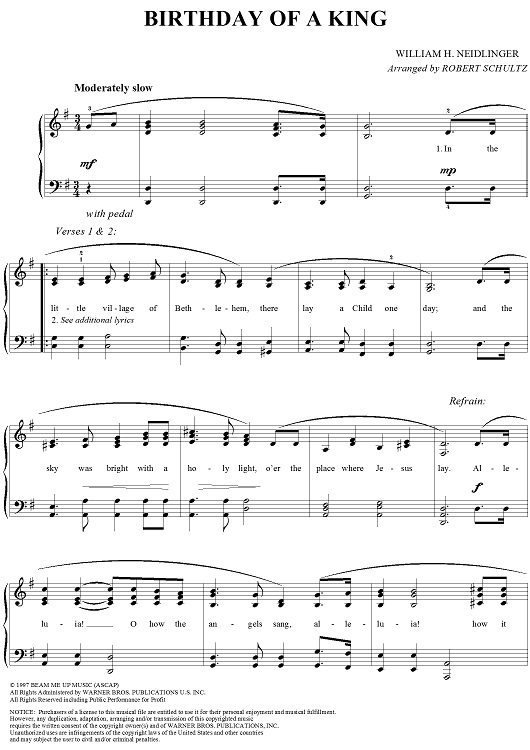
Christmas Music: The Birthday of a King

The Birthday of a King

Words and music by William Harold Neidlinger (1863-1924), circa 1890.  Neidlinger was a composer, conductor, organist at St. Michael’s Church, New York City, and voice teacher, but his main interest was working with retarded children, and he founded a school for this purpose in East Orange, N.J. Originally published in 1912 in Neidlinger’s native Brooklyn, the song has been popular ever since, particularly as a baritone solo, since it shows off the voice quite well and is not difficult to sing.

1. In the little village of Bethlehem,
There lay a Child one day;
And the sky was bright with a holy light
Over the place where Jesus lay.

Refrain
Alleluia! O how the angels sang.
Alleluia! How it rang!
And the sky was bright with a holy light
‘Twas the birthday of a King.

2. ‘Twas a humble birthplace,
But O how much God gave to us that day,
From the manger bed what a path has led,
What a perfect, holy way. Refrain

Beautiful song of God’s love for His creation.
Done beautifully by The Brooklyn Tabernacle Choir.

December 15 ~ This Day in Music History

hanukkah

Hanukkah
Hanukkah Music
Hanukkah Music Lyrics


Hanukkah 2017 began at sunset (4:48 at the O’Connor Music Studio) on Tuesday, December 12 and ends on Wednesday, December 20.

Christmas Music: The First Noel

• 1910 ~ John Hammond, American jazz critic

• 1922 ~ Alan Freed, American disc jockey

• 1939 ~ One of the most celebrated motion pictures of all time, Gone with the Wind, starring Vivien Leigh and Clark Gable was premiered in Atlanta to critical acclaim. The picture ran for close to four hours.


• 1941 ~ A musical standard was recorded this day on Victor Records. Lena Horne sang the torch classic that became her signature: Stormy Weather. “Don’t know why there’s no sun up in the sky. Stormy weather…”


• 1942 ~ Dave Clark, British rock drummer and singer

• 1943 ~ Fats (Thomas Wright) Waller died at the age of 39 from pneumonia.  He was an American jazz pianist, organist, composer, singer, and comedic entertainer, whose innovations to the Harlem stride style laid the groundwork for modern jazz piano

More information about Waller


• 1944 ~ Glenn Miller passed away when his plane disappeared over the English Channel. Major Glenn Miller was on his way to lead his Air Force Band in a Christmas concert.

• 1954 ~ Davy Crockett, Indian Fighter was featured on Walt Disney’s TV series for the first time. Crockett was played by Fess Parker. It wasn’t long before the Davy Crockett craze brought a new number one song to the pop music charts. “Davy, Davy Crockett, king of the wild frontier.”

• 1962 ~ The first record album to poke fun at a U.S. President became the #1 LP in the country. Vaughn Meader’s The First Family made the humorist a household word. The album stayed at #1 for three months.

• 1984 ~ Jan Peerce passed away

• 1986 ~ Violinist Isaac Stern arrived in a horse-drawn carriage to cut the ribbon for the renovated Carnegie Hall in New York City.

• 1986 ~ Kenny Rogers cut himself a deal with the Dole Food Company. The singer became the highest-paid celebrity pitchman, ‘doling’ out nice words about pineapple and other Dole products for 17 million dollars.

• 2000 ~ Revered conjunto musician Valerio Longoria, who taught accordion to children in San Antonio for many years, died at the age of 76. Musicians and friends remembered the master accordionist as an innovator and influential stylist of conjunto music, a Texas-based rhythm fueled by the accordion and the bajo sexto, a 12-string Spanish bass guitar. As a teenager, Longoria played weddings and parties in Harlingen. In 1942, he was drafted into the U.S. Army and at the end of World War II was stationed in Germany, where he managed to get an accordion and play in nightclubs. In 1945, he moved to San Antonio, where he began recording for Corona Records. Longoria was among the first inductees into the Tejano Conjunto Music Hall of Fame in 1982, and in 1986 he received the National Heritage Award, the nation’s highest honor for folk artists.

• 2001 ~ Rufus Thomas, a musician whose Bear Cat helped Sun Records get its start and whose Funky Chicken gave a boost to the Stax Label, died at the age of 84. Rufus Thomas was best known for novelty dance recordings like Walking the Dog, Do the Funky Chicken and Push and Pull. He began tap dancing on the streets of Memphis for tips and performed in amateur shows in high school. In the 1940s, Thomas ran his own Beale Street amateur show that attracted B.B. King, Bobby “Blue” Bland and many other performers who went on to become famous. In his declining years, Thomas took on the title of Beale Street ambassador and liked to refer to himself as the world’s oldest teen- ager. In 1953, Thomas recorded Bear Cat, an answer to Big Mama Thornton’s Hound Dog, and it became Sun Record’s first hit. That was before Elvis Presley arrived on the scene to become Sun’s undisputed star. Thomas complained in later years that Sun’s black artists were pushed aside after Presley’s success. In the 1960s, Thomas became one of the founding performers for Stax Records, which created what came to be known as “the Memphis sound,” with performers like Isaac Hayes, Otis Redding and Sam and Dave.

• 2002 ~ John Crosby, founder and longtime former general director of the Santa Fe Opera, died in Rancho Mirage, Calif., after a brief illness. He was 76. Crosby founded the Santa Fe Opera in 1957 and was its general director until his retirement at the end of the 2000 season. After his military service during World War II, Crosby majored in music theory at Yale and studied under composer Paul Hindemith, whom Crosby later brought to Santa Fe for the 1961 U.S. premiere of Hindemith’s opera News of the Day. Crosby also had worked as a Broadway arranger and studied at Columbia University in New York before making his move to found an opera company in Santa Fe. With $200,000 in financing from his father, Crosby purchased a ranch seven miles north of Santa Fe and oversaw construction of a 480-seat, open-air theater. The inaugural performance July 3, 1957, was Puccini’s Madama Butterfly. With the participation of Igor Stravinsky, early Santa Fe seasons gained world attention. Stravinsky brought music to the 1957 through 1963 seasons. His last night as both conductor and general director was Aug. 24, 2000, when he led Richard Strauss’ Elektra. Former President Bush presented Crosby a National Medal of Arts in 1991. He also received an Officer’s Cross of the Federal German Order of Merit in 1992 for his service to German music.

• 2002 ~ Rick Chase, a morning radio personality for KWIN-FM of Stockton, was found dead in his apartment. He was 45. Chase was best known for his work at KMEL-FM in San Francisco from 1986 to 1998. He also worked at KFRC-FM and KITS-FM in the Bay Area, KNVQ-FM in Reno and KZZO-FM in Sacramento. Chase, a 20-year radio veteran known to his listeners for his bombastic on-air personality, had worked at KWIN for two years.

• 2002 ~ Washington, DC Area: The storied history and sweeping skyline of US Airways Arena ended in a billowing cloud of dust Sunday morning as technicians reduced it to rubble with hundreds of pounds of dynamite. Almost 200 people, some of whom grew up watching sports and cultural events at the arena, gathered hundreds of yards away in the chill morning to say goodbye to the piece of 20th-century Washington’s history just outside the Capital Beltway. A shopping center will replace it. The arena began life in 1973 as the Capital Centre, a state-of-the-art architectural gem. In the ensuing decades, it housed the Washington Bullets basketball team and the Washington Capitals hockey team and held concerts by Elvis Presley, Michael Jackson, Frank Sinatra, the Rolling Stones, Luciano Pavarotti. “I remember seeing the Washington Bullets when they were really good and the Caps when they were really bad, as well as Prince and Tina Turner,” said Stewart Small, who grew up near the arena and now lives in Alexandria, Va. “I know it’s not Ebbets Field, but it had a lot of memories for me.” Crews used about 400 pounds of dynamite at 500 locations to do the job. In just over 15 seconds, the stadium that took 15 months to build caved into a cloud of light brown dust. Some in the crowd cheered, but most were silent. A few were teary-eyed as dust soared above where the 18,000-seat arena had stood. The arena opened Dec. 2, 1973, to a sellout crowd that watched the Bullets beat the Seattle SuperSonics 98-96. It has had no regular clients since the NBA Bullets, now Wizards, and the NHL Capitals moved to the MCI Center downtown.