National Mario Day is observed each year on March 10th and honors Mario from the popular Nintendo game. It is celebrated on March 10th because of the way the date appears, when abbreviated (Mar.10), it looks just like the name Mario.
And
. 1832 ~ Muzio Clementi died. He was an Italian-born English composer, pianist, pedagogue, conductor, music publisher, editor, and piano manufacturer.
. 1844 ~ Pablo de Sarasate, Spanish violinist
. 1879 ~ Ignaz Moscheles died. He was a Bohemian composer and piano virtuoso.
. 1892 ~ Arthur Honegger, French composer Read quotes by and about Honegger More information about Honegger
1903 ~ “Bix” Beiderbecke, American jazz cornetist More information about Beiderbecke
. 1910 ~ Carl Heinrich Carsten Reinecke, composer, died at the age of 85
. 1935 ~ Nelson Eddy recorded Ah! Sweet Mystery of Life for Victor Records. The song came from the film, “Naughty Marietta”. Later, Eddy recorded the classic tune with Jeanette MacDonald.
. 1937 ~ An audience of 21,000 jitterbuggers jammed the Paramount Theatre in New York City to see a young clarinetist whom they would crown, ‘King of Swing’ on this night. The popular musician was Benny Goodman.
. 1940 ~ W2XBS-TV in New York City originated the first televised opera as members of the Metropolitan Opera Company presented scenes from “I Pagliacci”.
. 1956 ~ Julie Andrews was 23 years old this night when she made her TV debut. She appeared with Bing Crosby and Nancy Olson in the musical adaptation of Maxwell Anderson’s play, “High Tor”.
. 1977 ~ E Power Biggs, English organist/composer (CBS), died at the age of 70
. 2003 ~ Lionel Dakers, who directed the Royal School of Church Music for 16 years, died at age 79. Dakers was a stickler for high musical standards and opposed some of the modernizing trends in English church music. Dakers was organist at Ripon Cathedral from 1954 to 1957, then moved to Exeter Cathedral before his appointment as director of the Royal School of Church Music in 1972. In 1976, he was appointed a director of Hymns Ancient & Modern, publisher of some of the most widely used Anglican hymnals.
. 2016 ~ Keith Emerson died. He was an English keyboardist and composer with English rock musician Emerson, Lake & Palmer.
. 2017 ~ (Joan) Joni Sledge, vocalist (Sister Sledge “We are Family”), died at the age of 60
. 1941 ~ Artie Shaw and his orchestra recorded Moonglow on Victor Records. In the band were such sidemen as Johnny Guarnieri, Jack Jenney, Billy Butterfield and Ray Conniff on trombone.
. 1943 ~ Duke Ellington and the band played for a black-tie crowd at Carnegie Hall in New York City. It was the first of what was to become an annual series of concerts featuring the Duke.
. 1943 ~ Louis Jordan and His Tympany Five took the song “What’s the Use of Getting Sober” to the top chart spot. It only stayed there for one week.
. 1948 ~ Anita Pointer, Singer with The Pointer Sisters
. 1950 ~ Bill Cunningham, Bass, piano with The Box Tops
. 1950 ~ Patrick Simmons, Singer, guitarist with The Doobie Brothers
. 1974 ~ Mike Oldfield’sTubular Bells opened the credits of the movie, “The Exorcist”, based on the book by William Peter Blatty. The song received a gold record this day.
. 1977 ~ Carole King’s landmark album, “Tapestry”, became the longest-running album to hit the charts, as it reached its 302nd week on the album lists.
. 1978 ~ Vic Ames killed in car crash
. 1981 ~ Samuel Barber, American composer (School for Scandal), died of cancer at the age of 70
. 1986 ~The first ten musicians were inducted into Rock ‘n’ Roll Hall of Fame including James Brown, Elvis Presley, Ray Charles, Buddy Holly, Chuck Berry, Sam Cooke, Fats Domino, the Everly Brothers, Jerry Lee Lewis and Little Richard.
When Chuck Berry was inducted into the Rock and Roll Hall of Fame in 1986, an all-star band, including John Fogerty, Billy Joel, Jerry Lee Lewis, Keith Richards, Neil Young and Steve Winwood, charged through a raucous “Roll Over Beethoven” with de facto bandleader Chuck Berry guiding the show.
. 1993 ~Thomas Gorsey passed away on this day. He was considered to be the “Father of Gospel Music” and had written over a thousand gospel songs in his lifetime.
. 2002 ~ Alfred Glasser, a former director of education for the Lyric Opera of Chicago, died of cancer. He was 70. Glasser held the education post for 30 years before his retirement in 1996. Since 1997, Glasser served as chairman of the board and commentator for Chicago’s concert opera company, da Corneto Opera. For the past decade, he served on the board of Alliance Francaise of Chicago, a French cultural group. Glasser also founded the Lyric Opera Lecture Corps, a community service project.
. 2003 ~ Nell Carter, actress-singer, died at the age of 54. She was best known for her role as the housekeeper in the TV sitcom “Gimme a Break!”. Carter, who was born September 13, 1948, in Birmingham, Alabama, first rose to stardom on the New York stage. After a series of roles on- and off-Broadway — and a short-lived part in the soap opera “Ryan’s Hope” — in 1977 she starred in the show “Ain’t Misbehavin’!”, a revue of the works of composer Fats Waller. She was rewarded for her performance with an Obie Award, and later with a Tony Award when the show moved to Broadway. Several years later, she earned an Emmy for her performance on a television presentation of the musical. Despite her Broadway success, Carter would have preferred to sing opera. “When I was growing up, it was not something you aspired to,” she said in 1988. “I was a weirdo to want to be in show business. Most kids wanted to be teachers or nurses.” “Gimme a Break!” ran from 1981 to 1987. Carter was nominated for two Emmys for her role as housekeeper Nell Harper, who helped run the household of police chief Carl Kanisky, played by Dolph Sweet. She also garnered two Golden Globe nominations for the role.
. 2003 ~ For Sale: One of London’s most famous music venues, which in its heyday in the 1960s played host to The Who, David Bowie and the Rolling Stones, is for sale, its administrators said. The Marquee Club, which in the 1970s was the epicenter of the punk explosion, ran into financial difficulties after its high-profile relaunch last fall, said a spokeswoman for administrator BDO Stoy Hayward. “We’re looking for someone in the music business who can capitalize on the Marquee brand and keep running it as a live venue,” she said. The price tag is at least $200 million. The club opened in London’s Soho district in 1958 and was so cramped and sweaty that, according to legend, Bob Geldof of the Boomtown Rats blacked out on stage. In 1988, it moved to a new location in nearby Charing Cross, but within eight years it had closed down. A high-profile relaunch at a new venue in Islington, north London September 2002 was headlined by the controversial electro-rockers Primal Scream, but according to the club’s administrators, huge start-up costs quickly led to its downfall.
. 2017 ~ Bobby Freeman, American singer (Do You Want to Dance), died at the age of 76
. 2018 ~ Hugh Masekela, South African trumpeter, anti-apartheid activist (I Am Not Afraid), described as the “father of South African jazz,” died at the age of 78
Muzio Clementi lived from January 23, 1752 until March 10, 1832. He was a composer and pianist who born in Rome. In 1766 he was brought to England, where he conducted the Italian Opera in London (1777–80), toured as a virtuoso pianist (1781), and went into the piano-manufacturing business.
He wrote the Gradus ad Parnassum from 1817 to 1826, a piano method on which subsequent piano methods have been based. He composed mainly piano and chamber music.
John Field lived from 1782 until 1837 and was an Irish pianist and composer. He has been credited the invention of the Nocturne, a form later adopted and developed by Chopin. Field was born in Dublin in 1782, the son of a violinist, but moved with his family to London in 1793, perhaps taking violin lessons from Haydn’s friend Salomon.
He became an apprentice of Muzio Clementi, appearing in a series of important London concerts, and later touring widely. After concerts in Russia, he remained in St. Petersburg, where he became a fashionable teacher and performer, moving to Moscow in 1821. Illness brought him, in 1831, to London again, a visit followed by a continental tour and a final return to Moscow, where he died in 1837.
Flowtow
Friedrich Adolf Ferdinand, Freiherr von Flotow was a German composer. He is chiefly remembered for his opera Martha, which was popular in the 19th century and the early part of the 20th.
Sammy Cahn (Samuel Cohen) lived from 1913 until 1993. If you care about anything at all, there’s a song written by Sammy Cahn for you to relate to. Sammy Cahn, the Tin Pan Alley legend, was born Samuel Cohen in New York City.
As a youngster, little Sammy wanted to grow up to be a famous vaudeville fiddler. How lucky we are that he stopped thinking about this in his teenage years. That’s when he met pianist, Saul Chaplin. Sammy wrote the words and Saul wrote the music to their first hit, Rhythm is Our Business for bandleader, Jimmie Lunceford. Then Until the Real Thing Comes Along for Andy Kirk and the jazz classic, Shoe Shine Boy, performed by Count Basie, Louis Armstrong, the Mills Brothers, even Bing Crosby. The Andrews Sisters were lucky to know Sammy, too. It was his adaptation of the Yiddish song, Bei Mir Bist Du Schön that became their signature.
Frank Sinatra’s many signature titles were Sammy Cahn’s words, too (with Jimmy Van Heusen’s music): All the Way (won an Oscar in 1957), My Kind of Town, and Grammy Award-winning September of My Years. As part of the personal song-writing team for Mr. Sinatra, Sammy also wrote Love and Marriage, The Second Time Around, High Hopes (another Oscar winner in 1959) and The Tender Trap.
If you still haven’t found a song that makes you care, try these additional Oscar winners by Sammy Cahn: Three Coins in the Fountain (1954) and Call Me Irresponsible (1963). He composed 22 other songs that were nominated but didn’t win the gold statue!
Want to know more? Pick up the autobiography of the talented Sammy Cahn, written in 1974, I Should Care.
Cage
John (Milton) Cage lived from 1912 until 1992. He was an American composer who was born in Los Angeles, California, USA. He studied with a number of teachers including Henry Cowell and Arnold Schoenberg, who helped provoke his avant-garde proclivities. He began writing all-percussion pieces in the 1930s and proclaimed the use of noise as the next musical horizon; in 1938 he introduced the “prepared piano,” an instrument whose sound is radically modified by various objects placed on the strings. While writing much for prepared piano in the 1940s, notably the Sonatas and Interludes, he also produced some pioneering electronic music. Among the most widely influential elements of his thought was the idea of indeterminacy, music that is not strictly controlled, as seen in his 1951 Landscape No. 4 for twelve radios – the sound of which depends on what happens to be on the air. Later works, especially the notorious 4’33” (1954), involve complete silence. He continued to develop such concepts and he also produced several quirky, engaging books beginning with the 1961 Silence. In his later years he was widely acclaimed as one of the more original of American artists.
Caruso
Enrico Caruso was a tenor opera singer who lived from 1873 until 1921. His best known roles are Canio in Pagliacci, Rodolfo in La Bohème. He made his Metropolitan Opera debut in Rigoletto. He sang nearly 70 roles and appeared in nearly every country of Europe and North and South America. His final performance was La Juive at the Met in 1920.
Carissimi
Giacomo Carissimi lived from 1604 until 1674. He is considered to be one of the greatest Italian composers of the 17th century, notable for his oratorios and secular cantatas.
Cash
John R. Cash was born Feb. 26, 1932, in Kingsland, Ark., one of seven children. When he was 12, his 14-year-old brother and hero, Jack, died after an accident while sawing oak trees into fence posts. The tragedy had a lasting impact on Cash, and he later pointed to it as a possible reason his music was frequently melancholy.
He worked as a custodian and enlisted in the Air Force, learning guitar while stationed in Germany, before launching his music career after his 1954 discharge.
“All through the Air Force, I was so lonely for those three years,” Cash told The Associated Press during a 1996 interview. “If I couldn’t have sung all those old country songs, I don’t think I could have made it.”
Cash launched his career in Memphis, performing on radio station KWEM. He auditioned with Sun Records, ultimately recording the single Hey Porter, which became a hit.
Sun Records also launched the careers of Elvis Presley, Roy Orbison, Jerry Lee Lewis and others.
Folsom Prison Blues, went to No. 4 on the country charts in 1956, and featured Cash’s most famous couplet: “I shot a man in Reno/ just to watch him die.”
Cash recorded theme albums celebrating the railroads and the Old West, and decrying the mistreatment of American Indians. Two of his most popular albums were recorded live at prisons. Along the way he notched 14 No. 1 country music hits.
Because of Cash’s frequent performances in prisons and his rowdy lifestyle early in his career, many people wrongly thought he had served prison time. He never did, though he battled addictions to pills on and off throughout his life.
He blamed fame for his vulnerability to drug addiction.
“When I was a kid, I always knew I’d sing on the radio someday. I never thought about fame until it started happening to me,” he said in 1988. “Then it was hard to handle. That’s why I turned to pills.”
He credited June Carter Cash, whom he married in 1968, with helping him stay off drugs, though he had several relapses over the years and was treated at the Betty Ford Center in California in 1984.
June Carter Cash was the daughter of country music great Mother Maybelle Carter, and the mother of singer Carlene Carter, whose father was country singer Carl Smith. Together, June Carter and Cash had one child, John Carter Cash. He is a musician and producer.
Singer Roseanne Cash is Johnny Cash’s daughter from his first marriage, to Vivian Liberto. Their other three children were Kathleen, Cindy and Tara. They divorced in 1966.
In March 1998, Cash made headlines when his California-based record company, American Recordings, took out an advertisement in the music trade magazine Billboard. The full-page ad celebrated Cash’s 1998 Grammy award for best country album for “Unchained.” The ad showed an enraged-looking Cash in his younger years making an obscene gesture to sarcastically illustrate his thanks to country radio stations and “the country music establishment in Nashville,” which he felt had unfairly cast him aside.
Jennings, a close friend, once said of Cash: “He’s been like a brother to me. He’s one of the greatest people in the world.”
Cash once credited his mother, Carrie Rivers Cash, with encouraging him to pursue a singing career.
“My mother told me to keep on singing, and that kept me working through the cotton fields. She said God has his hand on you. You’ll be singing for the world someday.”
Dozens of hit records like Folsom Prison Blues, I Walk the Line, and Sunday Morning Coming Down defined Cash’s persona: a haunted, dignified, resilient spokesman for the working man and downtrodden.
Cash’s deeply lined face fit well with his unsteady voice, which was limited in range but used to great effect to sing about prisoners, heartaches, and tales of everyday life. He wrote much of his own material, and was among the first to record the songs of Bob Dylan and Kris Kristofferson.
One Piece at a Time was about an assembly line worker who built a car out of parts stolen from his factory. A Boy Named Sue was a comical story of a father who gives his son a girl’s name to make him tough. The Ballad of Ira Hayes told of the drunken death of an American Indian soldier who helped raise the American flag at Iwo Jima during World War II, but returned to harsh racism in America.
Cash said in his 1997 autobiography “Cash” that he tried to speak for “voices that were ignored or even suppressed in the entertainment media, not to mention the political and educational establishments.”
Cash’s career spanned generations, with each finding something of value in his simple records, many of which used his trademark rockabilly rhythm.
Cash was a peer of Elvis Presley when rock ‘n’ roll was born in Memphis in the 1950s, and he scored hits like Cry! Cry! Cry! during that era. He had a longtime friendship and recorded with Dylan, who has cited Cash as a major influence.
He won 11 Grammys – most recently in 2003, when Give My Love To Rose earned him honors as best male country vocal performance – and numerous Country Music Association awards. He was elected to the Country Music Hall of Fame in 1980 and inducted into the Rock and Roll Hall of Fame in 1992.
His second wife, June Carter Cash, and daughter Roseanne Cash also were successful singers. June Carter Cash, who co-wrote Cash’s hit Ring of Fire and partnered with her husband in hits such as Jackson, died in May 2003.
The late 1960s and ’70s were Cash’s peak commercial years, and he was host of his own ABC variety show from 1969-71. In later years, he was part of the Highwayman supergroup with Waylon Jennings, Willie Nelson and Kris Kristofferson.
In the 1990s, he found a new artistic life recording with rap and hard rock producer Rick Rubin on the label American Recordings. And he was back on the charts with the 2002 album “American IV: The Man Comes Around.”
Most recently, Cash was recognized for his cover of the Nine Inch Nails song Hurt with seven nominations at the August 2003 MTV Video Music Awards. He had hoped to attend the event but couldn’t because of his hospital stay. The video won for best cinematography.
He also wrote books including two autobiographies, and acted in films and television shows.
In his 1971 hit Man in Black, Cash said his black clothing symbolized the downtrodden people in the world. Cash had been “The Man in Black” since he joined the Grand Ole Opry at age 25.
“Everybody was wearing rhinestones, all those sparkle clothes and cowboy boots,” he said in 1986. “I decided to wear a black shirt and pants and see if I could get by with it. I did and I’ve worn black clothes ever since.”
Johnny Cash, ‘”The Man in Black” who became a towering figure in American music with such hits as Folsom Prison Blues, I Walk the Line, and A Boy Named Sue, died Friday, September 12, 2003. He was 71.
“Johnny died due to complications from diabetes, which resulted in respiratory failure,” Cash’s manager, Lou Robin, said in a statement issued by Baptist Hospital in Nashville.”
Cash had battled a disease of the nervous system, autonomic neuropathy, and pneumonia in recent years. Cash lived in Hendersonville, Tenn., just outside of Nashville. He also had a home in Jamaica.
Cesti
Marc Antonio Cesti, 1623 to 1669, was an Italian composer working in Venice, Rome and Vienna. He reputedly wrote over one hundred operas of which 15 are extant.
Charles
Ray Charles (Robinson) is a singer, pianist, composer who was born in Albany, Ga in 1930. He lost his sight (from glaucoma) when he was six and attended a school for the blind where he learned to read and write music in braille and play piano and organ. Orphaned at age 15, he left school and began playing music to earn a living, moving to Seattle, Wash., in 1947. Dropping his last name, he performed at clubs in the smooth lounge-swing style of Nat “King” Cole. After some hits on Swing Time Records, he switched to Atlantic Records in 1952 and began to develop a rougher blues and gospel style. For New Orleans bluesman, Guitar Slim, he arranged and played piano on “The Things I Used To Do” (1953); the record sold a million copies. He went on to record his own “I’ve Got a Woman” in 1955 with an arrangement of horns, gospel-style piano, and impassioned vocals that led to the gospel-pop and soul music of the 1960s and to his hit “What’d I Say” (1959). Possessing a multifaceted talent, he recorded with jazz vibist Milt Jackson, made a country and western album that sold 3 million copies (1962), and continued to release a variety of pop hits, Broadway standards, and blues, gospel, and jazz albums. A major influence on popular black music during his early years, he gradually reached out to influence both white musicians and audiences. And although he had been convicted of using drugs in the 1950s, he lived to see the day when he was so acceptable to mainstream Americans that he became virtually the chief image for promoting Pepsi-Cola and he was asked to perform at many national patriotic and political events.
Charpentier
Marc Antoine Charpentier, 1636 to 1704, was a French composer who studied in Italy. When he returned to France he became the most outstanding French composer of oratorios.
Cherubini
Luigi Cherubini lived from 1760 until 1842. The Italian composer Cherubini came to occupy a dominant position in French musical life. He was employed at the Conservatoire in Paris on its foundation and from 1822 was director of the institution, retaining this position until the year of his death. His works include compositions for the stage, the church and for political purposes, a requirement of the turbulent revolutionary years.
Cherubini wrote some 30 operas and of these Les deux journées, now seldom heard, had influence on Beethoven’s only opera, Fidelio. The opera Médée, first staged in Paris in 1797, remains in occasional repertoire, with the aria Ah, nos peines, providing a popular soprano operatic recital item.
Chopin
Step into the melodious world of Frédéric François Chopin (1 March 1810 – 17 October 1849), the Polish maestro who danced his fingers across the piano keys, creating ripples in the Romantic era. Renowned globally as a virtuoso pianist and composer, Chopin dedicated his life to the ivory keys, weaving compositions that spoke a poetic language, unmatched in technique and emotional depth.
Born in the quaint village of Żelazowa Wola, in what was then the Duchy of Warsaw, Chopin grew up under the artistic skyline of Warsaw. As Congress Poland unfolded its wings, so did Chopin’s prodigious talent. By the tender age of 20, having already mastered his art in Warsaw, he embarked on a journey just before the November 1830 Uprising broke out, a journey that would take him to the heart of Paris at 21.
Parisian life saw Chopin shine not in grand concert halls, but in the intimate embrace of salons, where his music found a home. In these salons, he enchanted a select few with 30 public performances, sustaining his life through the sale of his compositions and highly sought-after piano lessons. Among his admirers and friends was the legendary Franz Liszt, alongside other contemporaries like Robert Schumann, who were spellbound by his musical prowess.
Chopin’s life, however, was a nocturne shadowed by the relentless pursuit of tuberculosis, which ultimately claimed him on October 17, 1849. For 11 years, he battled the disease, pouring his soul into his music.
The essence of Chopin’s music is a beautiful paradox – it’s an intricate blend of lyrical romanticism, the rustic charm of Polish folk tunes, and awe-inspiring technical virtuosity. His legacy lives on in the dreamy realms of his nocturnes, the precision of his études, and the rhythmic grace of his waltzes. Transcending the barriers of piano, his compositions have found new life in various instruments and have gracefully waltzed into films, television shows, and commercials.
Chopin’s melodies are not just notes strung together; they are a testament to his undying love for Poland and his genius, resonating through time and continuing to stir the hearts of audiences worldwide. In Chopin’s music, we find an eternal resonance that speaks of passion, homeland, and the unquenchable spirit of creativity.
Christoff
Boris Christoff lived from 1914 until 1993. He was a bass-baritone who was born in Plovdiv, Bulgaria. He studied law in Sofia, then studied singing in Rome and Salzburg. His debut recital was in Rome in 1946. He sang at La Scala in Milan in 1947, at Covent Garden in 1949, and from 1956 in the USA.
Clementi
Muzio Clementi lived from 1752 until 1832. He was a composer and pianist who born in Rome. In 1766 he was brought to England, where he conducted the Italian Opera in London (1777–80), toured as a virtuoso pianist (1781), and went into the piano-manufacturing business. He wrote the Gradus ad Parnassum from 1817 to 1826, a piano method on which subsequent piano methods have been based. He composed mainly piano and chamber music.
Coates
Eric Coates lived from 1886 until 1957 and was the greatest British composer of light music in the 20th century, though his education never looked to be leading him in that direction. He was born in the midlands of England, in the county of Nottinghamshire, in 1886. He studied at the Royal Academy of Music in London, taking viola with the legendary Lionel Tertis, and composition with Frederick Corder. But it was as a violist that he earned his living, joining the famous Queen’s Hall Orchestra under Sir Henry Wood. From 1913 to 1919 he was principal viola, and a list of first British performances by that orchestra would indicate that he came into contact with all the most avant garde music of his day. Yet it was to be in the field of light music that he was to become famous.
It was the time of the radio, the BBC Light Programme with its demands for new music, and the need to brighten the country after the First World War, and above all it was the day of the ‘bright young thing’. It was the perfect scene for a composer who could produce a seemingly endless stream of easily memorable melodies. A publishing house commissioned him to write a major light music work for orchestra each year, while they were happy to take anything from him including his large output of songs.
Orchestras demanded that he conduct his own music with them, and he started a second career as a conductor of light music including many appearances with the BBC Theatre Orchestra. His music spoke to all generations, from those looking for nostalgia, to the very young, with his phantasies, ‘Cinderella’ and ‘The Three Bears’. He produced one major success after another, his music in the war years valuable to the morale of the nation, and included the stirring march for the Eighth Army to mark their Alamein victory in 1942 under General Montgomery.
Though he continued conducting his own music after the war, including definitive recordings of much of his output, his compositional career seemingly burned out. Then in a sudden flurry of activity he produced a number of fine works in his last years. That period included the Dambusters March for the film on that theme, the first time he succumbed to the many film music offers made to him.
He had so many successes, and his music became known to just about everyone in the UK, that it was thought he had a considerable output, but apart from his songs, it numbered less than fifty. Without doubt it was his training in classical music, and the years in the orchestra, that enabled him to write so fluently and so colourfully.
Sleepy Lagoon dates from 1930, but was not a huge success until an American dance orchestra turned it into a slow foxtrot. That led to the work being chosen for the opening music to the longest running radio show, Desert Island Discs, which started in 1948 and is still broadcast 50 years later. It remains probably the best known melody in the UK.
Two years later, among a number of short pieces written at this time, comes the very relaxed, Lazy Nights. Springtime Suite dates from 1937, and though its three movements never quite achieved the success of his other suites, it is one of his most skilfully constructed works. The previous year Coates met a commission from a virtuoso saxophonist for a new work. The brilliant Saxo-Rhapsody was the result. Composed in less than a month, its jaunty and jolly atmosphere so perfectly captured the nature of the instrument, while providing the soloist with a piece of unabashed showmanship.
The waltz was still the ballroom favourite, and Coates provided a number of such works, though truth to tell, they were more often played as an orchestral work than for dancing. Footlights dates from 1939, the same year that saw the little orchestral romance, Last Love.
Four Ways Suite dates from 1925, Coates looking in four directions, north, south, east and west. The north is represented by Scotland; the second movement has a distinct Italian flavour; China is the east, and flying in the face of the mood among British musicians at that time, it is jazz for the West. The disc ends with Coates’ last composition, High Flight, intended for a Warwick film of 1957.
Cohan
George M. (Michael) Cohan was an actor, singer, composer os songs such as Over There, The Yankee Doodle Boy, Give My Regards to Broadway, Mary’s a Grand Old Name, You’re a Grand Old Flag and Harrigan. He was the subject of movie called Yankee Doodle Dandy, as well as a Broadway show named George M!
There is a statue of George M. Cohan in New York.
Cole
Nat King Cole lived from 1917 until 1965. He was born Nathaniel Adams Coles in Birmingham, Alabama and raised in Chicago. Cole was a jazz pianist, singer, bandleader,for the King Cole Trio, a songwriter who wrote Straighten Up and Fly Right, an actor in St. Louis Blues, the first black entertainer to host a national TV show and the father of singer Natalie Cole.
His daughter, Natalie, became a pop music star with many hits in the 1990s – including an album of standards made popular by her father: “Mona Lisa”, “For Sentimental Reasons”, “Nature Boy”, “Too Young” and “Unforgettable”. With modern recording technology, she was able to record a duet with her father’s voice.
His first recording was in 1936. Although Cole’s commercial success as a pop artist was phenomenal, it unfortunately came with the sacrifice of his exemplary and extremely influential talents as a jazz pianist. Before he turned full-time to singing, he had already influenced the likes of Oscar Peterson, Ahmad Jamal, and Ray Charles with his intricate and innovative piano style and piano/guitar/bass lineup.
Cole’s songs included: Mona Lisa, Too Young, Unforgettable, Pretend, Ballerina, Ramblin’ Rose and The Christmas Song Cole passed away Feb 15, 1965 and was posthumously awarded a Lifetime Achievement Grammy in 1990.
Coleman, Cy
Born Seymour Kaufman of immigrant East European Jewish parents in the Bronx, Coleman’s first major hit was Wildcat, the 1960 musical about wildcat oil drilling that starred Lucille Ball (news) and featured the classic Hey Look Me Over. His later hits included City of Angels and Barnum.
Coleman was a self-taught jazz pianist whose career started at the age of 7 when he played a recital at Carnegie Hall.
Songs such as Witchcraft and The Best is Yet to Come were made popular by Sinatra, while another longtime collaborator was screenwriter and lyricist Adolph Green, best known for 1950s classic Singin’ in the Rain.
Coleman also worked closely with Shirley MacLaine, conceiving and co-writing her television special If My Friends Could See Me Now and creating the musical Gypsy in My Soul in 1976 that won Emmy awards for both Coleman and MacLaine.
He won three Tony Awards (news – web sites) as well as several Grammys and Emmys and an Oscar nomination for the music for the 1969 film Sweet Charity. which also starred MacLaine.
Coleman, Ornette
Ornette Coleman is a jazz musician, saxophonist and composer. He was born in 1930 in Fort Worth, Texas. His experiments in free-form improvisation sharply divided the jazz establishment upon his emergence in 1959. Largely self-taught, he played in rhythm-and-blues bands before settling in Los Angeles in 1951, where he gradually formed a quartet of musicians who were receptive to his unorthodox ideas. He first recorded in 1958 and made his New York debut the following year. He made a series of important recordings between 1959 and 1961 that shaped the direction of jazz for the next twenty years. A sporadic performing artist after the early 1960s, he occasionally led both a conventional jazz quartet and the rock band Prime Time, but turned increasingly to composition, producing several works for symphony orchestra in accordance with his “harmolodic theory.”
Copland
Aaron Copland lived between 1900 and 1990. He is considered to be a twentieth century composer.
Copland often used American folk music in his ballets, such as “Appalachian Spring”, which won a Pulitzer Prize.
Copland also wrote background music for movies and a ballet based on the story of Billy the Kid. He often used American themes in an expressive modern style, sometimes employing jazz rhythms.
Corelli
Arcangelo Corelli lived from 1653 until 1713. His contributions to the development of European music are the foundations of violin technique and creating the basic style for concerti grossi.
He spent most of his life in Rome, under the patronage of Cardinal Pietro Ottobani.
Couperin
François Couperin lived from 1668 until 1733. He was part of a famous French musical family and is most well-known for his harpsichord music.
Cowell
Henry Dixon Cowell lived from 1897 until 1965. He was a composer who was born in Menlo Park, California. Cowell was largely self-taught as pianist and composer. In his teens he gravitated to radical musical experiments including his trademark use of tone-cluster harmony. From the 1920s he pursued an international career as composer, concert promoter, and pianist, specializing in his own and others’ “ultra-modern” music; he also taught and wrote books including the 1919 New Musical Resources, and in 1927 founded the historic New Music Quarterly. In his own music, progressive ideas appear alongside traditional material; his works include 20 symphonies.
Cristofori
Bartolommeo Cristofori (1655) Italian instrument maker, credited with designing the first pianoforte, which he called “the harpsichord that plays soft and loud”.
Cruger
Johann Cruger lived from 1598 until 1662. His Now Thank We All our God was harmonized by Felix Mendelssohn.
Cugat
Xavier Cugat lived from 1900 until 1990. He was a violinist and bandleader who was born in Barcelona, Spain and raised in Cuba. He first became popular in the United States in the 1920s with his tango orchestra; in the 1930s he introduced other Latin dance rhythms including the Cuban rumba. In the 1940s he appeared in many musical films, such as You Were Never Lovelier (1942). He promoted the popularity of Latin music in the United States.
Czerny
Carl Czerny was an Austrian composer, teacher, and pianist of Czech origin whose vast musical production amounted to over a thousand works. His books of studies for the piano are still widely used in piano teaching.
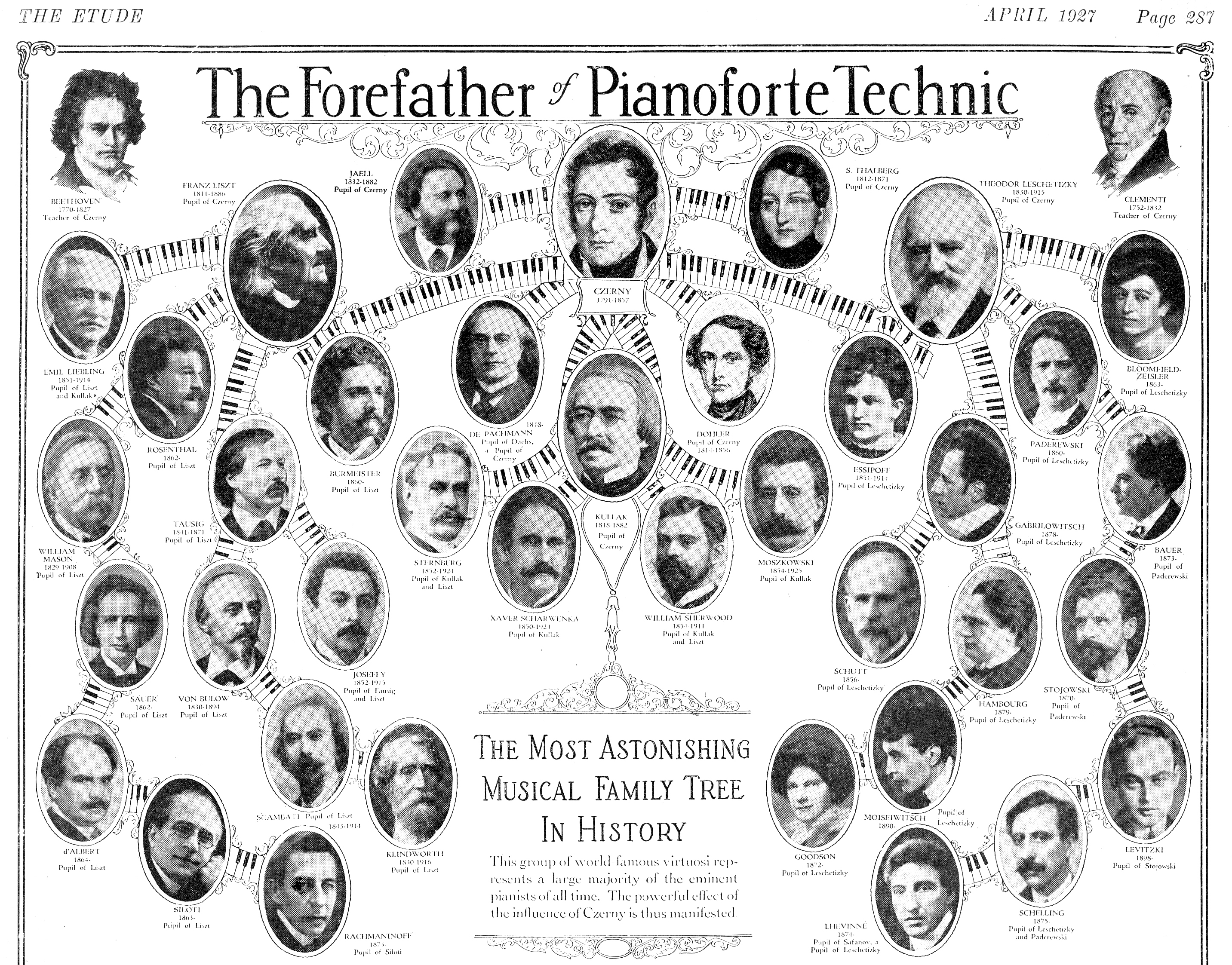
Czerny is in the center top of this image. He influenced many!
. 1715 ~ Jacques Duphly, French harpsichordist and composer.
.1782 ~ On this day Mozart wrote a letter to his father about Muzio Clementi. He said: “Clementi plays well, as far as execution with the right-hand goes. His greatest strength lies in his passages in 3rds. Apart from that, he has not a kreuzer’s worth of taste or feeling – in short he is a mere mechanicus.”
. 1876 ~ Ermanno Wolf-Ferrari, Italian Opera Composer
. 1905 ~ Tex (Woodward Maurice) Ritter, Country singer, actor, John Ritter’s father
. 1921 ~ The opening of Town Hall in New York City, an important new concert hall
. 1926 ~ Ray Price, Singer
. 1926 ~ Morton Feldman, American composer, born in NYC, New York
. 1928 ~ Vladimir Horowitz debuted as a soloist with the New York Philharmonic at Carnegie Hall in New York City. It was the very same night that Sir Thomas Beecham gave his first public performance in the United States.
. 1930 ~ Glenn Yarbrough, Singer with The Limeliters
. 1933 ~ Václav Suk, Czech-born Russian composer and violinist, died at the age of 71
. 1939 ~ William Lee Golden, Singer with The Oak Ridge Boys
. 1939 ~ The Ink Spots gained national attention after five years together, as they recorded If I Didn’t Care. Many other standards by the group soon followed.
. 1940 ~The Shep Fields Orchestra went to the top of Billboard’s Pop Chart with their song “South of the Border (Down Mexico Way).”
. 1946 ~ Cynthia Robinson, Singer, trumpeter with Sly and the Family Stone
. 1949 – Arthur Godfrey and His Friends was first seen on CBS-TV this day. The program stayed on the network for seven years.
. 1959 ~ Per Gessle, Guitarist, singer with Roxette
. 1963 ~ Songwriter Bob Dylan sang Blowin’ In the Wind on the BBC radio presentation of “The Madhouse on Castle Street”. The song soon became one of the classics of the 1960s protest movement.
. 1985 ~ After a record 24 weeks as the #1 album in the nation, Prince (now known as The Artist Previously Known as Prince) slipped to the #2 spot with Purple Rain. Replacing Prince at the top spot: ‘The Boss’ Bruce Springsteen’s Born In the USA, which spent 24 weeks waiting for Purple Rain to fall.
. 1995 ~ Laurel McGoff, American singer
. 2001 ~ Luis Floriano Bonfa, the master guitarist and composer who helped found Bossa Nova music, died of cancer at the age of 78. Bonfa, who was born in Rio de Janeiro in Oct. 17, 1922, began composing in the 1940s and launched his career as a solo artist in 1952. Better known abroad than at home, Bonfa became internationally famous for his contributions to the soundtrack of Marcel Camus’ 1959 classic film “Black Orpheus.” The film introduced an international audience to Bossa Nova – a more sophisticated and less percussive samba style – and made Bonfa and fellow composer Antonio Carlos Jobim stars. “Bonfa plays the guitar like no other, in a very personal, charismatic style. His guitar is a little orchestra,” the late composer Jobim once said. His reputation grew further when he was a featured performer at the Bossa Nova festival at Carnegie Hall in New York City in 1962. He was even more famous for his more than 500 compositions especially Manha de Carnaval andSamba de Orpheu. Placido Domingo, Julio Iglesias, Frank Sinatra and Elvis Presley recorded songs written by Bonfa. In recent years, his productivity slowed. His last major label release “The Bonfa Magic,” was recorded in 1991.
. 2001 ~ Opera singer Kyra Vayne, a star of the 1940s and 1950s whose talents were rediscovered in the 1990s, died at age 84. The Russian-born soprano was born in St. Petersburg. Vayne fled the 1917 Bolshevik Revolution with her family and was eight years old when her family settled in London. She began a successful opera career in the 1940s, and sang for allied troops during World War II. She later joined the Russian Opera Company, then based at London’s Savoy Theater. Her career collapsed in 1957 when her agent, Eugene Iskoldoff, committed suicide, and for the next 35 years she worked as a secretary for the British Broadcasting Corp.
In the early 1990s, a music company released four recordings of her voice, leading the U.S. music magazine “Fanfare” to ask, “How is it possible that such a singer has not come down to us as one of the century’s most celebrated sopranos?” Soon afterward, Arcadia Books published her autobiography, “A Voice Reborn,” which tenor Placido Domingo described as having “all the elements of an opera.” At the end of 1999, nearly 80 years after she fled Russia, Vayne was invited to perform at Moscow’s Bolshoi Theater to mark the new millennium – her first public performance in 40 years. “For me to sing at the Bolshoi is beyond any fairy tale,” she said at the time. “I am not worried about singing in public again after so long, but I am fearful of the emotional impact.” Vayne never married and had no children.
. 2003 ~ Maurice Gibb, a member of the famed disco band the Bee Gees, died at a Miami Beach hospital. He was 53. Gibb, joined with his older brother and his twin to harmonize their way to becoming one of the best selling musical groups ever. Gibb played bass and keyboard for the group, whose name is short for the Brothers Gibb. In a 1978 interview with TG Magazine, Gibb lamented the perception that the Bee Gees were only a disco band. “People accuse us of being nothing more than a disco band now,” Gibb said. “But they don’t know what they’re talking about. If you listen to our records, you’ll find that there’s dance music. But there are also ballads like More Than A Woman. And there are some very beautiful, undanceable songs, too.” The Bee Gees – twins Maurice and Robin, and their older brother Barry – have lived in South Florida since the late 1970s. Their younger brother, Andy, who had a successful solo career, died in 1988 at age 30 from a heart ailment. Chris Hutchins, a writer and former press agent for the Bee Gees, said Maurice was “very much a tormented soul.” “He was not the star (of the Bee Gees), and he knew it, he felt it,” Hutchins told British Broadcasting Corp. radio. Known for their close harmonies and original sound, the Bee Gees are members of the Rock and Roll Hall of Fame, and their 1977 contributions to the “Saturday Night Fever” album made it the best selling movie soundtrack ever with more than 40 million copies sold. Among their disco hits on that album are Stayin’ Alive, More Than a Woman and How Deep Is Your Love and Night Fever. The group won seven Grammy Awards. The Bee Gees last album was in 2001, entitled “This Is Where I Came In.” The family emigrated from England to Australia in 1958, and the brothers soon gained fame as a teen pop group. They returned to England in the 1960s, and their first four albums contained hits such as 1941 New York Mining Disaster, To Love Somebody and their first U.S. number one song, 1971’s How Can You Mend A Broken Heart.
The Bee Gees followed “Saturday Night Fever” with the 1978 album “Spirits Having Flown” which sold 20 million copies. The brothers wrote and produced songs for Barbra Streisand, Diana Ross and Dionne Warwick in the 1980s. They also wrote the Kenny Rogers and Dolly Parton hit Islands in the Stream. The Bee Gees released three studio albums and went on a world tour in the 1990s. The live album from the tour “One Night Only,” sold more than 1 million albums in the United States. The Bee Gees run a music production company in Miami called Middle Ear Studios. Gibb’s first wife was British singer Lulu. He and his second wife, Yvonne, were married for more than 20 years and had two children.
World Pianist Day, celebrated on November 8, is a symphony of joy for pianists and music lovers alike. It’s a day dedicated to tickling the ivories, embracing the melodies, and having a grand ol’ time celebrating the magic of the piano and the talented souls who make it sing.
In the world of piano, we’re transported on a musical journey, where the notes and chords create a tapestry of emotions that tug at our heartstrings. Pianists, those maestros of the keys, have the power to move us to the rhythm of ultimate joy. And how do we revel in this melodious merriment? Well, we throw a piano party, of course! From dazzling classical compositions to the jazzy, bluesy tunes, pianists have a treasure trove of styles to choose from, and they’re ready to share their musical gifts with the world. And guess what? You don’t have to be a seasoned pianist to join in the fun – it’s the perfect day to tinkle those ivories if you’ve never tried before!
Now, let’s take a little trip down the history of World Pianist Day. Picture the greats like Mozart, Beethoven, Clementi, Liszt, Brahms, Chopin, Mendelssohn, Rachmaninoff, and Schumann. They’re like the rockstars of classical piano, setting stages ablaze with their virtuosity. These ivory-ticklers aren’t just known for their compositions; they were the original piano showstoppers, dazzling audiences far and wide.
And then there’s the fabulous world of jazz pianists, where spontaneity reigns supreme. It’s like a jam session where they dance to the rhythm of their own tune, improvising and weaving musical stories on the spot. Names like Bill Evans, Art Tatum, Duke Ellington, Thelonious Monk, Oscar Peterson, and Baden Powell are the jazz legends who’ve made the keys sing with swing.
So, how can you join the grand celebration of World Pianist Day? Here are some jazzy suggestions:
1. **Concert Time:** Hit up a piano concert and let the melodies sweep you off your feet. It’s like a musical rollercoaster that you won’t want to end.
2. **Movie Magic:** Watch “The Pianist” movie, a deep dive into the intricate and fulfilling life of a pianist and composer. You’ll be mesmerized by the world of music.
3. **Tickle the Ivories:** If you’ve always wanted to try your hand at piano, seize the moment on World Pianist Day. Grab an instrument, play your favorite tune, and let the music flow through your fingertips.
So, here’s to a day of musical wonder, where the piano takes center stage, and joyous melodies fill the air. Whether you’re a seasoned pianist or a newbie, let the piano keys be your guide to an enchanting musical journey.
National Mario Day is observed each year on March 10th and honors Mario from the popular Nintendo game.
It is celebrated on March 10th because of the way the date appears, when abbreviated (Mar.10), it looks just like the name Mario.
. 1832 ~ Muzio Clementi died. He was an Italian-born English composer, pianist, pedagogue, conductor, music publisher, editor, and piano manufacturer. He is also the subject of this month’s Piano Explorer, which is enjoyed by my students.
. 1844 ~ Pablo de Sarasate, Spanish violinist
. 1879 ~ Ignaz Moscheles died. He was a Bohemian composer and piano virtuoso
. 1892 ~ Arthur Honegger, French composer
Read quotes by and about Honegger
More information about Honegger
1903 ~ “Bix” Beiderbecke, American jazz cornetist
More information about Beiderbecke
. 1910 ~ Carl Heinrich Carsten Reinecke, composer, died at the age of 85
. 1935 ~ Nelson Eddy recorded Ah! Sweet Mystery of Life for Victor Records. The song came from the film, “Naughty Marietta”. Later, Eddy recorded the classic tune with Jeanette MacDonald.
. 1937 ~ An audience of 21,000 jitterbuggers jammed the Paramount Theatre in New York City to see a young clarinetist whom they would crown, ‘King of Swing’ on this night. The popular musician was Benny Goodman.
. 1940 ~ W2XBS-TV in New York City originated the first televised opera as members of the Metropolitan Opera Company presented scenes from “I Pagliacci”.
. 1956 ~ Julie Andrews was 23 years old this night when she made her TV debut. She appeared with Bing Crosby and Nancy Olson in the musical adaptation of Maxwell Anderson’s play, “High Tor”.
. 1977 ~ E Power Biggs, English organist/composer (CBS), died at the age of 70
. 2003 ~ Lionel Dakers, who directed the Royal School of Church Music for 16 years, died at age 79. Dakers was a stickler for high musical standards and opposed some of the modernizing trends in English church music. Dakers was organist at Ripon Cathedral from 1954 to 1957, then moved to Exeter Cathedral before his appointment as director of the Royal School of Church Music in 1972. In 1976, he was appointed a director of Hymns Ancient & Modern, publisher of some of the most widely used Anglican hymnals.
. 2016 ~ Keith Emerson died. He was an English keyboardist and composer with English rock musician Emerson, Lake & Palmer.
. 2017 ~(Joan) Joni Sledge, vocalist (Sister Sledge “We are Family”), died at the age of 60
. 1941 ~ Artie Shaw and his orchestra recorded Moonglow on Victor Records. In the band were such sidemen as Johnny Guarnieri, Jack Jenney, Billy Butterfield and Ray Conniff on trombone.
. 1943 ~ Duke Ellington and the band played for a black-tie crowd at Carnegie Hall in New York City. It was the first of what was to become an annual series of concerts featuring the Duke.
. 1948 ~ Anita Pointer, Singer with The Pointer Sisters
. 1950 ~ Bill Cunningham, Bass, piano with The Box Tops
. 1950 ~ Patrick Simmons, Singer, guitarist with The Doobie Brothers
. 1974 ~ Mike Oldfield’sTubular Bells opened the credits of the movie, “The Exorcist”, based on the book by William Peter Blatty. The song received a gold record this day.
. 1977 ~ Carole King’s landmark album, “Tapestry”, became the longest-running album to hit the charts, as it reached its 302nd week on the album lists.
. 1978 ~ Vic Ames killed in car crash
. 1981 ~ Samuel Barber, American composer (School for Scandal), died of cancer at the age of 70
. 2002 ~ Alfred Glasser, a former director of education for the Lyric Opera of Chicago, died of cancer. He was 70. Glasser held the education post for 30 years before his retirement in 1996. Since 1997, Glasser served as chairman of the board and commentator for Chicago’s concert opera company, da Corneto Opera. For the past decade, he served on the board of Alliance Francaise of Chicago, a French cultural group. Glasser also founded the Lyric Opera Lecture Corps, a community service project.
. 2003 ~ Nell Carter, actress-singer, died at the age of 54. She was best known for her role as the housekeeper in the TV sitcom “Gimme a Break!”. Carter, who was born September 13, 1948, in Birmingham, Alabama, first rose to stardom on the New York stage. After a series of roles on- and off-Broadway — and a short-lived part in the soap opera “Ryan’s Hope” — in 1977 she starred in the show “Ain’t Misbehavin’!”, a revue of the works of composer Fats Waller. She was rewarded for her performance with an Obie Award, and later with a Tony Award when the show moved to Broadway. Several years later, she earned an Emmy for her performance on a television presentation of the musical. Despite her Broadway success, Carter would have preferred to sing opera. “When I was growing up, it was not something you aspired to,” she said in 1988. “I was a weirdo to want to be in show business. Most kids wanted to be teachers or nurses.” “Gimme a Break!” ran from 1981 to 1987. Carter was nominated for two Emmys for her role as housekeeper Nell Harper, who helped run the household of police chief Carl Kanisky, played by Dolph Sweet. She also garnered two Golden Globe nominations for the role.
. 2003 ~ For Sale: One of London’s most famous music venues, which in its heyday in the 1960s played host to The Who, David Bowie and the Rolling Stones, is for sale, its administrators said. The Marquee Club, which in the 1970s was the epicenter of the punk explosion, ran into financial difficulties after its high-profile relaunch last fall, said a spokeswoman for administrator BDO Stoy Hayward. “We’re looking for someone in the music business who can capitalize on the Marquee brand and keep running it as a live venue,” she said. The price tag is at least $200 million. The club opened in London’s Soho district in 1958 and was so cramped and sweaty that, according to legend, Bob Geldof of the Boomtown Rats blacked out on stage. In 1988, it moved to a new location in nearby Charing Cross, but within eight years it had closed down. A high-profile relaunch at a new venue in Islington, north London September 2002 was headlined by the controversial electro-rockers Primal Scream, but according to the club’s administrators, huge start-up costs quickly led to its downfall.
. 2017 ~ Bobby Freeman, American singer (Do You Want to Dance), died at the age of 76
. 2018 ~ Hugh Masekela, South African trumpeter, anti-apartheid activist (I Am Not Afraid), described as the “father of South African jazz,” died at the age of 78
. 1715 ~ Jacques Duphly, French harpsichordist and composer.
.1782 ~ On this day Mozart wrote a letter to his father about Muzio Clementi. He said: “Clementi plays well, as far as execution with the right-hand goes. His greatest strength lies in his passages in 3rds. Apart from that, he has not a kreuzer’s worth of taste or feeling – in short he is a mere mechanicus.”
. 1876 ~ Ermanno Wolf-Ferrari, Italian Opera Composer
. 1905 ~ Tex (Woodward Maurice) Ritter, Country singer, actor, John Ritter’s father
. 1921 ~ The opening of Town Hall in New York City, an important new concert hall
. 1926 ~ Ray Price, Singer
. 1926 ~ Morton Feldman, American composer, born in NYC, New York
. 1928 ~ Vladimir Horowitz debuted as a soloist with the New York Philharmonic at Carnegie Hall in New York City. It was the very same night that Sir Thomas Beecham gave his first public performance in the United States.
. 1930 ~ Glenn Yarbrough, Singer with The Limeliters
. 1933 ~ Václav Suk, Czech-born Russian composer and violinist, died at the age of 71
. 1939 ~ William Lee Golden, Singer with The Oak Ridge Boys
. 1939 ~ The Ink Spots gained national attention after five years together, as they recorded If I Didn’t Care. Many other standards by the group soon followed.
. 1946 ~ Cynthia Robinson, Singer, trumpeter with Sly and the Family Stone
. 1949 – Arthur Godfrey and His Friends was first seen on CBS-TV this day. The program stayed on the network for seven years.
. 1959 ~ Per Gessle, Guitarist, singer with Roxette
. 1963 ~ Songwriter Bob Dylan sang Blowin’ In the Wind on the BBC radio presentation of “The Madhouse on Castle Street”. The song soon became one of the classics of the 1960s protest movement.
. 1985 ~ After a record 24 weeks as the #1 album in the nation, Prince (now known as The Artist Previously Known as Prince) slipped to the #2 spot with Purple Rain. Replacing Prince at the top spot: ‘The Boss’ Bruce Springsteen’s Born In the USA, which spent 24 weeks waiting for Purple Rain to fall.
. 1995 ~ Laurel McGoff, American singer
. 2001 ~ Luis Floriano Bonfa, the master guitarist and composer who helped found Bossa Nova music, died of cancer at the age of 78. Bonfa, who was born in Rio de Janeiro in Oct. 17, 1922, began composing in the 1940s and launched his career as a solo artist in 1952. Better known abroad than at home, Bonfa became internationally famous for his contributions to the soundtrack of Marcel Camus’ 1959 classic film “Black Orpheus.” The film introduced an international audience to Bossa Nova – a more sophisticated and less percussive samba style – and made Bonfa and fellow composer Antonio Carlos Jobim stars. “Bonfa plays the guitar like no other, in a very personal, charismatic style. His guitar is a little orchestra,” the late composer Jobim once said. His reputation grew further when he was a featured performer at the Bossa Nova festival at Carnegie Hall in New York City in 1962. He was even more famous for his more than 500 compositions especially Manhade Carnaval andSamba de Orpheu. Placido Domingo, Julio Iglesias, Frank Sinatra and Elvis Presley recorded songs written by Bonfa. In recent years, his productivity slowed. His last major label release “The Bonfa Magic,” was recorded in 1991.
. 2001 ~ Opera singer Kyra Vayne, a star of the 1940s and 1950s whose talents were rediscovered in the 1990s, died at age 84. The Russian-born soprano was born in St. Petersburg. Vayne fled the 1917 Bolshevik Revolution with her family and was eight years old when her family settled in London. She began a successful opera career in the 1940s, and sang for allied troops during World War II. She later joined the Russian Opera Company, then based at London’s Savoy Theater. Her career collapsed in 1957 when her agent, Eugene Iskoldoff, committed suicide, and for the next 35 years she worked as a secretary for the British Broadcasting Corp.
In the early 1990s, a music company released four recordings of her voice, leading the U.S. music magazine “Fanfare” to ask, “How is it possible that such a singer has not come down to us as one of the century’s most celebrated sopranos?” Soon afterward, Arcadia Books published her autobiography, “A Voice Reborn,” which tenor Placido Domingo described as having “all the elements of an opera.” At the end of 1999, nearly 80 years after she fled Russia, Vayne was invited to perform at Moscow’s Bolshoi Theater to mark the new millennium – her first public performance in 40 years. “For me to sing at the Bolshoi is beyond any fairy tale,” she said at the time. “I am not worried about singing in public again after so long, but I am fearful of the emotional impact.” Vayne never married and had no children.
. 2003 ~ Maurice Gibb, a member of the famed disco band the Bee Gees, died at a Miami Beach hospital. He was 53. Gibb, joined with his older brother and his twin to harmonize their way to becoming one of the best selling musical groups ever. Gibb played bass and keyboard for the group, whose name is short for the Brothers Gibb. In a 1978 interview with TG Magazine, Gibb lamented the perception that the Bee Gees were only a disco band. “People accuse us of being nothing more than a disco band now,” Gibb said. “But they don’t know what they’re talking about. If you listen to our records, you’ll find that there’s dance music. But there are also ballads like More Than A Woman. And there are some very beautiful, undanceable songs, too.” The Bee Gees – twins Maurice and Robin, and their older brother Barry – have lived in South Florida since the late 1970s. Their younger brother, Andy, who had a successful solo career, died in 1988 at age 30 from a heart ailment. Chris Hutchins, a writer and former press agent for the Bee Gees, said Maurice was “very much a tormented soul.” “He was not the star (of the Bee Gees), and he knew it, he felt it,” Hutchins told British Broadcasting Corp. radio. Known for their close harmonies and original sound, the Bee Gees are members of the Rock and Roll Hall of Fame, and their 1977 contributions to the “Saturday Night Fever” album made it the best selling movie soundtrack ever with more than 40 million copies sold. Among their disco hits on that album are Stayin’ Alive, More Than a Woman and How Deep Is Your Love and Night Fever. The group won seven Grammy Awards. The Bee Gees last album was in 2001, entitled “This Is Where I Came In.” The family emigrated from England to Australia in 1958, and the brothers soon gained fame as a teen pop group. They returned to England in the 1960s, and their first four albums contained hits such as 1941 New York Mining Disaster, To Love Somebody and their first U.S. number one song, 1971’s How Can You Mend A Broken Heart.
The Bee Gees followed “Saturday Night Fever” with the 1978 album “Spirits Having Flown” which sold 20 million copies. The brothers wrote and produced songs for Barbra Streisand, Diana Ross and Dionne Warwick in the 1980s. They also wrote the Kenny Rogers and Dolly Parton hit Islands in the Stream. The Bee Gees released three studio albums and went on a world tour in the 1990s. The live album from the tour “One Night Only,” sold more than 1 million albums in the United States. The Bee Gees run a music production company in Miami called Middle Ear Studios. Gibb’s first wife was British singer Lulu. He and his second wife, Yvonne, were married for more than 20 years and had two children.





 MaryO'Studio