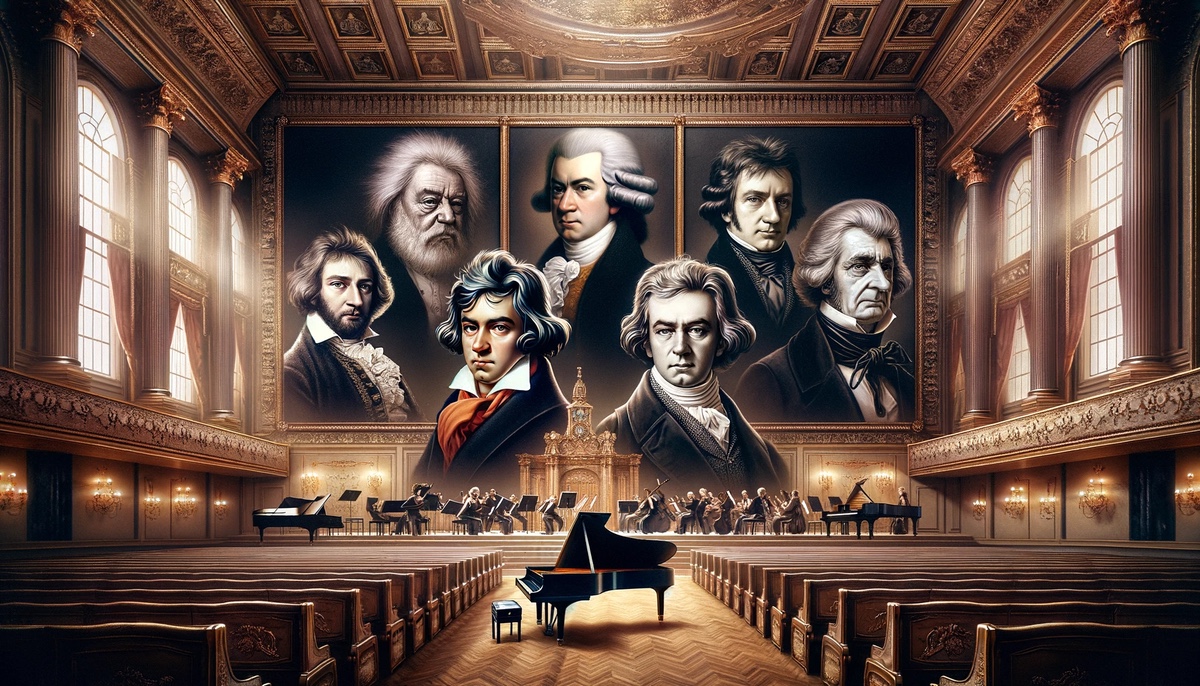
. 1791 ~ Carl Czerny, Austrian pianist and composer whose vast musical production amounted to over a thousand works. His books of studies for the piano are still widely used in piano teaching. More information on Czerny
Czerny is in the center top of this image. He influenced many!
. 1836 ~ Léo Delibes, French composer of ballets, operas, and other works for the stage. More information on Delibes
. 1893 ~ Andrés Segovia, Spanish guitarist More information on Segovia
. 1933 ~ Nina Simone, American jazz and soul singer. Simone is best known and remembered for her string of hits in the Sixties and Seventies and often referred to as the “High Priestess of Soul”. She was a civil rights activist who advocated violent revolution during the civil rights period as opposed to Martin Luther King’s non-violent approach.
. 1943 ~ David Geffen, Tony Award-winning producer of Cats in 1983, M Butterfly in 1988, “Miss Saigon”, Beetlejuice and Risky Business. Also a record executive: Geffen Records and a partner in Dreamworks film production company with Jeffrey Katzenberg and Steven Spielberg.
. 1982 ~”Ain’t Misbehavin'” closed at Longacre Theater in New York City after 1604 performances
. 1990 ~ “The Batman Theme” by Danny Elfman won Grammy Award for Best Instrumental Composition at 32nd Annual Grammy Awards
. 1991 ~ Dame Margot Fonteyn died. She is widely regarded as one of the greatest classical ballet dancers of all time.
. 2015 ~ Clark Terry died. He was an American swing and bebop trumpeter, a pioneer of the flugelhorn in jazz, educator, and NEA Jazz Masters inductee. He played with Charlie Barnet (1947), Count Basie (1948–1951), Duke Ellington (1951–1959) and Quincy Jones (1960).
Terry’s career in jazz spanned more than seventy years and he is among the most recorded of jazz musicians.
. 2017 ~ Stanislaw Skrowaczewski, Polish-born classical conductor and composer, died at the age of 93
. 2019 ~ Peter Tork, a musician who became a teeny-bopper sensation as a member of The Monkees, the wisecracking, made-for-TV pop group that imitated and briefly outsold The Beatles, has died at the age of 77.
. 1571 ~ Michael Praetorius, German organist, composer and theorist
. 1621 ~ Michael Praetorius, German composer (In Dulce Jubilo), died on his 50th birthday
More information about Praetorius
. 1797 ~ Heinrich Engelhard Steinway, German piano manufacturer
More information about Steinway
. 1847 ~ Robert Fuchs, Austrian composer and music teacher
. 1857 ~ Mikhail Glinka, Russian composer (“Ruslan and Ludmilla”), died at the age of 53
More about Glinka
. 1905 ~ Harold Arlen, (Hyman Arluck) American composer of musicals and songs
More information about Arlen
. 1918 ~ Hank Locklin (Lawrence Hankins Locklin), Country singer
. 1932 ~ George Burns and Gracie Allen debuted as regulars on The Guy Lombardo Show on CBS radio. The couple was so popular that soon, they would have their own Burns & Allen Show. George and Gracie continued on radio for 18 years before making the switch to TV. All in all, they were big hits for three decades.
. 1941 ~ Brian Holland, Songwriter
. 1941 ~ Duke Ellington and his orchestra recorded one of big band’s all-time classics on this day. Take the “A” Train was recorded at Victor’s Hollywood studio and became the Duke’s signature song.
. 1944 ~ Mick Avory, Drummer with The Kinks
. 1951 ~ Melissa Manchester, Singer
. 1958 ~ Get A Job, by The Silhouettes, reached the top spot on the music Tunedex. It remained at #1 for two weeks. Talk about sudden change in American popular music! One week earlier, the number one song was Sugartime, by The McGuire Sisters, a song that definitely was not classified as rock ‘n’ roll. Get A Job was replaced by Tequila, an instrumental by a studio group known as The Champs.
. 1959 ~ Ali (Alistair) Campbell, Guitarist, lead singer with UB40
. 1964 ~ Jack Teagarden [Weldon Leo Teagarden], American trombonist and actor (Meet Band Leaders), died from bronchial pneumonia at the age of 58
More about Teagarden
. 1965 ~ This was a sad day in music, as singer Nat ‘King’ Cole died in Santa Monica, CA. The music legend was 45.
. 1986 ~ Whitney Houston reached the #1 spot on the music charts. Her single, How Will I Know, replaced a song recorded by her first cousin, Dionne Warwick (That’s What Friends Are For). Whitney is the daughter of singer Cissy Houston.
. 1992 ~ William Schuman passed away. Schuman was an American composer and arts administrator.
. 2010 ~ Adam Kaczyński, Polish pianist and composer, died at the age of 76
. 2012 ~ Oscar-nominated singer and composer Dory Previn died at the age of 86 in Massachusetts. Previn had worked on songs with her former husband composer Andre Previn and had found solo success after releasing several albums of her own. She had also written songs for famous singers like Doris Day and won an Emmy award for co-writing the theme song for television show Two Of A Kind.
. 2016 ~ George Gaynes, American singer, actor and voice artist (Tootsie, Police Academy, General Hospital), died at the age of 98
. 1941 ~ Artie Shaw and his orchestra recorded Moonglow on Victor Records. In the band were such sidemen as Johnny Guarnieri, Jack Jenney, Billy Butterfield and Ray Conniff on trombone.
. 1943 ~ Duke Ellington and the band played for a black-tie crowd at Carnegie Hall in New York City. It was the first of what was to become an annual series of concerts featuring the Duke.
. 1943 ~ Louis Jordan and His Tympany Five took the song “What’s the Use of Getting Sober” to the top chart spot. It only stayed there for one week.
. 1948 ~ Anita Pointer, Singer with The Pointer Sisters
. 1950 ~ Bill Cunningham, Bass, piano with The Box Tops
. 1950 ~ Patrick Simmons, Singer, guitarist with The Doobie Brothers
. 1974 ~ Mike Oldfield’sTubular Bells opened the credits of the movie, “The Exorcist”, based on the book by William Peter Blatty. The song received a gold record this day.
. 1977 ~ Carole King’s landmark album, “Tapestry”, became the longest-running album to hit the charts, as it reached its 302nd week on the album lists.
. 1978 ~ Vic Ames killed in car crash
. 1981 ~ Samuel Barber, American composer (School for Scandal), died of cancer at the age of 70
. 1986 ~The first ten musicians were inducted into Rock ‘n’ Roll Hall of Fame including James Brown, Elvis Presley, Ray Charles, Buddy Holly, Chuck Berry, Sam Cooke, Fats Domino, the Everly Brothers, Jerry Lee Lewis and Little Richard.
When Chuck Berry was inducted into the Rock and Roll Hall of Fame in 1986, an all-star band, including John Fogerty, Billy Joel, Jerry Lee Lewis, Keith Richards, Neil Young and Steve Winwood, charged through a raucous “Roll Over Beethoven” with de facto bandleader Chuck Berry guiding the show.
. 1993 ~Thomas Gorsey passed away on this day. He was considered to be the “Father of Gospel Music” and had written over a thousand gospel songs in his lifetime.
. 2002 ~ Alfred Glasser, a former director of education for the Lyric Opera of Chicago, died of cancer. He was 70. Glasser held the education post for 30 years before his retirement in 1996. Since 1997, Glasser served as chairman of the board and commentator for Chicago’s concert opera company, da Corneto Opera. For the past decade, he served on the board of Alliance Francaise of Chicago, a French cultural group. Glasser also founded the Lyric Opera Lecture Corps, a community service project.
. 2003 ~ Nell Carter, actress-singer, died at the age of 54. She was best known for her role as the housekeeper in the TV sitcom “Gimme a Break!”. Carter, who was born September 13, 1948, in Birmingham, Alabama, first rose to stardom on the New York stage. After a series of roles on- and off-Broadway — and a short-lived part in the soap opera “Ryan’s Hope” — in 1977 she starred in the show “Ain’t Misbehavin’!”, a revue of the works of composer Fats Waller. She was rewarded for her performance with an Obie Award, and later with a Tony Award when the show moved to Broadway. Several years later, she earned an Emmy for her performance on a television presentation of the musical. Despite her Broadway success, Carter would have preferred to sing opera. “When I was growing up, it was not something you aspired to,” she said in 1988. “I was a weirdo to want to be in show business. Most kids wanted to be teachers or nurses.” “Gimme a Break!” ran from 1981 to 1987. Carter was nominated for two Emmys for her role as housekeeper Nell Harper, who helped run the household of police chief Carl Kanisky, played by Dolph Sweet. She also garnered two Golden Globe nominations for the role.
. 2003 ~ For Sale: One of London’s most famous music venues, which in its heyday in the 1960s played host to The Who, David Bowie and the Rolling Stones, is for sale, its administrators said. The Marquee Club, which in the 1970s was the epicenter of the punk explosion, ran into financial difficulties after its high-profile relaunch last fall, said a spokeswoman for administrator BDO Stoy Hayward. “We’re looking for someone in the music business who can capitalize on the Marquee brand and keep running it as a live venue,” she said. The price tag is at least $200 million. The club opened in London’s Soho district in 1958 and was so cramped and sweaty that, according to legend, Bob Geldof of the Boomtown Rats blacked out on stage. In 1988, it moved to a new location in nearby Charing Cross, but within eight years it had closed down. A high-profile relaunch at a new venue in Islington, north London September 2002 was headlined by the controversial electro-rockers Primal Scream, but according to the club’s administrators, huge start-up costs quickly led to its downfall.
. 2017 ~ Bobby Freeman, American singer (Do You Want to Dance), died at the age of 76
. 2018 ~ Hugh Masekela, South African trumpeter, anti-apartheid activist (I Am Not Afraid), described as the “father of South African jazz,” died at the age of 78
Hanns Eisler lived from 1898 until 1962. He was a composer, born in Leipzig, Germany. He studied under Schoenberg at the Vienna Conservatory (1919–23). A committed Marxist, he wrote political songs, choruses, and theatre music, often in collaboration with Brecht. From 1933 he worked in Paris, London, and Copenhagen, and moved to Hollywood in 1938, teaching and writing film music. Denounced in the McCarthy anti-Communist trials, he returned to Europe in 1948. He settled in East Germany in 1952, composing popular songs and organizing workers’ choirs. He wrote about 600 songs and choruses, and music for over 40 films and for nearly 40 plays.
Elgar
Edward Elgar lived from 1857 until 1934. He was a British composer whose works in the late 19th century orchestral style brought a Renaissance of English music.
His Pomp and Circumstance, usually heard at graduations, was featured in Fantasia 2000.
Ellington
Duke Ellington (1899 to 1974) was a composer, bandleader, and pianist. He was born Edward Kennedy Ellington in Washington, D.C.
From an early age, the handsome, sharply dressed teenager (that’s where he got the nickname, Duke) was headed for success. At first it was art. He won a poster-design contest and an art scholarship, left school and started a sign-painting business. But it was his natural piano-playing ability that attracted the young women, so Duke Ellington headed in that direction. He developed his keyboard skills by listening to local black ragtime pianists; he composed his first piece, Soda Fountain Rag, around 1915. A successful professional musician by the early 1920s, he left Washington in the spring of 1923 for New York, which was his home base for the rest of his life. Between December 1927 and 1931 his orchestra held forth at Harlem’s Cotton Club, where regular radio broadcasts, together with an active recording schedule, helped him establish a nationwide reputation. Take the “A” Train was his “signature song”.
In such compositions as Black and Tan Fantasy (1927), Mood Indigo (1930), Solitude (1934), and Echoes of Harlem (1935), Ellington emerged as a distinctive composer for his ensemble, employing the rhythms, harmonies, and tone colors of jazz to create pieces that vividly captured aspects of the African-American experience. At the same time, he sought to broaden jazz’s expressive range and formal boundaries in such extended works as Reminiscing in Tempo (1935), Black, Brown, and Beige (1943), and Harlem (1951).
An essential feature of Ellington’s composing method was to write with specific instrumentalists in mind, often drawing them into the creative process by building entire pieces out of their musical ideas.
He wrote scores for big band pieces, film scores, operas, ballets, Broadway shows, gospel music, musicals, films, television, and ballet and in the 1960s produced a series of sacred concerts combining his orchestra, choirs, vocalists, and dancers. He would work with each section of his orchestra as an entity unto its own and then bring them together to create the unique sounds such as, Mood Indigo. Over 1,000 musical pieces are credited to the great Duke Ellington. James Lincoln Collier studied the Duke and his Orchestra, comparing Duke Ellington to a “master chef who plans the menus, trains the assistants, supervises them, tastes everything, adjusts the spices … and in the end we credit him with the result.”
Ellington was successful, as few others have been, in reconciling the practical function of a popular entertainer with the artistic aspirations of a serious composer. His rich legacy consists of hundreds of recordings, his many pieces that have entered the standard repertory, and his musical materials now preserved in the Duke Ellington Collection at the Smithsonian Institution. There is a statue of Duke Ellington in New York.
Entwistle
John Entwistle, the bass player for veteran British rock band The Who, died in Las Vegas on Thursday, June 27, 2002, at age 57, just one day before the group was set to begin a North American tour in the city, officials said.
Entwistle, a bearded, taciturn musician affectionately known as “Ox” or “Thunderfingers,” died in his room at the Hard Rock Hotel and Casino, officials said, of an apparent heart attack.
The Who, known for such raw percussive hits as “My Generation,” “Pinball Wizard” and “Won’t Get Fooled Again,” were scheduled to begin their three-month tour at the Joint, a small club at the hotel. An MCA official said the show had been canceled, as well as two weekend concerts in Los Angeles. She referred questions about the rest of the tour to promoter Clear Channel, where a spokesman was not available for comment.
With Entwistle’s death, The Who are down to just two original members — singer Roger Daltrey and guitarist-songwriter Pete Townshend. Original drummer Keith Moon died of an accidental pill overdose in 1978.
A source close to the band told Reuters that a devastated Daltrey and Townshend spent several hours together in Los Angeles after hearing of Entwistle’s death. Entwistle had arrived in Las Vegas ahead of his bandmates to open a traveling exhibition of his artwork, said a statement from MCA Records.
In addition to his lightning finger work on the bass, Entwistle helped out on backing vocals, supplying an alto-tenor on “A Quick One While He’s Away” and “Summertime Blues.” His unique playing style mixed bass melodies with a more rhythmic role, producing a trebly sound that essentially became the band’s lead instrument.
On stage he rarely moved from his spot, allowing his colorful bandmates to vie for the spotlight.
His songwriting contributions were mostly limited to a few album tracks and B-sides. The first song he wrote for The Who, 1966’s creepy-crawly gem “Boris the Spider,” was resurrected on their 1989 reunion tour. Other songs he wrote for The Who included “My Wife” and “Whiskey Man.”
Entwistle released a half-dozen eclectic solo albums that revealed his wry sense of humor, and he also dabbled in art. He had spent the last dozen years writing a novel, although he noted in a recent interview that “at the current rate of writing they’re gonna have to engrave the end on my tombstone.”
ROOTS OF THE WHO
Born John Alec Entwistle in the London suburb of Chiswick on Oct. 9, 1944, he studied piano, trumpet and French horn as a youngster before moving on to a homemade bass. The formal music education proved helpful later on as he performed and arranged all the brass parts on The Who’s records.
At the age of 14, he formed a traditional jazz band at his grammar school, the Confederates, and invited schoolmate Townshend to join the short-lived combo. He then joined the Detours, a band formed by an older boy at their school, Roger Daltrey. At Entwistle’s suggestion, Daltrey brought in Townshend, and the early The Who started to take shape.
After leaving school, Entwistle worked as a tax clerk by day and played with the band by night. The group changed its name to The Who in 1964, and Moon joined later that year, replacing drummer Doug Sandom, who did not play aggressively enough for the other members of the band.
Influenced by the likes of bluesman Jimmy Reed, rocker Eddie Cochran and soul giants James Brown and Jackie Wilson, The Who made an immediate impression on the London “Mod” scene with its seemingly undisciplined garage rock, which it dubbed “Maximum R&B.”
The band trashed its equipment at the end of each show, and it was years before it made enough money to pay off its bills for new instruments.
After briefly flirting with a new name, the High Numbers, The Who released its first single in early 1965, “I Can’t Explain.” It followed up with “Anyway Anyhow Anywhere” and its signature anthem, “My Generation,” famed for Townshend’s nihilistic lyric “Hope I die before I get old.”
GOING SOLO
With Townshend and Daltrey often at loggerheads with each other, and Moon busy pioneering the lifestyle of a destructive rock star, Entwistle became the first member to release a solo album, 1971’s “Smash Your Head Against the Wall.”
“I never really wanted The Who to do more of my songs because I thought at the time they would mess them up,” Entwistle once said.
He released a succession of follow-up albums, and launched a money-losing tour of Britain and the United States with his own band, the Ox, in the mid-1970s.
The Who, meanwhile, became one of the biggest bands in the world, even earning a mention in the 1976 Guinness Book of Records for playing the loudest concert — 120 decibels, the same intensity as a jet engine.
Albums such as the 1969 rock opera “Tommy,” “Who’s Next” (1971) and “Quadrophenia” (1973) cemented its position as the third band in the great triumvirate of British rock, just below the Beatles and the Rolling Stones.
After Moon’s death in 1978, shortly following the release of “Who Are You,” the band recruited former Faces drummer Kenney Jones. But the group had lost its momentum and released its last studio album in 1982, “It’s Hard,” accompanied by a farewell tour. It regrouped in 1989 and toured sporadically.
Entwistle was married twice and has one son from his first marriage, Christopher.
. 1775 ~ Giovanni Battista Sammartini, composer, died
. 1890 ~ Premiere of The Sleeping Beauty, ballet by Pyotr Il’yich Tchaikovsky. After the less-than-promising 1877 debut of Swan Lake, marred by a largely amateur production, over a decade elapsed before the composer was commissioned by the Director of the Imperial Theatres in St. Petersburg to supply music for a ballet on the Perrault fairy tale, The Sleeping Beauty. Tchaikovsky threw himself arms-deep into the project. Not only was the composer again on happy turf, but he was also currently in a state of delight by the occasional presence of a three-year-old little girl; children seemed to tap a joyful vein in Tchaikovsky. The little girl’s proximity fed a spirit of fantasy that transmitted to this most lighthearted of the composer’s scores. Most musicologists and historians concede that Sleeping Beauty is the most perfectly wrought of Tchaikovsky’s three ballet scores, classic in its restraint, yet possessing the right amount of color and panache to render it pure Tchaikovsky; its waltz remains a Pops favorite.
. 1896 ~ Alexander Scriabin made his European debut as a pianist at the Salle Erard in Paris
. 1909 ~ Gene Krupa, American Jazz bandleader and drummer
. 1919 ~ Pianist and statesman Ignace Paderewski became the first premier of Poland
. 1925 ~ Ruth Slenczynska, pianist, born in Sacramento, California
. 1941 ~ Captain Beefheart (Don Van Vliet), Singer with Captain Beefheart & His Magic Band, artist
. 1942 ~ Kenny Sargent vocalized with the Glen Gray Orchestra on Decca Records’ It’s the Talk of the Town.
. 1944 ~ Duke Ellington and His Famous Orchestra took the song “Do Nothin’ Till You Hear From Me” to the top of the charts. It was there for eight weeks before being knocked out off the top.
. 1948 ~ Ronnie Van Zandt, Singer, songwriter with Lynyrd Skynyrd
. 1964 ~ The soundtrack album of the musical, “The King and I”, starring Yul Brynner, earned a gold record.
. 1967 ~ Ed Sullivan told the Rolling Stones to change the lyrics and the title to the song, Let’s Spend the Night Together, so it became Let’s Spend Some Time Together.
. 1972 ~ Elvis Presley, who was also censored from the waist down by Ed Sullivan, reportedly drew the largest audience for a single TV show to that time. Elvis presented a live, worldwide concert from Honolulu on this day.
. 1972 ~ “American Pie” by Don McLean hit #1 on the pop charts
. 1987 ~ Ray Bolger died. He was an American entertainer of vaudeville, stage and actor, singer and dancer best known for his portrayal of the Scarecrow in The Wizard of Oz.
. 1993 ~ Sammy Cahn passed away. He was an American lyricist, songwriter and musician.
. 2018 ~ Edwin Hawkins, American gospel musician, choirmaster and composer (Oh Happy Day), died of pancreatic cancer at the age of 74
. 2019 ~ Carol Elaine Channing died at the age of 98. She was an American actress, singer, dancer and comedian. Notable for starring in Broadway and film musicals, her characters typically radiate a fervent expressiveness and an easily identifiable voice, whether singing or for comedic effect.
. 1884 ~ Sophie Tucker (Abuza), Russian-born American burlesque and vaudeville singer
. 1904 ~ Richard Addinsell was born
More information about Addinsell
. 1909 ~ Quentin ‘Butter’ Jackson, Trombonist, played with Duke Ellington
. 1910 ~ Enrico Caruso and Emmy Destinn were heard via a telephone transmitter; rigged by DeForest Radio-Telephone Company to broadcast from the Metropolitan Opera House in New York City.
. 1930 ~ Robert ‘Squirrel’ Lester, Singer with The Chi-Lites
. 1938 ~ Singer Allan Jones recorded The Donkey Serenade for Victor Records. The song became the one most often associated with the singer. Allan sang and acted in several Marx Brothers films: “A Night at the Opera”, “A Day at the Races”, but the film that catapulted him to stardom was the operetta, “Firefly”, with Jeanette MacDonald. Singer Jack Jones is the son of Allan and wife, actress Irene Hervey.
. 1941 ~ The four Modernaires joined to sing with the Glenn Miller Band on a permanent basis beginning this day. They had a ‘solo’ hit in 1946 with To Each His Own.
. 1957 ~ Elvis Presley recorded All Shook Up and That’s When Your Heartaches Begin for Victor Records in Hollywood. The former tune became Elvis’ ninth consecutive gold record.
. 1961 ~ Wayne Marshall, English pianist, organist and conductor
. 1962 ~ Singer Chubby Checker set a record, literally, with the hit, The Twist. The song reached the #1 position for an unprecedented second time – in two years. The Twist was also number one on September 26, 1960.
. 1968 ~ Johnny Cash performed live for the second time at Folsom Prison in the prison cafeteria which was recorded as the album “Johnny Cash at At Folsom Prison”.
. 2001 ~ Kenneth Haas, the former general manager of the Boston Symphony Orchestra and the Cleveland Orchestra, died after a long illness at the age of 57. Haas was general manager of the Boston orchestra from 1987 to 1996 and was instrumental in appointing Keith Lockhart conductor of the Boston Pops Orchestra. Haas was general manager of the Cleveland Orchestra from 1976 to 1987 after performing the same job for the Cincinnati Symphony Orchestra in 1975. In Cleveland he established the orchestra’s chamber music and recital series.
. 2001 ~ Michael Cuccione, youngest of the five-member spoof boy band 2gether, died at age 16 from complications from Hodgkin’s disease. The teen played Jason “Q.T.” McKnight on the MTV show “2gether,” which poked fun at the boy band craze. His character had a fictional illness, “biliary thrombosis,” but Cuccione really had suffered from Hodgkin’s disease as a child and underwent five months of chemotherapy. The singer-actor set up a cancer research foundation co-wrote a book with his grandmother and appeared on “Baywatch” as a cancer victim.
. 1803 ~ Henri Herz, Austrian pianist and composer
. 1838 ~ Max Bruch, German Composer
More information about Bruch
. 1850 ~ Franz Xaver Scharwenka, Polish composer
More information about Scharwenka
. 1852 ~ Louis Braille died. He was a French educator and inventor of a system of reading and writing for use by the blind or visually impaired. His system remains virtually unchanged to this day and is known worldwide simply as braille.
. 1856 ~ Giuseppe Martucci, Italian composer, conductor, pianist and teacher influential in reviving Italian interest in non-operatic music.
. 1863 ~ First performance of Johannes Brahms‘ Piano Sonata No. 3 in f, in Vienna.
. 1878 ~ Carl Sandburg, Author, poet, folk balladeer
. 1916 ~ Philip Bezanson, American composer and educator
. 1924 ~ Earl Scruggs, American country music singer, banjo player and songwriter, born. He was with the Grand Ole Opry.
. 1929 ~ Wilbert Harrison, Singer
. 1934 ~ Bobby Lord, Country singer
. 1937 ~ Nino Tempo, Sax musician, singer with April Stevens
. 1937 ~ Doris Troy, Singer
. 1938 ~ Trummy Young played trombone and sang with the Jimmy Lunceford Orchestra in New York City as Margie became Decca record number 1617.
. 1946 ~ Roger Keith, Lead guitarist, Pink Floyd
. 1946 ~ Syd (Roger) Barrett, Guitarist, singer with Pink Floyd
. 1959 ~ Kathy Sledge, Singer with Sister Sledge
. 1964 ~ Premier of “Hello Dolly”
. 1966 ~ Duke Ellington’s concert of sacred music, recorded at 5th Avenue Presbyterian Church in New York City, was broadcast on CBS-TV.
. 1975 ~ The Broadway premiere of “The Wiz” opened, receiving enthusiastic reviews. The show, a black version of “The Wizard of Oz”, ran for 1,672 shows at the Majestic Theatre. Moviegoers, however, gave a thumbs down to the later cinema version of the musical that starred Diana Ross and Michael Jackson. One memorable song from the show is Ease on Down the Road.
. 1993 ~ The great jazz trumpeter, Dizzy Gillespie died of cancer at age 75. He has been credited with being a co-founder (with Charlie Parker) of ‘bebop’ music and wrote many jazz numbers (Salt Peanuts, Night in Tunisia). Gillespie also created the ‘afro-cuban’ sound in jazz music. A few of the disciples who preached Dizzy’s gospel of bebop were Thelonious Monk, Earl ‘Bud’ Powell, Charlie Parker and Miles Davis.
• 1723 ~ Carl Friedrich Abel, German composer of the Classical era. He was a renowned player of the viola da gamba, and composed important music for that instrument.
• 1808 ~ Beethoven’s Fifth Symphony given world premiere in Vienna.
• 1821 ~ Giovanni Bottesini, Italian Romantic composer, conductor, and a double bass virtuoso
• 1853 ~ Maria Teresa Carreno, Venezuelan pianist, singer, composer, and conductor.
• 1858 ~ Giacomo Puccini, Italian opera composer More information about Puccini
• 1874 ~ Franz Schmidt, Austrian composer, cellist and pianist.
• 1883 ~ Edgard Varèse, French-born American avant-garde composer More information about Varèse
• 1885 ~ (Joseph) Deems Taylor, American opera composer and writer, music critic for New York World from 1921 until 1925, New York American from 1931 to 1932, intermission commentator for Sunday radio broadcasts of NY Philharmonic (1936 to 1943), president of ASCAP, married to poet and playwright Mary Kennedy
• 1894 ~ Claude Debussy’s first orchestral masterpiece “Prélude à l’apres-midi d’un faune” premiered in Paris
• 1901 ~ André Kostelanetz, Russian-born American conductor and arranger of Broadway show tunes
• 1939 ~ Gertrude ‘Ma’ Rainey (Mother of the Blues) passed away
• 1941 ~ Jimmy Lunceford and his orchestra recorded Blues in the Night on Decca. The song became one of Lunceford’s biggest hits. Between 1934 and 1946 Jimmy Lunceford had more hits (22) than any other black jazz band (except Duke Ellington and Cab Calloway).
• 1944 ~ Barry Jenkins, Drummer with Nashville Teens and also the Animals
• 1946 ~ Rick Nielsen, Guitarist, singer with Cheap Trick
• 1949 ~ Maurice Gibb, Bass, songwriter with the Bee Gees, married to singer Lulu, twin of Robin Gibb. The Bee Gees sold over 200 million records and were one of the most popular groups from the mid 60’s to late 70’s.
• 1949 ~ Robin Gibb, Songwriter for Bee Gees, twin of Maurice Gibb
• 1958 ~ The Chipmunks were at the #1 position on the music charts on this day in 1958 as Alvin, Simon, and Theodore sang with David Seville. The Chipmunk Song, the novelty tune that topped the charts for a month, is still a Christmas favorite today…
Christmas, Christmas time is near Time for toys and time for cheer We’ve been good, but we can’t last Hurry Christmas, hurry fast
Want a plane that loops the loop Me, I want a hula hoop We can hardly stand the wait Please Christmas, don’t be late.
• 1972 ~ Folk singer Joni Mitchell received a gold record for the album, For the Roses. The album included the song, You Turn Me on, I’m a Radio.
• 1981 ~ London was the scene of a rock ’n’ roll auction where buyers paid $2,000 for a letter of introduction from Buddy Holly to Decca Records. Cynthia and John Lennon’s marriage certificate was worth $850 and an autographed program from the world premiere of the Beatles film Help! brought $2,100.
• 1984 ~ CBS Records announced plans for the release of Mick Jagger’s first solo album, set for February,
• 1985 ~ The Rolling Stones went solo after a 20-year career with the self- proclaimed “greatest rock ’n’ roll band in the world.” The album: She’s the Boss.
• 2002 ~ Joe Strummer (John Mellors), who brought punk attitude and politics to one of the most significant bands in rock ‘n’ roll history, the Clash, died of a heart attack at his home in Somerset, England. He was 50. Strummer, a singer, guitarist, songwriter, activist and actor, had been touring with his band the Mescaleros since the release of their second album “Global a- Go-Go” in July 2001; the latest leg of the tour ended in November in Liverpool. The Clash, which formed in 1976, released its first album in ’77 and broke up for good in 1986, will be inducted into the Rock and Roll Hall of Fame in March. The original lineup of Strummer, Mick Jones, Terry Chimes and Paul Simonon was expected to re-form for the induction ceremony and play the band’s first single, “White Riot,” at the ceremony. Although it was written as an advertising tagline, the Clash successfully lived up to its slogan as “the only band that matters.” The son of a diplomat, Strummer was born John Graham Mellor on Aug. 21, 1952, in Ankara, Turkey. He attended boarding schools in London, and as a teenager grew infatuated with reggae, R&B and rock ‘n’ roll. He formed a pub band, the 101ers, in 1974, which he gave up to form the Clash with Jones, Chimes and Keith Levene. The band was playing standard rock ‘n’ roll prior to Strummer’s arrival. He added reggae to the mix and upped the ante in politics and intensity. He took a Jones tune, for example, that was a complaint about a girlfriend and turned it into one of the band’s early anthems, “I’m So Bored With the U.S.A.” “Within the Clash, Joe was the political engine of the band,” British troubadour Billy Bragg said. “Without Joe there’s no political Clash, and without the Clash the whole political edge of punk would have been severely dulled.” Jones and Strummer penned all of the tunes on their debut and often worked as a team, though later albums would have songs attributed solely to Strummer and, for their final two efforts, have all songs attributed to the band.
• 1911 ~ “Spike” (Lindley Armstrong) Jones, American drummer, bandleader of satiric music
• 1913 ~ Dan Dailey, Singer, dancer, actor
• 1914 ~ Rosalyn Tureck, American pianist and harpsichordist
• 1920 ~ Clark Terry, Trumpet, flugelhorn with Lionel Hampton, Count Basie, Duke Ellington, Quincy Jones
• 1928 ~ America’s original Funny Girl, Fanny Brice, recorded If You Want the Rainbow, a song from the play, My Man, on Victor Records.
• 1932 ~ Abbe Lane (Lassman), Singer, glamour actress, photographed in a bathtub filled with coffee, bandleader Xavier Cugat’s ex-wife
• 1932 ~ Charlie RIch, American Country and Western Singer . He began his career while serving in the U.S. Air Force in the early 1950s, but did not have major success until the 70’s when he had a string of number 1 Country and Western Singles Hits including Behind Closed Doors, “The Most Beautiful Girl”, “A Very Special Love Song”, “I Don’t See Me in Your Eyes Anymore” and “I Love My Friend”. “The Most Beautiful Girl” also made number one on the US pop charts.
• 1936 ~ You Can’t Take It with You opened at the Booth Theatre in New York City.
• 1946 ~ Patty Duke, US film actress
• 1947 ~ Christopher Parkening, American guitarist
• 1953 ~ Fred Allen returned from semi-retirement to narrate Prokofiev’s classic, Peter and the Wolf, on the Bell Telephone Hour on NBC radio.
• 1963 ~ Singer Dinah Washington died in Detroit.
• 1970 ~ George Harrison received a gold record for his single, My Sweet Lord.
• 1983 ~ The musical biography of Peggy Lee opened at the Lunt-Fontanne Theatre in New York City. The show was titled Peg.
• 1984 ~ The Cotton Club opened around the U.S. There were nine classic songs by Duke Ellington on the soundtrack of the movie.
• 1990 ~ Opera lovers were turned into couch potatoes. For four evenings, starting on this day, they watched and listened to an unabridged telecast of Richard Wagner’s marathon-length opera The Ring.
• 2001 ~ Conte Candoli, a Trumpet player and staple of The Tonight Show band during Johnny Carson’s era, died of cancer. He was 74. Candoli was recognized for developing a musical style based on Dizzy Gillespie’s bebop playing, with a touch of Miles Davis and Clifford Brown. The Indiana-born Candoli, grew up surrounded by musical instruments and influences. His father, a factory worker, played the trumpet and wanted Candoli and his brother Pete to become musicians. At 16, he worked in Woody Herman’s orchestra during summer vacations. While playing in California, Candoli began his association with the then New York-based Tonight Show. In 1972, when Carson moved the show to Burbank, Candoli joined the band. He left when Carson retired in 1992.
• 1910 ~ Dennis Morgan (Stanley Morner), Singer, actor
• 1910 ~ Tenor Enrico Caruso and conductor Arturo Toscanini were featured at the Metropolitan Opera House in New York City for the world premiere of Puccini’sThe Girl of the Golden West.
• 1913 ~ Morton Gould, American Pulitzer Prize-winning composer, conductor and pianist
• 1924 ~ Ken Albers, Bass singer with The Four Freshmen
• 1927 ~ For the first time, famed radio announcer George Hay introduced the WSM Barn Dance as the Grand Ole Opry. The show’s title may have changed but it remained the home of country music.
• 1930 ~ Duke Ellington and his orchestra recorded the haunting Mood Indigo on Victor Records. It became one of the Duke’s most famous standards.
• 1943 ~ Chad Stuart, Guitarist, lyricist, singer with the duo – Chad & Jeremy
• 1946 ~ Christopher ‘Ace’ Kefford, Bass with The Move
• 1947 ~ Walter ‘Clyde’ Orange, Drummer, singer with The Commodores
• 1948 ~ Jessica Cleaves, Singer with Friends of Distinction
• 1949 ~ Frank Beard, Drummer with ZZ Top
• 1949 ~ Fats Domino recorded his first sides for Imperial Records. The legend from New Orleans recorded The Fat Man, one of the earliest rock and roll records. The title also turned into Domino’s nickname and stayed with him through his years of success.
• 1951 ~ John (Raul) Rodriguez, Singer
• 1953 ~ Harry Belafonte debuted on Broadway in Almanac at the Imperial Theatre. Critics hailed Belafonte’s performance as “electrifyingly sincere.” Also starring in the show: Hermione Gingold, Billy DeWolfe, Polly Bergen and Orson Bean.
• 1966 ~ The Beach Boys made a one-week stop at the top of the Billboard Hot 100 asGood Vibrations made it to #1. It was the third #1 hit the group scored. The others were I Get Around and Help Me, Rhonda.
• 1967 ~ Otis Redding and four members of the Bar-Kays (Otis’ backup group) were killed in the crash of a private plane near Madison, Wisconsin. Redding was 26 years old. His signature song, (Sittin’ On) The Dock of the Bay was recorded three days before his death. It was #1 for four weeks beginning February 10, 1968. Redding was inducted into the Rock and Roll Hall of Fame in 1989. The Bar-Kays biggest hit was in July, 1967: Soul Finger. James Alexander, bass player for the group, was not on the plane. Ben Cauley, trumpet player, survived the crash. The group played for a time with various new members.
• 1987 ~ Jascha Heifetz passed away
Read quotes by and about Heifetz
More information about Heifetz
• 2021 ~ Michael Nesmith, a singer and guitarist for the hit group the Monkees, died at the age of 78.





 MaryO'Studio