Composers – L


Lamb

Joseph Lamb (1887 to 1960) was an extraordinarily gifted ragtime pianist and composer along with Scott Joplin and James Scott. He differed from them, though, because the art of improvisation completely baffled him. In response to this, Lamb viewed ragtime as an art form written on paper, instead of a spontaneous one. Though his style and approach were markedly different from his peers, he still left behind a rich legacy and remained one of the most influential ragtime composers.

Lehar

Franz Lehar, 1870 to 1948 was the son of a bandmaster serving principally in Hungary. He followed his father’s profession, before winning, in 1902, success in the theatre in Vienna, where he succeeded in the following years in reviving the operetta, providing music of greater distinction, with tenor arias written specifically for Richard Tauber.

The reputation of Franz Lehar as a composer of operetta is assured as he wrote nearly forty of them. Of these by the far the best known is Die lustige Witwe (The Merry Widow), first staged in Vienna in 1905, the favourite operetta of Adolf Hitler.

Lennon

John Lennon, 1940 to 1980,was a pop star, composer, songwriter, and recording artist. He was born in Liverpool, Merseyside, NW England, UK. and was The Beatles rhythm guitarist, keyboard player, and vocalist, and a partner in the Lennon–McCartney song-writing team. He married Japanese artist Yoko Ono in 1969. On the birth of his son, Sean (born in 1975), he retired from music to become a house-husband. Five years later he recorded (Just Like) Starting Over, but he was shot and killed by a deranged fan just before its release. His death affected millions of people, record sales soared, and he continues to be admired by new generations of fans.

Lerner and Lowe

Alan Jay Lerner,
Playwright, born August 31, 1918, New York, New York; died June 14, 1986

Frederick Loewe,
Composer, born June 10, 1904, Vienna, Austria; died February 14, 1988

Frederick Loewe, an unheralded Vienna-born composer, and Alan Jay Lerner, the lyricist-playwright son of the proprietors of an American chain of women’s clothing shops, with sketches and lyrics for two Harvard Hasty Pudding shows among his major credits, met by chance at New York’s Lambs Club in 1942. Had they not, Brigadoon would never have emerged from the mists of the Scottish Highlands to make the world feel “Almost Like Being in Love” . . . no one would have been there to “Paint Your Wagon” . . . My Fair Lady would still be a less than lyrical English girl from George Bernard Shaw’s Pygmalion who couldn’t sing a note. . . we might never have thought to “Thank Heaven for Little Girls” like “Gigi” . . . and Camelot would most likely have stayed within the pages of Arthurian legend.

When the two, who were destined to enrich the American musical theater with some of its most poignant, rousing, and memorable lyrics, engaging books and powerful musical scores, had that chance meeting more than 50 years ago, neither was widely known. Loewe’s Great Lady had had a brief run on Broadway in 1938. Lerner had added radio scripts to his Hasty Pudding Club show credits. But later collaborations after one brief failure, What’s Up? (1943), and the moderately successful The Day Before Spring (1945), which ran five months on Broadway, made musical history.

Alan Jay Lerner was one of three sons of Joseph J. Lerner, who founded Lerner Stores, Inc. He was educated in England and at the Choate School in Wallingford, Connecticut, before entering Harvard. He studied at the Juilliard School of Music during vacations from Harvard. After graduating in 1940 with a B.S. degree, he wrote advertising copy and radio scripts for such programs as the “Philco Hall of Fame.”

Frederick “Fritz” Loewe was the son of Edmund Loewe, an eminent operetta tenor. When he was two, Frederick accompanied his father on a tour of the United States. The youngster played piano at four and, at nine, composed the tunes for a music hall sketch in which his father toured Europe. At 15, he wrote “Katrina,” a popular song that sold 3,000,000 copies in Europe. He had begun his own concert career as soloist with some of Europe’s leading symphony orchestras at the age of 13 after having studied with the noted European musician Ferruccio Busoni and Eugene d’Albert. In 1923, young Loewe was awarded the Hollander Medal in Berlin and studied composition and orchestration with Nickolaus von Reznicek.

The following year, the younger Loewe accompanied his father to America. Since neither a concert he gave at New York’s Town Hall, nor a subsequent week’s engagement at the Rivoli Theater led to further concert engagements, he tried teaching music and playing at Greenwich Village night clubs. When music failed to earn him a living, he worked as a busboy in a cafeteria and as a riding instructor at a New Hampshire resort. He took up flyweight boxing and failed, then went West, cowpunching, gold mining, and carrying mail on horseback over the Montana mountains before returning to New York where he found work as a piano player. In 1935, Loewe’s song “Love tiptoes Through My Heart” was accepted for the musical Petticoat Fever. His own musical, Salute to Spring, was presented in St. Louis in 1937. The next year, his Great Lady reached Broadway, but ran for only 20 performances.

The first Lerner-Loewe collaboration was a musical adaptation of Barry Connor’s farce The Patsy for a Detroit stock company in 1942. They called it Life of the Party and it enjoyed a nine-week hit that encouraged them to continue with the musical comedy What’s Up? which opened on Broadway in 1943. Lerner wrote the book and lyrics with Arthur Pierson, and Loewe composed the music. It ran for 63 performances and was followed in 1945 by their The Day Before Spring.

It was when the curtain went up to the haunted strains of bagpipes on the night of March 13, 1947, and the mist-shrouded Scottish Highland village of Brigadoon first appeared, that the team of Lerner and Loewe also emerged as potentially legendary. The musical, which after its original 581 performances on Broadway, toured extensively and has been revived frequently, won the “best musical”award from the New York Drama Critics Circle the year it opened and was hailed as having “evoked magic on Broadway.”

Between Brigadoon and Paint Your Wagon, the next team effort by Lerner and Loewe, Lerner wrote Love Life, with music by Kurt Weill, which was selected as one of the best plays of the 1948-49 Broadway season, plus the story, screenplay and lyrics for the films Royal Wedding and Brigadoon and the story and screenplay for An American in Paris, for which he won an Oscar in 1951.

Paint Your Wagon rolled in in 1951, and then, five years later, on March 15, 1956, My Fair Lady opened and became one of the most spectacular successes–artistic and financial–in the history of the American theater. Playing a record 2,717 performances on Broadway alone, it went on to break all other existing world records. This musicalization of Shaw’s classic Pygmalion was named “outstanding musical of the year” by the New York Drama Critics Circle–and by millions of theater goers.

Lerner and Loewe’s next collaboration was on the film adaptation of the Colette novel Gigi, another success filled with songs destined to become standard.

There was more collaborating to come–the film version of the Antoine de Saint-Exupery fable The Little Prince in 1972, but the 1960 Broadway hit Camelot which brought Arthurian England to life for its most shining hour, rang the curtain down on the phenomenon of Lerner and Loewe. Loewe, who had suffered a heart attack in 1958, went into retirement.

In tribute to his long time former partner, Lerner wrote, “There will never be another Fritz. . . . Writing will never again be as much fun . A collaboration as intense as ours inescapably had to be complex. But I loved him more than I understood or misunderstood him, and I know he loved me more than he understood or misunderstood me.”

Lewis

Jerry Lee Lewis (September 29, 1935 – October 28, 2022) was an American pianist, singer and songwriter. Nicknamed “The Killer”, he was described as “rock ‘n’ roll’s first great wild man”.

Liadov

Anatol Konstantinovich Liadov lived from 1855 until 1914. He was the son of a conductor at the Mariinsky Theatre in St Petersburg, and was trained at the Conservatory, where he was briefly a pupil of Rimsky-Korsakov and later a member of the teaching staff. He was associated with Balakirev and subsequently became a member of Belyayev’s circle, helping, in particular, in the establishment of the publishing-house that Belyayev established for Russian composers.

He was a thoroughly competent musician, conductor and composer, but did not apply himself constantly to work. His failure to supply music for the Dyagilev ballet in Paris in 1910 allowed Stravinsky his first chance with the Ballets russes. His compositions are characteristic of the period in Russian nationalism, when nationalism was joined with technical competence inculcated at the Conservatories.

The best known orchestral compositions by Liadov are the descriptive Russian fairy-tale pieces Kikimora, Baba-Yaga and Volshebnoye ozero (The Enchanted Lake). His last orchestral work was the symphonic poem Skorbnaya pesn. All are very much in the nationalist tradition exemplified by Rimsky-Korsakov.

Liadov wrote a number of shorter piano pieces, including Fugues and a set of Canons, testimony to his contrapuntal ability. Other pieces have characteristic titles, examples of pleasing and well crafted compositions for which there was a ready market.

Liadov wrote a setting of the final scene of Schiller’s Die Braut von Messina (The Bride from Messina) for his Conservatory graduation. Of some 26 songs, eighteen are Children’s Songs.

Liberace

(Walter) (Wladziu Valentino) Liberace, American pianist and showman. Lee, as he was known, was the master of Las Vegas. Hundreds of thousands flock to his museum there (operated by his brother, George) to see Liberace’s garish suits, trademark candelabra, and learn of the myths behind this hugely successful star of television, stage and concerts the world over.

Ligeti

György Ligeti, a composer, was born in 1923 in Transylvania. He studied and later taught at the Budapest Academy of Music. After leaving Hungary in 1956, he worked at the electronics studio in Cologne, then settled in Vienna, where he developed an experimental approach to composition. His first large orchestral work, Apparitions (1958–9), made his name widely known. In Aventures (1962) he uses his own invented language of speech sounds. He has also written a choral requiem, a cello concerto, and music for harpsichord, organ, and wind and string ensembles.

Lipatti

Dinu Lipatti was born in Bucharest and lived from 1917 until 1950. He was a pianist and composer who studied in Paris with Cortot and Boulanger, and after World War 2 established an international reputation as a gifted pianist, especially in the works of Chopin. His compositions include a Symphonie concertante for two pianos and strings, and a concertino for piano and orchestra. His career was cut short when he died of a rare form of cancer.

Liszt

Franz Liszt was born in Raiding, near Doborján, October 22, 1811 and died in Bayreuth, July 31, 1886. He was a Hungarian composer and pianist who was a major influence during the romantic period. Liszt was an outstanding pianist at seven, composed at eight and made concert appearances at nine. In addition to being a piano virtuoso, he was also a critic, conductor, city music director, literary writer and transcriber of the works of other composers. He transcribed Beethoven’s Symphonies for the piano.

Franz Liszt began his career as the outstanding concert pianist of the century, who, along with the prodigious violinist Niccolò Paganini (1782-1840), created the cult of the modern instrumental virtuoso. To show off his phenomenal and unprecedented technique, Liszt composed a great deal of music designed specifically for this purpose, resulting in a vast amount of piano literature laden with dazzling scales, trills, arpeggios, leaps, and other technical marvels. In this vein, Liszt composed a series of virtuosic rhapsodies on Hungarian gypsy melodies, the best-known being the all too familiar Hungarian Rhapsody no. 2. Liszt developed the rhapsody as a form of serious music. This kind of music is worlds apart from the generally more introspective, poetic music of pianist-composer Frédéric Chopin.

Liszt was wildly handsome and hugely talented. He was extremely popular in Paris during the 1830’s. It is said that women actually fainted at his piano recitals. He was the first to position the piano so that its lid reflected the sound and the audience could see his profile as he performed.

Liszt was the first to write a tone poem, which is an extended, single-movement work for orchestra, inspired by paintings, plays, poems or other literary or visual works, and attempting to convey the ideas expressed in those media through music. Such a work is Les Pruludes, based on a poem in which life is expressed as a series of struggles, passions, and mysteries, all serving as a mere prelude to . . .what? The Romantic genre of the symphonic poem, as well as its cousin the concert overture, became very attractive to many later composers, including Saint-Saëns, Tchaikovsky, Dvořák, Sibelius, and Richard Strauss.

Lloyd Webber

British composer Andrew Lloyd Webber is one of the most successful composers of this era with hugely successful commercial hits such as Jesus Christ Superstar, Sunset Boulevard, Cats, Phantom of the Opera and Evita. Cats, the longest-running production in Broadway history, closed after 7,397 performances on June 25, 2000.

Locatelli

Pietro Antonio Locatelli lived from 1695 until 1764. He was born in Bergamo, later moving to Rome, where he might have studied with Corelli, but more probably was a pupil of Valentini. He was an Italian composer of sonatas and concerti, but he was best known as a virtuoso violinist playing mostly in Amsterdam where he settled in 1721. He won a reputation as a virtuoso, performing in Italy, in Bavaria and in Berlin. In 1729 he settled in Amsterdam, where he taught and conducted an amateur orchestra and was able to pursue his wider cultural interests.

Locatelli wrote a number of concerti grossi, following the example of Corelli. The first set, published in Amsterdam in 1720, include twelve fugues. L’arte del violino (The Art of the Violin), published in 1733, contains twelve violin concertos and 24 Caprices, precursors of Paganini’s famous set for unaccompanied violin. A further set of six concertos was published two years later and a set of six, published in 1744, is scored for four violins, two violas and basso continuo. Locatelli combines the Roman style of Corelli with, in his solo concertos, the virtuosity of Vivaldi in Venice.

In his Concerti grossi, works for string orchestra with a smaller group of soloists, Locatelli at first follows the pattern of Corelli, with one or two violas added to Corelli’s solo group of two violins, cello and harpsichord. There is also a Concerto grosso that includes a group of solo wind instruments, in addition to solo violin concertos. Some of these works have programmatic titles. His L’arte del violino (The Art of the Violin) includes 24 Caprices for unaccompanied violin, challenging works that have been regarded by some as foreshadowing the Caprices of Paganini in the following century. Locatelli also published sets of trio sonatas and solo sonatas, including a set of the latter for flute and basso continuo.

Loewe

Frederick “Fritz” Loewe lived from 1904 until 1988. He was a composer, born in Vienna, Austria and at age 13 he was the youngest pianist to solo with the Berlin Symphony. At age 15 he composed Katrina (1919), which sold two million copies of sheet music in Europe. Although he had studied with great European masters of the piano, when he came to the U.S.A. in 1924 he failed as a piano virtuoso. He took up a series of odd jobs–prospecting for gold, professional boxing–but by the mid-1930s he had launched his career as a composer for the musical theater. Not until he teamed up with lyricist Alan Jay Lerner in 1942, however, did he find his true talent; their first big success was Brigadoon (1947) and this was followed by such classic stage and film musical scores as My Fair Lady (1956), Gigi (1958), and Camelot (1960). This last led to their falling-out and they did not collaborate again until in 1973 when they made a stage version of their film musical, Gigi. Their last collaboration was The Little Prince (1974), after which Loewe retired.

If ever I would leave you from Camelot won him a Grammy Award.

Lully

Jean Baptiste Lully lived from about 1632 until 1687 and was considered to be a baroque composer. He was an Italian-born French court composer who molded Italian opera music to suit the French text. He was the first to compose French overtures, which served as model for subsequent composers, especially J. S. Bach. He changed his name from the Italian Giovanni Battista Lulli when he became a French citizen.

Lully was conducting a Te Deum to celebrate Louis XIV’s recovery from illness. He was banging loudly on the floor with a staff when he struck his foot with such force that it developed an abscess, from which the unfortunate Lully died shortly after.

Lunceford

James Melvin Lunceford was born. June 6, 1902, Fulton, Miss., U.S. and died on July 12, 1947, Seaside, Ore. He was an American jazz dance-band leader whose rhythmically appealing, well-disciplined orchestra performed arrangements by trumpeter Sy Oliver and others to popular acclaim from 1934 to 1945 and influenced both swing and post-World War II dance bands.

Lunceford, during his youth, acquired proficiency on all reed instruments, but he seldom played with his band because he preferred to conduct. He taught and organized a student orchestra in a Memphis, Tenn., high school before beginning his professional career as a bandleader in 1929. Practiced showmanship, precise ensembles, and a medium two-beat swing tempo rather than exciting soloists were the Lunceford band’s trademarks. The band’s most popular songs included Organ Grinder’s Swing (1936) and For Dancers Only (1937). The Lunceford band was considered to be on a par with bands led by Duke Ellington, Count Basie, and Benny Goodman during the 1930s, and in 1940 the ensemble won a celebrated “battle of the bands” from a field of 28 groups, among them Basie’s, Goodman’s, and Glenn Miller‘s. Arranger Oliver left Lunceford in 1939, and by 1942 the band’s popularity had declined. Following Lunceford’s death while on tour, pianist Edwin Wilcox and saxophonist Joe Thomas led the band for several years.

Lutoslawski

Witold Lutoslawski lived from 1913 until 1994. He was born and studied in Warsaw, winning a distinguished international reputation particularly from the 1950s onwards, a leading composer among a group of creative artists of outstanding ability, remarkable in his handling of forms and textures of great originality.

The genius of Lutoslawski was early evident in his 1938 Symphonic Variations. The years after the war brought a return to more conventional national modes of composition, heard in his Little Suite and Concerto for Orchestra. Later works have allowed a more experimental approach on a broader palette, to be heard in his Funeral Music of 1958, his Second Symphony and the Prelude and Fugue for thirteen string instruments.

Characteristic works for voice and orchestra include Paroles tissées for tenor and chamber orchestra, and Three Poems by Henri Michaux for twenty voices and orchestra.

August 21: On This Day in Music


• 1904 ~ (William Allen) Count Basie, Bandleader, pianist
More information about Count Basie

• 1928 ~ Art Farmer, Trumpeter, flugelhorn, worked with Horace Henderson, Johnny Otis, Lionel Hampton Band; recorded be-bop classic Farmer’s Market; developed musical instrument called ‘flumpet’

OCMS   1933 ~ Dame Janet Baker, British mezzo-soprano Read quotes by and about Baker

More information about Baker

• 1938 ~ Kenny (Kenneth Donald) Rogers, Grammy and CMA Award-winning singer; groups: The Kirby Stone Four, The New Christy Minstrels, The First Edition

• 1938 ~ A classic recording was made this day when Fats Waller performed Ain’t Misbehavin.

• 1939 ~ Harold Reid, Singer with The Statler Brothers

• 1944 ~ Jackie DeShannon (Sharon Myers), Singer, songwriter

• 1947 ~ Carl Giammarese, Guitarist with The Buckinghams

• 1952 ~ Joe Strummer (John Mellors), Guitarist and singer

• 1957 ~ Kim Sledge, Singer with Sister Sledge

• 1976 ~ RCA Victor Records announced that sales of Elvis Presley records had passed the 400 million mark.

• 1980 ~ Linda Ronstadt debuted on Broadway in the production of Gilbert and Sullivan’s, The Pirates of Penzance.

• 2005 ~ Robert Moog, American engineer (Moog synthesizer, Moog Music), died of a brain tumor at 71

March 1: On This Day in Music

goodbye-february-hello-march

. 1643 ~ Girolamo Frescobaldi, Italian composer/organist, died at the age of 59
More about Frescobaldi

https://youtu.be/205tzaWnq5A

. 1810 ~ Frédéric Chopin, Polish composer and pianist
Read quotes by and about Chopin
More information about Chopin
Grammy winner

. 1826 ~ John Thomas, Welsh composer and harpist

. 1904 ~ Glenn Miller, American trombonist and bandleader
More information about Miller

. 1907 ~ Albert Clifton Ammons was born in Chicago, Illinois. He developed an interest in boogie-woogie and his 1936 recording of “Boogie Woogie Stomp” has been described as “the first 12-bar piano-based boogie-woogie.”

https://youtu.be/J48v82RvHR0


. 1922 ~ Michael Flanders, Songwriter, comedian with the duo: Flanders and [Donald] Swann, made humorous mockery of English and American failings, died in 1975

. 1927 ~ Harry Belafonte, American calypso and folk singer, UNICEF goodwill ambassador, father of Shari Belafonte

. 1928 ~ Paul Whiteman and his orchestra recorded Ol´ Man River for Victor Records. The featured vocalist on the track was 29-year-old Paul Robeson. The song became an American classic.

. 1930 ~ Benny Powell, Jazz musician, trombone with the Ernie Fields band, Lionel Hampton, a Count Basie veteran

. 1941 ~ FM Radio began in the U.S. when station W47NV in Nashville, TN started operations on this day. W47NV was the first commercial FM radio station to receive a license, some 20 years after its AM radio counterpart, KDKA in Pittsburgh. FM stands for ‘frequency modulation´ as opposed to ‘amplitude modulation´.

. 1941 ~ Downbeat magazine scooped the entertainment world with news that Glenn Miller’s renewed contract with Chesterfield Cigarettes was worth $4,850 a week (for three 15-minute programs).

. 1944 ~ Roger Daltrey, Singer with The Who

. 1968 ~ Country music stars Johnny Cash and June Carter got married on this day. Johnny walked down the aisle knowing that his 1956 hit, Folsom Prison Blues, was about to be redone for a June release. Cash has a daughter, Rosanne, (previous marriage) who became a country star in her own right in the 1980s.

. 1968 ~ Elton John’s first record, I’ve Been Loving You, was released by Philips Records in England. Philips, not realizing the potential of the soon-to-be superstar, released him in 1969, just prior to his teaming with lyricist Bernie Taupin. Elton then signed a contract with Uni Records and began to turn out what would become a string of more than 50 hits over the next 25 years.

. 1973 ~ The Robert Joffrey Dance Company opened with a unique presentation in New York City. The show featured music of the Beach Boys in “Deuce Coupe Ballet”. A clever show, even if it didn’t do much to bring the masses to ballet.

. 1985 ~ A Beatles song was used for the first time in a U.S. TV commercial. The rights for Lincoln-Mercury to use the song, HELP!, cost $100,000, helping boost the fortunes of the Ford Motor Company.

. 1985 ~ Eugene List, American concert pianist and teacher (Eastman School of Music), died at the age of 66. List performed internationally during the mid-to-late 1900s. He championed the works of the American pianist and composer Louis Moreau Gottschalk (1829-1869). Gottschalk played this piece, with all its fanfares and flourishes reminiscent of an imaginary band concert, at all his concerts.

. 2003 ~ Nadine Conner, a soprano who performed for nearly two decades at the Metropolitan Opera after singing on national radio, died. She was 96. Conner debuted at the Met in 1941 as Pamina in Mozart’s “The Magic Flute,” conducted by Bruno Walter. She performed there 249 times over 18 seasons. She won acclaim not only for her Mozart roles, including Zerlina in “Don Giovanni” and Susanna in “The Marriage of Figaro,” but also for her portrayals of Violetta in Verdi’s “La Traviata,” Mimi in Puccini’s “La Boheme,” Gilda in Verdi’s “Rigoletto,” and Rosina in Rossini’s “The Barber of Seville.” Conner began her career singing on national radio from Los Angeles, and appeared with such stars as Bing Crosby and Gordon MacRae and toured with film star Nelson Eddy. She joined a fledgling opera troupe in Los Angeles, making her debut as Marguerite in Gounod’s “Faust.” Her Met farewell, in 1960, also was in “Faust.”

February 21: On This Day in Music

today

. 1791 ~ Carl Czerny, Austrian pianist and composer whose vast musical production amounted to over a thousand works. His books of studies for the piano are still widely used in piano teaching.
More information on Czerny

Czerny is in the center top of this image. He influenced many!

Czerny is in the center top of this image. He influenced many!


. 1836 ~ Léo Delibes, French composer of ballets, operas, and other works for the stage.
More information on Delibes

http://youtu.be/DFe1N5KQyQU

. 1893 ~ Andrés Segovia, Spanish guitarist
More information on Segovia

http://youtu.be/eBQfHJA2Lng

. 1933 ~ Nina Simone, American jazz and soul singer

. 1943 ~ David Geffen, Tony Award-winning producer of Cats in 1983, M Butterfly in 1988, “Miss Saigon”, Beetlejuice and Risky Business. Also a record executive: Geffen Records and a partner in Dreamworks film production company with Jeffrey Katzenberg and Steven Spielberg.

. 1944 ~ New York City Opera, first performance

. 1958 ~ Mary Chapin Carpenter, Grammy Award-winning singer

. 1982 ~”Ain’t Misbehavin'” closed at Longacre Theater in New York City after 1604 performances

. 1990 ~ “The Batman Theme” by Danny Elfman won Grammy Award for Best Instrumental Composition at 32nd Annual Grammy Awards

. 1991 ~ Dame Margot Fonteyn died. She is widely regarded as one of the greatest classical ballet dancers of all time.

http://youtu.be/qG7JvpPGdEU

. 2015 ~ Clark Terry died.   He was an American swing and bebop trumpeter, a pioneer of the flugelhorn in jazz, educator, and NEA Jazz Masters inductee. He played with Charlie Barnet (1947), Count Basie (1948–1951), Duke Ellington (1951–1959) and Quincy Jones (1960).

Terry’s career in jazz spanned more than seventy years and he is among the most recorded of jazz musicians.

. 2017 ~ Stanislaw Skrowaczewski, Polish-born classical conductor and composer, died at the age of 93

. 2019 ~ Peter Tork, a musician who became a teeny-bopper sensation as a member of The Monkees, the wisecracking, made-for-TV pop group that imitated and briefly outsold The Beatles, has died at the age of 77.

February 4: On This Day in Music

today

. 1677 ~ Johann Ludwig Bach, German composer/violinist and second cousin of Johann Sebastian Bach. (d. 1731)

. 1893 ~ Bernard Rogers, American composer

. 1894 ~ Adolphe Sax, Belgian musician and inventor of the saxophone, died at the age of 79
More about Sax

. 1912 ~ Erich Leinsdorf, Austrian-born American conductor

. 1937 ~ Glen Gray and his Casa Loma Orchestra recorded A Study in Brown, on Decca Records.

. 1941 ~ John Steel, Singer, drummer with The Animals

. 1944 ~ Florence LaRue (Gordon), Singer with The Fifth Dimension

. 1962 ~ Clint Black, Singer, actor

. 1975 ~ Louis (Thomas) Jordan passed away

. 1983 ~ Karen Carpenter died at 32 of cardiac arrest at her parent’s house in Downey, California; the coroner’s report gave the cause of death of imbalances associated with anorexia nervosa. The Carpenters 1970 album Close to You, featured two hit singles: “(They Long to Be) Close to You” and “We’ve Only Just Begun.”  They peaked at No.1 and No.2, on the US chart. In 1975 – In Playboy’s annual opinion poll; its readers voted Karen Carpenter the Best Rock Drummer of the year.

. 1987 ~ The show-biz world was saddened when Liberace died at his Palm Springs, CA estate. He was 67. Lee, as he was known, was the master of Las Vegas. Hundreds of thousands flock to his museum there (operated by his brother, George) to see Liberace’s garish suits, trademark candelabra, and learn of the myths behind this hugely successful star of television, stage and concerts the world over.
More information about Liberace

. 2001 ~ James Louis “J.J.” Johnson, an influential jazz trombonist who later forged a career arranging and recording scores for motion pictures and television, died at the age of 77. The Indianapolis native, who began playing piano at age 11, was a perennial winner of “Down Beat” magazine’s reader’s poll as best trombonist. While he was praised by jazz aficionados, Johnson also made his mark in popular culture, writing and arranging music for such television shows as “Starsky and Hutch”, “Mayberry, R.F.D.” and “That Girl”. His film music credits included “Cleopatra Jones” and “Shaft.” During his long career, he performed with such jazz greats as Count Basie and Dizzy Gillespie. While touring with jazz bands during the heyday of those ensembles, he played with the Clarence Love and Snookum Russell bands. He got his first big break with the Benny Carter band in 1942.

. 2016 ~ Leslie Bassett, American classical composer (Variations for Orchestra – Pulitzer Prize 1966), died at the age of 93

February 3: On This Day in Music

today

. 1525 ~ Giovanni Perluigi da Palestrina, composer

. 1736 ~ Johann Georg Albrechtsberger, Austrian musician

. 1809 ~ (Jacob Ludwig) Felix Bartholdy Mendelssohn, German composer
More information about Mendelssohn

. 1900 ~ Mabel Mercer, British-born American cabaret singer

. 1904 ~ Luigi Dallapiccola, Italian composer
More information about Dallapiccola

. 1911 ~ Jehan Alain, French organist and composer

. 1928 ~ Frankie Vaughn (Abelson), Singer

. 1929 ~ Russell Arms, Singer

. 1940 ~ Angelo D’Aleo, Singer with Dion and The Belmonts

. 1941 ~ Jimmy Dorsey and his orchestra recorded the classic, Amapola, on Decca Records. Helen O’Connell and Bob Eberly joined in a vocal duet on this very famous and popular song of the Big Band era.

. 1943 ~ Eric Haydock, Bass with The Hollies

. 1943 ~ Dennis Edwards, singer with the Temptations since 1968. He sang on a string of the group’s hits including “I Can’t Get Next to You,” “Ball of Confusion” and “Papa Was a Rollin’ Stone” in an initial tenure that stretched to 1977.

. 1947 ~ Melanie (Safka), Singer

. 1947 ~ Dave Davies, Singer, guitarist with The Kinks

. 1950 ~ Ed, Gene, Joe and Vic, The Ames Brothers, reached the #1 spot on the pop music charts for the first time, as Rag Mop became the most favorite song in the U.S. The brothers enjoyed many successes with their recording efforts.

.

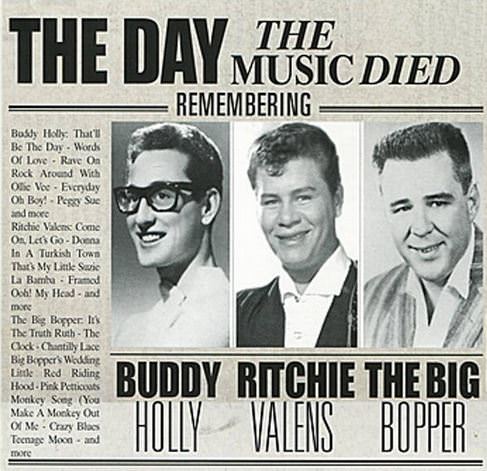
1959 ~ 22-year-old Buddy Holly, 28-year-old J.P. Richardson (The Big Bopper) and 17-year-old Ritchie Valens died in an airplane crash near Mason City, Iowa. February 3rd has been remembered as ‘The Day the Music Died’ since Don McLean made the line popular in his 1972 hit, “American Pie”. Buddy Holly, born Charles Hardin Holly in Lubbock, Texas, recorded That’ll Be the Day, Peggy Sue, Oh, BoyMaybe Baby, and others, including It Doesn’t Matter Anymore (recorded just before his death, a smash in the U.K., non-top-10 in the U.S.). Buddy was inducted into the Rock and Roll Hall of Fame in 1986. A convincing portrait of the singer was portrayed by Gary Busey in The Buddy Holly Story, a made for TV movie. J.P. (Jiles Perry) Richardson was from Sabine Pass, TX. He held the record for longest, continuous broadcasting as a DJ at KTRM Radio in Beaumont, TX in 1956. He was on the air for 122 hours and eight minutes. In addition to his smash hit, Chantilly Lace, Richardson also penned Running Bear (a hit for Johnny Preston) plus White Lightning (a hit for country star, George Jones). Richard Valenzuela lived in Pacoima, CA (near LA) and had a role in the 1959 film, Go Johnny Go. Ritchie Valens’ two big hits were Donna and La Bamba … the last, the title of a 1987 film depiction of his life. La Bamba also represented the first fusion of Latin music and American rock. Of the three young stars who died in that plane crash, the loss of Buddy Holly reverberated the loudest over the years. But, fans of 1950s rock ‘n’ roll will agree, all three have been sorely missed.

. 1959 ~ Lol (Laurence) Tolhurst, Drummer, keyboard with The Cure

. 1964 ~ The British group, The Beatles, received its first gold record award for the single, I Want To Hold Your Hand. The group also won a gold LP award for “Meet The Beatles”. The album had been released in the United States only 14 days earlier.

. 1971 ~ Lynn Anderson received a gold record for the single, Rose Garden. The Grand Forks, ND country singer was raised in Sacramento, CA. In addition to being a singer, she was an accomplished equestrian and California Horse Show Queen in 1966.

. 1974 ~ “Pajama Game” closed at Lunt Fontanne Theater NYC after 65 performances

. 1979 ~ YMCA by Village People peaked at #2 on the pop singles chart.  It was fun to dance to!

https://youtu.be/y0ImdPdbqmw

. 2002 ~ Remo Palmier, a self-trained guitarist who was a fixture in the New York jazz scene in the 1940s, died at the age of 78, and had been suffering from leukemia and lymphoma, his wife said. Over the course of his career, Palmier played with jazz legends Charlie Parker, Billie Holiday and Dizzy Gillespie, among others. Born Remo Palmieri in the Bronx, Palmier achieved his greatest fame performing with broadcaster Arthur Godfrey on CBS, and taught Godfrey how to play the ukulele. After Godfrey retired, Palmier released his own albums, “Windflower and “Remo Palmier”.

. 1912 ~ Erich Leinsdorf, Austrian-born American conductor

. 1937 ~ Glen Gray and his Casa Loma Orchestra recorded A Study in Brown, on Decca Records.

. 1941 ~ John Steel, Singer, drummer with The Animals

. 1944 ~ Florence LaRue (Gordon), Singer with The Fifth Dimension

. 1962 ~ Clint Black, Singer, actor

. 2002 ~ Blues and jazz pianist Abie “Boogaloo” Ames died at the age of 83. Ames was born on Big Egypt Plantation in Cruger, Miss., on May 23, 1918. He began playing piano at the age of 5 and his style earned him the nickname “Boogaloo” in the 1940’s. Ames moved to Detroit as a teenager and started a band, touring Europe with Louis Armstrong in 1936. Ames worked at Motown Studio and befriended other great musicians like Nat King Cole and Erroll Garner. In 1980, Ames moved to Greenville, where he became a regular performer at local clubs and festivals. Cassandra Wilson’s forthcoming Blue Note CD tentatively titled “Belly of the Sun” is set to include Darkness in the Delta, a song written by Ames for the CD. Ames was named the 2001 winner of the Artist’s Achievement Award of the Governor’s Awards for Excellence in the Arts in the state of Mississippi. With his protege and 1990s musical partner Eden Brent, Ames performed at the Kennedy Center for Performing Arts in Washington, D.C., in 2000. Ames’ last public performance was in October 2001 at the E.E. Bass Cultural Center in Greenville with another former student, Mulgrew Miller.

. 2002 ~ David Stetler, a big band swing drummer who played with Benny Goodman and Spike Jones, died of pneumonia. He was 79. A Seattle native, Stetler was discovered in high school by Lunceford. With a style close to that of Gene Krupa and Jo Jones, Stetler toured the country in the 1940s but returned to Seattle after his first son was born. He backed up national acts in local performances, including many during the world’s fair in 1962.

. 2003 ~ Charlie Biddle, a leader of Montreal’s jazz scene in the 1950s and ’60s who played bass with Thelonious Monk and Charlie Parker, died after a battle with cancer. He was 76. Biddle was a native of Philadelphia who moved to Canada in 1948. Over the next five decades, the World War II veteran and former car salesman became synonymous with jazz in Montreal. Biddle opened his own club, Uncle Charlie’s Jazz Joint, in suburban Ste- Therese in 1958. He later performed in such legendary Montreal nightspots as The Black Bottom and the Penthouse, where he worked with the likes of Oscar Peterson, Art Tatum, Charlie Parker and Lionel Hampton. When there were no jobs in Montreal, Biddle played smaller Quebec cities with a group called Three Jacks and a Jill. Until recently, Biddle played four nights a week at Biddle’s Jazz and Ribs, a Montreal landmark for nearly 25 years. Coincidentally, the club closed Tuesday for planned renovations, which included erecting a wall of fame to honor Biddle and others who have played at the club. In 1979, he organized the three-day festival that some say paved the way for the renowned Montreal International Jazz Festival. News Item about Charlie Biddle

. 2003 ~ Jerome Hines, a bass vocalist who performed regularly at the Metropolitan Opera during a career that spanned more than six decades, died. He was 81. Hines spent 41 years performing at the Met, more than any other principal singer in its history. He was known for his timbral richness, as well as the research he conducted into the historical and psychological background of the roles he portrayed. During his career at the Met, he portrayed 45 characters in 39 works, including title roles in Mussorgsky’s “Boris Godunov” and Mozart’s “Don Giovanni,” and Colline in Puccini’s “La Boheme.” He gave a total of 868 performances at the Met, retiring in 1987. He went on to perform with regional opera companies and at benefits. Hines, who became a born-again Christian in the 1950s, composed his own opera, “I Am the Way,” about the life of Jesus. He sang the title role at the Met in 1968 and 93 times around the world.

. 2003 ~ Saxophonist Cornelius Bumpus, a former member of the Doobie Brothers who had performed with Steely Dan since 1993, died en route to a series of performances in California. He was 58. Bumpus began his career at age 10, playing alto saxophone in the school band in Santa Cruz, Calif. In 1966, he spent six months performing with Bobby Freeman, and joined Moby Grape in 1977, writing one tune for the “Live Grape” album. Bumpus also recorded two solo albums and toured with his own band. Since performing with The Doobie Brothers in the early 1980s, Bumpus played with a number of bands, most recently with Steely Dan, which won the “Album of the Year” Grammy for its 2000 “Two Against Nature” release. His relations with his former Doobies bandmates turned contentious in the late 1990s, when they sued him and several other musicians over their use of the Doobies name. A federal judge in 1999 ruled against Bumpus and the other musicians, ordering them not to use the name.

February 1: On This Day in Music

month-february


. 1669 ~ Miquel Lopez, composer, born. He died sometime in 1723

. 1671 ~ Francesco Stradivari, Italian violin maker

. 1862 ~ The Battle Hymn of the Republic was first published in “Atlantic Monthly”. The lyric was the work of Julia Ward Howe. The Battle Hymn of the Republic is still being sung and to the tune of a song titled John Brown’s Body.

. 1869 ~ Victor Herbert, Composer, cellist and conductor of the Pittsburgh Symphony. He composed operettas such as Babes in Toyland, Naughty Marietta and songs like Ah Sweet Mystery of Life (At Last I’ve Found You)

. 1877 ~ Thomas Frederick Dunhill, English composer and writer on musical subjects

. 1894 ~ James P. Johnson, American pianist and composer (Charleston), born in New Brunswick, New Jersey

. 1904 ~ Enrico Caruso recorded his first sides for Victor Records. He did ten songs in the session and was paid only $4,000.

. 1907 ~ Mozart Camargo Guarnieri, Brazilian composer

. 1934 ~ Bob Shane, Singer with The Kingston Trio

. 1937 ~ Don Everly born, Singer with his brother, Phil, in The Everly Brothers. Some of their hits were: Wake Up Little Susie, Bye Bye Love, Cathy’s Clown and All I Have To Do Is Dream

http://youtu.be/i90r6OX3RYo

. 1937 ~ Ray Sawyer, Singer with Dr. Hook and The Medicine Show

. 1939 ~ Benny Goodman and his orchestra recorded And the Angels Sing on Victor Records. The vocalist on that number, who went on to find considerable fame at Capitol Records, was Martha Tilton.

. 1940 ~ Frank Sinatra sang Too Romantic and The Sky Fell Down in his first recording session with the Tommy Dorsey Band. The session was in Chicago, IL. Frankie replaced Jack Leonard as lead singer with the band.

. 1941 ~ “Downbeat” magazine reported this day that Glenn Miller had inked a new three-year contract with RCA Victor Records. The pact guaranteed Miller $750 a side, the fattest record contract signed to that time.

. 1949 ~ RCA Victor countered Columbia Records’ 33-1/3 long play phonograph disk with not only a smaller, 7-inch record (with a big hole in the center), but an entire phonograph playing system as well. The newfangled product, the 45- rpm, which started a revolution (especially with the new rock and roll music), soon made the 78-rpm record a blast from the past.

. 1952 ~ Rick James (James Johnson), Singer

. 1954 ~ Mike Campbell, Guitarist with Tom Petty and The Heartbreakers

. 1968 ~ Elvis Presley celebrated the birth of his daughter, Lisa Marie. Lisa Marie married and divorced the ‘Gloved One’, Michael Jackson, in the ’90s.

. 1971 ~ The soundtrack album from the movie, “Love Story”, starring Ryan O’Neal and Ali McGraw, with music by Frances Lai, was certified as a gold record on this day.

. 1995 ~ Richey Edwards, guitarist with the Manic Street Preachers, vanished leaving no clues to his whereabouts. He left The Embassy Hotel in London at 7am, leaving behind his packed suitcase. His car was found on the Severn Bridge outside Bristol, England sixteen days later. Edwards has never been found, despite constant searching, and in November 2008 he was declared officially dead.

. 2002 ~ Hildegard Knef, a smoky-voiced actress and singer who starred in Germany’s first post-World War II movie and scandalized church officials with a 1951 nude scene, died of a lung infection at a Berlin hospital. She was 76. Knef became a star for her role as a former concentration camp inmate returning home in Wolfgang Staudte’s 1946 “Murderers Are Among Us.” Knef, who sometimes went as Hildegard Neff in the United States, appeared in more than 50 films, most of them made in Europe. She reportedly turned down a Hollywood studio contract after being told she would have to change her name and say she was Austrian, not German. She scandalized Roman Catholic authorities with a brief nude scene in the 1951 German film “The Story Of A Sinner.” Her work in the United States included the role of Ninotchka in Cole Porter’s Broadway musical “Silk Stockings” in the 1950s, and a supporting role in “The Snows of Kilimanjaro.” She launched a career as a singer in the 1960s and wrote a best-selling 1970 autobiography. She continued to act and sing almost until the end of her life, appearing as herself in the 2000 documentary “Marlene Dietrich: Her Own Song” and in the 1999 German comedy, “An Almost Perfect Wedding.”

. 2003 ~ Latin jazz musician Ramon “Mongo” Santamaria, a Cuban-born percussionist and bandleader known for his conga rhythms, died in Miami at age 85. He was best known for his 1963 recording of Herbie Hancock’s song Watermelon Man, which became his first Top 10 hit. In 1959, Santamaria penned Afro Blue, which quickly became a jazz standard covered by stars such as Count Basie and Dizzy Gillespie. Born in Havana, Santamaria performed at Havana’s famed Tropicana Club before moving to New York City in the early 1950s, touring with the Mambo Kings and performing with Tito Puente and Cal Tjader. Santamaria recorded scores of albums in a career that spanned nearly 40 years, mixing rhythm and blues with jazz and hip-swaying conga. In 1977 he was awarded a Grammy for Best Latin Recording for his album “Amancer.” In recent years, he divided his time between Manhattan and Miami.

. 2007 ~ Gian Carlo Menotti, Italian-born composer died

. 2018 ~ Alan Stout, American composer, died at the age of 85

. 2018 ~ Dennis Edwards, who joined the Temptations in 1968 and sang on a string of the group’s hits including “I Can’t Get Next to You,” “Ball of Confusion” and “Papa Was a Rollin’ Stone” in an initial tenure that stretched to 1977, died at the age of 74

January 21: On This Day in Music

hug-day


. 1626 ~ John Dowland, English composer (In Darkness We Dwell), died at the age of 62

. 1899  ~ Alexander Tcherepnin, pianist and composer

. 1903 ~ First performance of “The Wizard of Oz” as a Broadway musical

. 1917 ~ Billy Maxted, Pianist, songwriter, arranger and bandleader

. 1927 ~ The first opera to be broadcast over a national radio network was presented in Chicago, IL. Listeners heard selections from “Faust” by Charles Gounod.

. 1932 ~ Annunzio Paolo Mantovani gave a memorable concert at Queen’s Hall in England to ‘glowing notices’. This was the beginning of the musician’s successful recording career that provided beautiful music to radio stations for nearly five decades. Better known as just Mantovani, his music still entertains us with hits like Red Sails in the Sunset, Serenade in the Night, Song from Moulin Rouge and Charmaine.

. 1939 ~ Wolfman Jack (Robert Smith), Disc jockey, icon of ’60s radio, broadcasting from XERF, then XERB in Mexico and heard throughout a major part of the U.S.; TV announcer: The Midnight Special; actor: American Graffiti; author: Have Mercy! Confessions of the Original Rock ‘n’ Roll Animal

. 1941 ~ Placido Domingo, Spanish tenor and conductor
More information about Domingo Grammy winner
Washington Honored Eastwood, Baryshnikov, Domingo, Berry in 2000


. 1941 ~ Ritchie Havens, American rock singer

. 1942 ~ Mac (Scott) Davis, Singer, actor, host of The Mac Davis Show, songwriter, ACM Entertainer of the Year in 1975

. 1942 ~ Nostalgia buffs will want to grab the greatest hits CD of Count Basie (on Verve) and crank up One O’Clock Jump. Just one of the many signature tunes by Bill Basie; the tune was originally recorded on Okeh Records this day.

. 1948 ~ Ermanno Wolf-Ferrari, Italian composer and teacher

. 1950 ~ Billy Ocean, Grammy Award-winning R&B Male Vocal in 1984

. 1957 ~ Singer Patsy Cline appeared on Arthur Godfrey’s nighttime TV show. She sang the classic, Walking After Midnight, which quickly launched her career.

. 1959 ~ The Kingston Trio (Bob Shane, Nick Reynolds and Dave Guard) received a gold record for Tom Dooley. The Kingston Trio recorded many hits, including Greenback Dollar, M.T.A., Reverend Mr. Black, Tijuana Jail, and the war protest song, Where Have All the Flowers Gone?.

. 1966 ~ George Harrison of The Beatles married Patricia (Patty) Anne Boyd in Surrey, England. The two met on the set of the movie, “A Hard Day’s Night”.

. 1970 ~ ABC-TV presented “The Johnny Cash Show” in prime time. Previously, the show had been a summer replacement. The regular season series was a big boost for country music. Johnny wore black in the all-color show, however, like he still does today.

. 1978 ~ The soundtrack of “Saturday Night Fever” reached #1 on the album charts — a position it held for the next six months.

. 1987 ~ Thirty years after its release, Jackie Wilson’s single, Reet Petite (written by Motown founder Berry Gordy), ended a month at the top of England’s music charts. Three years earlier, on this same date, Jackie Wilson died after being in a coma (following a heart attack) for eight and a half years.

. 2002 ~ Peggy Lee, the singer-composer whose smoky voice in such songs as Is That All There Is? and Fever made her a jazz and pop legend, died of a heart attack. She was 81. Lee battled injury and ill health, including heart trouble, throughout a spectacular career that brought her a Grammy, an Oscar nomination and sold- out houses worldwide. In more than 50 years in show business, which began during a troubled childhood and endured through four broken marriages, Lee recorded hit songs with the Benny Goodman band, wrote songs for a Disney movie and starred on Broadway in a short-lived autobiographical show, Peg. A string of hits, notably Why Don’t You Do Right?, made her a star. Then she fell in love with Goodman’s guitarist, Dave Barbour, and withdrew from the music world to be his wife and raise their daughter, Nicki. She returned to singing when the marriage fell apart. Lee’s other notable recordings included Why Don’t You Do Right? I’m a Woman, Lover, Pass Me By, Where or When, The Way You Look Tonight, I’m Gonna Go Fishin‘ and Big Spender. The hit Is That All There Is? won her a Grammy for best contemporary female vocal performance in 1969. She collaborated with Sonny Burke on the songs for Disney’s The Lady and the Tramp, and was the voice for the wayward canine who sang He’s a Tramp (But I Love Him).


On December 6 ~ in Music History

today

Christmas Countdown: Just In Time For Christmas

• 1877 ~ Thomas Alva Edison made the first sound recording ever by reciting and recording the nursery rhyme, “Mary had a Little Lamb”. Edison recorded sound on a cylinder, which was then rotated against a needle. The needle moved up and down in the grooves of the cylinder, producing vibrations that were amplified by a conical horn. Edison assumed that this would be useful only for office dictation purposes and not much for recording music.

• 1887 ~ Joseph Lamb, American ragtime composer

• 1896 ~ Ira Gershwin (Israel Gershvin), American librettist and lyricist

OCMS 1920 ~ Dave Brubeck, American jazz pianist and composer
More information about Brubeck

• 1929 ~ Nikolaus Harnoncourt, German conductor, cellist and musicologist

• 1930 ~ Bobby Van (Bobby King Robert Stein), Actor, dancer

• 1939 ~ Steve Alaimo, Singer, actor

• 1941 ~ Helen Cornelius, Singer

• 1942 ~ Len Barry (Borrisoff), Singer, with The Dovells

• 1944 ~ Jonathan (Kenneth) King, Singer, songwriter, producer

• 1944 ~ Red Bank Boogie, Count Basie’s salute to his hometown, was recorded on Columbia Records. The tune is a tribute to Red Bank, New Jersey.

• 1948 ~ Arthur Godfrey’s Talent Scouts debuted on CBS-TV. The show ran for almost10 years and the redhead introduced such talent as Pat Boone, The Chordettes, Carmel Quinn, The McGuire Sisters, Rosemary Clooney, Tony Bennett, Connie Francis, Steve Lawrence and Al Martino.

• 1950 ~ Joe Hisaishi, Japanese composer

• 1956 ~ Peter Buck, Guitarist with R.E.M.

• 1956 ~ Rick (Paul) Buckler, Drummer, singer with The Jam

• 1960 ~ Eileen Farrell debuted at the Metropolitan Opera House in NYC in the title role of Gluck’s Alcestis.

• 1962 ~ Ben Watt, Guitarist, keyboard, singer with Everything but the Girl

• 1969 ~ Musician Cab Calloway turned actor as he was seen in the Hallmark Hall of Fame presentation of The Littlest Angel on NBC. The big band singer, known for such classics as Minnie the Moocher, became a movie star in The Blues Brothers (1980) with John Belushi and Dan Ackroyd.

• 1969 ~ Na Na Hey Hey Kiss Him Goodbye, by Steam, reached the #1 spot on the top 40. It stayed at the top for two weeks and was the only major hit for the group.

• 1984 ~ Two former Beatles debuted in two film releases this day. Paul McCartney’s Give My Regards to Broad Street and George Harrison’s A Private Function were finalized for theater audiences.

• 1988 ~ Roy Orbison, Singer, passed away

• 1989 ~ Sammy Fain passed away
More information about Fain

• 2000 ~ Werner Klemperer, a Jewish refugee from Nazi Germany who went on to play the inept German prison-camp commandant Col. Klink on TV’s “Hogan’s Heroes,” died of cancer at the age of 80. Klemperer fled Germany in 1935 with his father, Otto, a distinguished conductor and composer. He won two Emmy Awards for his portrayal of the monocled Col. Wilhelm Klink on the 1960s sitcom about World War II Allied prisoners of war. He was a gifted actor on both film and stage, receiving a Tony nomination in 1988 as a feature actor in a musical for his role in Hal Prince’s revival of “Cabaret.” Other Broadway roles included starring opposite Jose Ferrer in “The Insect Comedy,” and with Tallulah Bankhead in the 1955 production of “Dear Charles.” Most recently, he co-starred in Circle in the Square’s production of Chekhov’s “Uncle Vanya.” Klemperer also appeared as a narrator with nearly every major symphony orchestra in the United States. His repertoire included such works as Beethoven’s “Egmont” and “Fidelio,” Stravinsky’s “L’Histoire du Soldat” and “Oedipus Rex.” His narration of Mozart’s “The Impresario,” with the Mostly Mozart Festival Orchestra, aired on PBS’s “Live from Lincoln Center.” He also performed in various operas, including “The Sound of Music,” with the New York City Opera. He played Prince Orlofsky in “Die Fledermaus” with companies in Seattle and Cleveland.

• 2003 ~ Hans Hotter, the world’s leading Wagnerian bass-baritone of his time, died at the age of 94. The 6-foot-4 Hotter, whose career spanned half a century, was known for his booming, noble voice. He mastered such roles as Wotan in Wagner’s Ring Cycle, Gurnemanz in “Parsifal”, the title role in “The Flying Dutchman” and Hans Sachs in Die Meistersinger. He also won praise for Schubert lieder. Hotter started his operatic career in 1930, and sang in Prague and Hamburg and at the Munich Opera, where he became a leading singer in 1937. He remained with the company until 1972. He also was a member of the Vienna Opera from 1939 until 1970. Hotter created the role of Olivier in the world premiere of Richard Strauss “Capriccio” in 1942. According to the British newspaper The Guardian, the role of Jupiter in Strauss’s “Die Liebe der Danae” had been written for him but its premiere was disrupted when all theaters were closed after the assassination attempt on Adolf Hitler in August 1944. After the war, Hotter began a 12-year association with the Wagner family’s opera house at the Bayreuth festival in 1952. The same year, he made his Metropolitan Opera debut as the Dutchman. He also became a producer. His final production was in 1981 in Chicago of Beethoven’s “Fidelio”.

On August 21 ~ This Day in Music History


• 1904 ~ (William Allen) Count Basie, Bandleader, pianist
More information about Count Basie

• 1928 ~ Art Farmer, Trumpeter, flugelhorn, worked with Horace Henderson, Johnny Otis, Lionel Hampton Band; recorded be-bop classic Farmer’s Market; developed musical instrument called ‘flumpet’

OCMS   1933 ~ Dame Janet Baker, British mezzo-soprano Read quotes by and about Baker
More information about Baker

• 1938 ~ Kenny (Kenneth Donald) Rogers, Grammy and CMA Award-winning singer; groups: The Kirby Stone Four, The New Christy Minstrels, The First Edition

• 1938 ~ A classic recording was made this day when Fats Waller performed Ain’t Misbehavin.

• 1939 ~ Harold Reid, Singer with The Statler Brothers

• 1944 ~ Jackie DeShannon (Sharon Myers), Singer, songwriter

• 1947 ~ Carl Giammarese, Guitarist with The Buckinghams

• 1952 ~ Joe Strummer (John Mellors), Guitarist and singer

• 1957 ~ Kim Sledge, Singer with Sister Sledge

• 1976 ~ RCA Victor Records announced that sales of Elvis Presley records had passed the 400 million mark.

• 1980 ~ Linda Ronstadt debuted on Broadway in the production of Gilbert and Sullivan’s, The Pirates of Penzance.

• 2005 ~ Robert Moog, American engineer (Moog synthesizer, Moog Music), died of a brain tumor at 71