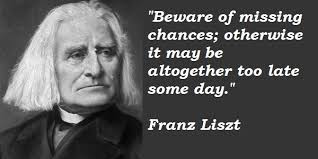
Happy Birthday to Franz Liszt!

liszt-quote

Franz Liszt was born in Raiding, near Ödenburg, October 22, 1811 and died in Bayreuth, July 31, 1886. He was a Hungarian composer and pianist who was a major influence during the romantic period. Liszt was an outstanding pianist at seven, composed at eight and made concert appearances at nine. In addition to being a piano virtuoso, he was also a critic, conductor, city music director, literary writer and transcriber of the works of other composers. He transcribed Beethoven’s Symphonies for the piano.

Franz Liszt began his career as the outstanding concert pianist of the century, who, along with the prodigious violinist Niccoló Paganini (1782-1840), created the cult of the modern instrumental virtuoso. To show off his phenomenal and unprecedented technique, Liszt composed a great deal of music designed specifically for this purpose, resulting in a vast amount of piano literature laden with dazzling, and other technical marvels. In this vein, Liszt composed a series of virtuosic rhapsodies on Hungarian gypsy melodies, the best-known being the all too familiar Hungarian Rhapsody no. 2. Liszt developed the rhapsody as a form of serious music. This kind of music is worlds apart from the generally more introspective, poetic music of pianist-composer Frédéric Chopin.

Liszt was wildly handsome and hugely talented. He was extremely popular in Paris during the 1830’s. It is said that women actually fainted at his piano recitals. He was the first to position the piano so that its lid reflected the sound and the audience could see his profile as he performed.

Liszt was the first to write a tone poem, which is an extended, single-movement work for orchestra, inspired by paintings, plays, poems or other literary or visual works, and attempting to convey the ideas expressed in those media through music. Such a work is Les Préludes, based on a poem in which life is expressed as a series of struggles, passions, and mysteries, all serving as a mere prelude to . . .what? The Romantic genre of the symphonic poem, as well as its cousin the concert overture, became very attractive to many later composers, including Saint-Saëns, TchaikovskyDvorák, Sibelius, and Richard Strauss.


     Liszt’s birthday

     anniversary of Liszt’s death

    Listen to Liszt’s transcription of Meyerbeer’s Hellish Waltz from Robert du Diable, which probably caused more public commotion than any other piano piece in history.


     Read quotes by and about Liszt

     Liszt was the first recitalist

     In Praise of Pianos and the Artists Who Play Them

     History of the Piano

     Franz Liszt

October 22, 2016 ~ Today in Music History

today

OCMS 1811 ~ Franz Liszt, Hungarian composer and pianist
Read quotes by and about Franz Liszt
More information about Liszt

• 1885 ~ Giovanni Martinelli, Opera singer, tenor with Metropolitan Opera for 30 seasons

• 1904 ~ Paul Arma, Hungarian composer and theorist

• 1917 ~ Leopold Stokowski led the Philadelphia Orchestra in its first recording session, for Victor Records.

• 1930 ~ Dory Previn, Songwriter with André Previn

• 1939 ~ Ray Jones, Bass with Billy J. Kramer & The Dakotas

• 1943 ~ Paul Zukofsky, American violinist

• 1943 ~ Bobby Fuller, Singer, guitarist with Bobby Fuller Four

• 1945 ~ Leslie West (Weinstein), Singer, musician, guitarist with Mountain

• 1945 ~ Eddie Brigati, Singer, musician with The (Young) Rascals

• 1959 ~ “Take Me Along” opened on Broadway and quickly became an American classic. Walter Pidgeon starred along with Jackie Gleason.

• 1966 ~ The Supremes rocketed to the top of the pop album charts with “Supremes A’ Go-Go”. They were the first all-female vocal group to hit the top of the LP chart.

• 1969 ~ Giovanni Martinelli passed away

• 1969 ~ Michael Tilson Thomas, the 25-year-old assistant conductor of the Boston Symphony Orchestra, took over for ailing conductor William Steinberg in the symphony’s appearance in New York City.

• 1971 ~ Folk singer Joan Baez received a gold record for her hit, The Night They Drove Old Dixie Down. It turned out to be her biggest hit, peaking at #3 on the charts on October 2, 1971.

• 1983 ~ Celebrating its 100th anniversary, New York’s Metropolitan Opera featured a daylong concert with some of the world’s greatest opera stars. On stage at the Met were Dame Joan Sutherland, Placido Domingo and Luciano Pavarotti.

• 2001 ~ Tom Baker, one of Australia’s most respected jazz musicians, died of a heart attack while touring in the Netherlands. He was 49. Baker, a native of California, took up residence in Australia 30 years ago. He was a regular at Sydney’s famous jazz club, The Basement. Willie Qua, drummer and co-founder of one of Australia’s best-known jazz bands, Galapagos Duck, said Baker had often played as “a part-time member” of the band and was an icon of the Sydney jazz scene. Baker formed his first band, Tom Baker’s San Francisco Jazz Band, in 1975, earning himself a reputation as one of Australia’s very best jazz musicians. Recently he toured extensively through Europe and America.

October 21, 2016 ~ Today in Music History

today

• 1885 ~ Egon Wellesz, Austrian composer and musicologist

• 1907 ~ The “Merry Widow” opened in New York. The play starred Ethel Jackson and Donald Brian. The operetta had been introduced in Europe two years before.

• 1908 ~ A Saturday Evening Post advertisement offered a chance to buy, for the first time, a two-sided record. It was on Columbia.

• 1912 ~ Sir Georg Solti, Hungarian-born British conductor, Chicago Symphony Orchestra. He conducted the first complete recording of Wagner’s “Der Ring des Nibelungen”.

OCMS 1917 ~ Dizzy (John Birks) Gillespie, American jazz trumpeter and bandleader Read quotes by and about “Dizzy” Gillespie
More information about Gillespie

• 1921 ~ Sir Malcolm Arnold, Composer of screen scores: “David Copperfield”, “The Chalk “Garden”, “Suddenly, Last Summer”, “Solomon and Sheba”, “Island in the Sun”, “The Bridge on the River Kwai”, “Trapeze”, “I Am a Camera”, “The Belles of St. Trinian’s” “the Eye Witness series”

• 1924 ~ It was a big night for a big band in New York’s Cinderella Ballroom. The crowd loved the Wolverine Orchestra from Chicago and the guy on the cornet, Bix Beiderbecke, the ‘young man with a horn’.

• 1938 ~ Quaker City Jazz was recorded on the Bluebird label by Jan Savitt’sorchestra. The tune would become the theme of the band. It was not, however, recorded in the Quaker City of Philadelphia. The song was waxed in New York City.

• 1940 ~ Manfred Mann (Michael Lubowitz), Singer with Mann-Hugg Blues Brothers

• 1941 ~ Steve Cropper, Guitarist with the groups: Blues Brothers as well as Booker T and The MG’s

• 1942 ~ Elvin Bishop, Guitarist, singer with Paul Butterfield Blues Band

• 1943 ~ Ron Elliott, Guitarist with Beau Brummels

• 1946 ~ Lee Loughnane, Brass with Chicago

• 1953 ~ Charlotte Caffey, Guitar, singer with The Go-Gos

• 1955 ~ Eric Faulkner, Guitarist with Bay City Rollers

• 1957 ~ Julian Cope, Bass, guitar, singer

• 1957 ~ Steve Lukather, Guitarist with Toto

• 1958 ~ Orchestral strings were used for the first time in a rock and roll tune. Buddy Holly recorded It Doesn’t Matter Anymore, written by Paul Anka. Sadly, it would be Holly’s last studio session. The song wasn’t released until after his death in February of 1959.

• 2001 ~ George Feyer, a pianist and entertainer who played at some of New York’s top hotels, died at the age of 92. Feyer, who was known for setting pop lyrics to classical music, entertained the sophisticated Manhattan cafe society for three decades. He played for decades at the Carlyle, the Stanhope and the Waldorf-Astoria. He made many recordings, including his Echoes album series, which featured Echoes of Paris and Echoes of Broadway. Born in Budapest on Oct. 27, 1908, Feyer attended the Franz Liszt Academy of Music, where he studied with composer Sir Georg Solti. One of his first jobs was playing for silent movies. During World War II, the Nazis put Feyer on forced labor details, then imprisoned him in the Bergen-Belsen concentration camp for the final year of the war. Feyer and his family moved to New York in 1951. He stopped working full time in 1982.

October 17, 2016 ~ Today in Music History

today

1810 ~ Giovanni Matteo Mario, Italian tenor

• 1892 ~ Herbert Howells, British composer

• 1909 ~ Cozy (William Randolph) Cole, Drummer. He played with Cab CallowayLouis Armstrong, in films – Make Mine Music, The Glenn Miller Story and started a drummers’ school with Gene Krupa

• 1938 ~ This was a big day in Tinseltown. NBC moved to the corner of Sunset and Vine, the ‘Crossroads of the World’. The new Hollywood Radio City drew thousands of visitors ready to fill studio-audience seats for popular radio programs.

• 1940 ~ James Seals, Singer, guitar, saxophone, fiddle with Seals and Crofts

• 1940 ~ One year before recording that memorable song, Fry Me Cookie, with a Can of Lard, Will Bradley’s orchestra recorded Five O’Clock Whistle, also on Columbia Records.

• 1941 ~ Alan Howard, Bass with Brian Poole & The Tremeloes

• 1942 ~ Gary Puckett, Singer with The Union Gap

• 1945 ~ Actress Ava Gardner made news. She married bandleader Artie Shaw.

• 1946 ~ Jim Tucker, Guitarist with The Turtles until 1965

• 1949 ~ Bill Hudson, Comedian, singer with The Hudson Brothers, was married to actress Goldie Hawn

• 1953 ~ The first concert of contemporary Canadian music presented in the U.S. was performed by conductor Leopold Stokowski at Carnegie Hall in New York City.

• 1955 ~ Jose Ferrer and Claire Bloom starred on NBC’s Producer’s Showcase. They performed in “Cyrano De Bergerac”. Ferrer also won an Oscar for his performance in the film version.

• 1958 ~ Alan Jackson, Singer

• 1962 ~ Though the ‘Fab Four’ would appear on both radio and television, on what they would call ‘Auntie Beeb’ (the BBC), The Beatles made their first appearance this day on Great Britain’s Grenada TV Network.

• 1967 ~ A controversial rock musical “Hair”, opened on this day at the Anspacher Theatre in New York City. It ran for 1,742 performances and then became a movie.

• 1983 ~ Actor Anthony Quinn lit up the Great White Way in the revival of the 1968 musical, “Zorba”, that reunited Quinn with Lila Kedrova, who played Madame Hortense. They both had appeared in the film portrayal, “Zorba the Greek”, which won Quinn a nomination for Best Actor, and an Oscar for Kedrova as Best Supporting Actress. This was one of the few films that came before the Broadway show, rather than the reverse.

• 2003 ~ Bernard Schwartz, who produced “Coal Miner’s Daughter,” the Academy Award-nominated biopic of country singer Loretta Lynn, died of complications following a stroke. He was 85. Schwartz was a one-time Broadway child actor who got into television and film production in the 1950s, working on the popular paranormal suspense show “Alcoa Presents: One Step Beyond” and the hit science fiction film “Journey to the Center of the Earth.” Schwartz’ best known and most lauded production was “Coal Miner’s Daughter,” the 1980 film inspired by Lynn’s song of the same name. Sissy Spacek won an Oscar for her portrayal of Lynn and the film won the Golden Globe award for best musical or comedy. It also was nominated for an Oscar for best picture. In 1985, Schwartz featured Patsy Cline’s life in “Sweet Dreams,” which was named for one of her songs and starred Jessica Lange as the music legend killed in a plane crash. He also produced country singer Amy Grant’s 1986 TV special “Headin’ Home for the Holidays” and worked with Priscilla Presley on the 1988 miniseries “Elvis and Me.” Another of his best known productions was 1983’s “Psycho II,” the darkly humorous but far bloodier sequel to Hitchcock’s 1960 thriller about troubled motel operator Norman Bates. Other feature films included “The Wackiest Ship in the Army,” “Global Affair,” which starred Bob Hope, and “Rage,” which starred Glenn Ford. Schwartz also produced “That Man Bolt” and “Bucktown,” both vehicles for former football star Fred Williamson, and the thriller “Roadgames” starring Stacey Keach and Jamie Lee Curtis.

October 16, 2016 ~ Today in Music History

today

1855 ~ William Barclay Squire, British musicologist

• 1893 ~ On this day a song called “Goodmorning to All” was copyrighted by two teachers who wrote it for their kindergarten pupils. The title was later changed to “Happy Birthday to You”.  The copyright was claimed illegal in September, 2015.

• 1923 ~ Bert Kaempfert, Musician

• 1941 ~ Fry Me Cookie, with a Can of Lard was recorded by the Will Bradley Orchestra on Columbia. Ray McKinley was featured.

• 1942 ~ Dave Lovelady, Drummer with The Fourmost

• 1943 ~ C.F. (Fred) Turner, Musician with Bachman~Turner Overdrive

• 1947 ~ Bob Weir (Hall), American rock guitarist and singer with The Grateful Dead

• 1953 ~ Tony Carey, Keyboards with Rainbow

• 1959 ~ Gary Kemp, Guitarist with Spandau Ballet, brother of musician Martin Kemp

• 1969 ~ Wendy Wilson, Singer with Wilson Phillips, daughter of Beach Boys singer, Brian Wilson

• 1972 ~ John C. Fogerty and Creedence Clearwater Revival called it a career … and the group disbanded. Fogerty continued in a solo career with big hits including, Centerfield and The Old Man Down the Road.

• 1976 ~ Memphis, TN disc jockey Rick Dees and his ‘Cast of Idiots’ made it all the way to number one on the Billboard Hot 100 with the immortal Disco Duck (Part 1). Dees is still around, but not as a recording artist. He’s a DJ in Los Angeles and is hosting several varieties of the Weekly Top 40 show, syndicated around the world.

• 1983 ~ George Liberace passed away.  He was an American musician and television performer. Born in Menasha, Wisconsin, he was the elder brother and business partner of famed U.S. pianist Liberace.

• 1990 ~ Art Blakey passed away.  He was an American jazz drummer and bandleader.

• 2000 ~ David Golub, American pianist and chamber music conductor, passed away at the age of 50. Born in Chicago, Golub grew up in Dallas, where he began learning the piano. In 1969 he moved to New York and spent his student years honing his technique at New York’s Juilliard School of Music. He also began conducting during summer breaks at Vermont’s Marlboro festival. In 1979, he accompanied violinist Isaac Stern on a tour of China. A film about the tour, “From Mao to Mozart,” won the 1980 Academy Award for Best Documentary. As a performer, Golub was perhaps best known for his work with violinist Mark Kaplan and cellist Colin Carr in the trio they formed in 1982. In the late 1990s, Golub began cultivating his interest in opera. Under his leadership, the Padua Chamber Orchestra recorded some of Haydn’s least-known work for opera. An acclaimed chamber ensemble performer – most notably with the Golub-Kaplan-Carr Trio – Golub led the Padua Chamber Orchestra during the 1994-95 season and took it on tour in the United States in 1999. He is survived by his wife, Maria Majno.

• 2001 ~ Oscar-winning composer and lyricist Jay Livingston, whose collaboration with Ray Evans led to such hits as Silver Bells, Que Sera, Sera and Mona Lisa, died of pneumonia. He was 86. Livingston’s songwriting partnership with Evans spanned 64 years. Often called the last of the great songwriters, Livingston and Evans had seven Academy Award nominations and won three – in 1948 for Buttons and Bows in the film The Paleface, in 1950 for Mona Lisa in Captain Carey, USA, and in 1956 for Que Sera, Sera in The Man Who Knew Too Much. They wrote the television theme songs for Bonanza and Mr. Ed, and were honored by the American Society of Composers, Authors and Publishers for the most performed music for film and TV for 1996. Livingston was born on March 28, 1915, in the Pittsburgh suburb of McDonald. He met Evans in 1937 at the University of Pennsylvania, where they were both students. The team’s final project was the recording, Michael Feinstein Sings the Livingston and Evans Song Book, due for 2002 release.

October 14, 2016 ~ Today in Music History

today

OCMS 1871 ~ Alexander Zemlinsky, Austrian composer and conductor
More information on Zemlinsky

• 1907 ~ Allan Jones, Singer, father of singer, Jack Jones

• 1926 ~ Bill (William E.) Justis (Jr.), Saxophone

• 1928 ~ Gary Graffman, American pianist

• 1930 ~ I Got Rhythm, by George Gershwin, sung by Ethel Merman, was a show-stopper in the production of “Girl Crazy” on Broadway. It was Merman’s debut on the Great White Way as she captivated audiences and launched her stellar career. “Girl Crazy” went on for 272 performances.

• 1931 ~ Rafael Puyana, Colombian harpsichordist

• 1938 ~ Melba Montgomery, Singer

• 1938 ~ One of the great songs of the big band era was recorded by Bob Crosby (Bing’s brother) and The Bob Cats. Big Noise from Winnetka on Decca Records featured Bob Haggart and Ray Bauduc. Haggart whistled and played bass, while Bauduc played the skins.

• 1939 ~ Broadcast Music, Inc. (BMI) was organized on this day to compete with ASCAP (American Society of Composers and Publishers). The two music licensing organizations’ goal is to ensure that composers, artists and publishers are properly paid for the use of their works.

• 1940 ~ Cliff Richard (Harry Webb), Singer

• 1946 ~ Justin Hayward, Guitarist, singer with The Moody Blues

• 1961 ~ The Broadway production “How to Succeed in Business without Really Trying” opened.

• 1971 ~ It was John and Yoko Day on The Dick Cavett Show on ABC. The couple promoted Lennon’s new LP (Imagine) and film (Imagine) and Yoko’s book, two films and a fine arts show.

• 1977 ~ Bing (Harry Lillis) Crosby passed away

• 1996 ~ Eighteen years after its creation, The Rolling Stones’ Rock & Roll Circus was finally released. The 1968 event put together by The Stones comprised two concerts on a circus stage and included performances by The Who, Taj Mahal, Marianne Faithfull and Jethro Tull. John Lennon and Yoko Ono performed as part of a supergroup called The Dirty Mac, along with Eric Clapton, Mitch Mitchell and Keith Richards. It was originally planned to be aired on BBC TV.

• 2001 ~ Willam Farr Christensen, a Utah dancer who started on the vaudeville stage and went on to become one of the most important figures in American ballet, died at the age of 99. Founder of the San Francisco Ballet and Utah’s Ballet West, Christensen was the first person in the United States to choreograph full-length versions of several ballet classics, including “The Nutcracker”, “Coppelia” and “Swan Lake”. With his brothers Lew and Harold, he toured the famous Orpheum vaudeville circuit in the 1920s, performing a ballet act at a time when few Americans were familiar with the art. By 1934, Christensen had quit the circuit to found the first ballet company in Portland, Ore., then left three years later to join the San Francisco Opera Ballet as a principal soloist. Within a year he was named ballet master of the company. In 1941 he founded the San Francisco Ballet, the first major ballet company in the West. Christensen choreographed the country’s first full-length production of “The Nutcracker” in 1944, and today it is a Christmas tradition for nearly every ballet company in the nation.

October 13, 2016 ~ Today in Music History

today

• 1903 ~ Beginning this night, and for 192 performances, “Babes in Toyland” entertained youngsters of all ages in New York City. Toyland is just one of Victor Herbert’s timeless operettas.

• 1910 ~ Art Tatum, American jazz pianist

• 1939 ~ Harry James and his band recorded On a Little Street in Singapore for Columbia Records. A kid singer named Frank Sinatra was the featured vocalist on what was his seventh recording.

• 1941 ~ Paul Simon, American folk-rock singer, songwriter and guitarist, duo called Simon and Garfunkel, Rock and Roll Hall of Famer

• 1944 ~ Robert Lamm, Singer, keyboards, songwriter with The Big Thing; Chicago Transit Authority; Chicago

• 1945 ~ Karen Akers, Singer

• 1947 ~ Sammy Hagar, Singer, guitarist with Van Halen

• 1948 ~ Leona Mitchell, American soprano

• 1948 ~ Lacy J. Dalton (Jill Byrem), Songwriter, singer

• 1957 ~ Two superstars introduced a new car on ABC-TV. Bing Crosby and Frank Sinatra joined forces in an hourlong special that turned out to be a big ratings hit. Too bad the Edsel, the car that Ford Motor Company was introducing, didn’t fare as well.

• 1958 ~ This day was musically memorable as Warren Covington conducted the Tommy Dorsey Orchestra for what would be the last big band tune to climb the pop charts. Tea for Two Cha Cha, made it into the Top 10, peaking at #7. And that was the end of the Big Band Era. Rock ’n’ roll was here to stay.

• 1959 ~ Marie (Olive) Osmond, Singer, TV host on Donny and Marie

• 1963 ~ Beatlemania hit the London Palladium. The Beatles made their first appearance on a major TV show for the BBC. Thousands of delirious fans jammed the streets outside the theatre to voice their support of the Fab Four. A few months later, Beatlemania would sweep the U.S. as well.

• 1965 ~The Who recorded ‘My Generation’ at Pye studios, London. When released as a single it reached No.2 on the UK chart, held off the No.1 position by The Seekers ‘The Carnival Is Over’. Roger Daltrey would later say that he stuttered the lyrics to try to fit them to the music. The BBC initially refused to play the song because it did not want to offend people who stutter.

• 1971 ~ ‘Little’ Donny Osmond received a shiny gold record for his rendition of the Steve Lawrence hit, Go Away Little Girl. He went on to garner million-seller success with Hey Girl and Puppy Love too. Donny was quite popular with the bubblegum set, as well he should have been. Donny was only 13 years old.

• 1979 ~ Michael Jackson went to #1 … 1 … 1 for the second time with Don’t Stop’Til You Get Enough. His first number one (Oct. 14, 1972 at age 14) was a ratty little number about Ben.

• 1979 ~’Reggatta De Blanc’ the second album from The Police started a four-week run at No.1 in the UK. The album which features the band’s first two No.1 hits, ‘Message in a Bottle’ and ‘Walking on the Moon’, cost only £6,000 to record. Do you have a favorite track from this album?

• 2000 ~ Britt Woodman, a versatile jazz musician best known for his work as a trombonist with Duke Ellington’s Orchestra in the 1950s, died. He was 80 and had been suffering from respiratory problems. Woodman was featured in Ellington numbers including Sonnet To Hank V (from “Such Sweet Thunder”) and Red Garter(from “Toot Suite”). He worked with greats including Miles Davis, Charles Mingus and John Coltrane, and played in many big bands, including the Lincoln Center Jazz Orchestra. Piano was Woodman’s first instrument, but soon he was playing trombone, saxophone and clarinet as well. By the time he was 15, he was playing professionally with his older brothers, William Jr. and Coney, in the Woodman Brothers Biggest Little Band in the World. The band became known in Los Angeles’ flourishing jazz scene of the 1930s because Britt and William – who played saxophone, clarinet and trumpet – often traded instruments in the middle of a set. William would go on to a professional career as a saxophonist. Britt Woodman played in such swing-oriented ensembles as the Les Hite Band in the late 1930s, and later played with the iconoclastic Boyd Raeburn Band.

• 2000 ~ Seiji Ozawa, Keith Lockhart and John Williams unveil a plaque giving Symphony Hall, in Boston, National Landmark status

• 2001 ~ Raoul Kraushaar, who scored or supplied music for classic television series like Lassie and Bonanza, and films including Cabaret and Invaders From Mars, died at the age of 93. Kraushaar’s contributions spanned film, cartoons and television dating back to the 1930s. Kraushaar is credited with composing hundreds of music cues – the bits of background music used to augment the action and emotion in a scene on film – during his 55-year career, according to The American Society of Composers, Authors and Publishers (ASCAP). Born in Paris, Kraushaar stowed away as a teen-ager aboard a ship bound for New York, where he went on to study at Columbia University. He moved to Los Angeles in the 1930s, and got his first music credit on the 1937 film, Round-Up Time In Texas, with Gene Autry. Kraushaar scored music for Hopalong Cassidy films, among other Westerns, musicals like “Cabaret”, and the 1953 film “Blue Gardenia”. Over the years, he supplied or scored music for such television shows as My Three Sons, The Donna Reed Show, Dennis The Menace and Father Knows Best.

October 12, 2016 ~ Today in Music History

today

1855 ~ Arthur Nikisch, Hungarian conductor

OCMS 1872 ~ Ralph Vaughan Williams, British composer
More information on Vaughan Williams

• 1935 ~ Luciano Pavarotti, Italian tenor, Emmy Award-winning opera star

• 1935 ~ Samuel Moore, Singer with Sam & Dave

• 1944 ~ Who could forget the picture of a huge crowd of swooning bobbysoxers stopping traffic in New York’s Times Square as Frank Sinatra made his triumphant return to the famed Paramount Theatre (he had played there for eight weeks starting on December 30, 1942). In what was called the ‘Columbus Day Riot’, 25,000 teenagers, mostly young women, blocked the streets, screaming and swooning for Frankie. Sinatra later explained, “It was the war years, and there was a great loneliness. And I was the boy in every corner drug store … who’d gone off, drafted to the war. That was all.”

• 1948 ~ Rick Parfitt, Singer, guitarist with Status Quo

• 1950 ~ Susan Anton, Singer

• 1956 ~ Dave Vanian (Letts), Singer

• 1968 ~ Big Brother And The Holding Company went to No.1 on the US album chart with ‘Cheap Thrills’. The cover, drawn by underground cartoonist Robert Crumb, replaced the band’s original idea, a picture of the group naked in bed together. Crumb had originally intended his art to be the LP’s back cover, but Joplin demanded that Columbia Records use it for the front cover. Initially the album title was to have been Sex, Dope and Cheap Thrills, but this didn’t go down too well at Columbia Records.

• 1971 ~ Some folks weren’t pleased when “Jesus Christ Superstar” premiered on Broadway because of the controversial content of the musical. Before the show opened at the Mark Hellinger Theatre, some 2.5 million copies of the album were sold to the curious. The Tim Rice/Andrew Lloyd Webber collaboration would become a big hit. “Jesus Christ Superstar would run on Broadway” for 720 shows, and spawn several hit songs, including I Don’t Know How to Love Him (Helen Reddy) and the title song, Jesus Christ Superstar (Murray Head).

• 1981 ~ Barbara Mandrell walked away with the Country Music Association’s Entertainer of the Year honor for the second year in a row.

• 1989 ~ Carmen Cavallaro passed away.  He  was an American pianist. He established himself as one of the most accomplished and admired light music pianists of his generation.

• 1994 ~ Pink Floyd played the first of a 15-night run at Earls Court, London, England. Less than a minute after the band had started playing ‘Shine On You Crazy Diamond’, a scaffolding stand holding 1200 fans, collapsed, throwing hundreds of people 20 feet to the ground. It took over an hour to free everyone from the twisted wreckage, ninety-six people were injured, with 36 needing hospital treatment. Six were detained overnight with back, neck and rib injuries. Pink Floyd sent a free T-shirt and a note of apology to all the fans who had been seated in the stand that collapsed. The show was immediately cancelled and re-scheduled.

• 2000 ~ Boston Symphony Hall celebrated its 100th anniversary

October 11, 2016 ~ Today in Music History

today

• 1894 ~ Albert Stoessel, American conductor and composer

• 1918 ~ Jerome Robbins (Rabinowitz), Academy Award-winning director of “West Side Story” in 1961, Tony Award-winning choreographer of “Fiddler on the Roof” in 1965, West Side Story in 1958, “High Button Shoes” in 1948, Tony Award-winning director of “Fiddler on the Roof” in 1965, Jerome Robbins’ Broadway in 1989.

• 1919 ~ Art Blakely, American jazz drummer, bandleader, composer

• 1932 ~ Dottie West (Dorothy Marie Marsh), Grammy Award-winning singer

• 1939 ~ One of the classics was recorded this day. Body and Soul, by jazz great Coleman Hawkins, was waxed on Bluebird Records. It’s still around on CD compilations.

• 1940 ~ Glenn Miller recorded Make Believe Ballroom Time for Bluebird Records at the Victor studios in New York City. It would become the theme song for Make Believe Ballroom on WNEW, New York, with host Martin Block. Block created the aura of doing a ‘live’ radio program, complete with performers (on records) like Harry James or Frank Sinatra, from the ‘Crystal Studios’ at WNEW. His daily program was known to everyone who grew up in the NYC/NJ/Philadelphia area in the 1940s and 1950s. Miller had been so taken with the show’s concept that he actually paid for the Make Believe Ballroom Time recording session himself and hired the Modernaires to join in.

• 1943 ~ Gene Watson, Singer

• 1946 ~ Viktor Tretyakov, Russian violinist

• 1948 ~ Starting this night and for 792 performances, the musical, “Where’s Charley?”, played on Broadway. It included the show-stopping hit song: Once in Love with Amy.

• 1949 ~ Daryl Hall (Hohl), Singer

• 1950 ~ Andre Woolfolk, Reeds with Earth, Wind and Fire

• 1955 ~ Lindy (Linda) Boone, Singer with The Boone Family, singer Pat Boone’s daughter

• 1967 ~ The Doors appeared at Danbury High School, Danbury, Connecticut. Before the group came on stage an announcer told the audience not to leave their seats during the performance or they would be escorted out of the venue. There was also a beauty pageant just prior to The Doors coming on stage.

• 1969 ~ One hit wonders Jane Birkin and Serge Gainsbourg were at No.1 on the UK singles chart with ‘Je t’aime… Moi non plus.’ Banned by many radio stations for its sexual content and sounds and for first time in the history of the show, the BBC’s Top Of The Pops producers refused to air the No. 1 song.

• 1985 ~ Tex (Sol) Williams passed away

• 2001 ~ Beni Montresor, a Tony award-winning set and costume designer who was also known for his plays and children’s books, died at age 75. Montresor worked as a set designer at Rome’s Cinecitta Studios. In 1960, he moved to New York, where he designed sets and costumes for both Italian and New York theatrical and operatic productions and began to write and illustrate children’s books. In 1986, he won a Tony, Broadway’s highest award, for scenic design in The Marriage of Figaro.

October 9, 2016 ~ Today in Music History

today

OCMS 1813 ~ Giuseppe Verdi, Italian composer
Read quotes by and about Verdi
More information about Verdi

OCMS 1835 ~ Camille Saint-Saëns, French composer, organist and conductor Saint-Saëns’ Carnival of the Animals is featured in Disney’s Fantasia and Fantasia 2000.
Read quotes by and about Saint-Saëns
More information about Saint-Saëns

• 1931 ~ Russ Columbo’s Prisoner of Love was recorded on Victor Records.

OCMS 1940 ~ John Lennon, British rock singer, songwriter and guitarist
More information about Lennon

• 1935 ~ Cavalcade of America was first broadcast on radio this very day. The CBS show featured some of Hollywood and Broadway’s most famous stars in leading roles in the half hour radio dramas. Thomas Chalmers narrated the stories about obscure incidents and people in American history. The orchestra (yes, radio shows had live orchestras back then) was led by Donald Voorhees. The show aired from 1935 to 1953, changing from CBS to NBC in 1939; with one sponsor for its entire duration. The DuPont Company introduced its slogan on Cavalcade of America …”Better things for better living through chemistry…”

• 1941 ~ Helen Morgan passed away

OCMS 1944 ~ John Entwistle, Bass, French horn with The Who
More information about Entwistle

• 1947 ~ “High Button Shoes”, opened on Broadway in New York City with an entertainer named Phil Silvers in the lead. The popular show ran for 727 performances.

• 1948 ~ Jackson Browne, Songwriter, singer

• 1967 ~ “And now…heeeeeeeeerrrree’s the Doctor!” Coming out of the NBC Tonight Show Orchestra to become musical director of The Tonight Show Starring Johnny Carson, Doc Severinsen replaced Skitch Henderson on this night. Doc became famous for an eccentric wardrobe, quick wit, great trumpet solos and fabulous charts.Tommy Newsome became Doc’s backup arranger for many of the tunes the band played. Later, Doc and the band would move to solo albums, group CDs and incredibly successful concert tours. Doc went on to play with various symphony orchestras and even became the owner of a custom trumpet company in the San Francisco Bay Area.

• 1973 ~ Priscilla Presley, was divorced from Elvis in Santa Monica, CA. Ms. Presley got $1.5 million in cash, $4,200 per month in alimony, half interest in a $750,000 home plus about 5% interest in two of Elvis’ publishing companies.

• 1973 ~ Paul Simon got a gold record this day for his hit, Loves Me like a Rock.

• 1975 ~ John Lennon turned 35. To celebrate, Yoko Ono Ono presented John with a newborn son, Sean Ono Lennon.

• 1976 ~ Ludwig van Beethoven’s “Symphony number 5 in c minor” landed for a twenty-two-week stop in the first spot on the Top 5. Beethoven is dead and this isn’t a ghost story. It’s simply a case of Beethoven being updated with a disco rock beat and a catchy new title: A Fifth of Beethoven.

• 1985 ~ A 2½ acre garden memorial was dedicated to John Lennon by his widow,Yoko Ono, this day. The memorial in New York City’s Central Park is named Strawberry Fields.

• 1988 ~ Elmer J. ‘Mousey’ Alexander passed away

• 2000 ~ Yoko Ono Opened John Lennon Museum in Japan

• 2001 ~ Herbert Ross died at the age of 76. He was a director and choreographer whose credits include the hit movies “The Goodbye Girl,” “The Sunshine Boys” and “The Turning Point.”

• 2003 ~ Don Lanphere, a saxophone player who came on strong at the dawn of bebop, nearly succumbed to drugs and drinking, then recovered to become the city’s jazz “grandpop,” died of hepatitis C. He was 75. As lead tenor in the Seattle Repertory Jazz Orchestra and in smaller groups, Lanphere’s versatility and virtuosity ranged from blazing riffs on the tenor to a solo jazz rendition of the Lord’s Prayer on the soprano sax. Many who were born long after Lanphere’s boyhood gigs with such legends as Charlie Parker, Fats Navarro and Max Roach hailed him as a jazz patriarch or, as his Web site proclaimed, “Seattle jazz grandpop.” Born in the apple country of central Washington about 95 miles east of Seattle, Lanphere played as a teenager with touring bands in Seattle, then studied music briefly at Northwestern University in Evanston, Ill. By the time he got to New York, captivated by the post-World War II bebop revolution, he was hooked on heroin. By his early 20s he had recorded with Navarro and Roach and played gigs with Parker, Woody Herman and top big bands, including one led by Artie Shaw. He could write a chart, the chord arrangement on which jazz improvisation is based, from the sound of water dripping in a tub. Battling alcohol and narcotics addictions that resulted in at least one arrest, he was back at his father’s store in Wenatchee – “from the Big Apple to the little apple,” he once said – by 1960. Only after he and his wife Midge became born-again Christians in 1969 did he dust off his horn. In an interview in 1998, he said that without the conversion, “I would be dead by now.”