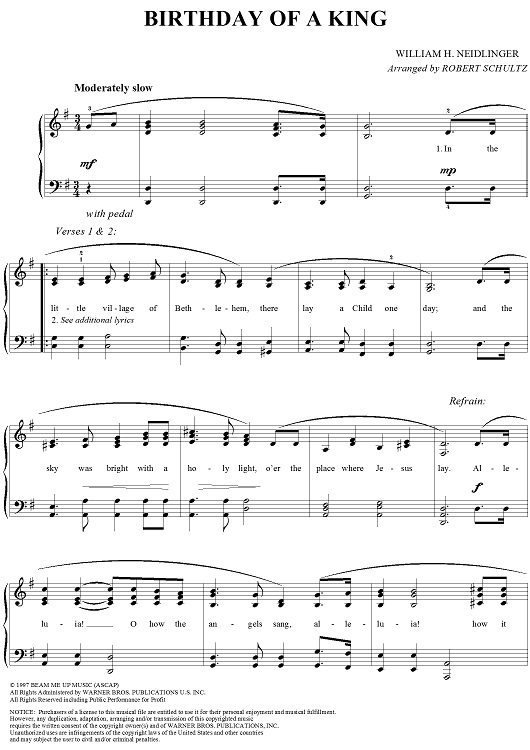
Words and music by William Harold Neidlinger (1863-1924), circa 1890. Neidlinger was a composer, conductor, organist at St. Michael’s Church, New York City, and voice teacher, but his main interest was working with retarded children, and he founded a school for this purpose in East Orange, N.J. Originally published in 1912 in Neidlinger’s native Brooklyn, the song has been popular ever since, particularly as a baritone solo, since it shows off the voice quite well and is not difficult to sing.
1. In the little village of Bethlehem,
There lay a Child one day;
And the sky was bright with a holy light
Over the place where Jesus lay.
Refrain Alleluia! O how the angels sang. Alleluia! How it rang! And the sky was bright with a holy light ‘Twas the birthday of a King.
2. ‘Twas a humble birthplace,
But O how much God gave to us that day,
From the manger bed what a path has led,
What a perfect, holy way. Refrain
Beautiful song of God’s love for His creation.
Done beautifully by The Brooklyn Tabernacle Choir.
• 1926 ~ Benny Goodman played a clarinet solo. This was not unusual for Benny except that it was his first time playing solo within a group recording session. Goodman was featured with Ben Pollack and His Californians on He’s the Last Word.
• 1930 ~ Peter Warlock [Philip Heseltine], British composer and music critic, died of a probable suicide at the age of 36
• 1936 ~ Tommy Steele (Hicks), Singer, actor
• 1937 ~ Art Neville, Keyboards, percussion, singer with The Neville Brothers
• 1937 ~ Nat Stuckey, Country singer, songwriter
• 1939 ~ Eddie Kendricks, Singer with The Temptations
• 1942 ~ Paul Butterfield, American blues singer and harmonica player with Paul Butterfield Blues Band
• 1943 ~ Dave Dee (Harmon), Tambourine, singer, record promoter
• 1955 ~ Carl Perkins wrote Blue Suede Shoes. Less than 48 hours later, he recorded it at the Sun Studios in Memphis. The tune became one of the first records to be popular simultaneously on rock, country and rhythm & blues charts.
• 1958 ~ Mike Mills, Bass with R.E.M
• 1961 ~ Sarah Dallin, Singer with Bananarama
• 1969 ~ Tiny Tim (Herbert Buchingham Khaury) married Miss Vickie (Victoria Budinger) on The Tonight Show starring Johnny Carson. This is the Tiny Tim of the falsetto version of Tiptoe Through the Tulips fame. The NBC-TV program earned the second-highest, all-time audience rating; second only to Neil Armstrong’s walking on the moon. Mr. Tiny Tim and Miss Vickie had a daughter, Tulip. Then in 1977 they stopped tiptoeing together.
• 1969 ~ Chicago Transit Authority became a gold record for the group of the same name (they later changed their name to Chicago). When the album was released by Columbia Records, it marked the first time an artist’s debut LP was a double record.
• 1970 ~ The Beach Boys played to royalty at Royal Albert Hall in London. Princess Margaret was in attendance and shook the royal jewelry to such classics as Good Vibrations, I Get Around and Help Me, Rhonda.
• 1977 ~ Elvis Costello, making a rare TV appearance, agreed to perform on NBC’s Saturday Night Live.
• 1978 ~ Don Ellis passed away
• 1999 ~ Rex Allen passed away
• 2004 ~ Johnnie Carl, Crystal Cathedral Orchestra conductor, took his life. Mr. Carl has been in the employment of the Crystal Cathedral for nearly 30 years and was internationally renowned as a conductor and as a composer and arranger of over 3,500 musical pieces. He was 57 years old.
• 2018 ~ Galt MacDermot, Canadian musician and composer (Hair), died at the age of 89
• 2018 ~ Raven Wilkinson, American ballerina, first African American woman to dance with a major ballet company, died at the age of 83
1803 ~ Louis-Hector Berlioz, French composer, conductor, music critic and major force in the development of musical form during the Romantic Era
More information about Berlioz
• 1876 ~ Mieczyslaw Karlowicz, Polish composer and conductor
• 1882 ~ The Bijou Theatre in Boston, MA became the first theatre to be lighted by electricity.
• 1908 ~ Elliot Cook Carter, Jr., American composer
• 1916 ~ (Damaso) Perez Prado, Piano, organ
• 1926 ~ Willie Mae ‘Big Mama’ Thornton, Blues singer
• 1931 ~ Rita Moreno (Rosita Alverio), Dancer, Academy and Emmy Award-winning actress
• 1934 ~ Curtis Williams, Singer with The Penguins
• 1935 ~ Tom Brumley, Steel guitar with Buck Owens and the Buckaroos, Stone Canyon Band
• 1939 ~ Marlene Dietrich recorded Falling In Love Again on the Decca label.
• 1940 ~ David Gates, Guitarist, keyboard, singer with Bread
• 1944 ~ Brenda Lee (Tarpley), American singer of popular music
• 1944 ~ “The Chesterfield Supper Club” debuted on NBC radio. Perry Como, Jo Stafford and many other stars of the day shared the spotlight on the 15-minute show that aired five nights a week. The show was sponsored by Chesterfield cigarettes.
• 1952 ~ An audience of 70,000 people watched from 31 theatres as Richard Tucker starred in Carmen. The event was the first pay-TV production of an opera. Ticket prices ranged from $1.20 to $7.20.
• 1954 ~ Jermaine Jackson, Singer with The Jackson Five, brother of Michael, Janet, La Toya, Tito, Randy, Marlon and Jackie
• 1973 ~ Karen and Richard Carpenter received a gold record for their single, Top of the World.
• 1982 ~ Toni Basil reached the #1 one position on the pop music charts for the first time, with her single, Mickey.
• 2000 ~ Ruth Martin, a writer whose translations of both popular and obscure operas were widely used in American opera houses, died at the age of 86. Martin collaborated with her husband Thomas Martin in translating the librettos of some of the world’s most famous operas, including Mozart’sDon Giovanni and The Marriage of Figaro, as well as Puccini’sBoheme, and Bizet’sCarmen. Martin and her husband also translated some of the rarest operas, such as Offenbach’sGrand Duchess of Gerolstein, and Dvorák’sRusalka. The Martins’ translations were marked by their clarity and singability, and despite the increasing use of closed-captioning systems in major opera houses, their translations are still used widely. Martin contributed articles on opera for Opera News, Aria, and Theater Arts. She also served on the boards of the New York Federation of Music Clubs, the Liederkranz Foundation and the National Opera Foundation.
• 2001 ~ Erik Johns, who wrote the libretto for Aaron Copland’s only full-length opera, The Tender Land, died in a fire at his home in Fishkill, N.Y. He was 74. Born Horace Eugene Johnston in Los Angeles, Johns began his career in music as a dancer. He met Copland when he was 19 at a New Year’s Eve party in New York. In 1952 the two began collaborating on an opera based on Let Us Now PraiseFamous Men, a book by writer James Agee and photographer Walker Evans that describes the lives of several Southern sharecropper families during the Depression. Copland composed the music and Johns wrote the libretto, or the words. The work was originally commissioned as a television opera by NBC but was subsequently rejected by the network. The New York City Opera performed it at its premiere at City Center in April 1954 in a short two-act version. The two later added a third act.
• 2001 ~ Jose Fajardo, a Cuban flutist who was one of the most influential bandleaders in Latin music, died an aneurysm. He was 82. The Cuban native had emigrated from Cuba in 1961, when he refused a request from the Cuban government to continue a musical tour to other communist countries. During his lengthy career, Fajardo recorded more than 40 albums and performed around the world. He was credited with expanding the audience for charanga, a Cuban musical style that backs a singer with flute, violins, piano, bass and percussion. Fajardo started his first group, Fajardo y sus Estrellas, in the 1940s. He later led three bands by the same name. After moving to the United States, he founded bands in New York and Miami and began performing in new style called pachanga, featuring a slightly more assertive rhythm. Fajardo was featured on “Cuban Masters: Los Originales,” an album of performances by leading Cuban musicians that was released November 2001.
• 2002 ~ Kay Rose, the first woman to win an Academy Award for sound editing, died. She was 80. Rose won the statuette for her work on the 1984 film The River. A native of New York, Rose was recognized in March with a career achievement award from the Cinema Audio Society. The Motion Picture Sound Editors gave her a similar lifetime achievement award in 1993. In October 2002, directors George Lucas and Steven Spielberg endowed the Kay Rose Chair in the Art of Sound and Dialogue Editing at the University of Southern California’s School of Cinema-Television. The chair is the first of its kind in the country. After studying film at Hunter College, she became a civilian film apprentice for the Army Signal Corps during World War II. There, she helped create such training films as How to Erect a Double Apron Barbed Wire Fence and the John Huston documentary Report from the Aleutians. She moved to Hollywood in 1944 and found a job as an assistant to an editor at Universal studios. In 1951, she married film editor Sherman Rose. Together, they produced the 1954 sci-fi cult classic, Target Earth. They later divorced. During her five-decade career, Rose received sound editing credits on such films as The Rose,Ordinary People,On Golden Pond,The Milagro Beanfield War, The Prince of Tides,For the Boys and Speed.
• 1910 ~ Dennis Morgan (Stanley Morner), Singer, actor
• 1910 ~ Tenor Enrico Caruso and conductor Arturo Toscanini were featured at the Metropolitan Opera House in New York City for the world premiere of Puccini’sThe Girl of the Golden West.
• 1913 ~ Morton Gould, American Pulitzer Prize-winning composer, conductor and pianist
• 1924 ~ Ken Albers, Bass singer with The Four Freshmen
• 1927 ~ For the first time, famed radio announcer George Hay introduced the WSM Barn Dance as the Grand Ole Opry. The show’s title may have changed but it remained the home of country music.
• 1930 ~ Duke Ellington and his orchestra recorded the haunting Mood Indigo on Victor Records. It became one of the Duke’s most famous standards.
• 1943 ~ Chad Stuart, Guitarist, lyricist, singer with the duo – Chad & Jeremy
• 1946 ~ Christopher ‘Ace’ Kefford, Bass with The Move
• 1947 ~ Walter ‘Clyde’ Orange, Drummer, singer with The Commodores
• 1948 ~ Jessica Cleaves, Singer with Friends of Distinction
• 1949 ~ Frank Beard, Drummer with ZZ Top
• 1949 ~ Fats Domino recorded his first sides for Imperial Records. The legend from New Orleans recorded The Fat Man, one of the earliest rock and roll records. The title also turned into Domino’s nickname and stayed with him through his years of success.
• 1951 ~ John (Raul) Rodriguez, Singer
• 1953 ~ Harry Belafonte debuted on Broadway in Almanac at the Imperial Theatre. Critics hailed Belafonte’s performance as “electrifyingly sincere.” Also starring in the show: Hermione Gingold, Billy DeWolfe, Polly Bergen and Orson Bean.
• 1966 ~ The Beach Boys made a one-week stop at the top of the Billboard Hot 100 asGood Vibrations made it to #1. It was the third #1 hit the group scored. The others were I Get Around and Help Me, Rhonda.
• 1967 ~ Otis Redding and four members of the Bar-Kays (Otis’ backup group) were killed in the crash of a private plane near Madison, Wisconsin. Redding was 26 years old. His signature song, (Sittin’ On) The Dock of the Bay was recorded three days before his death. It was #1 for four weeks beginning February 10, 1968. Redding was inducted into the Rock and Roll Hall of Fame in 1989. The Bar-Kays biggest hit was in July, 1967: Soul Finger. James Alexander, bass player for the group, was not on the plane. Ben Cauley, trumpet player, survived the crash. The group played for a time with various new members.
• 1987 ~ Jascha Heifetz passed away
Read quotes by and about Heifetz
More information about Heifetz
• 1791 ~ Peter Joseph Von Lindpaintnerr, German composer,
• 1837 ~ Charles-Emile Waldteufel, French pianist, conductor and composer of dance music
• 1882 ~ Joaquín Turina, Spanish pianist and composer
• 1906 ~ Freddy Martin ‘Mr. Silvertone’, Tenor sax, bandleader
• 1915 ~ Elisabeth Schwarzkopf, German soprano
• 1926 ~ Benny Goodman’s first recording session was this day. He played clarinet with the Ben Pollack Orchestra on a tune titled Downtown Shuffle on Victor Records. Goodman, incidentally, was all of 17 years old.
• 1938 ~ Tatiana Troyanos, American mezzo-soprano
• 1938 ~ David Houston, Grammy Award-winning singer, actor
• 1944 ~ Neil Innes, Keyboard, singer, songwriter with The Bonzo Dog Doo-Dah Band
• 1950 ~ Joan Armatrading, British rock singer and songwriter
• 1953 ~ Frank Sinatra recorded Young At Heart. The song was turned down by Nat ‘King’ Cole and other artists, believe it or not. It became a top hit in the U.S. in March of 1954.
• 1954 ~ Jack Hues, Singer with Wang Chung
• 1956 ~ Sylvia (Sylvia Allen), Singer
• 1956 ~ The Million Dollar Session was held at Sun Records in Memphis, TN. Elvis Presley, Johnny Cash, Carl Perkins and Jerry Lee Lewis gathered for an impromptu jam session. Six songs by the artists were recorded at this session. None of the songs was released for nearly three decades.
• 1957 ~ Donny Osmond, Singer with the Osmond Brothers, TV host of Donny and Marie, actor
• 1973 ~ Keith Moon, Rod Stewart and Roger Daltrey opened the rock opera Tommy in London. The show featuring Tommy, Pinball Wizard and other tunes, was so hot that tickets sold for $50 and up.
• 1984 ~ The Jackson’s Victory Tour came to a close at Dodger Stadium in Los Angeles after 55 performances in 19 cities. The production was reported to be the world’s greatest rock extravaganza and one of the most problematic. The Jackson brothers received about $50 million during the five-month tour of the U.S., with some 2.5 million fans in attendance.
• 2000 ~ Marina Koshetz, who followed her famous Russian diva mother Nina to the opera and concert stage and into the movies, died at the age of 88.
• 2004 ~ Country and Western singer Jerry Scoggins, whose baritone rendition of the theme song of “The Beverly Hillbillies” became one of television’s favorite tunes, died at age 93.
• 1637 ~ Bernardo Pasquini, Italian composer of operas, oratorios, cantatas and keyboard music.
• 1840 ~ Hermann Goetz, German Composer
• 1842 ~ The Philharmonic Society of New York, the first permanent orchestra in the U.S., held its first concert. Despite uncomfortable seating, the event was a huge success. They performed works of Beethoven.
1863 ~ Pietro Mascagni, Italian composer and conductor
More information about Mascagni
• 1879 ~ Rudolf Friml, Musician, composer
• 1887 ~ Ernst Toch, Austrian-born American composer
• 1899 ~ Antoni de Kontski, Polish pianist and composer, died at the age of 82
• 1911 ~ Louis Prima, Trumpeter, bandleader with Louis Prima and His New Orleans Gang, Gleeby Rhythm Orchestra; songwriter, singer, married to Keely Smith
• 1931 ~ Bobby Osborne, Musician, mandolin, singer with the duo – Osborne Brothers
• 1942 ~ Harry Chapin, American folk-rock singer and songwriter, Recipient of Special Congressional Gold Medal, Worldwide Humanitarian for the Hungry, Needy and Homeless
• 1948 ~ NBC presented Horace Heidt’s Youth Opportunity Program for the first time. The talent show earned Dick Contino, an accordionist, the $5,000 prize as the program’s first national winner.
• 1949 ~ Tom Waits, Singer, songwriter, playwright, married to Kathleen Brennan
• 1954 ~ Mike Nolan, Singer with Bucks Fizz
• 1957 ~ Pat Boone was at the top of the pop charts for the first of six weeks with April Love. His other number one hits included Ain’t That a Shame, I Almost Lost My Mind, Don’t Forbid Me and Love Letters in the Sand.
• 1984 ~ Michael Jackson was in Chicago to testify that the song, The Girl is Mine, was exclusively his and he didn’t swipe the song, Please Love Me Now. It was a copyright infringement case worth five million dollars. He won.
• 1990 ~ Dee (Delectus) Clark passed away
• 2016 ~ Greg Lake, English rock vocalist and bassist (King Crimson, Emerson, Lake & Palmer), died of cancer at the age of 69
• 1877 ~ Thomas Alva Edison made the first sound recording ever by reciting and recording the nursery rhyme, “Mary had a Little Lamb”. Edison recorded sound on a cylinder, which was then rotated against a needle. The needle moved up and down in the grooves of the cylinder, producing vibrations that were amplified by a conical horn. Edison assumed that this would be useful only for office dictation purposes and not much for recording music.
• 1887 ~ Joseph Lamb, American ragtime composer
• 1896 ~ Ira Gershwin (Israel Gershvin), American librettist and lyricist
1920 ~ Dave Brubeck, American jazz pianist and composer
More information about Brubeck
• 1929 ~ Nikolaus Harnoncourt, German conductor, cellist and musicologist
• 1930 ~ Bobby Van (Bobby King Robert Stein), Actor, dancer
• 1939 ~ Steve Alaimo, Singer, actor
• 1941 ~ Helen Cornelius, Singer
• 1942 ~ Len Barry (Borrisoff), Singer, with The Dovells
• 1944 ~ Jonathan (Kenneth) King, Singer, songwriter, producer
• 1944 ~ Red Bank Boogie, Count Basie’s salute to his hometown, was recorded on Columbia Records. The tune is a tribute to Red Bank, New Jersey.
• 1948 ~ Arthur Godfrey’s Talent Scouts debuted on CBS-TV. The show ran for almost10 years and the redhead introduced such talent as Pat Boone, The Chordettes, Carmel Quinn, The McGuire Sisters, Rosemary Clooney, Tony Bennett, Connie Francis, Steve Lawrence and Al Martino.
• 1950 ~ Joe Hisaishi, Japanese composer
• 1956 ~ Peter Buck, Guitarist with R.E.M.
• 1956 ~ Rick (Paul) Buckler, Drummer, singer with The Jam
• 1960 ~ Eileen Farrell debuted at the Metropolitan Opera House in NYC in the title role of Gluck’sAlcestis.
• 1962 ~ Ben Watt, Guitarist, keyboard, singer with Everything but the Girl
• 1969 ~ Musician Cab Calloway turned actor as he was seen in the Hallmark Hall of Fame presentation of The Littlest Angel on NBC. The big band singer, known for such classics as Minnie the Moocher, became a movie star in The Blues Brothers (1980) with John Belushi and Dan Ackroyd.
• 1969 ~ Na Na Hey Hey Kiss Him Goodbye, by Steam, reached the #1 spot on the top 40. It stayed at the top for two weeks and was the only major hit for the group.
• 1984 ~ Two former Beatles debuted in two film releases this day. Paul McCartney’sGive My Regards to Broad Street and George Harrison’sA Private Function were finalized for theater audiences.
• 1988 ~ Roy Orbison, Singer, passed away
• 1989 ~ Sammy Fain passed away
More information about Fain
• 2000 ~ Werner Klemperer, a Jewish refugee from Nazi Germany who went on to play the inept German prison-camp commandant Col. Klink on TV’s “Hogan’s Heroes,” died of cancer at the age of 80. Klemperer fled Germany in 1935 with his father, Otto, a distinguished conductor and composer. He won two Emmy Awards for his portrayal of the monocled Col. Wilhelm Klink on the 1960s sitcom about World War II Allied prisoners of war. He was a gifted actor on both film and stage, receiving a Tony nomination in 1988 as a feature actor in a musical for his role in Hal Prince’s revival of “Cabaret.” Other Broadway roles included starring opposite Jose Ferrer in “The Insect Comedy,” and with Tallulah Bankhead in the 1955 production of “Dear Charles.” Most recently, he co-starred in Circle in the Square’s production of Chekhov’s “Uncle Vanya.” Klemperer also appeared as a narrator with nearly every major symphony orchestra in the United States. His repertoire included such works as Beethoven’s “Egmont” and “Fidelio,” Stravinsky’s “L’Histoire du Soldat” and “Oedipus Rex.” His narration of Mozart’s “The Impresario,” with the Mostly Mozart Festival Orchestra, aired on PBS’s “Live from Lincoln Center.” He also performed in various operas, including “The Sound of Music,” with the New York City Opera. He played Prince Orlofsky in “Die Fledermaus” with companies in Seattle and Cleveland.
• 2003 ~ Hans Hotter, the world’s leading Wagnerian bass-baritone of his time, died at the age of 94. The 6-foot-4 Hotter, whose career spanned half a century, was known for his booming, noble voice. He mastered such roles as Wotan in Wagner’s Ring Cycle, Gurnemanz in “Parsifal”, the title role in “The Flying Dutchman” and Hans Sachs in DieMeistersinger. He also won praise for Schubert lieder. Hotter started his operatic career in 1930, and sang in Prague and Hamburg and at the Munich Opera, where he became a leading singer in 1937. He remained with the company until 1972. He also was a member of the Vienna Opera from 1939 until 1970. Hotter created the role of Olivier in the world premiere of Richard Strauss“Capriccio” in 1942. According to the British newspaper The Guardian, the role of Jupiter in Strauss’s “Die Liebe der Danae” had been written for him but its premiere was disrupted when all theaters were closed after the assassination attempt on Adolf Hitler in August 1944. After the war, Hotter began a 12-year association with the Wagner family’s opera house at the Bayreuth festival in 1952. The same year, he made his Metropolitan Opera debut as the Dutchman. He also became a producer. His final production was in 1981 in Chicago of Beethoven’s“Fidelio”.
• 1667 ~ Michel Pignolet De Monteclair, French composer
• 1861 ~ Lillian Russell (Helen Louise Leonard), Singer, actress, burlesque
• 1879 ~ Sir Herbert Hamilton Harty, Irish composer, conductor, pianist and organist
• 1915 ~ Eddie Heywood, Jr., Pianist, composer
• 1927 ~ Duke Ellington’s big band opened the famed Cotton Club in Harlem. It was the first appearance of the Duke’s new and larger group. He played the club until 1932.
For part 2:
• 1934 ~ Ethel Merman recorded I Get a Kick Out of You, from Cole Porter’s musical, Anything Goes. She was backed by the Johnny Green Orchestra. The tune was recorded for Brunswick Records.
• 1934 ~ Wink (Winston Conrad) Martindale, TV host, singer
• 1938 ~ Yvonne Minton, Australian mezzo-soprano
• 1940 ~ John Cale, Bass, keyboard, viola, singer with The Velvet Underground
• 1942 ~ Bob Mosley, Bass with Moby Grape
• 1942 ~ Chris Hillman, Guitar, bass, mandolin with The Byrds
• 1944 ~ Dennis Wilson, American rock-and-roll singer and drummer
• 1948 ~ Southside Johnny (Lyon), Singer with Southside Johnny and The Asbury Dukes
• 1965 ~ Composer, lyricist, and singer, Jacques Brel made his American debut in concert at Carnegie Hall in New York City. Brel composed Jackie, You’re Not Alone, If You Go Away and more.
• 1972 ~ Billy Paul from Philadelphia received a gold record for his smash hit, Me and Mrs. Jones.
• 2002 ~ Emmy-nominated pianist George Gaffney, who accompanied such musicians as Peggy Lee, Engelbert Humperdink and Sarah Vaughan, died. He was 62. Born in New York City, Gaffney began studying the piano at age 10 but switched to the trombone. After serving in the U.S. Marine Corps from 1958 to 1961, Gaffney returned to New York, where he played piano and began arranging and accompanying singers. Gaffney moved to the Chicago area in the mid-1960s and was musical director of the Playboy Club in Lake Geneva, Wis., where he first met Vaughan. Gaffney came to California in the early 1970s and found work as a studio musician and accompanist. He worked on a number of television programs, including the TV series “Moonlighting,” and was nominated for an Emmy. From 1980 to 1990, he was Vaughan’s accompanist and musical director. He moved to Las Vegas in 1994 and worked as Humperdink’s musical director. In recent years, he also orchestrated tunes for Rita Moreno.
• 2002 ~ Mary Hansen, guitarist and vocalist with the ’90s alternative band Stereolab died. She was 36. Hansen, from Maryborough in Queensland, Australia, died in a cycling accident in London, The Independent newspaper reported Friday. Details of the accident were not available. Band spokesman Mick Houghton was quoted by The Independent as saying a truck might have backed into her, “but I really don’t know much more than that.” Hansen joined the band in 1992, two years after it was formed by Tim Gane, formerly of the band McCarthy, and his girlfriend Laetitia Sadier. Among hundreds of messages posted on the band Web site, one from a fan who identified himself as Louis called Hansen “the soul” of the band. Hansen, who played several instruments, first appeared on 1992’s LoFi single and all subsequent releases, including 1994’s Mars Audiac Quintet and 1996’s Emperor Tomato Ketchup. Stereolab had been working on a new album, expected to be released next year.
• 2003 ~ Barry Morell, a tenor who played leading roles at the Metropolitan Opera and internationally for more than two decades, died of esophageal cancer. He was 75. Morell began his career as a baritone, until he sought the guidance of former Metropolitan Opera baritone Giuseppe Danise, who told him he should be a tenor. He was best known for performing the operas of Puccini. He made his debut as Pinkerton in “Madame Butterfly” in 1955 with the New York City Center Opera Company. In 1958, he made his Met debut in the same role. He appeared in Berlin, Barcelona, Vienna and other opera houses in Europe, South America and across the United States. Among his more than 20 roles during 257 performances at the Met were Rodolfo in “LaBoheme,” Enzo in “La Gioconda” and the title roles of “Don Carlo”and “Faust”.
• 1918 ~ Milton DeLugg, Bandleader on The Tonight Show Starring Johnny Carson; Milton DeLugg and His Orchestra: Abe Burrows’ Almanac, The Chuck Barris Rah Rah Show, Dagmar’s Canteen, Doodles Weaver, The Gong Show, Judge for Yourself, Your Hit Parade; played accordion in The Milton DeLugg Quartet and songwriter
• 1928 ~ Jörg Demus, Austrian pianist
• 1934 ~ Billy Paul (Paul Williams), Singer
• 1941 ~ Tom McGuinness, Bass, guitar with Manfred Mann; McGuinness Flint; and Blues Band
• 1942 ~ Ted Bluechel, Jr., Singer, drummer with The Association
• 1944 ~ Eric Bloom, Singer, guitarist
• 1945 ~ John Densmore, Musician with The Doors
• 1950 ~ Dino Lipatti, classical pianist and composer whose career was cut short from causes related to Hodgkin’s disease, died at the age of 33
• 1952 ~ Michael McDonald, Singer, songwriter, keyboard with The Doobie Brothers
• 1960 ~ Rick Savage, Bass with Def Leppard
• 1972 ~ Motown’s Temptations reached the #1 spot on the top 40 charts with Papa Was a Rollin’ Stone. It was the fourth #1 hit for the Temptations, joining My Girl, I Can’t Get Next to You and Just My Imagination.
• 1981 Hershy Kay, composer, died at the age of 62. Union Jack is a ballet made by New York City Ballet co-founder and founding choreographer George Balanchine to traditional British tunes, hornpipe melodies and music-hall songs, ca. 1890–1914, adapted by Hershy Kay. The premiere took place on 13 May 1976, at the New York State Theater, Lincoln Center, to honor British heritage in the United States its bicentennial with costumes by Rouben Ter-Arutunian, original lighting by Ronald Bates and current lighting by Mark Stanley. At the finale, the ensemble spells out “God Save the Queen” in semaphore code and the Union Jack unfurls. Principal dancer Jock Soto included an excerpt from Union Jack in his farewell performance in June 2005.
• 1709 ~ Franz Xaver Richter, Austro-Moravian singer, violinist, composer, conductor and music theoretician
• 1879 ~ Gilbert and Sullivan’s operetta, H.M.S. Pinafore, opened. Arthur Sullivan conducted the orchestra while William Gilbert played the role of a sailor in the chorus and in the Queen’s Nay-vee.
• 1912 ~ Terence Beckles, pianist/teacher
• 1913 ~ Mary Martin, American singer and actress, primarily for the musical theater, Tony and Emmy Award-winning actress, mother of actor Larry Hagman
• 1924 ~ Lady Be Good opened in New York City. George Gershwin wrote the music while Fred and Adele Astaire were well-received by the show’s audience for their dancing talents.
• 1936 ~ Lou Rawls (Louis Allen), American Grammy Award-winning singer of popular music, TV regular on Dean Martin Presents
• 1938 ~ Sandy Nelson, Drummer
• 1939 ~ Diane Lennon, Singer with The Lennon Sisters on Lawrence Welk Show, Jimmy Durante Presents the Lennon Sisters
• 1940 ~ Glenn Miller got a call from ASCAP (American Society of Composers and Publishers). He was informed that he couldn’t use his Moonlight Serenade as his band’s theme song. He had to use Slumber Song instead because of an ASCAP ban.
• 1945 ~ Bette Midler, American Grammy Award-winning pop-rock singer and actress
• 1945 ~ Burl Ives made his concert debut. He appeared at New York’s Town Hall. We lovingly listen every year for the voice of this old-time radio personality as the narrator and banjo-pickin’ snowman in TV’s Rudolph the Red-Nosed Reindeer.
• 1946 ~ Gilbert (Raymond) O’Sullivan, Singer
• 1950 ~ John Wesley Ryles, Singer
• 1950 ~ Ernest John Moeran passed away
• 1968 ~ Promises, Promises opened on Broadway. The play ran for 1,281 performances, earning $35,000 in profits each week of 1969. Dionne Warwick had a hit version of the title song.
• 1986 ~ Horace Heidt, orchestra leader (Swift Show Wagon), died at the age of 85
• 1989 ~ Alvin Ailey, US choreographer (Blues Suite, Revelations), died at the age of 58
• 1997 ~ Stéphane Grappelli, French jazz violinist who founded the Quintette du Hot Club de France, died at the age of 89
• 2012 ~ Galina Vishnevskaya, Russian soprano opera singer, died at the age of 85

 1894 ~ Arthur Fiedler, American violinist and conductor

