January 17 ~ This Day in Music History

today

. 1712 ~ John Stanley, English composer and organist

. 1728 ~ Johann Gottfried Muthel, German composer and noted keyboard virtuoso

. 1734 ~ François-Joseph Gossec, Belgian composer
More information about Gossec

. 1876 ~ The saxophone was played by Etta Morgan at New York City’s Olympic Theatre. The instrument was little known at the time in the United States.

. 1913 ~ Vido Musso, Reed instruments, played with Benny Goodman, bandleader: Stan Kenton was his pianist

. 1920 ~ George Handy (George Joseph Hendleman), Pianist, composer, arranger for the Boyd Raeburn band, Alvino Rey band, Paramount Studios

. 1922 ~ Betty White, Emmy Award-winning actress on The Mary Tyler Moore Show, singer

. 1926 ~ Moira Shearer, Ballerina

. 1927 ~ Eartha Kitt, Singer. Kitt’s birth certificate listing her actual birthdate as 1/17/27 was found in 1997. She has celebrated her birthday as Jan. 26 (1928) all of her life and says, “It’s been the 26th of January since the beginning of time and I’m not going to change it and confuse my fans.”

. 1941 ~ Gene Krupa and his band recorded the standard, Drum Boogie, on Okeh Records. The lady singing with the boys in the band during the song’s chorus was Irene Daye.

. 1944 ~ Chris Montez, Singer

. 1948 ~ Mick Taylor, Singer, rhythm guitar with The Rolling Stones

. 1955 ~ Steve Earle, Songwriter, singer, guitar

. 1956 ~ Paul Young, Singer

. 1959 ~ Susanna Hoffs, Singer, guitar with The Bangles

. 1960 ~ John Crawford, Singer, bass with Berlin

. 1969 ~ Lady Samantha, one of the very first recordings by Reginald Kenneth Dwight (aka Elton John), was released in England on Philips records. The song floundered, then bombed. The rock group, Three Dog Night, however, recorded it for an album.

. 2001 ~ Pianist and singer Emma Kelly, the “Lady of 6,000 Songs” made famous by the book “Midnight in the Garden of Good and Evil,” died from a liver ailment at the age of 82. Kelly’s nightclub act, in which she tapped her vast repertoire of American popular standards five nights a week until she became ill a month ago, was a must-see for Savannah tourists itching to meet a real-life character from author John Berendt’s Southern Gothic best seller. Though the book helped her book performances from New York to Switzerland, Kelly continued to crisscross south Georgia to play church socials and high school graduations, Kiwanis luncheons and wedding receptions. Berendt devoted an entire chapter to Kelly in the 1994 book, describing her as a teetotaling Baptist who would play smoky cocktail lounges Saturday nights and Sunday school classes the next morning. Kelly performed at her own nightclub, Emma’s, in Savannah, for five years in the late 1980s. She then bounced between lounges near the downtown riverfront. She also independently recorded three albums, the last of which were released posthumously, her son said.

. 2001 ~ Jazz musician, composer and conductor Norris Turney, who played alto sax and flute with the Duke Ellington Orchestra and led the Norris Turney Quartet, died of kidney failure at the age of 79. Turney recorded with a number of bands over the years, and toured with Billy Eckstine, Ray Charles and others. He was an original member of the Lincoln target=”_blank”Center Jazz Orchestra directed by Wynton Marsalis. Turney’s lone CD as a band leader, “Big, Sweet ‘N Blue,” was warmly received by jazz critics.

. 2002 ~ Edouard Nies-Berger, the veteran organist and protege of Albert Schweitzer, died at the age of 98. Nies-Berger, who played with the New York Philharmonic, was a native of Strasbourg in Alsace. His father, a church organist, was an associate of Schweitzer. The doctor, philosopher and Nobel laureate was pastor of a nearby church where the teen- age Nies-Berger played occasionally. Nies-Berger moved to New York in 1922 and for the next 15 years played the organ in houses of worship across the country. By the mid-’30s he settled in Los Angeles and performed in the soundtracks of several films, including “The Bride of Frankenstein” and “San Francisco.” He returned to Europe in 1937 to study conducting with Bruno Walter in Salzburg, Austria. After conducting for two years in Latvia and Belgium he returned to the United States. He was named organist of the New York Philharmonic, where he played under the direction of such conductors as Walter, George Szell and Leonard Bernstein. Nies-Berger was reunited with Schweitzer in 1949, when the humanitarian visited the United States. For six years they collaborated on the completion of Schweitzer’s edition of the organ music of Johann Sebastian Bach. After serving at St. Paul’s in Richmond, Nies-Berger returned to Europe for several years to perform as a recitalist and write several books, including a memoir of Schweitzer. In 1991 he was awarded the gold medal of the Art Institute of Alsace, and in 1993 was named a knight of the arts and letters by the French Ministry of Education and Culture.
January 15 ~ This Day in Music History

today

1890 ~ Premiere of The Sleeping Beauty, ballet by Pyotr Il’yich Tchaikovsky. After the less-than-promising 1877 debut of Swan Lake, marred by a largely amateur production, over a decade lapsed before the composer was commissioned by the Director of the Imperial Theatres in St. Petersburg to supply music for a ballet on the Perrault fairy tale, The Sleeping Beauty. Tchaikovsky threw himself arms-deep into the project. Not only was the composer again on happy turf, he was currently in a state of delight by the occasional presence of a three-year old little girl; children seemed to tap a joyful vein in Tchaikovsky. The little girl’s proximity fed a spirit of fantasy which transmitted to this most lighthearted of the composer’s scores. Most musicologists and historians concede that Sleeping Beauty is the most perfectly wrought of Tchaikovsky’s three ballet scores, classic in its restraint, yet possessing the right amount of color and panache to render it pure Tchaikovsky; its waltz remains a Pops favorite.

. 1896 ~ Alexander Scriabin made his European debut as a pianist at the Salle Erard in Paris

. 1904 ~ Ellie Sigmeister, Classical composer

. 1905 ~ Weldon Leo ‘Jack’ Teagarden, died of pneumonia
More information about Teagarden

. 1909 ~ Gene Krupa, American Jazz bandleader and drummer

. 1941 ~ Captain Beefheart (Don Van Vliet), Singer with Captain Beefheart & His Magic Band, artist

. 1942 ~ Kenny Sargent vocalized with the Glen Gray Orchestra on Decca Records’ It’s the Talk of the Town.

. 1948 ~ Ronnie Van Zandt, Singer, songwriter with Lynyrd Skynyrd

. 1951 ~ Charo (Maria Rosario Pilar Martinez Molina Baeza), ‘The Hootchy Cootchy Girl’, actress, singer, wife of Xavier Cugat

. 1951 ~ Martha Davis, Singer with The Motels

. 1959 ~ Peter Trewavas, Bass with Marillion

. 1964 ~ The soundtrack album of the musical, “The King and I”, starring Yul Brynner, earned a gold record.

. 1967 ~ Ed Sullivan told the Rolling Stones to change the lyrics and the title to the song, Let’s Spend the Night Together, so it became Let’s Spend Some Time Together.

. 1972 ~ Elvis Presley, who was also censored from the waist down by Ed Sullivan, reportedly drew the largest audience for a single TV show to that time. Elvis presented a live, worldwide concert from Honolulu on this day.

. 1987 ~ Ray Bolger died.  He was an American entertainer of vaudeville, stage and actor, singer and dancer best known for his portrayal of the Scarecrow in The Wizard of Oz.

. 1993 ~ Sammy Cahn passed away.  He was an was an American lyricist, songwriter and musician.

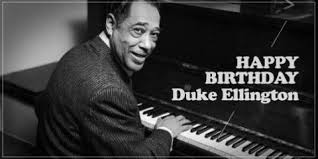
Duke Ellington’s Birthday

ellington-bd
Duke Ellington (1899 to 1974) was a composer, bandleader, and pianist. He was born Edward Kennedy Ellington in Washington, D.C.

From an early age, the handsome, sharply dressed teenager (that’s where he got the nickname, Duke) was headed for success. At first it was art. He won a poster-design contest and an art scholarship, left school and started a sign-painting business. But it was his natural piano-playing ability that attracted the young women, so Duke Ellington headed in that direction. He developed his keyboard skills by listening to local black ragtime pianists; he composed his first piece, Soda Fountain Rag, around 1915. A successful professional musician by the early 1920s, he left Washington in the spring of 1923 for New York, which was his home base for the rest of his life. Between December 1927 and 1931 his orchestra held forth at Harlem’s Cotton Club, where regular radio broadcasts, together with an active recording schedule, helped him establish a nationwide reputation. Take the “A” Train was his “signature song”.

In such compositions as Black and Tan Fantasy (1927), Mood Indigo (1930),Solitude (1934), and Echoes of Harlem (1935), Ellington emerged as a distinctive composer for his ensemble, employing the rhythms, harmonies, and tone colors of jazz to create pieces that vividly captured aspects of the African-American experience. At the same time, he sought to broaden jazz’s expressive range and formal boundaries in such extended works asReminiscing in Tempo (1935), Black, Brown, and Beige (1943), and Harlem(1951).

An essential feature of Ellington’s composing method was to write with specific instrumentalists in mind, often drawing them into the creative process by building entire pieces out of their musical ideas.

He wrote scores for big band pieces, film scores, operas, ballets, Broadway shows, gospel music, musicals, films, television, and ballet and in the 1960s produced a series of sacred concerts combining his orchestra, choirs, vocalists, and dancers. He would work with each section of his orchestra as an entity unto its own and then bring them together to create the unique sounds such as, Mood Indigo. Over 1,000 musical pieces are credited to the great Duke Ellington. James Lincoln Collier studied the Duke and his Orchestra, comparing Duke Ellington to a “master chef who plans the menus, trains the assistants, supervises them, tastes everything, adjusts the spices … and in the end we credit him with the result.”

Ellington was successful, as few others have been, in reconciling the practical function of a popular entertainer with the artistic aspirations of a serious composer. His rich legacy consists of hundreds of recordings, his many pieces that have entered the standard repertory, and his musical materials now preserved in the Duke Ellington Collection at the Smithsonian Institution. There is a statue of Duke Ellington in New York.

 Ellington’s birthday

 anniversary of Ellington’s death

Ellington’s works were played in an Grammy Winning performance, Forty-Second Annual Awards

Read quotes by and about Ellington

 News Item about Ellington

April 25 in Music History

today

. 1906 ~ John Knowles Paine died.  He was the first American-born composer to achieve fame for large-scale orchestral music.

. 1913 ~ Earl Bostic, Saxophonist, bandleader

. 1915 ~ Italo Tajo, Italian bass

. 1915 ~ Sal Franzella, Jazz musician, alto sax, clarinet

. 1918 ~ Ella Fitzgerald, American Grammy Award-winning singer (12), jazz and popular music. She was discovered at age 16 at an amateur night at the Apollo Theater in Harlem, and went on to work with Louis Armstrong, Duke Ellington and Count Basie.

. 1923 ~ Albert King, American blues singer and guitarist

. 1923 ~ Melissa Hayden (Mildred Herman), Ballerina with the New York City Ballet

. 1926 ~ Arturo Toscanini conducted the first performance of Giacomo Puccini’s opera “Turandot” at La Scala, Milan.

. 1932 ~ Gator (Willis) Jackson, Composer, tenor sax, invented the gator horn

. 1933 ~ Jerry Leiber, Record producer with Mike Stoller

. 1945 ~ Stu Cook, Bass with Creedence Clearwater Revival

. 1945 ~ Bjorn Ulvaeus, Musician, guitar, singer with Abba

. 1946 ~ The popular Jimmy Lunceford Orchestra recorded Cement Mixer for Majestic records, tapes and CDs this day. Well, not tapes and CDs. We were still listening to 78s back then … thick, heavy ones, at that.

. 1956 ~ The rock ‘n roll legend, Elvis Presley’s Heartbreak Hotel went No.1.

. 1970 ~ DJs around the U.S. played the new number one song, ABC, quite often, as the Jackson 5 reached the number one spot in pop music for two weeks. ABC was the second of four number one songs in a row for the group from Gary, IN. I Want You Back was their first. ABC was one of 23 hits for Michael, Tito, Jackie, Jermaine and Marlon. ABC was knocked out of first place by The Guess Who and their hit, American Woman.

. 1973 ~ The group, The Sweet, received a gold record for the hit Little Willy. The English rocker band recorded four hits in addition to their first million- seller, Ballroom Blitz, Fox on the Run, Action and Love is like Oxygen. Little Willy was a top-three hit, while the group’s other gold record winner, Fox on the Run made it to the top five.

. 2000 ~ David Merrick, one of Broadway’s most flamboyant and successful theatrical producers who created “Gypsy,” “Hello, Dolly!” and “42nd Street,” died in London at the age of 88. During his long career as arguably Broadway’s most successful producer, Merrick won all the major theatrical awards, including 10 Tony Awards just for “Hello, Dolly!” He was best-known for his musicals but he produced many non-musicals as well.

February 28 ~ Today in Music History

today

. 1876 ~ John Alden Carpenter, American composer

. 1882 ~ Geraldine Farrar, American soprano

. 1890 ~ Vasalav Nijinsky, Ballet dancer

. 1903 ~ Vincente Minnelli (Lester Anthony Minnelli), Director, Judy Garland’s husband and Liza Minnelli’s father

. 1915 ~ Lee Castle (Castaldo), Trumpet, bandleader, led Jimmy Dorsey’s band during time of smash hit, So Rare

. 1926 ~ Seymour Shifrin, American composer

. 1930 ~ Ted Lewis and his orchestra recorded On the Sunny Side of the Street for Columbia Records on this day. Mr. Lewis was heard as the featured vocalist as well, on the tune that has been recorded hundreds of times and is an American music standard.

. 1939 ~ Tommy Tune, Tony Award-winning dancer, actor, director of musical theater

. 1942 ~ Brian Jones (Lewis Hopkin-Jones), Singer, rhythm guitar with The Rolling Stones

. 1948 ~ Bernadette Peters, Singer and actress

. 1959 ~ Cash Box magazine, a trade publication for the music/radio industry, began using a red ‘bullet’ on its record charts to indicate those records that have the strongest upward movement each week. The phrase, “Number one with a bullet” designates those hits that have reached the pinnacle of statistical chartdom. To be so means to be at the top of the list and still climbing higher.

. 1966 ~ The famous Cavern Club in Liverpool, England closed because of financial difficulties. During its peak of success, the club was best known as the home of The Beatles.

. 1968 ~ Frankie Lymon passed away.  He was an American rock and roll/rhythm and blues singer and songwriter.

. 1984 ~ It was Michael Jackson Night at the Grammy Awards in Los Angeles. He set a record for most wins by taking home eight of the gramophone statuette honors. He broke the previous record of six awards set by Roger Miller in

. 1965. The reason: the biggest selling album of all time, Thriller, which sold more than 35-million copies around the world soon after its release in 1983.

. 1993 ~ Ruby Keeler passed away.  She was a Canadian-born American actress, dancer and singer most famous for her on-screen coupling with Dick Powell in a string of successful early musicals at Warner Brothers, particularly 42nd Street.

February 21 ~ Today in Music History

today

. 1791 ~ Carl Czerny, Austrian pianist and compose whose vast musical production amounted to over a thousand works. His books of studies for the piano are still widely used in piano teaching.
More information on Czerny

Czerny is in the center top of this image. He influenced many!

Czerny is in the center top of this image. He influenced many!

. 1836 ~ Léo Delibes, French composer of ballets, operas, and other works for the stage.
More information on Delibes

. 1893 ~ Andrés Segovia, Spanish guitarist
More information on Segovia

. 1933 ~ Nina Simone, American jazz and soul singer
More information about Nina Simone

. 1943 ~ David Geffen, Tony Award-winning producer of Cats in 1983, M Butterfly in 1988, “Miss Saigon”, Beetlejuice and Risky Business. Also a record executive: Geffen Records and a partner in Dreamworks film production company with Jeffrey Katzenberg and Steven Spielberg.

. 1944 ~ New York City Opera, first performance

. 1958 ~ Mary Chapin Carpenter, Grammy Award-winning singer

. 1991 ~ Dame Margot Fonteyn died. She is widely regarded as one of the greatest classical ballet dancers of all time.

. 2015 ~ Clark Terry died.   He was an American swing and bebop trumpeter, a pioneer of the flugelhorn in jazz, educator, and NEA Jazz Masters inductee. He played with Charlie Barnet (1947), Count Basie (1948–1951), Duke Ellington (1951–1959) and Quincy Jones (1960).

Terry’s career in jazz spanned more than seventy years and he is among the most recorded of jazz musicians.

February 12 in Music History

today

. 1728 ~ Mysterious priest-composer Agostino Steffani died.

. 1760 ~ Jan Ladislav Dussek, Czech composer and pianist

. 1881 ~ Anna (Pavlovna) Pavlova, Russia’s premier ballerina

. 1898 ~ Roy Harris, American composer

. 1904 ~ Ted Mack (William Maguiness), TV host of The Original Amateur Hour, The Ted Mack Family Hour

. 1914 ~ (Gordon) Tex Beneke, Bandleader, singer, tenor sax in the Glenn Miller Orchestra

. 1918 ~ All theatres in New York City were shut down in an effort to conserve coal.

. 1923 ~ Mel Powell, American jazz pianist and composer. One of his works is Mission to Moscow for Benny Goodman. He was also Dean of Music at California Institute of Arts.

. 1923 ~ Franco Zeffirelli, Italian director and producer of opera, theatre, film and television

. 1924 ~ Bandleader Paul Whiteman presented his unique symphonic jazz at the Aeolian Hall in New York City. The concert marked the first public performance of George Gershwin’s Rhapsody in Blue. The composer, himself, was at the piano this night. Distinguished guests included John Philip Sousa and Jascha Heifetz.

. 1935 ~ Gene McDaniels (Eugene Booker McDaniels), Singer

. 1939 ~ Ray Manzarek, Keyboards with The Doors

. 1942 ~ Mildred Bailey recorded More Than You Know on Decca Records.

. 1948 ~ Joe Schermie, Bass with Three Dog Night

. 1964 ~ The Beatles played two concerts at Carnegie Hall in New York City, concluding a very successful American tour.

. 1968 ~ Singer and famed guitarist, Jimi Hendrix, received an honorary high school diploma from Garfield High School in Seattle, WA, where he had dropped out at the age of 14.

. 1972 ~ Al Green’s Let’s Stay Together knocked American Pie out of the top spot on the music charts. The record stayed at the top for one week, before giving way to Nilsson’s Without You. Green returned to his gospel roots in 1980 and is a minister in Memphis, TN. Green recorded 14 hit songs with six of them making it to the Top 10.

. 1976 ~ Sal Mineo, singer, died

February 11 in Music History

today

. 1830 ~ Peter Arnold Heise, Danish composer

. 1830 ~ Hans Bronsart Von Schellendorf, classical musician, pianist and composer who studied under Franz Liszt

. 1889 ~ John Mills, Guitarist, singer, bass with The Mills Brothers. He was father of the four Mills brothers and took youngest son John, Jr.’s place after his death in 1935

. 1908 ~ Josh White, ‘The Singing Christian’, blues/folk singer, guitarist

. 1912 ~ Rudolf Firkušný, Czech composer, classical pianist

. 1914 ~ Matt Dennis, Pianist, singer, recorded vocals for Paul Whiteman

. 1916 ~ The Baltimore Symphony Orchestra presented its first concert. The symphony was the first by a municipal orchestra to be supported by taxes.

. 1941 ~ Sergio Mendes, Brazilian jazz pianist and composer

. 1935 ~ Gene Vincent (Craddock), Singer, actor

. 1938 ~ Larry Clinton and his orchestra recorded Martha on Victor Records. Bea Wain was heard warbling the vocals on the tune.

. 1939 ~ Gerry Goffin, Lyricist with Carole King and with Michael Masser

. 1940 ~ Bobby ‘Boris’ Pickett, Singer

. 1940 ~ NBC radio presented “The Chamber Music Society of Lower Basin Street” for the first time. The famous Blue network series included several distinguished alumni — among them, Dinah Shore and Zero Mostel. The chairman, or host, of “The Chamber Music Society of Lower Basin Street” was Milton Cross. He would say things like, “A Bostonian looks like he’s smelling something. A New Yorker looks like he’s found it.” The show combined satire, blues and jazz and was built around what were called the three Bs of music: Barrelhouse, Boogie Woogie and Blues.

. 1968 ~ The new 20,000 seat Madison Square Garden officially opened in New York. It was the fourth arena to be named Madison Square Garden. The showplace for entertainment and sports opened with a gala show hosted by Bob Hope and Bing Crosby.

. 2001 ~ Dame Sonia Arova, a Bulgarian-born ballerina who danced with Rudolf Nureyev, at his request, in his American debut, died of pancreatic cancer at the age of 74. Arova was knighted by King Olaf V of Norway, only the second woman to receive that distinction. During her years as founding artistic director of the State of Alabama Ballet, Dame Sonia Arova changed the face of dance in Birmingham. Through a stage career that lasted three decades and a teaching career that occupied three more, she lived and breathed ballet. Born in Sofia, Bulgaria, Arova began dancing at age 6. By 8, she was studying ballet intensively in Paris. When war broke out in 1940, she escaped the Nazis’ advance with her English piano teacher in a harrowing flight during which their train was machine-gunned by German troops. Arriving in England, Arova was enrolled in an arts school and later joined the International Ballet. In 1965, Arova became artistic director of the Norwegian National Ballet, moved to California in 1971 to co-direct the San Diego Ballet and in 1975 accepted a teaching position at the Alabama School of Fine Arts. Maintaining her position at ASFA, she took over the newly formed State of Alabama Ballet in 1981 as artistic director, with her husband, Thor Sutowski, as artistic associate and choreographer. In 1996, the couple returned to San Diego, and she spent her last years with the San Diego Ballet.

. 2003 ~ Moses G. Hogan, 45, a pianist and choral conductor known for his contemporary arrangements of spirituals, died of a brain tumor in New Orleans. He was editor of the Oxford Book of Spirituals, published in 2001 by Oxford University Press. The book has become the U.S. music division’s top seller. Mr. Hogan also toured with his own singing groups, the Moses Hogan Chorale and Moses Hogan Singers. His arrangements, more than 70 of which have been published by the Hal Leonard publishing company, were performed by the Mormon Tabernacle Choir, soprano Barbara Hendricks and countertenor Derek Lee Ragin.

. 2003 ~ William L. “Weemo” Wubbena Jr., 72, a retired Army colonel who sang in Washington area barbershop quartets, died of cancer. Col. Wubbena was born in Marquette, Mich., and raised in Washington. He was a member of the Montgomery County chapter of the Society for the Preservation and Encouragement of Barber Shop Quartet Singing in America.

February 8 in Music History

today

. 1741 ~ Andre-Ernest-Modeste Gretry, composer

. 1932 ~ John Williams, American Academy Award-winning composer and conductor
More information about Williams

. 1934 ~ Elly Ameling, Dutch Soprano

. 1936 ~ Larry Verne, Singer

. 1938 ~ Ray Sharpe, Singer

. 1941 ~ Tom Rush, American folk singer, songwriter and guitarist

. 1943 – Creed Bratton, Guitarist, banjo, sitar with The Grass Roots

. 2001 ~ Leslie Edwards, a dancer and director at the Royal Ballet, died of cancer at the age of 84. Edwards made his debut in 1933 with the Vic-Wells Ballet. Except for a stint with the Ballet Rambert from 1935 to 1937, Edwards spent his entire career with Sadler’s Wells Ballet, which became the Royal Ballet Company in 1956. He appeared in more than 70 roles at the Royal Ballet and was a key figure in its choreographic group, as well as working as ballet master to the Royal Opera for 20 years. Edwards was awarded the Order of the British Empire in 1975, and a studio at the rebuilt Sadler’s Wells Theatre was named for him.

January 31 in Music History

today

. 1759 ~ François Devienne, French composer and professor of flute

. 1797 ~ Franz Peter Schubert, Austrian composer
Read quotes by and about Schubert
More information about Schubert

. 1798 ~ Carl Gottlieb Reissiger, German Kapellmeister and composer

. 1882 ~ Anna Pavlova, Russian ballerina and choreographer

. 1892 ~ Eddie Cantor (Iskowitz), Entertainer, ‘banjo eyes’ Some of his hits were: If You Knew Susie like I Know Susie, Alabamy Bound, Dinah, Ida, Makin’ Whoopee and Ma He’s Makin’ Eyes at Me

. 1906 ~ Benjamin Frankel, British composer

. 1921 ~ Mario Lanza, Opera singer. Some of his non-operatic songs were Be My Love, The Loveliest Night of the Year and Because You’re Mine

. 1923 ~ Carol Channing, Broadway entertainer and Tony Award-winning actress in shows such as Hello, Dolly! (1964) and Thoroughly Modern Millie

. 1936 ~ “The Green Hornet” was introduced by its famous theme song, The Flight of the Bumble Bee, originally by Rachmaninoff. The radio show was first heard on WXYZ radio in Detroit, MI on this day. The show stayed on the air for 16 years. “The Green Hornet” originated from the same radio station where “The Lone Ranger” was performed.

. 1937 ~ Phillip Glass, American composer of minimalist music
More information about Glass

. 1946 ~ Terry Kath, Guitarist with Chicago

. 1951 ~ Harry Wayne Casey, Keyboards, singer with KC and the Sunshine Band

. 1951 ~ Phil Collins, British rock drummer, songwriter and singer

. 1951 ~ Phil Manzanera (Targett-Adams), Guitarist with Roxy Music

. 1955 ~ Electronics pioneer RCA demonstrated the first music synthesizer that could electronically play musical sounds.

. 1960 ~ Julie Andrews, Henry Fonda, Rex Harrison and Jackie Gleason, appeared in a two-hour TV special titled, The Fabulous ’50s. 1961 ~ Lloyd Cole, Guitarist, singer with Lloyd Cole and The Commotions Dial Records founder Ross Russell died. He released 78-rpm recordings of Charlie Parker on his small jazz label and wrote a biography of Parker in 1973 called “Bird Lives! The High Life and Hard Times of Charlie (Yardbird) Parker”.

. 1976 ~ ABBA knocked Queen from the UK No.1 position on the UK singles chart with ‘Mamma Mia.’ Queen’s single ‘Bohemian Rhapsody’ had enjoyed a nine week run at the top of the charts, by coincidence, Queen’s single contains the famous “mamma mia, mamma mia, mamma mia let me go” line.

. 1981~ Justin Timberlake, singer with *NSYNC who had the 2000 US No.1 single ‘It’s Gonna Be Me’ and the 1999 UK No.5 single ‘I Want You Back’. As a solo artist scored the 2003 UK No.2 & US No.3 single ‘Cry Me A River’. His second solo album ‘FutureSex/LoveSounds’ was released in 2006 with the US No.1 hit singles ‘SexyBack’, ‘My Love’ and ‘What Goes Around… Comes Around.’ With his first two albums, Timberlake has sold over fourteen million albums worldwide. Timberlake has his own record label called Tennman Records. He also has an acting career, having starred in films such as The Social Network, Bad Teacher and Friends with Benefits.

. 1982 ~ Sandy Duncan of Tyler, Texas gave her final performance as Peter Pan in Los Angeles, CA. The actress completed 956 performances without missing a show. She flew a total of 261.5 miles while on stage.

. 1985 ~ John Fogerty, former leader of Creedence Clearwater Revival, returned to the A&M recording studios in Hollywood, CA to give his first ‘live’ performance in 14 years. Actually, Fogerty performed in a video called Rock and Roll Girls.

. 1987 ~ Madonna’s record, Open Your Heart, moved to the #2 spot on the pop charts (right behind At This Moment by Billy Vera and The Beaters). A week later,Open Your Heart became Madonna’s fifth #1 hit since 1983. She had 11 consecutive singles in the Top 10, the most for any female artist of the rock era.

. 1995 ~ George Abbott, Director, passed away.

. 2002 ~ Evelyn Scott, the city’s first female disc jockey who later played a tough- talking tavern keeper on the television soap opera “Peyton Place,” died at the age of 86. Born in Brockton, Mass., Scott moved to Los Angeles and landed a job as a disc jockey on radio station KMPC. She later was hired as a singing DJ on KHJ’s “Rise and Shine” morning show. She began acting in theater companies and eventually landed small roles in films such as “Wicked Woman,” “The Green-Eyed Blonde” and “I Want to Live.” She may be best remembered as saloon keeper Ada Jacks in the soap “Peyton Place,” which showed the extramarital affairs and other dark secrets of the residents of a small New England town. Scott played the role from 1965 to 1969, and then reprised the role on “Return to Peyton Place” from 1972 to 1974. She also came back for the 1985 television movie “Peyton Place: The Next Generation.” Scott appeared in episodes of other TV shows including “Bonanza,” “Gunsmoke” and “Perry Mason.” After she retired from acting, she dedicated her time to helping the homeless and served as a board member of Portals House Inc., a center for mentally ill people.

. 2004 ~ Roberto Ocasio, a versatile musician and band leader of Latin Jazz Project, died in a car accident. He was 49. Ocasio performed more than 250 times last year, mostly in Cleveland. He has shared stages with such other Latino musicians as Eddie Palmieri and Nestor Torres. His band played venues from street festivals to Cleveland’s Severance Hall. Ocasio played the piano and six other instruments. He earned a degree in composition and arranging from the Berklee College of Music in Boston. He formed Latin Jazz Project in 1997. Ocasio composed and arranged the band’s music, a repertoire ranging from original pieces to rock tunes and American standards with his own twist. He performed songs in Spanish and English.